If I ask Claude Code to implement the same task in C/C++/Rust/Zig, will there be differences in behavior across languages?

This page has been translated by machine translation. View original
Introduction
Does the choice of programming language affect generation quality when having AI write code? Does Rust's borrow checker help AI fix code, or does C's simplicity work in AI's favor...? I observed the differences between languages by having Claude Code (Opus 4.6) implement the same tasks in C, C++, Rust, and Zig.
What is Rust
Rust is a systems programming language initially developed at Mozilla. It is now developed by the community under the Rust Foundation. Its ownership system and borrow checker guarantee memory and thread safety at compile time.
What is Zig
Zig is a systems programming language designed as an alternative to C. While adopting manual memory management, it reinforces safety with compile-time computation (comptime) and runtime safety checks.
Target Audience
- Software engineers interested in AI code generation
- Developers interested in programming language safety mechanisms
- Those wanting to know the practicality of Claude Code
Test Environment
- OS: Windows 11 Home (Build 26200)
- CPU: Intel Core i7-11700F, RAM: 32 GB
- C/C++: MSVC v143 (Visual Studio 2022), CMake 4.2.1, C implements threads using Win32 API (CreateThread)
- Rust: rustc 1.93.1
- Zig: 0.15.2
- AI: Claude Code (Opus 4.6)
References
Test Plan
If language safety mechanisms affect AI, memory management and concurrent processing would be the areas where differences are most likely to appear. This is because these areas have the most divergent approaches across languages: C/C++ requires manual management, Rust strictly checks at compile time, and Zig reinforces with runtime checks.
As hypotheses, I considered the following possibilities:
- Rust's borrow checker helps with repairs, minimizing correction rounds
- Conversely, the borrow checker challenges AI, consuming rounds in dialogue with compiler errors
- C's simplicity works in AI's favor, passing even with manual memory management on the first try
- There is little difference between languages, and generation quality is language-independent
Testing Method
For this test, I prepared two tasks:
- Task A: LRU Cache
Focus on memory management, testing ownership, lifetime, and release responsibilities. - Task B: Thread Pool
Focus on concurrent processing, testing shutdown, join, and condition variable synchronization.
For each task, I defined L1 tests (12 specification tests) and L2 stress tests (fixed seed, repeated execution). I allowed a maximum of 5 rounds of repairs for the AI-generated code to pass these tests.
Control of Confounding Variables
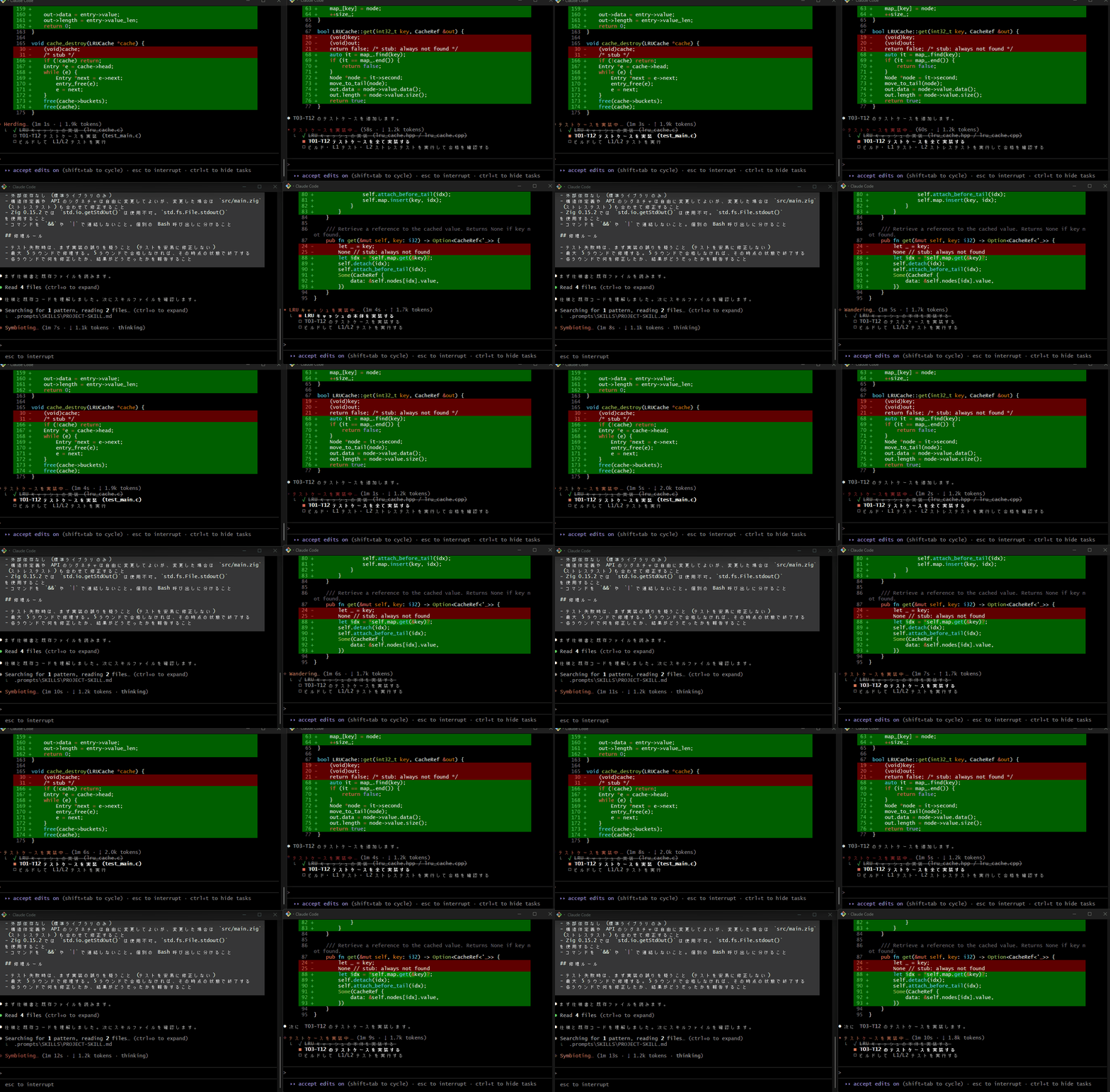
To prevent learning effects from carrying over between languages, implementations for each language were done in independent Claude Code sessions. Each session was provided only with specifications, test code, and build commands.
I also conducted comprehension tests on the completed code. If the readability of AI-generated code differs by language, there should also be differences when another AI maintains that code later. To verify this, I had separate sessions read just the code without the specifications and assigned three tasks: providing an overview, identifying issues, and adding functionality.
Result 1: No Difference in Memory Management Tasks
Results for the LRU cache:
| Metric | C | C++ | Rust | Zig |
|---|---|---|---|---|
| First-pass result | All pass | All pass | All pass | All pass |
| Rounds to green | 0 | 0 | 0 | 0 |
| Compile-fix cycles | 0 | 0 | 0 | 0 |
| Stress survival | All pass | All pass | All pass | All pass |
All 4 languages passed the L1 tests (12/12) on the first try and also passed the stress test (10,000 iterations). No repair rounds were needed. Algorithm selection was consistent across all 4 languages, with each adopting the standard LRU cache pattern of a hash map plus a doubly linked list. However, Rust alone showed unique adaptation to accommodate the borrow checker.
Rust's Index-Based List
In the C implementation, nodes are linked with pointers:
typedef struct Entry {
    int32_t key;
    uint8_t *value;
    size_t value_len;
    struct Entry *prev;
    struct Entry *next;
    struct Entry *hash_next;
} Entry;
In contrast, the Rust implementation links nodes using Vec indices instead of pointers:
struct Node {
    key: i32,
    value: Vec<u8>,
    prev: usize,  // index instead of pointer
    next: usize,
}

pub struct LRUCache {
    capacity: usize,
    map: HashMap<i32, usize>,
    nodes: Vec<Node>,  // node arena
    head: usize,       // sentinel (index 0)
    tail: usize,       // sentinel (index 1)
}
Implementing a doubly linked list with pointers in Rust would create a situation where nodes are mutably borrowed from both previous and next nodes, which isn't possible without unsafe. AI avoided this by using Vec<Node> as an arena and using indices as pseudo-pointers. There were 0 unsafe blocks. This is a pattern known in the Rust community. It's noteworthy that AI naturally chose this strategy.
Result 2: Differences Appeared in Concurrent Processing Tasks
Results for the Thread Pool:
- Rounds to green: Number of correction rounds required to pass all tests (generation→build→test→failure presentation→correction counts as 1 round)
- Compile-fix cycles: Number of times stopped by compilation errors before test execution and required fixes
- Regression count: Number of times a fix caused another test to newly fail
| Metric | C | C++ | Rust | Zig |
|---|---|---|---|---|
| First-pass result | T08 fail | Build error | T08 fail | Build error |
| Rounds to green | 1 | 2 | 2 | 3 |
| Compile-fix cycles | 0 | 1 | 0 | 1 |
| Regression count | 0 | 0 | 1 | 0 |
| Stress survival | All pass | All pass | All pass | All pass |
In contrast to Task A, repairs were required for all languages. The number of repair rounds was C: 1, C++: 2, Rust: 2, Zig: 3.
Common Wall Across All Languages: Timing Race in Tests
Test T08 (case where shutdown is called while submit is blocking) failed in all 4 languages. The cause was not incorrect implementation logic but timing dependencies in the test code. AI was able to generate mostly correct concurrent processing logic, but couldn't correctly handle the constraint of waiting for submit to complete before calling shutdown on the first try.
Different Types of Failures by Language
The T08 test-side race was common to all languages, but other failures differed by language. C completed with just one round of fixing the test-side race, but the other 3 languages had additional problems:
- C++
Definedworker_loopas a free function but couldn't access the privateImplstructure, causing compilation error (C2248) - Zig
Compilation error due to Zig API changes movingstd.time.sleeptostd.Thread.sleep. Additionally, returningThreadPoolby value caused worker threads to reference dangling pointers, resulting in runtime panic - Rust
The T08 fix caused regression in T09 (the only language that broke another test during repair)
Case Where Zig's Runtime Detection Helped AI
Zig's R2 is an interesting case. Returning ThreadPool by value causes the structure to move on the stack, invalidating pointers held by worker threads. Zig's runtime boundary check immediately detected this as an index out of bounds error, allowing AI to complete the fix in one round by placing SharedState on the heap.
pub const ThreadPool = struct {
    state: *SharedState,  // Pointer to heap (not value embedding)
    workers: []std.Thread,

    pub fn init(thread_count: usize, queue_capacity: usize) ThreadPool {
        const alloc = std.heap.page_allocator;
        // Place SharedState on heap to ensure stable address
        const state = alloc.create(SharedState) catch @panic("alloc failed");
        // ...
    }
};
In Rust, this type of problem would be detected at compile time, but in C, it might silently proceed as undefined behavior. Zig's runtime detection is a good example of early error detection even in languages without compile-time guarantees.
Result 3: All Languages' Code Was Accurately Understood in Comprehension Tests
For the completed code, I assigned 3 tasks to a separate AI session without providing specifications:
- Task 1: Overview
Evaluated understanding of implementation structure, synchronization method, and lifecycle across 7 items - Task 2: Issue identification
Analysis of potential risks in specified functions - Task 3: Feature addition
Implementation of a new function, checking that it doesn't break existing tests
The results for both tasks across all 4 languages were Task 1: 7/7, Task 2: accurate, Task 3: 0 repair rounds. Despite differences appearing between languages during implementation of Task B, no differences appeared in reading comprehension and modification.
However, there were qualitative differences in the Task 2 findings. Regarding reference invalidation in cache_get for Task A, C/C++/Zig identified it as a use-after-free risk, while Rust recognized that reference invalidation is prevented by the borrow checker and instead identified it as a constraint on API usability due to &mut self. AI reinterpreted the same problem in language-specific contexts, demonstrating understanding of each language's safety model.
Findings from the Test
Hypotheses 1, 2: Borrow Checker Influence
Neither hypothesis - that the borrow checker helps with repairs or that the borrow checker challenges AI - was supported. Rust had 0 compilation errors, showing no signs of struggling with the borrow checker. In Task A, it naturally chose an index-based list, accommodating the borrow checker from the start. However, it didn't have the fewest repair rounds (C had the minimum of 1) and was the only language where regression occurred.
Hypothesis 3: C's Simplicity Is Advantageous
This was partially supported. In Task B, C passed with the minimum of 1 round and had no compilation errors or runtime panics, requiring only test-side race fixes. However, in Task A, there was no difference between the 4 languages, so the advantage was limited.
Hypothesis 4: No Language Difference in Generation Quality
This was closest to reality. It was fully supported in Task A, and even in Task B, the dominant factor was the test-side race common to all languages, with language-specific differences being relatively minor.
Unexpected Findings
C++ and Zig detected errors at compile time, and Zig also caught dangling pointers at runtime. Rust guaranteed thread safety without unsafe code. However, timing races in tests couldn't be prevented by any safety mechanism. The effect of language safety mechanisms is reflected in the speed and specificity of error messages.
Conclusion
The choice of language has a slight influence on generation quality for AI, but this influence is relatively small compared to the complexity of the task. No differences appeared in known patterns like memory management, and differences only became apparent in concurrent processing. Language safety mechanisms contribute to early error detection, but timing constraints in test design required repairs in all 4 languages, representing a challenge that couldn't be avoided by language choice.