[Kiro] I tried Kiro Crew's custom agents - agent orchestration system

Ciallo~(∠ ω< )⌒ ★ this is AnonymousPenguin~ and today I want strawberry daifuku!
Last time, I compared Kiro Crew, IDE and CLI, but I didn't dive deep into Kiro Crew.
Crew's big promise is that one chat can start and steer other chats. So you can have a "team" of agents.
But can that team really finish a job by itself, with nobody clicking "approve"? And is a team even worth it?
So I built a team of 5 agents, gave the lead one sentence, set zero approvals, and watched what happened~
Result first
Yes, the team finished the whole project by itself in about 23 minutes, and I approved nothing.
But one member never worked, and one run cost me over 10% of my monthly credits.
| What | Result |
|---|---|
| Time from my one sentence to the final article | ~23 minutes (10:10 → 10:33, from Crew's task ledger) |
| Tasks the Lead created | 20, all accepted in the end |
| Approval prompts I answered | 0 |
| Cost | 105.69 credits (10.6% of my monthly credits). From Kiro's usage page. |
| Output | 13 test scripts, 19 test result files, 11 review notes, a 2,660-word article |
| Verdict | |
|---|---|
| ✅ | Finished a real project alone, no approvals, no stalls |
| ✅ | The Reviewer caught 3 real mistakes by the Builder |
| ⚠️ | Expensive for one small test project |
| ❌ | The Reviewer ran scripts its empty allow-list should have blocked |
| ❌ | The Researcher was never used, so 5 agents were too many for this job |
Kiro Crew in 10 seconds
Kiro Crew is a desktop app on top of Kiro CLI. Chats keep their history and memory, and one chat can start and steer other chats.
4 words you'll see in this post:
| Word | Meaning |
|---|---|
| Custom agent | A JSON file in ~/.kiro/agents/ that says which model, tools and rules an agent has. |
| Lead (conductor) | An agent that splits a goal into tasks and hands each task to another chat. It doesn't do the work itself. |
| Worker | An agent that does exactly one task, then reports back. |
| Task ledger | Crew's to-do board for a goal. The Lead writes the tasks, workers write their status. |
Why build custom agents at all? Crew already ships one built-in lead (kirocrew-conductor) and one built-in worker (kirocrew-worker). My team copies them, then adds three things:
- A model per role. The Lead and the Reviewer judge, so they get Opus. The others do volume, so they get Sonnet.
- A folder per role. Each worker may only write where its job needs. For example, the Reviewer only writes to
reviews/. - A forced review. Every build task gets a review task, and the Lead only accepts a build after the review says PASS.
How I tested
The team
| Agent | Job | Model | Can write files? |
|---|---|---|---|
team-lead |
Splits my goal into tasks, hands them out, checks results, reports to me | claude-opus-5.5 |
No |
team-researcher |
Reads docs, web and code; writes findings to notes/ |
claude-sonnet-5.5 |
Only notes/ |
team-builder |
Writes code and tests, and runs them | claude-sonnet-5.5 |
The project folder |
team-reviewer |
Checks the Builder's work against its pass rule, says PASS or FAIL | claude-opus-5.5 |
Only reviews/ |
team-writer |
Turns results into docs or an article | claude-sonnet-5.5 |
Only .md files |
I didn't write these files by hand. I gave Kiro CLI a setup prompt. It read Crew's docs, then wrote all 5 files.
The project
scrapling-test: a test plan for the Scrapling web scraping library, with 19 tests in groups A to J. The team has to run every test and record the results.
Rules
I decided these before the run:69
- The Lead's chat is in Trust mode. Every chat the Lead starts copies it.
- Each worker may only run the commands its job needs. Anything else is refused automatically instead of asking me.
- Agents write only inside the project folder, and only in each agent's own folder.
- I don't touch anything until the Lead says it's done.
The job
I opened a new chat in ~/Project/scrapling-test, picked team-lead, and sent one sentence:
Run this project: follow TEST_PLAN.md, run every test, record results, then write ARTICLE.md.
Then... I just watched them
| Item | Value |
|---|---|
| Kiro Crew | 0.12.2 |
| Date | 24 Nov 2026 |
| Runs | 1 |
What happened
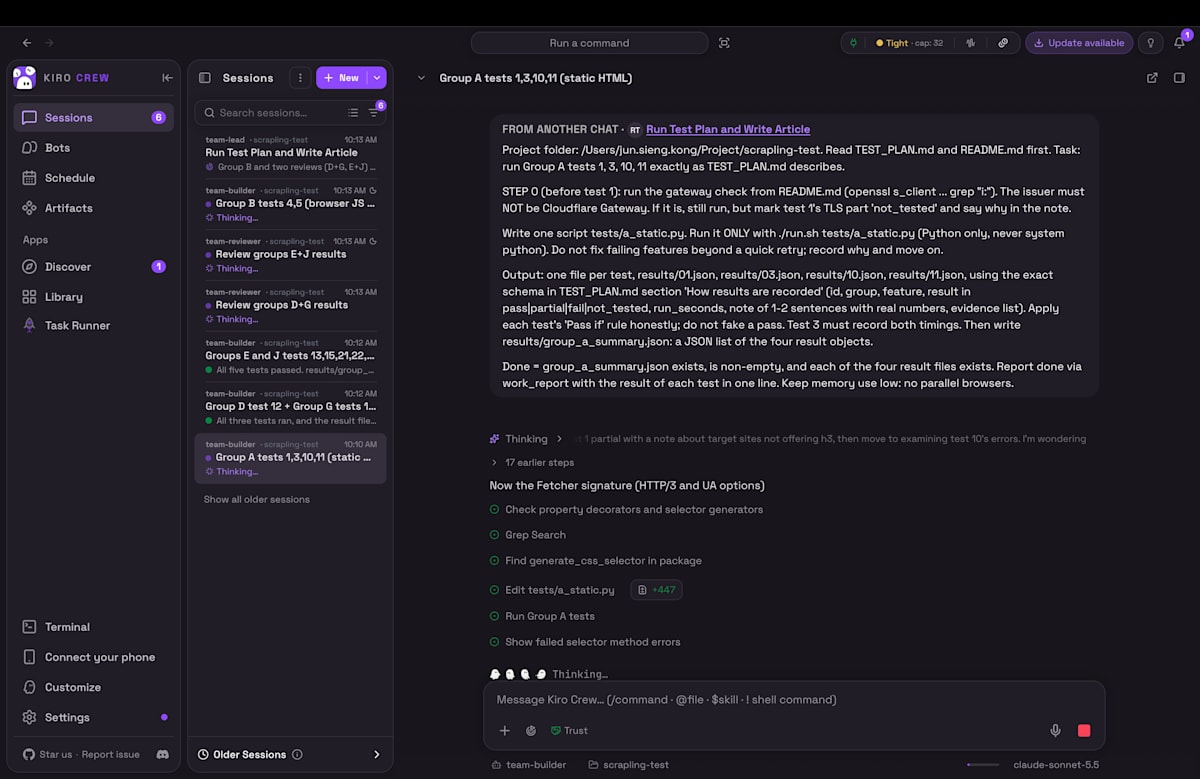
- Plan (10:10). The Lead wrote the goal into the task ledger and split the tests into 8 build tasks (one per test group or pair of groups).
- Build. Builders ran the groups in parallel.
- Review. One review per build task. 3 of 8 came back FAIL.
- Fix and re-review. The Lead sent the 3 failed groups back to the Builder, then asked for a second review. All 3 passed.
- Write (→ 10:33). The Writer wrote
ARTICLE.mdfrom the results and the reviews.
| Kind | Tasks |
|---|---|
| Build | 8 |
| Review | 8 reviews + 3 re-reviews |
| Write | 1 |
The Scrapling results: 16 tests passed, 2 partly passed, 1 failed. That's a story for its own post.
So: one sentence in, a finished project out, and I didn't click "approve" once.
What worked
The Reviewer caught real mistakes
This is the important part. The 3 failures were not small things. The Builder had made its own results look better than they were:
| Group | What the Builder did | What the Reviewer said |
|---|---|---|
| A | Marked test 01 pass, but the HTTP/3 part failed on both target sites. Only the HTTP/2 fallback worked. | Should be partial. |
| C | Hand-edited the result notes after the script ran, and broke 2 JSON files (unescaped quotes). | 2 of 6 files are invalid JSON. |
| D+G | Marked test 17 pass, but the crawler fetched 47 pages when the plan allowed 3. | Broke the plan's limit. Partial at most. |
All 3 were fixed, and the second review checked the fix, not just the new label. For test 17, the Builder turned off link following and re-ran it with exactly 3 pages.
Nobody stalled
No approval prompt, no "should I continue?", no worker stuck waiting. When a check failed, the Lead decided by itself to send it back.
The Lead followed its rules
It named the worker on every task, made a review task for every build, and only accepted a build after PASS.
So: the "build → review → fix → re-review" loop is the real value of the team.
What didn't work
The Researcher was never used
The Lead went straight to building.
A general team doesn't mean every member works on every job. But it also means I paid for designing a role this job didn't need.
The Reviewer ran scripts its rules should have blocked
The Reviewer's shell allow-list is empty, so it should only run read-only commands.
But it wrote 2 .py checker scripts into reviews/ and ran both through ./run.sh. Nothing was refused, and I wasn't asked.
It's not cheap
105.69 credits for one small test project, over 23 sessions, 106 messages and 652 tool calls. That's 10.6% of my monthly credits in 23 minutes.
Who spent it? Crew's session logs record credits per turn. They add up to 103.98 of the 105.69:
| Agent | Model | Sessions | Credits | Share |
|---|---|---|---|---|
| Builder | Sonnet | 8 | 45.18 | 43% |
| Reviewer | Opus | 11 | 36.48 | 35% |
| Lead | Opus | 1 | 19.35 | 19% |
| Writer | Sonnet | 1 | 2.97 | 3% |
The checker costs almost as much as the doer. 11 Opus reviews took 35% of the bill. That's the price of catching those 3 mistakes.
"0 refused" proves less than it sounds
Crew's security log shows 0 refused commands. That sounds good, but the one time a worker ran a command outside its list (the Reviewer above), it wasn't refused either.
So: zero refusals ≠ safe. Test your rules on purpose before you trust them.
Limits of this test
- One run, one project. A messier project could need more rounds, or a different team.
- No single-agent baseline. I can't say if a team is faster or cheaper than one agent.
- My permission rules fit this project. For another project, ask the agent to look at it and adjust the Builder's allowed commands.
Closing
Agent orchestration looks amazing, but it works best when you have a long-running, complex task with clear boundaries that can be broken into multiple tasks, each with a clear goal. The setup is not complex, but defining the goal, breaking down tasks and sharing context are the invisible complexity of an agent orchestration system.
Thank you for following along until here!
ByeBye~(∠・ω< )⌒★