![[New Service] Amazon Bedrock AgentCore Managed Agent Harness Now Generally Available (GA)](https://images.ctfassets.net/ct0aopd36mqt/7M0d5bjsd0K4Et30cVFvB6/5b2095750cc8bf73f04f63ed0d4b3546/AgentCore2.png?w=3840&fm=webp)
[New Service] Amazon Bedrock AgentCore Managed Agent Harness Now Generally Available (GA)

This page has been translated by machine translation. View original
This is Ishikawa from the Cloud Business Division. At AWS New York Summit on June 17, 2026, the general availability (GA) of Amazon Bedrock AgentCore Managed Agent Harness was announced. Simply declare the model, tools, skills, and instructions as "configuration," and you can get a production-quality AI agent up and running in minutes.
For those who were previously implementing orchestration loops and infrastructure from scratch, this update can significantly reduce the man-hours required for agent development.
What is Amazon Bedrock AgentCore?
Amazon Bedrock AgentCore is a fully managed platform for building and operating AI agents at production scale. It provides a set of capabilities necessary for agent operations, including runtime, memory, gateway, identity, and observability.
The Managed Agent Harness, which became GA this time, serves as the foundation for actually "running" agents. Every agent must have an orchestration layer — a loop that calls the model, selects tools, returns results, manages context, and handles failures. Running this in production requires underlying infrastructure such as compute, sandboxes, secure tool connections, file systems, memory, identity, and observability, all of which teams previously had to build themselves. Managed Agent Harness replaces this work with "configuration."
What is Managed Agent Harness?
With Managed Agent Harness, you simply declare "what the agent does" (model, tools, skills, and instructions), and AgentCore manages the environment, compute, memory, identity, network, and observability needed to run it. Changes such as trying a different model or adding a new tool are completed through configuration changes rather than rewriting code.
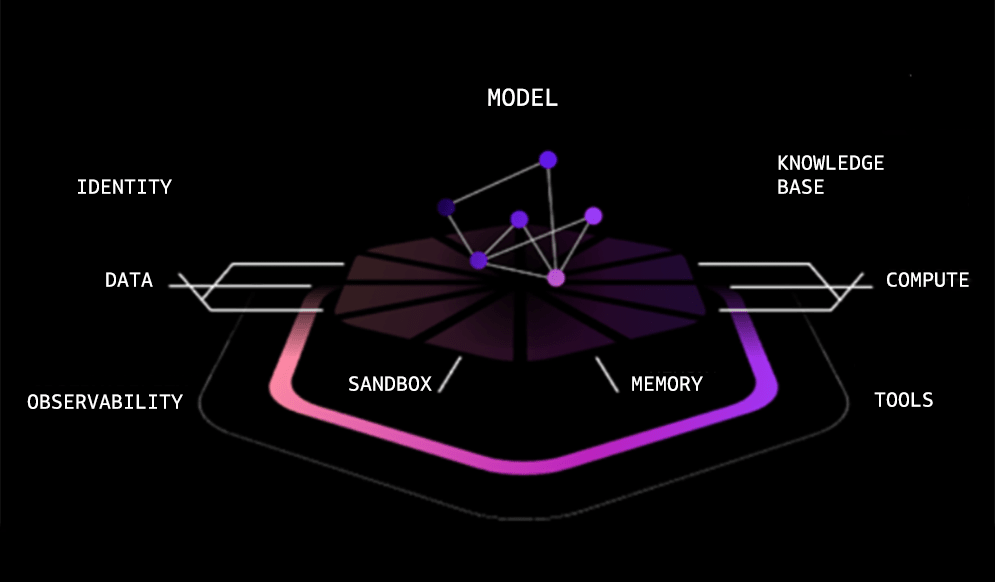
An agent is more than just a model. If the model is the brain, the harness is the body — everything the brain needs to get work done. The harness runs the orchestration loop, executes tools, manages the context window, maintains state between turns, recovers from failures, and isolates each session.
Quote: New in Amazon Bedrock AgentCore: Build agents with broader knowledge and continuous learning
The main features are as follows.
- Per-session isolation: Each harness session is stateful by default and runs as an independent microVM per session on the AgentCore runtime.
- File system and shell: Agents have their own file system and shell and can write and execute code. Even when microVM sessions expire and are replaced, short-term and long-term memory and files can be persisted across sessions.
- Model-agnostic: Models from Amazon Bedrock, OpenAI, Google Gemini, and other LiteLLM-compatible providers can be used, and you can switch providers mid-session without losing context. You can also use one model for planning and another for execution.
- Diverse tool connections: Available via AgentCore Gateway, MCP servers, or built-in browser, code interpreter, and web search.
- Skill attachment: Add skills with a single toggle from Git, Amazon S3, or an AWS-curated skills catalog to incorporate domain knowledge when needed.
- Flexible environment configuration: Bring your own container if you need custom dependencies, and mount S3 Files or Amazon EFS to share data across sessions and harnesses.
- Automatic tracing and optimization: All actions are automatically traced in AgentCore Observability, allowing you to review agent behavior in a unified view. AgentCore Evaluations / Optimization enables scoring of behavior, suggestions for improving prompts and tool descriptions, and A/B testing with per-session statistical significance.
- Safe releases: Roll out with immutable versions and named endpoints, and instantly roll back by simply redirecting the endpoint to a previous version.
- Pipeline integration and export: Integrate into larger pipelines with the AgentCore InvokeHarness state in AWS Step Functions, and if configuration alone is insufficient, export to Strands-based code and run on the AgentCore runtime (export to Claude Agent SDK also coming soon).
Note that Managed Agent Harness is powered by Strands Agents, AWS's open-source agent framework.
Supported Regions
Available in all AWS commercial regions where AgentCore is offered. According to the region table in the official documentation, AgentCore harness is supported in commercial regions including the United States, Europe, and Asia Pacific.
Pricing Impact
There are no additional charges for the harness itself. It follows a pay-as-you-go model, charging only for each AgentCore feature (underlying resources) you use.
How to Use
Managed Agent Harness is characterized by its ability to "declare and run" without writing orchestration code.
An AgentCore CLI is also available that handles everything from prototype to production in a single workflow, supporting Infrastructure as Code via AWS CDK (with Terraform support planned) and versioned agent configurations.
Harness has already been added to the left menu of Amazon Bedrock AgentCore. Press the [Quick create Harness] button.
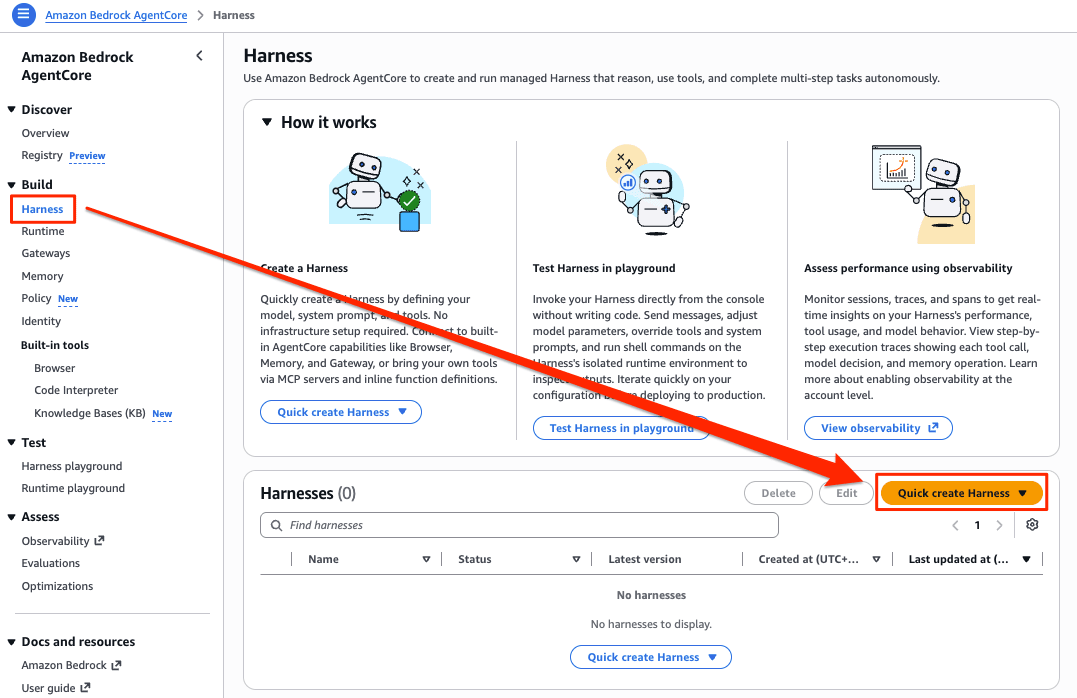
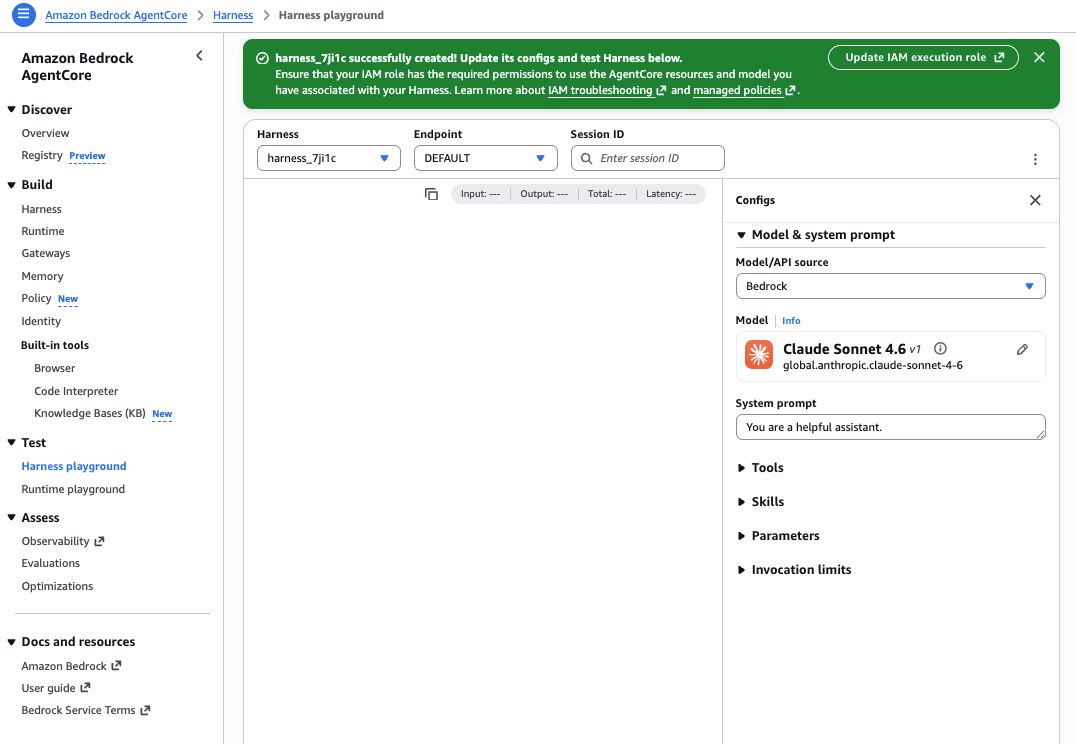
The Harness was created in about 2 to 3 minutes. You will declare and create the model, tools, skills, and instructions in this Harness.
Conclusion
The Managed Agent Harness for Amazon Bedrock AgentCore has become GA, making it possible to run a production-quality agent in minutes simply by declaring the model, tools, skills, and instructions. Features required for production operation are all in place, including session isolation via microVM, persistence of memory and file systems, mid-session model switching, automatic tracing, and rollback through version management.
For those who have been spending time on agent orchestration and infrastructure operations, why not start by declaring and running a small agent?