
[Update] Amazon Quick and Amazon Quick Sight Have Been Renamed to AWS Quick and AWS Quick Sight

This page has been translated by machine translation. View original
I'm Ishikawa from the Cloud Business Division. On November 9, 2026 (November 10 in Japan time), Amazon Quick was renamed AWS Quick. Along with this, its BI (business intelligence) feature, Amazon Quick Sight, was also renamed AWS Quick Sight. (The name of this blog is outdated too.)
Existing users need to take no action, and AWS Quick Sight dashboards, datasets, analyses, and pricing remain unchanged. This article summarizes what changed, what did not change, how the change is reflected on actual screens, the difference between "Amazon" and "AWS" at the start of service names, and where the old names remain.
Update details
The content announced in What's New is as follows.
- Amazon Quick was renamed AWS Quick. The new name is described as reflecting the enterprise-grade security and governance that have been built into it as an AWS service from the start
- The new name is reflected on the AWS Quick website, the web, desktop, and mobile apps, and the AWS documentation
- Amazon Quick Sight, the BI feature of AWS Quick, was renamed AWS Quick Sight
- Existing users need to take no action, and AWS Quick works the same as before
- AWS Quick Sight users can keep using dashboards, datasets, and analyses as before. There are no changes to data, settings, or pricing
What's New also states that AWS Quick is a HIPAA-eligible service and has obtained compliance certifications such as FedRAMP, SOC 2, and ISO 27001, and that data is kept within the user's environment and is not used to train other parties' models.
Name mapping
| Target | Before | After |
|---|---|---|
| Whole service | Amazon Quick | AWS Quick |
| BI feature | Amazon Quick Sight | AWS Quick Sight |
Name history
The history of names from Amazon QuickSight to now is as follows.
The upper row shows the names of the whole service, and the lower row shows the names of the BI feature. The arrow from Amazon Quick Suite to Amazon Quick is dotted because I could not confirm when the change happened.
On October 9, 2025, Amazon QuickSight was expanded from a standalone BI service into a service that handles analytics and AI. At that time the name of the whole service became Amazon Quick Suite, and the BI feature continued as Quick Sight. The name of the whole service later became Amazon Quick, and has now changed to AWS Quick. I could not identify when Amazon Quick Suite changed to Amazon Quick from the official AWS information I checked this time.
How it is reflected on screens (as of November 11, 2026)
What's New says the new name has been reflected in the web, desktop, and mobile apps. When I checked the actual screens at the time of writing, the web version displayed differently depending on the region.
| Target | Name on screen |
|---|---|
| Web version (US East (N. Virginia) Region) | AWS Quick |
| Web version (Asia Pacific (Tokyo) Region) | Amazon Quick |
| Desktop app (version 1.2.4308 (Build 6546743970)) | AWS Quick |
Web version (US East (N. Virginia) Region)
The web version in the US East (N. Virginia) Region (us-east-1) had already changed to display AWS Quick.
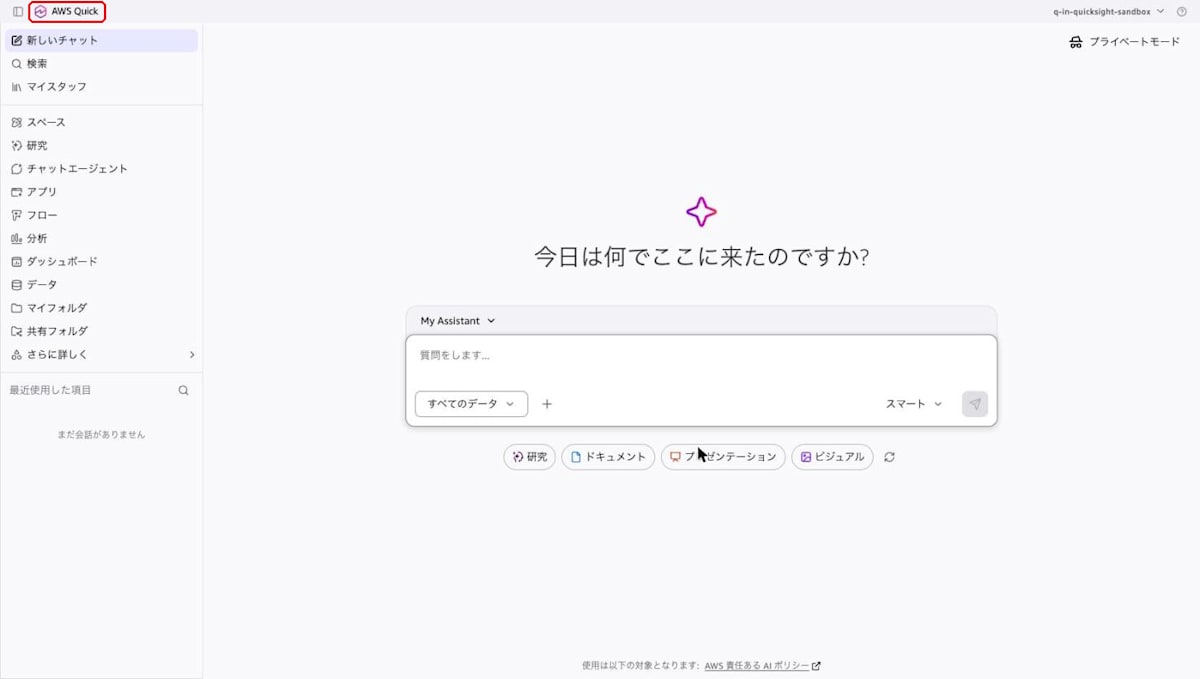
"AWS Quick" is displayed at the top left of the screen (red frame).
Web version (Asia Pacific (Tokyo) Region)
The web version in the Asia Pacific (Tokyo) Region (ap-northeast-1) still displayed Amazon Quick.
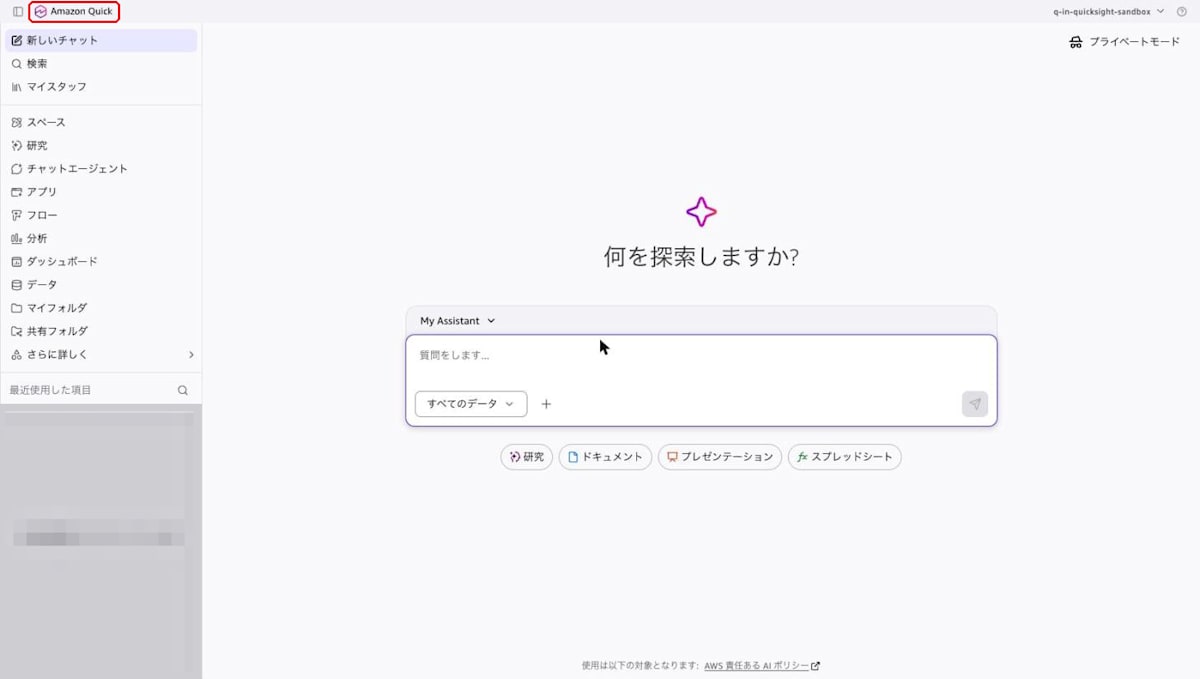
This is the screen after switching to the Tokyo Region in the same account. The display at the top left of the screen (red frame) is still "Amazon Quick".
The document history of the user guide states that new releases are rolled out to each Region over a period of time starting from the first Region. It has not been announced when the display in the Tokyo Region will change to AWS Quick. Even if the Tokyo Region shows Amazon Quick, it is the same service that has now been renamed AWS Quick.
Desktop app
The Amazon Quick on Desktop app had changed to display AWS Quick as of version 1.2.4308 (Build 6546743970).
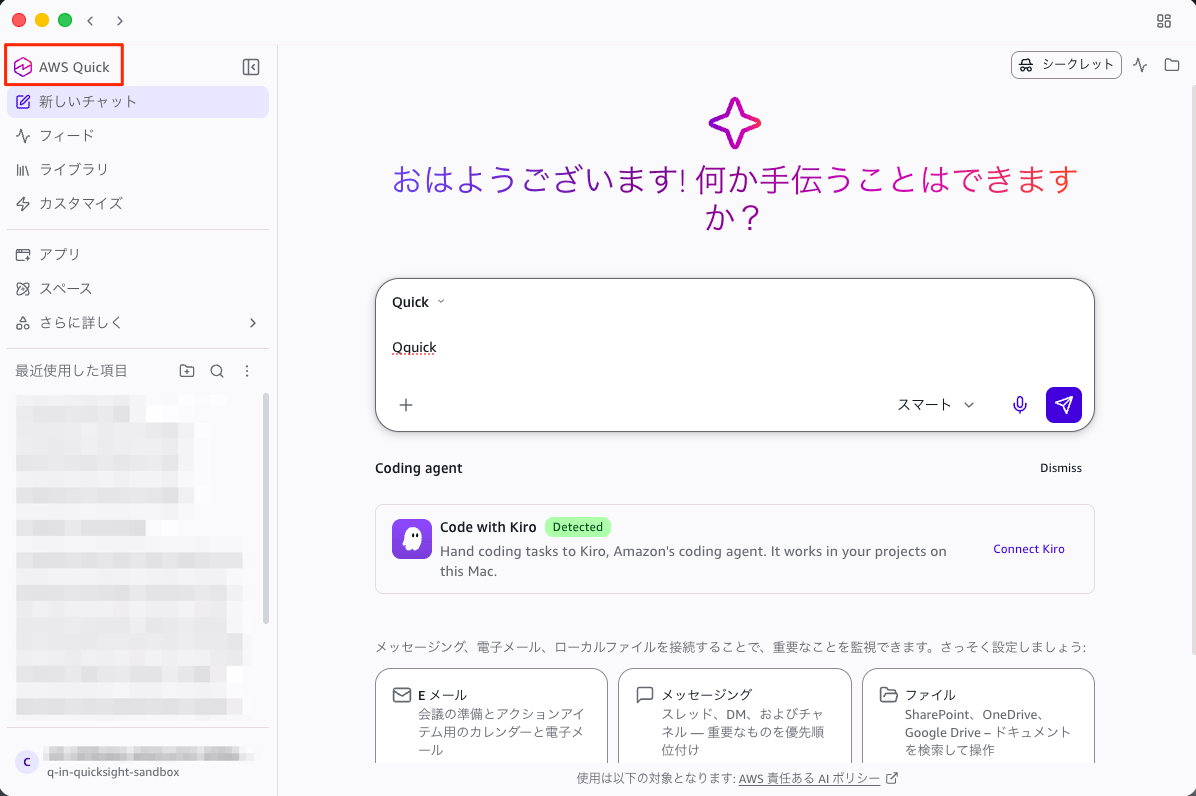
This is the About screen of the macOS version. The app name is "AWS Quick", and the copyright notice is also "© 2026 AWS Quick." Note that the file name in the Applications folder was still "Amazon Quick.app".
Supported Regions
AWS Quick is available in many AWS Regions. Check the AWS Regions table for the Regions where it is available.
Impact on pricing
What's New states that there is no change to AWS Quick Sight pricing.
What is the difference between "Amazon" and "AWS" at the start of service names in the first place?
In this change, the start of the service name changed from "Amazon" to "AWS". AWS service names include those that start with "Amazon", such as Amazon S3 and Amazon EC2, and those that start with "AWS", such as AWS Lambda and AWS CloudFormation.
A frequently cited explanation
I could not find an official standard for how to choose between them. A frequently cited explanation is the one in a Stack Overflow answer: "standalone services" get Amazon, and "utility services" get AWS. The DevelopersIO article "I looked into the difference between "AWS ○○" and "Amazon ○○" in AWS service names" (published August 18, 2022) builds on this answer and introduces the tendency that many services starting with AWS use or launch other services. The examples of services starting with AWS given in that article are AWS Elastic Beanstalk, AWS OpsWorks, AWS CloudFormation, AWS Lambda, and AWS Data Pipeline.
This explanation is not an official AWS position, but is introduced as a general tendency.
The numbers of Amazon and AWS are almost the same
botocore 1.43.93, used by the AWS SDK for Python (Boto3), contains 431 API definitions. The results of tallying the beginning of the official service name (serviceFullName) in each API definition are as follows.
| Beginning of serviceFullName | Count |
|---|---|
| AWS | 174 |
| Amazon | 173 |
| Neither | 84 |
"Neither" includes names without a prefix, such as "Auto Scaling", and names where the prefix and service name are joined together, such as "AmazonApiGatewayV2". Because a single service may have multiple API definitions, the counts do not match the number of services. Even so, it is clear that names are not skewed toward either prefix.
The reason for prefix changes differs with each rename
The announcements for Systems Manager and End User Messaging include relationships with other services, such as "multiple AWS services" and "other AWS services". This is consistent with the explanation that utility services get AWS.
On the other hand, for AWS Quick this time, the reason given is not a relationship with other services but the enterprise-grade security and governance it has as an AWS service. Also, AWS Chatbot changed from AWS to Amazon because its functionality moved to Amazon Q Developer.
The reason for prefix changes differs with each rename and cannot be explained by a single standard. When writing service names, do not guess the prefix; check the official name on the official AWS page.
Usage notes
The service identifier in ARNs, IAM policies, and the CLI remains quicksight
The AWS Machine Learning Blog article "AWS Quick ARNs: Cross-account migration and namespace permissions" explains that quicksight continues to be used as the service identifier in ARNs and API endpoints. This is to maintain compatibility with existing IAM policies, automation, and integrations.
arn:aws:quicksight:us-east-1:123456789012:dashboard/...
The same article states that existing code, IAM policies, and CLI commands continue to work without changes. The user guide also states that existing QuickSight APIs, SDKs, and integrations work without changes. You do not need to rewrite IAM policies or IaC code because of this rename.
Where the old names remain
When I checked at the time of writing (November 11, 2026), the old names remained in the following places.
- Web version in the Asia Pacific (Tokyo) Region: As described above, the screen still displayed Amazon Quick
- API definitions in the SDK: In botocore 1.43.93, the official service name (
serviceFullName) in the quicksight API definition was still "Amazon QuickSight" - AWS managed policy:
AmazonQuickSuiteAccessPolicy, added in October 2026, uses the Amazon Quick Suite name in both the policy name and the description - Japanese version of the user guide: The page title of the English version has been updated to "What is AWS Quick?", but the Japanese version (machine translated) was still "What is Amazon Quick"
- URLs of past blog articles: The AWS Business Intelligence Blog article published on October 9, 2025 has had its title updated to "Reimagine business intelligence: AWS Quick Sight evolves to AWS Quick", but the URL still contains
amazon-quicksight-evolves-to-amazon-quick-suite
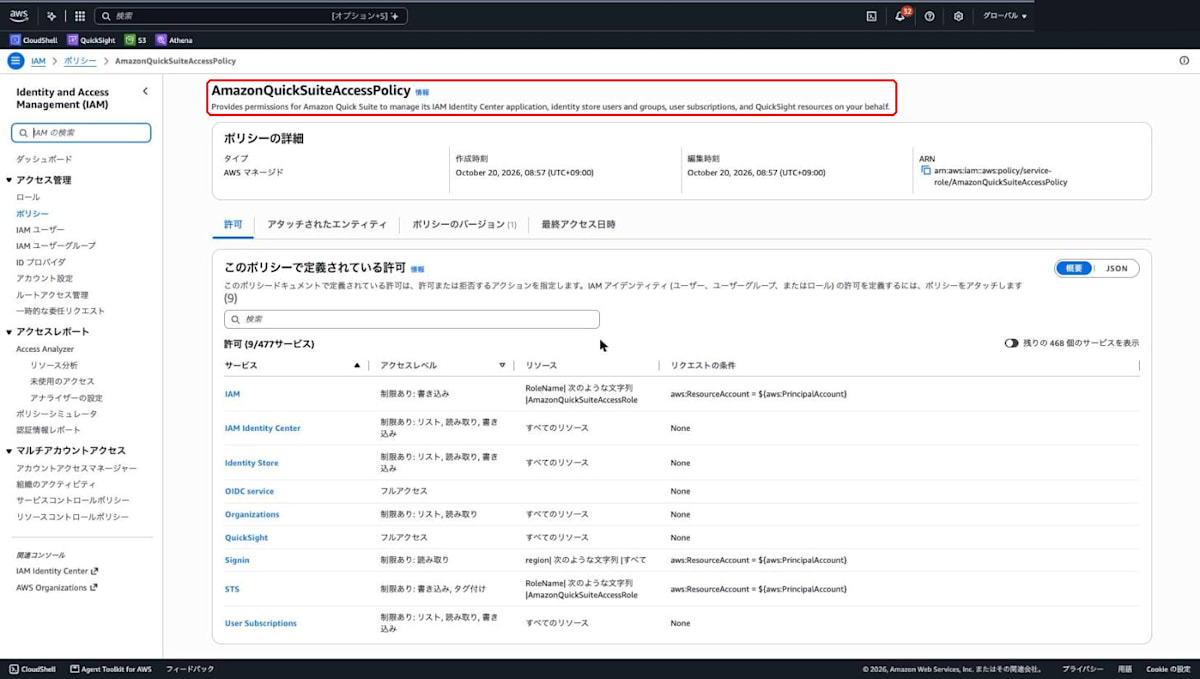
This is the screen showing the details of AmazonQuickSuiteAccessPolicy in the IAM console. The Amazon Quick Suite name is used in the policy name and description in the red frame. In the list of permissions, QuickSight is displayed as the service. The account information at the top right of the screen is masked.
When searching for information, searching for Amazon Quick, Amazon Quick Suite, and QuickSight in addition to AWS Quick will make it easier to find related information.
Conclusion
Amazon Quick was renamed AWS Quick, and Amazon Quick Sight was renamed AWS Quick Sight. Existing users need to take no action, and AWS Quick Sight dashboards, datasets, analyses, and pricing remain unchanged. The service identifier in ARNs and API endpoints remains quicksight, so there is no need to change IAM policies or IaC code.
As of November 11, 2026, the web version in the US East (N. Virginia) Region and the desktop app (version 1.2.4308 (Build 6546743970)) had changed to display AWS Quick, while the web version in the Asia Pacific (Tokyo) Region still displayed Amazon Quick. The name on screen may differ depending on the Region you use.
If the old names remain in your internal procedures, architecture diagrams, or user guidance, why not consider aligning the notation to AWS Quick / AWS Quick Sight at the next update?