![[Session Report] Transforming Unstructured Data in Amazon S3 into AI-Ready Assets with Amazon SageMaker Catalog [ANT308] #AWSSummit](https://images.ctfassets.net/ct0aopd36mqt/7cN8mkB4Ni5uqeEvJpsSW1/b629d0b5a4a192e6547eaa743065e1bd/aws-summit-japan2026_session.png?w=3840&fm=webp)
[Session Report] Transforming Unstructured Data in Amazon S3 into AI-Ready Assets with Amazon SageMaker Catalog [ANT308] #AWSSummit

This page has been translated by machine translation. View original
Introduction
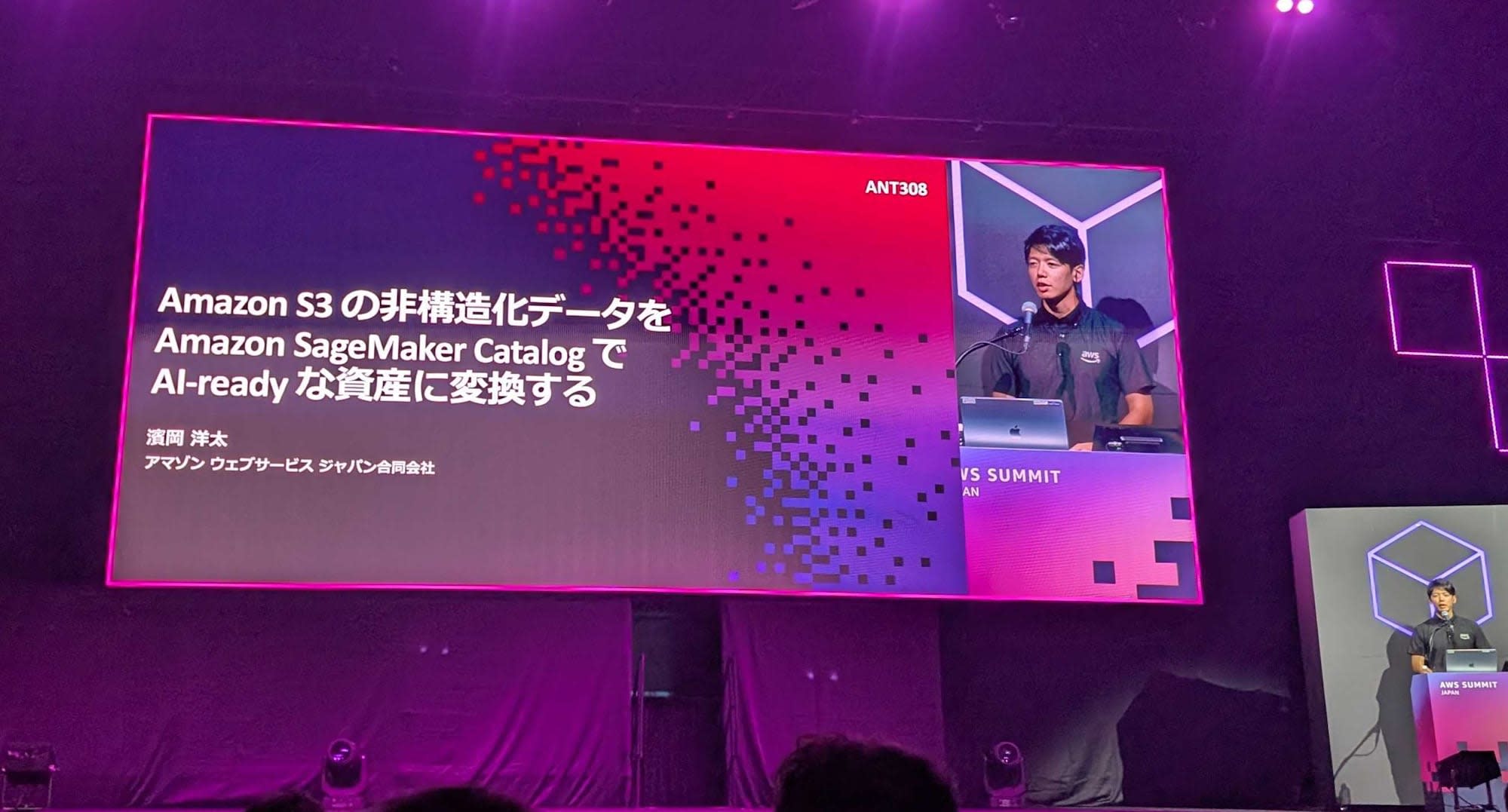
This is a report on the Amazon S3 session ANT308, which I attended at AWS Summit Japan 2026.
To make the most of AI agents, a solid data foundation is essential. Poor-quality data yields poor-quality results. This session explained the concepts and tools for transforming unstructured data accumulated in S3 into assets that AI can work with.
The session overview is as follows.
- Session number: ANT308
- Title: Transforming Unstructured Data in Amazon S3 into AI-Ready Assets with Amazon SageMaker Catalog
- Speaker: Yota Hamaoka (WWSO Big Data Specialist Solutions Architect, Amazon Web Services Japan G.K.)
- Date and time: June 25, 2026, 14:30–15:10
Data Modality and Integrated Analysis
The session began with an overview of processing approaches for each data modality (type or format).
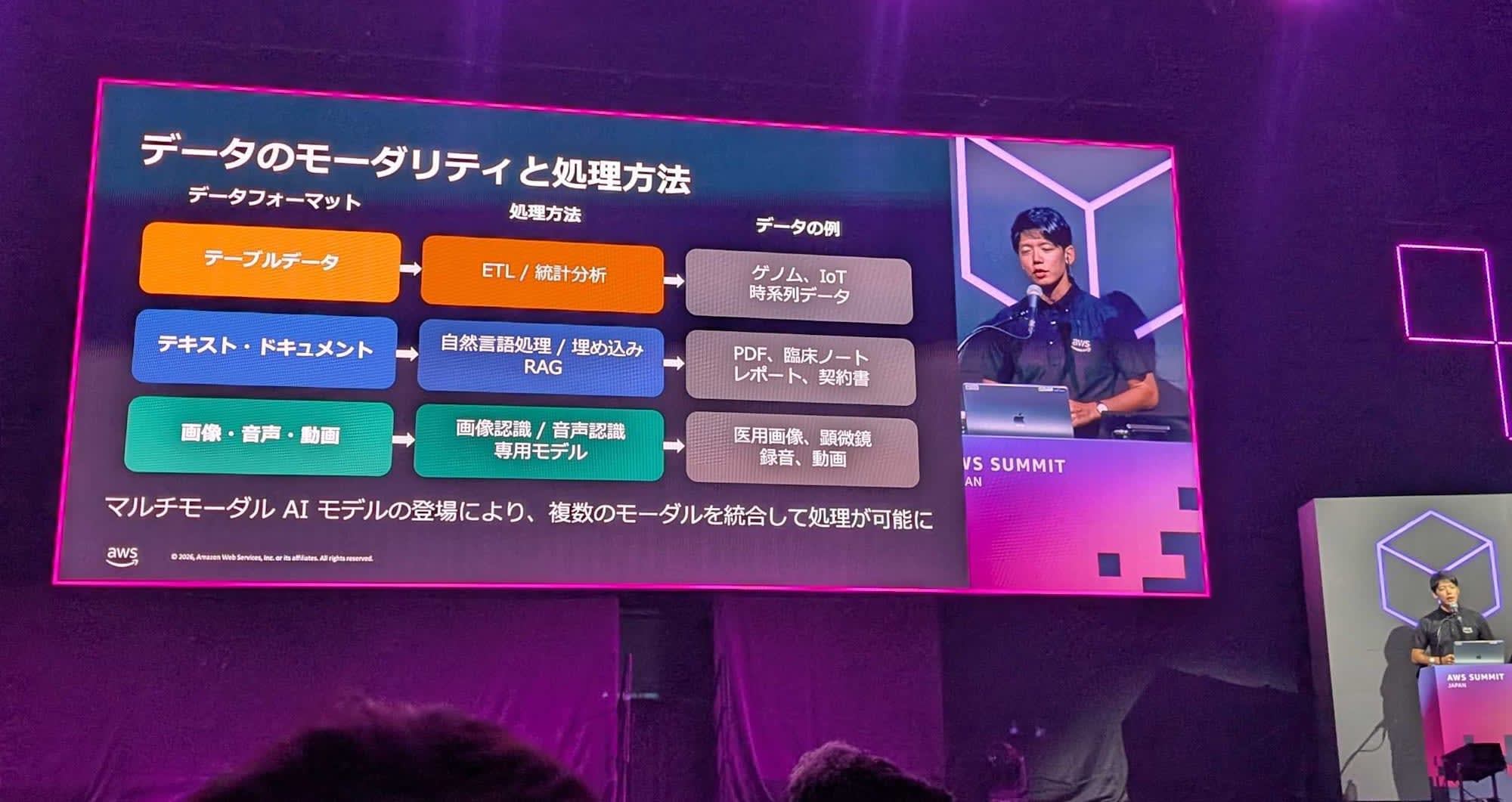
Tabular data is handled through ETL and statistical analysis, text and documents through natural language processing and RAG, and images, audio, and video through recognition with specialized models. In recent years, multimodal AI models have made it possible to combine these approaches for integrated analysis.
As a concrete example, medical case analysis was introduced. When asked to find past cases similar to a patient's symptoms, an analysis agent goes to work. Structured data is aggregated from the data lake using SQL, while unstructured data is searched for similar cases using vector search. By combining both, the agent was able to answer questions about trends in the number of patients with similar cases.
Elements for Converting Data into AI-Ready Assets
AI agents behave differently from humans.
Humans rely on domain knowledge to navigate directly to the data they need, whereas agents explore a broad range of data and gradually narrow down what is relevant. For this reason, three elements are required: context that provides meaning and relationships within the data, access methods suited to each modality, and data quality.
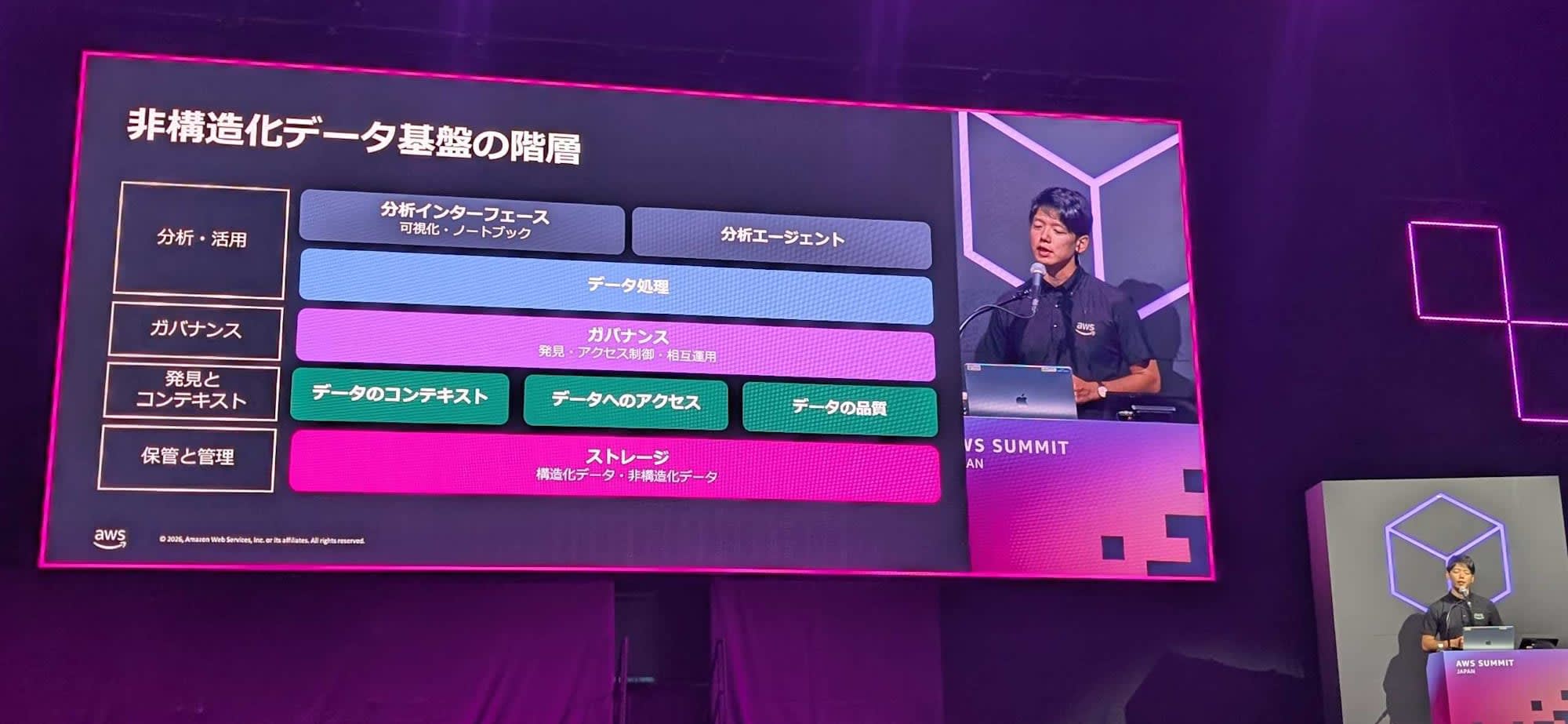
At the center of this is Amazon SageMaker Catalog.
By registering S3 paths as S3 Object Collections in the catalog and attaching business metadata, data becomes easier to discover within the organization. It was also shown that by combining Amazon Bedrock Knowledge Bases for RAG and Amazon Bedrock Guardrails for evaluating inputs and outputs, analysis can flow seamlessly from S3 through the catalog to generative AI.
Summary
At the close of the presentation, three recommendations were offered: review what modalities of data your organization has and where they reside, attach business metadata to unstructured data to improve discoverability, and start small with a knowledge base and agents. Rather than aiming for a large-scale foundation all at once, the suggested approach of starting small with a single S3 bucket felt very approachable.
Reference Links
- Amazon SageMaker Data and AI Governance
- Amazon SageMaker Catalog expands discoverability and governance for Amazon S3 general purpose buckets
- Improve the discoverability of your unstructured data in Amazon SageMaker Catalog using generative AI
- Amazon Bedrock Knowledge Bases
- Amazon Bedrock Guardrails
©2026, Amazon Web Services, Inc. or its affiliates. All rights reserved.