![[Report] What is Snowflake Cortex Sense - The Importance of Ontology and Context Layers in the Age of Agents #SWTTokyo26](https://images.ctfassets.net/ct0aopd36mqt/4kFYCMTvi9ucEtpiAfvm01/b605f81aa314b1fdbc86f8fee275fb43/eyecatch_snowflakeworldtourtokyo2026.webp?w=3840&fm=webp)
[Report] What is Snowflake Cortex Sense - The Importance of Ontology and Context Layers in the Age of Agents #SWTTokyo26

This page has been translated by machine translation. View original
This is Suzuki from the Data Business Division.
"SNOWFLAKE WORLD TOUR TOKYO 2026" was held from September 10, 2026 to September 11, 2026.
This article is a report blog for the session 'What is Snowflake Cortex Sense - The Importance of Ontology and Context Layers in the Age of Agents'.
The features introduced include those in preview or related to future roadmaps. Please check the latest official documentation for availability.
(Safe harbor and disclaimer projected at the beginning of the session)
This article introduces the key points as understood by the author based on the content viewed.
Speaker
- Masato Takada
- Snowflake G.K.
- Solution Engineering · Senior Architect, Machine Learning, Applied Field Engineering Office

Introduction to the Content
1. About Ontology and Context Layers
Among users who are evaluating and adopting AI agents, the keywords ontology and context layer have been attracting significant interest.
The concept of ontology itself has been around for a long time in the field of information science, but recently it has been gaining attention as a technology for conveying the relationships between things to AI agents.
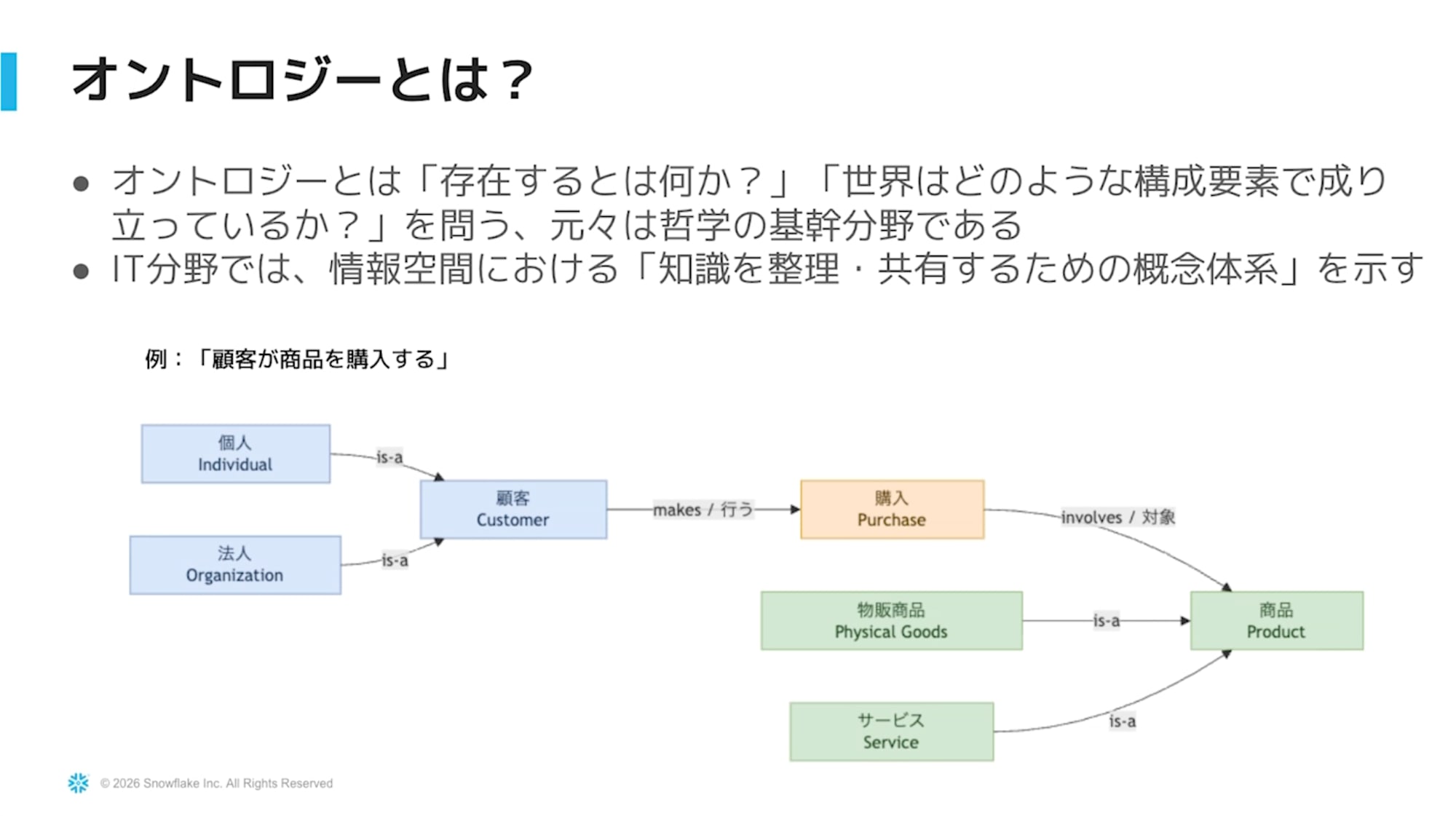
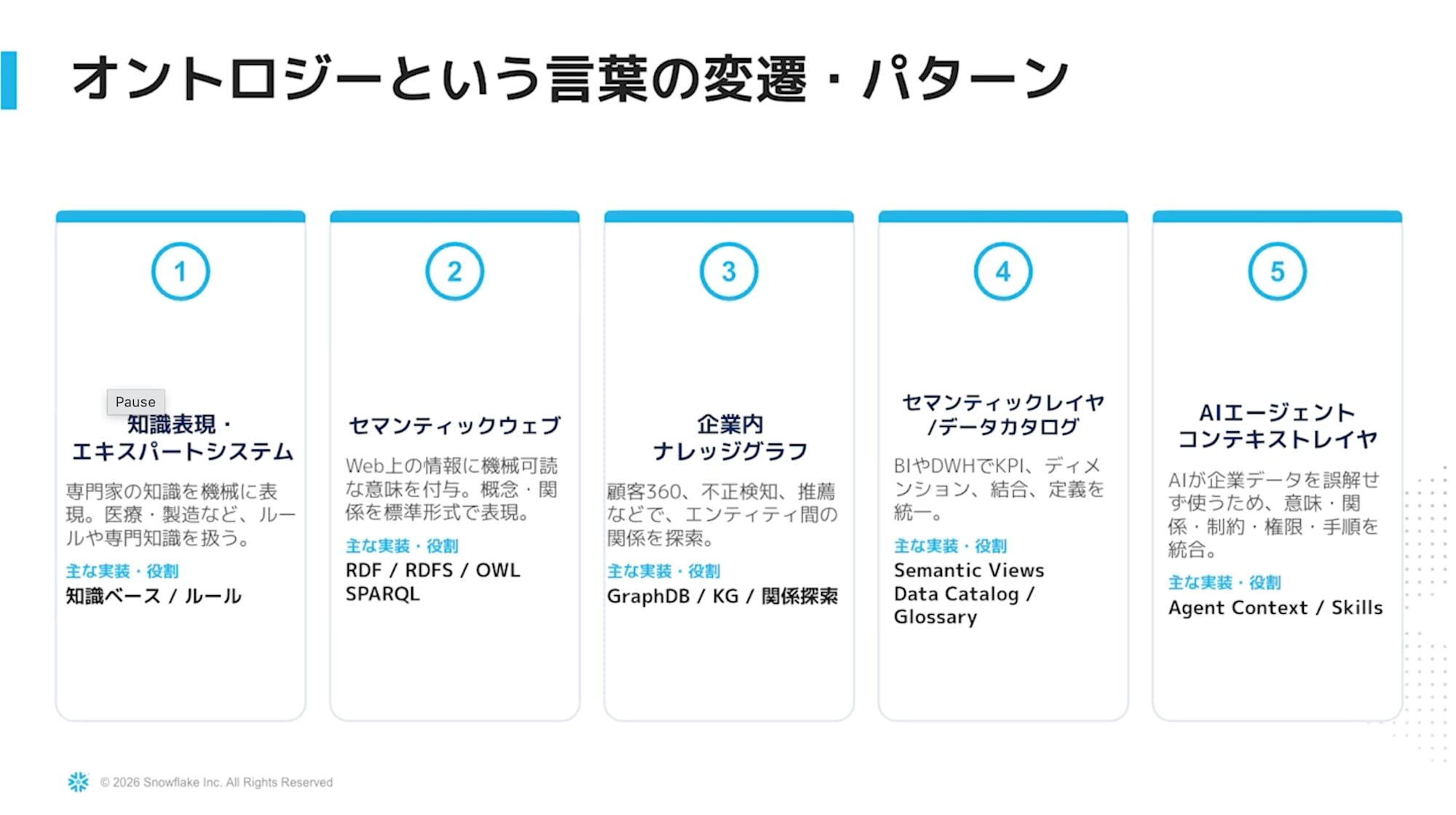
In the context of AI agents, it is introduced as a method for realizing the context layer. Currently, Snowflake's semantic views handle elements that can be expressed in data, as shown by the black text in the diagram below, but the context layer is expected to also handle elements shown in red that require capturing business context.
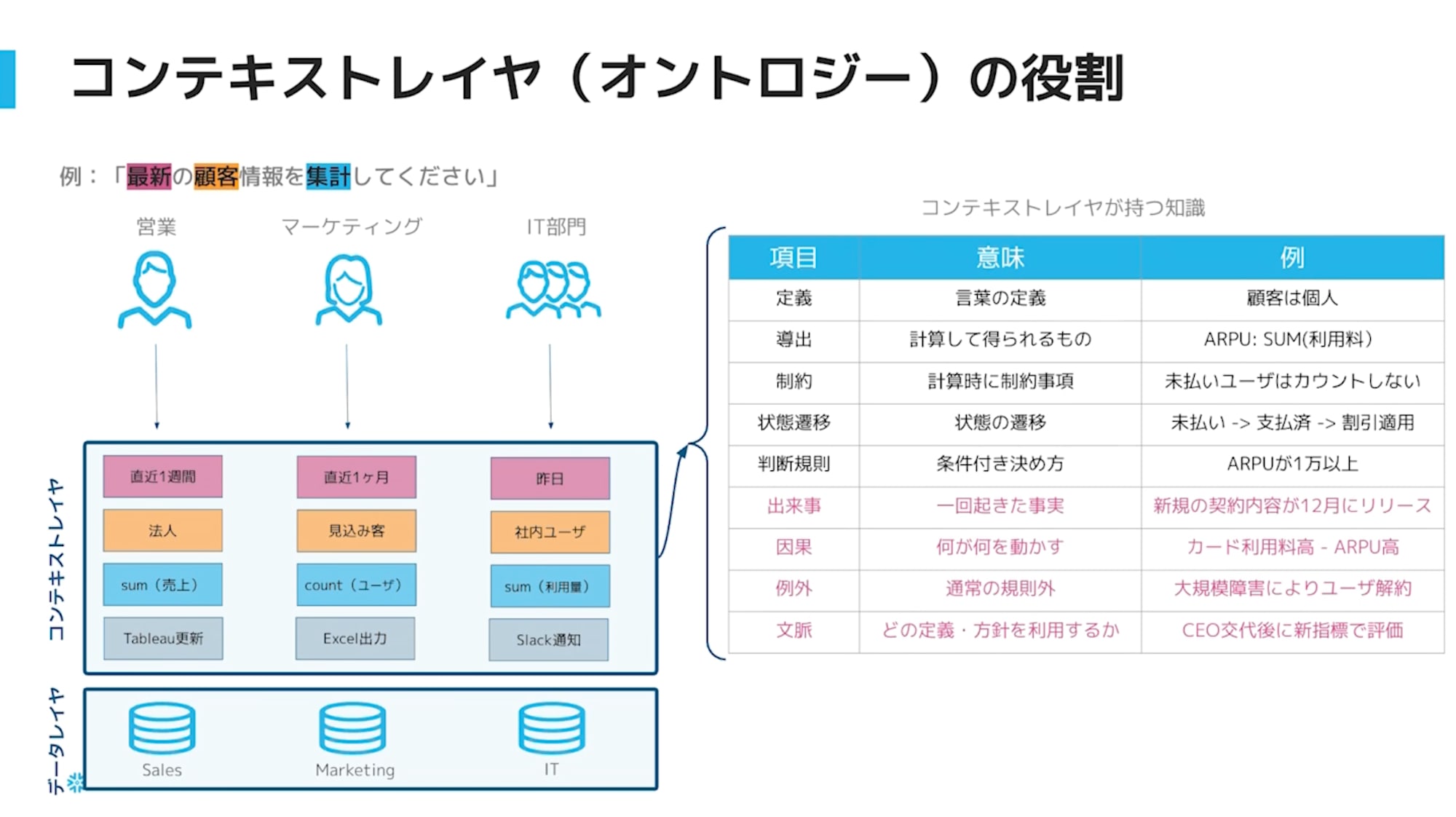
In the session, it was explained that the semantic layer handles "What" such as the definition of aggregated values, while the context layer handles something closer to "How," and I found this distinction very easy to understand.
Throughout the session, it was emphasized that the most important point of the context layer is that it allows AI agents to operate autonomously in accordance with the business structure, including business processes.
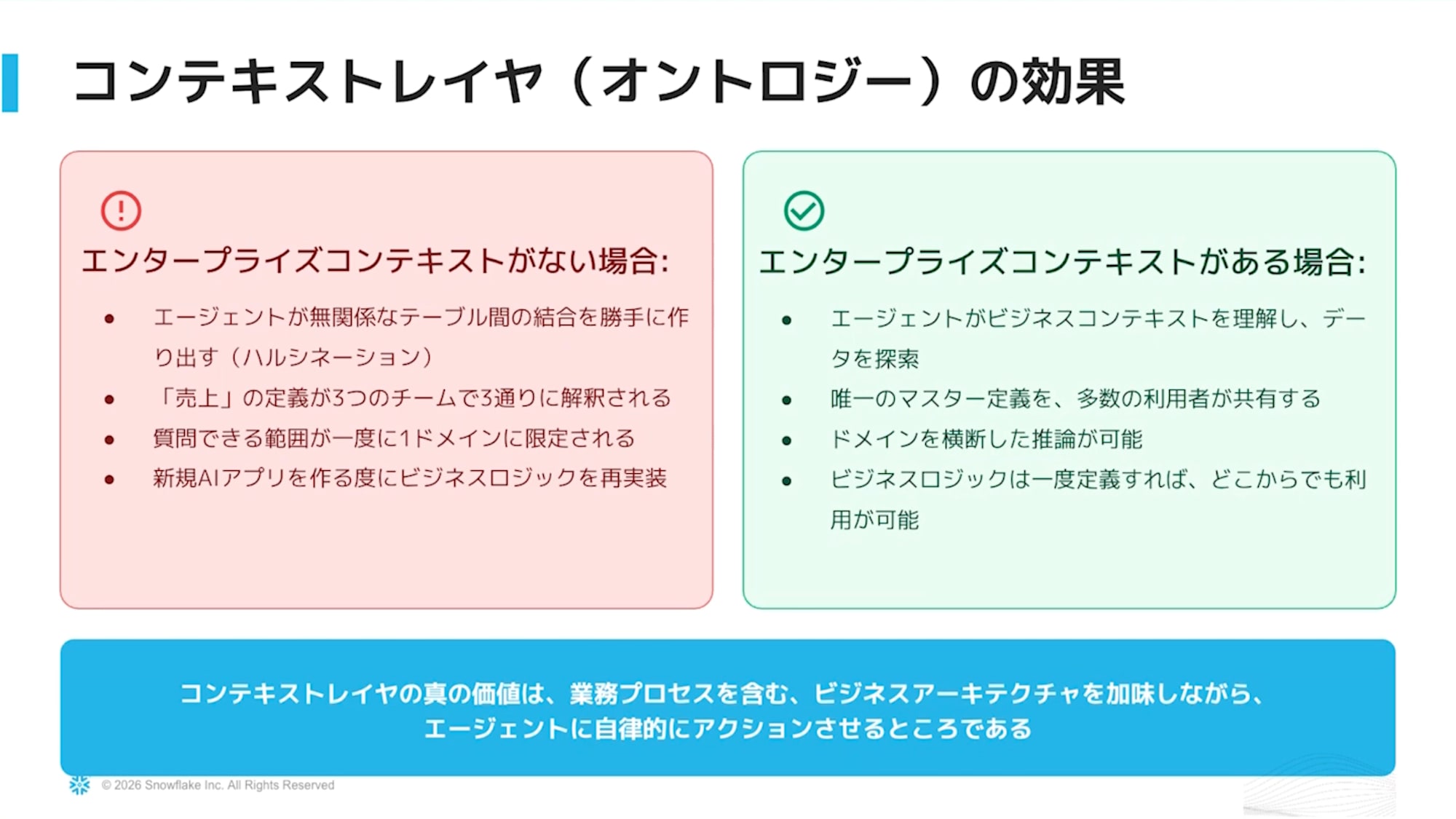
I also consider this point to be very important. With the current Cortex Agents, you can describe what you want to aggregate and explanations of columns in the semantic view, but the business processes for how and in what order to aggregate and use them must be communicated mainly as the order of tool usage, such as by writing them in Orchestration instructions. With a context layer, AI agents can be expected to understand business processes more flexibly and operate autonomously.
2. How to Realize the Context Layer
We were also shown the relationship between the context layer and other concepts, and how the presence of a context layer improves AI agent behavior.
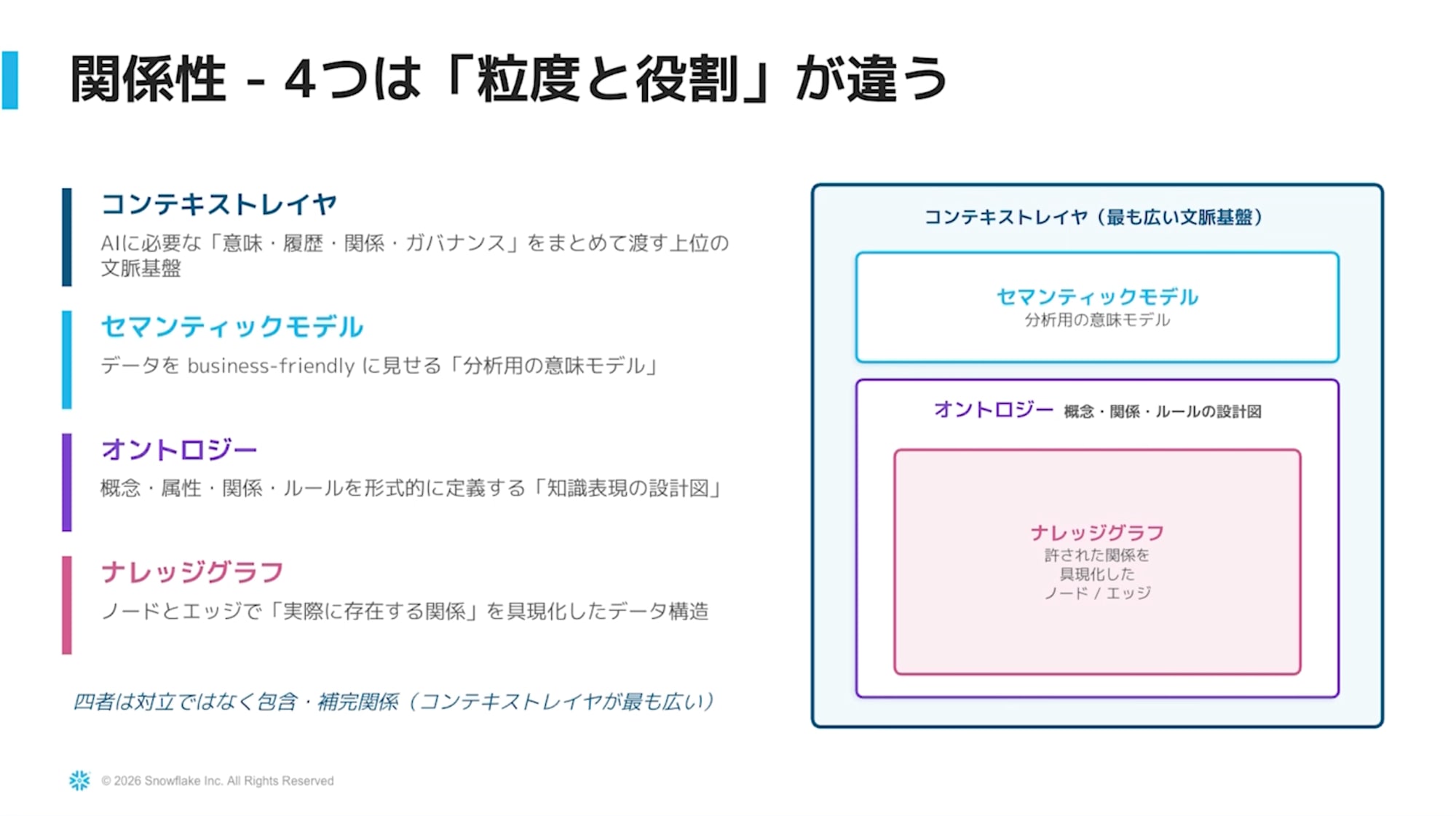
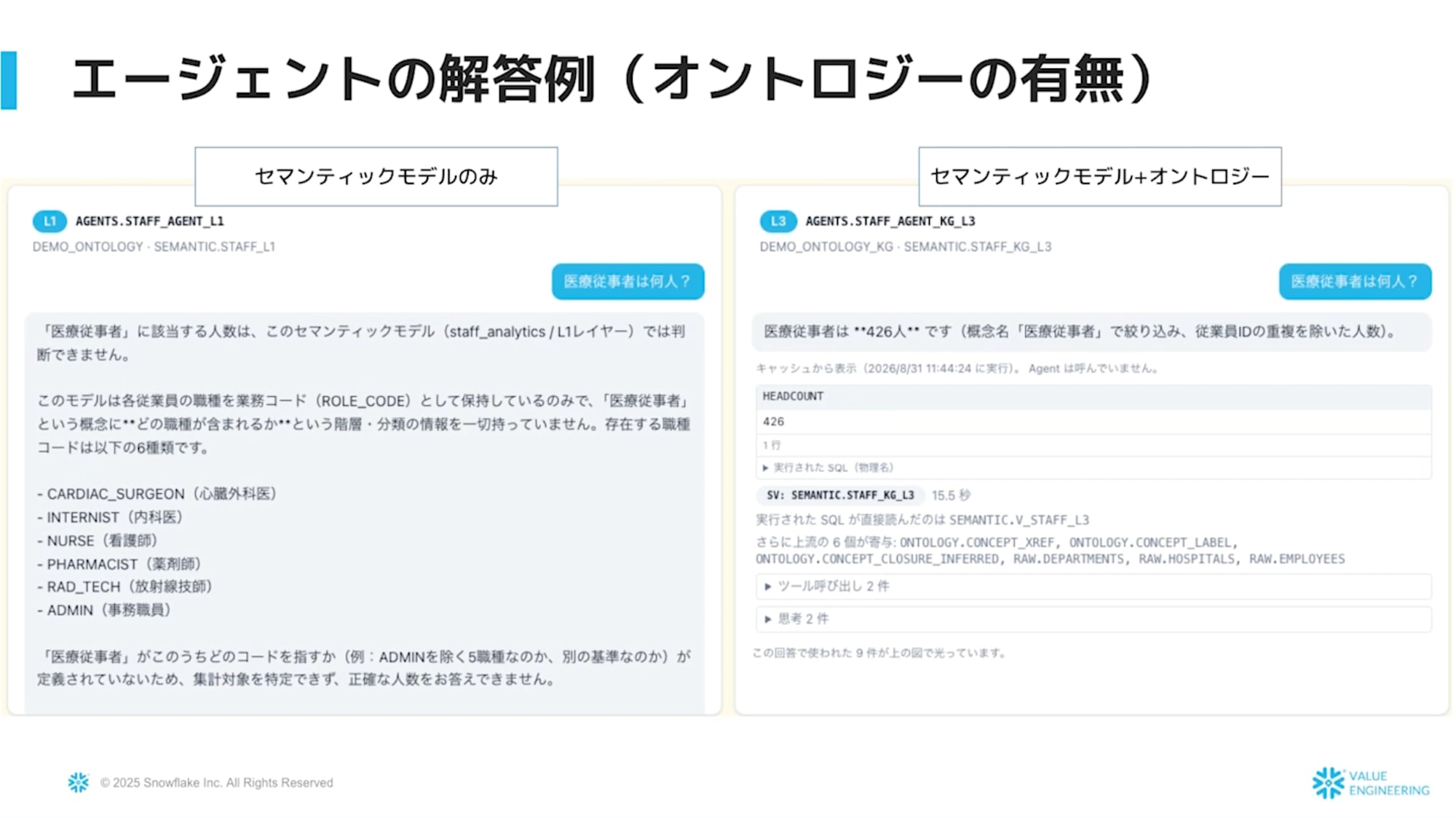
In the demo results tried by the speaker, for example, when using only a semantic model versus when an ontology is also available, information not in the semantic model could be retrieved from the ontology, enabling appropriate answers.
Results comparing the use of ontology alone versus also having a knowledge graph — which is the actual concrete relational data — were also introduced.
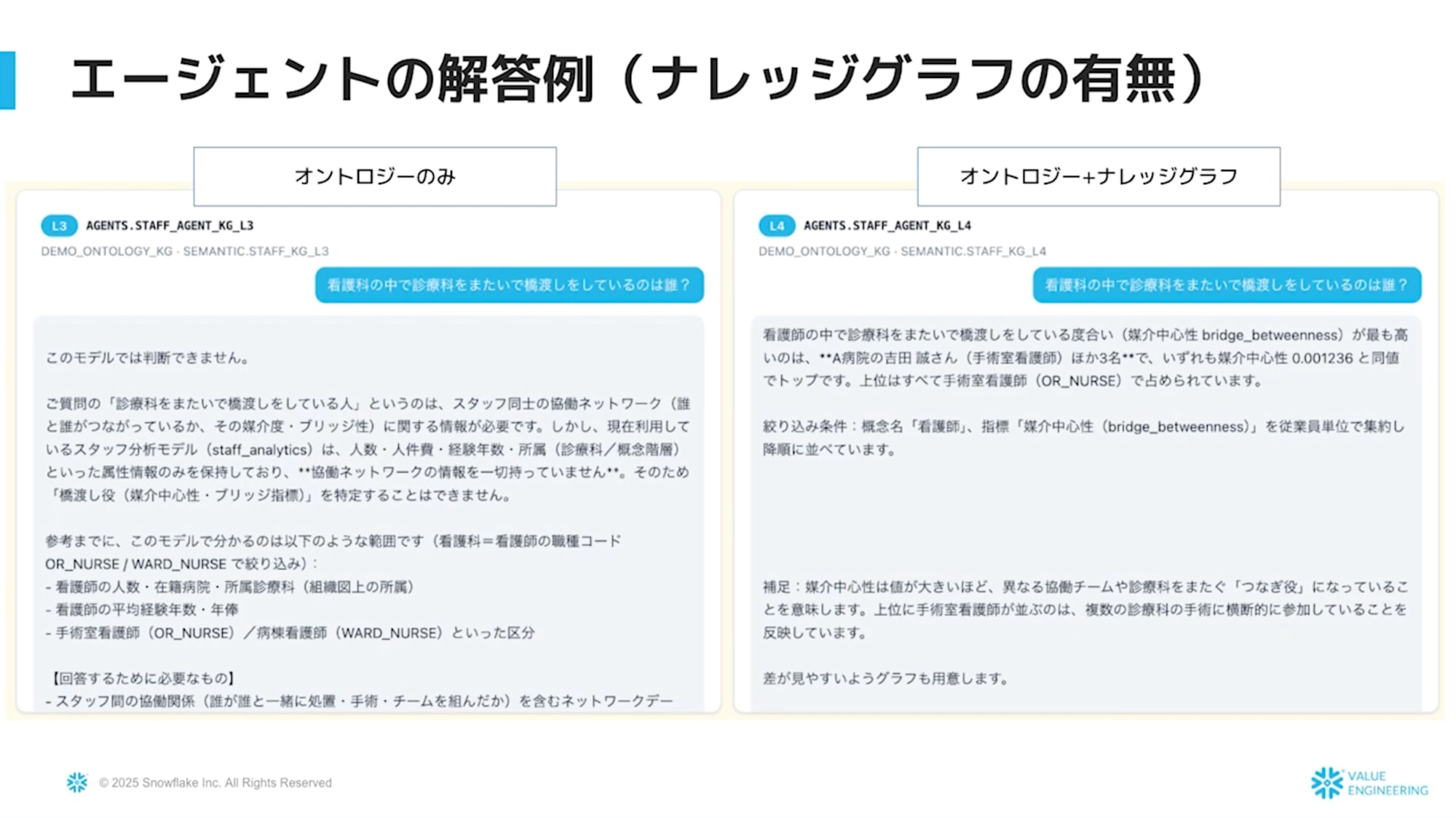
It was a very easy-to-understand demo result showing that the context information required by AI agents differs depending on the task.
Cortex Sense and Snowflake features, which are among the themes covered in this session, are said to support adaptive intelligence and the context layer. Ontology on Snowflake and RelationalAI were introduced for knowledge graphs.
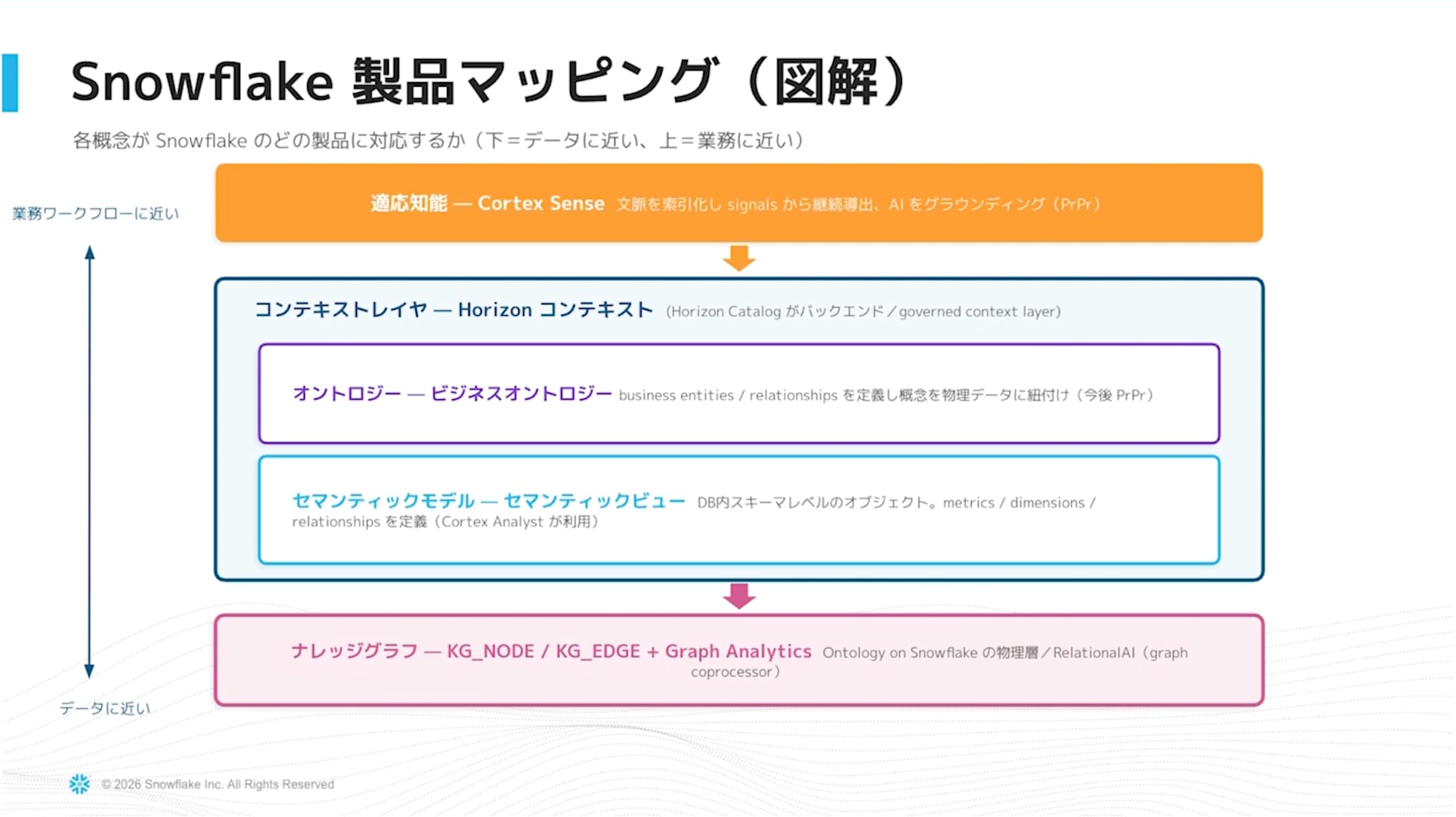
When building, it was noted that you don't necessarily have to build everything at once, and that it is best to start with semantic views and build incrementally as needed.
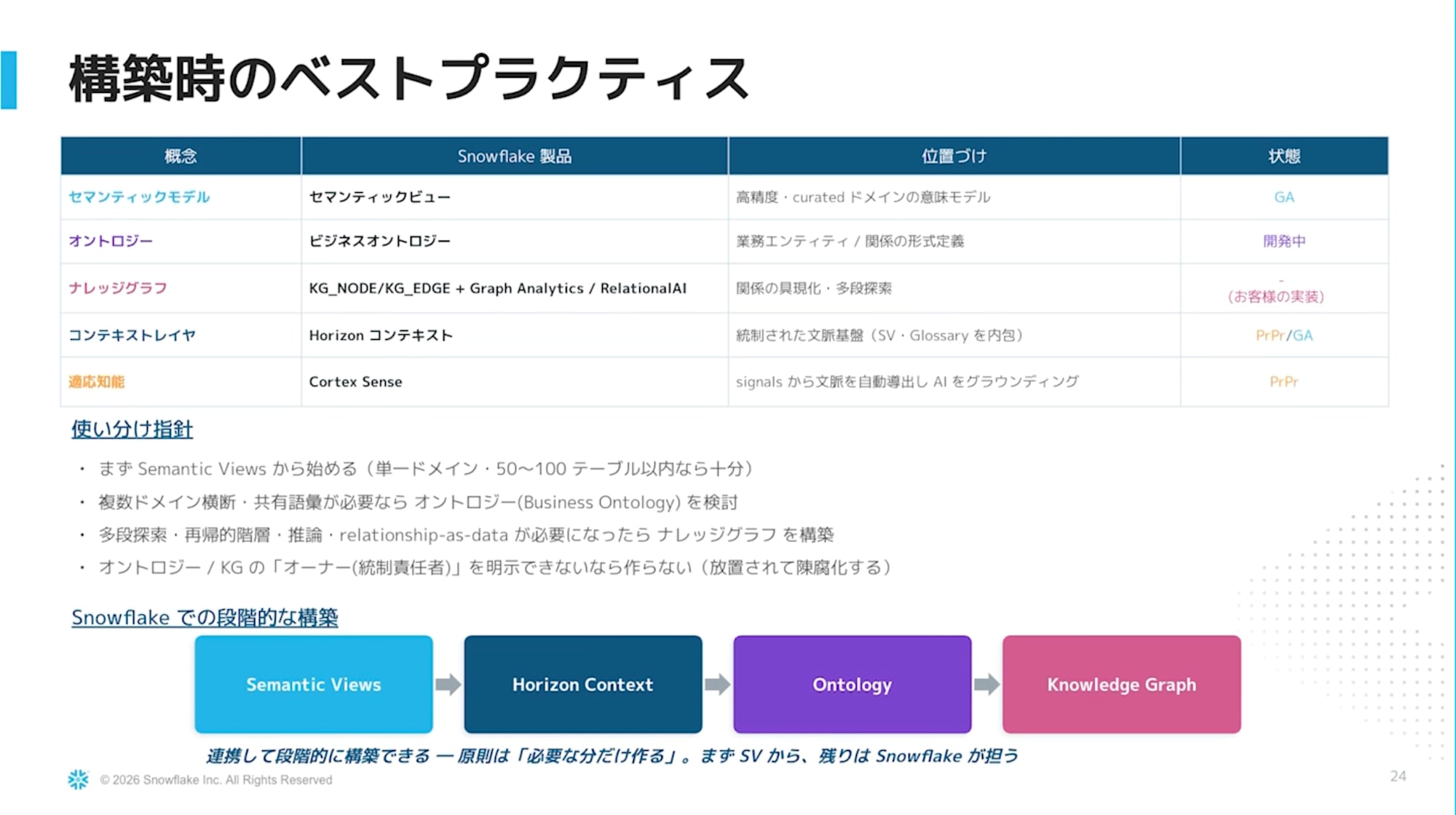
I personally feel that knowledge graphs in particular take a lot of time to implement. Depending on the requirements for what you want AI agents to do, I think there are many cases that can be handled with Horizon Context, so the point that it is fine to proceed step by step was very helpful.
3. About Cortex Sense
Cortex Sense was also introduced.
The content introduced may change by the time of preview release or general availability, but I think it will serve as a useful reference for how to build the foundation with existing features going forward.
Cortex Sense was described as a fully managed Snowflake feature that indexes Horizon Context and internal knowledge.
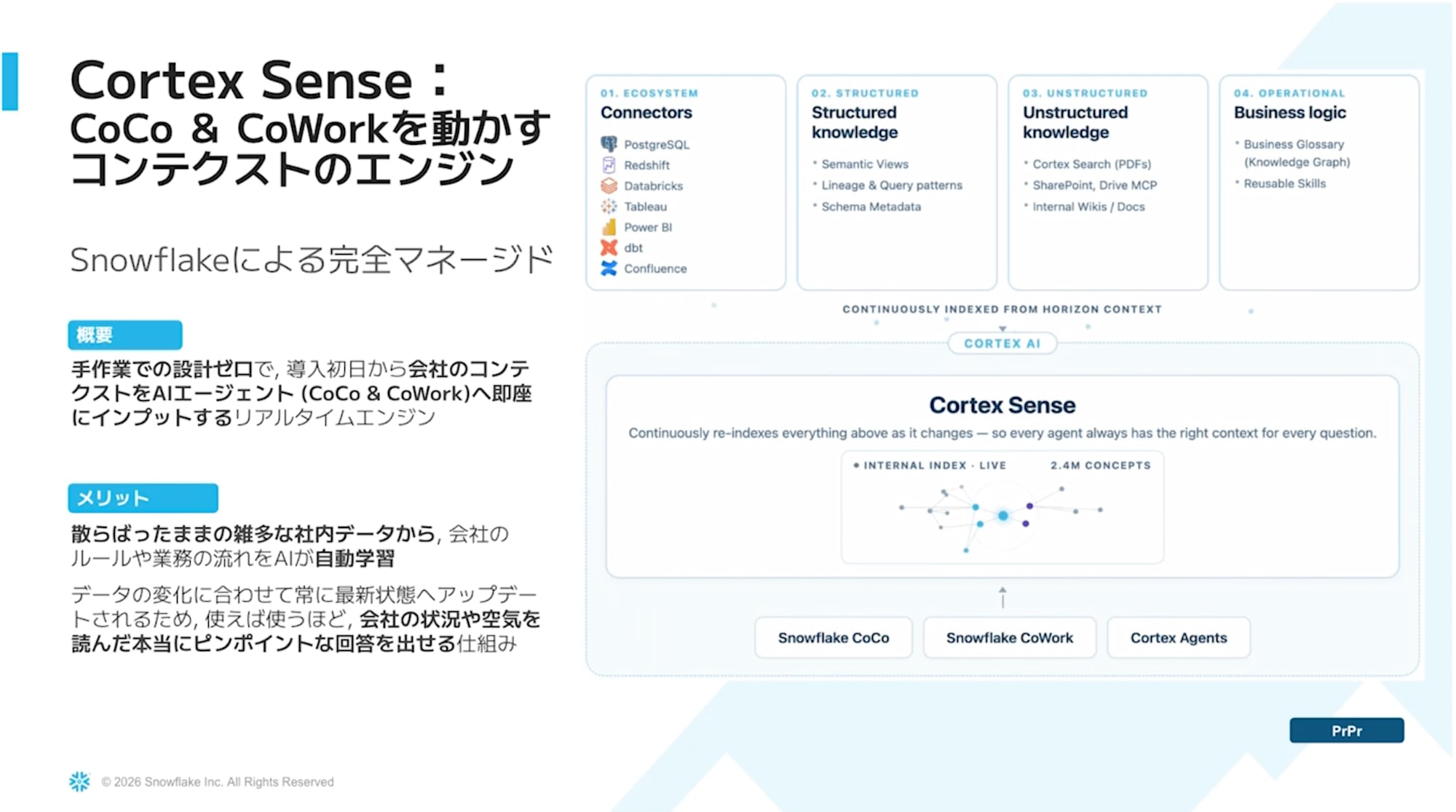
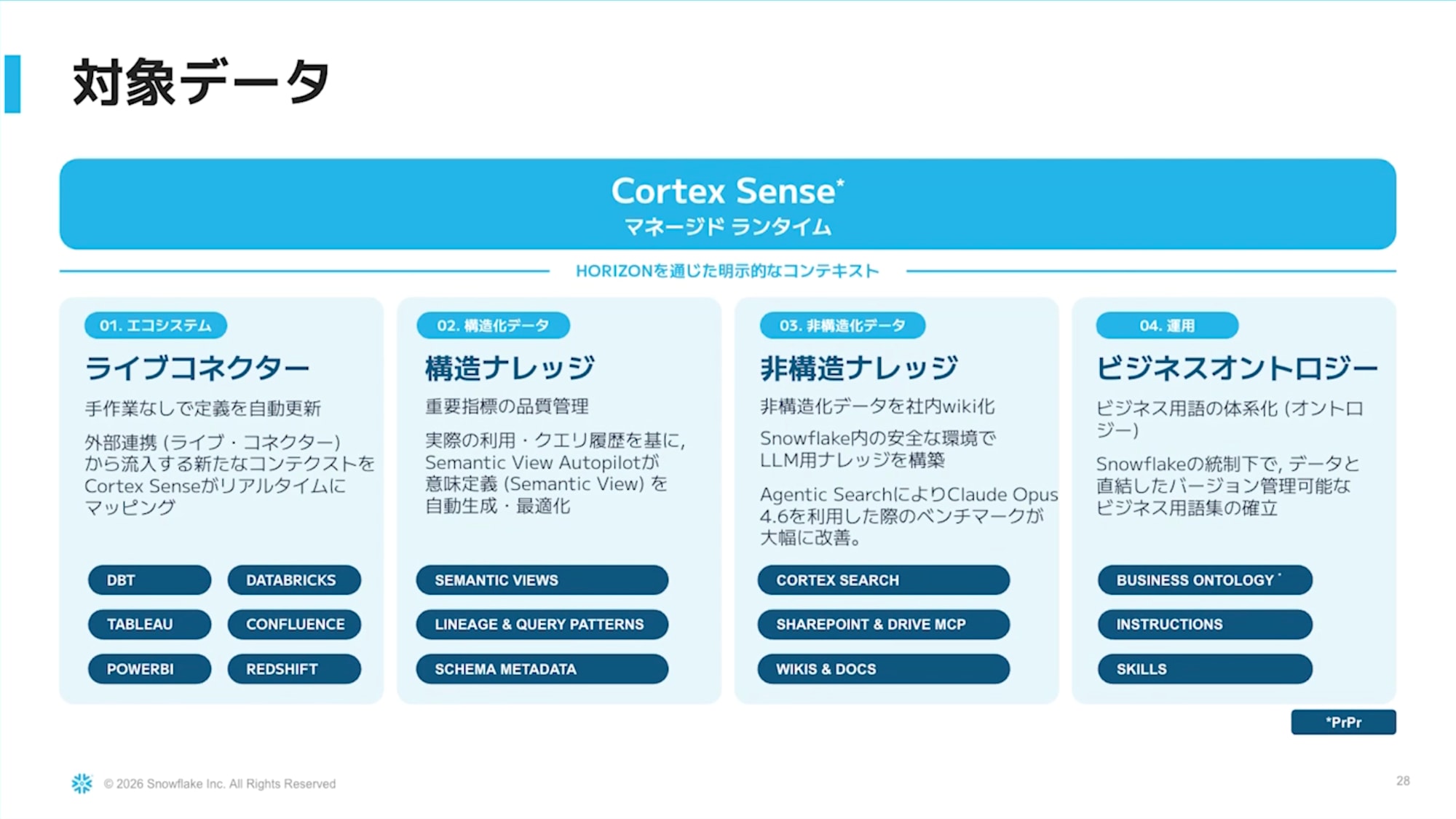
The following were introduced as ingestible contexts. The ability to ingest information from dbt projects, external DWHs, and internal knowledge is extremely powerful.
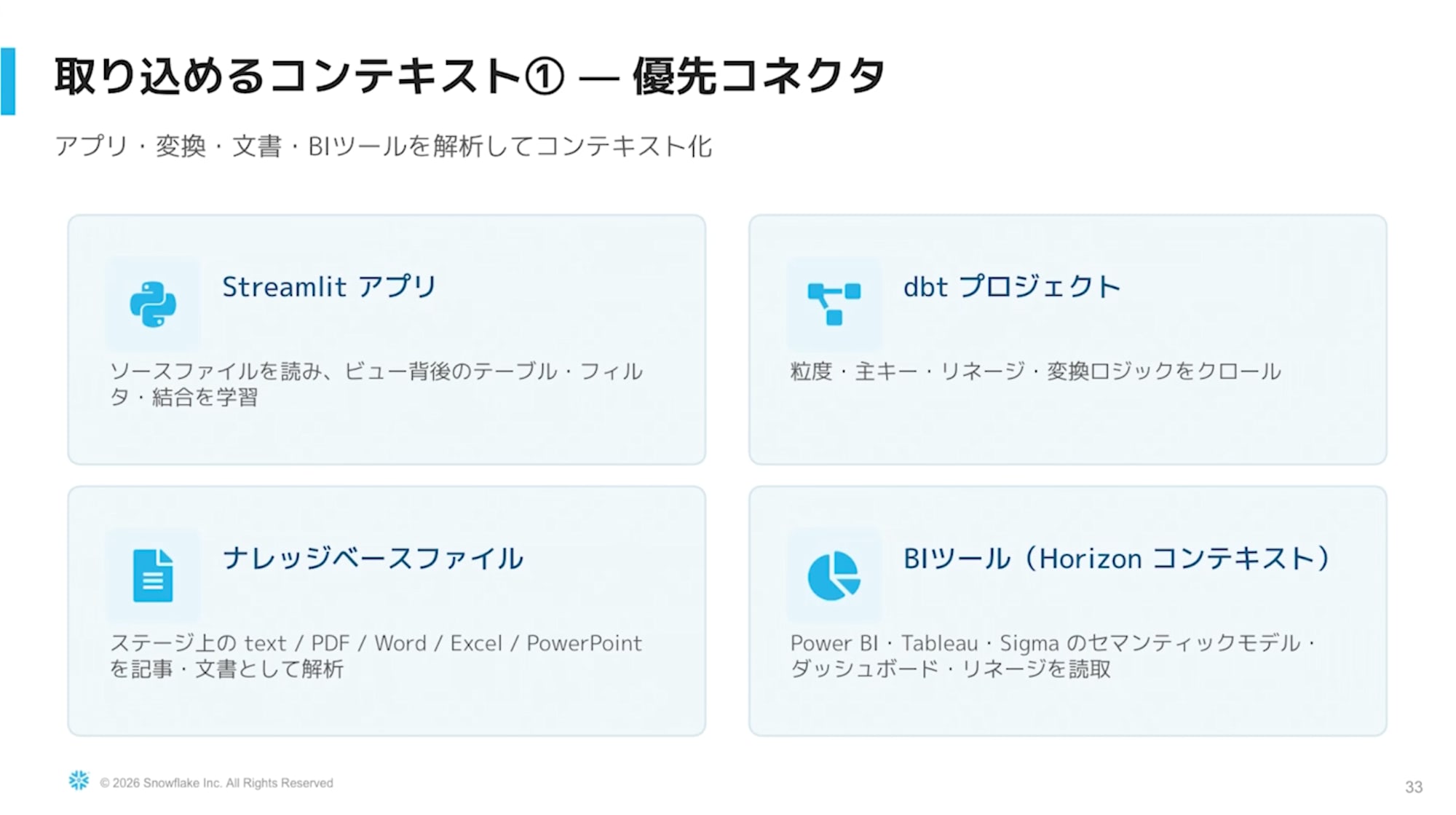
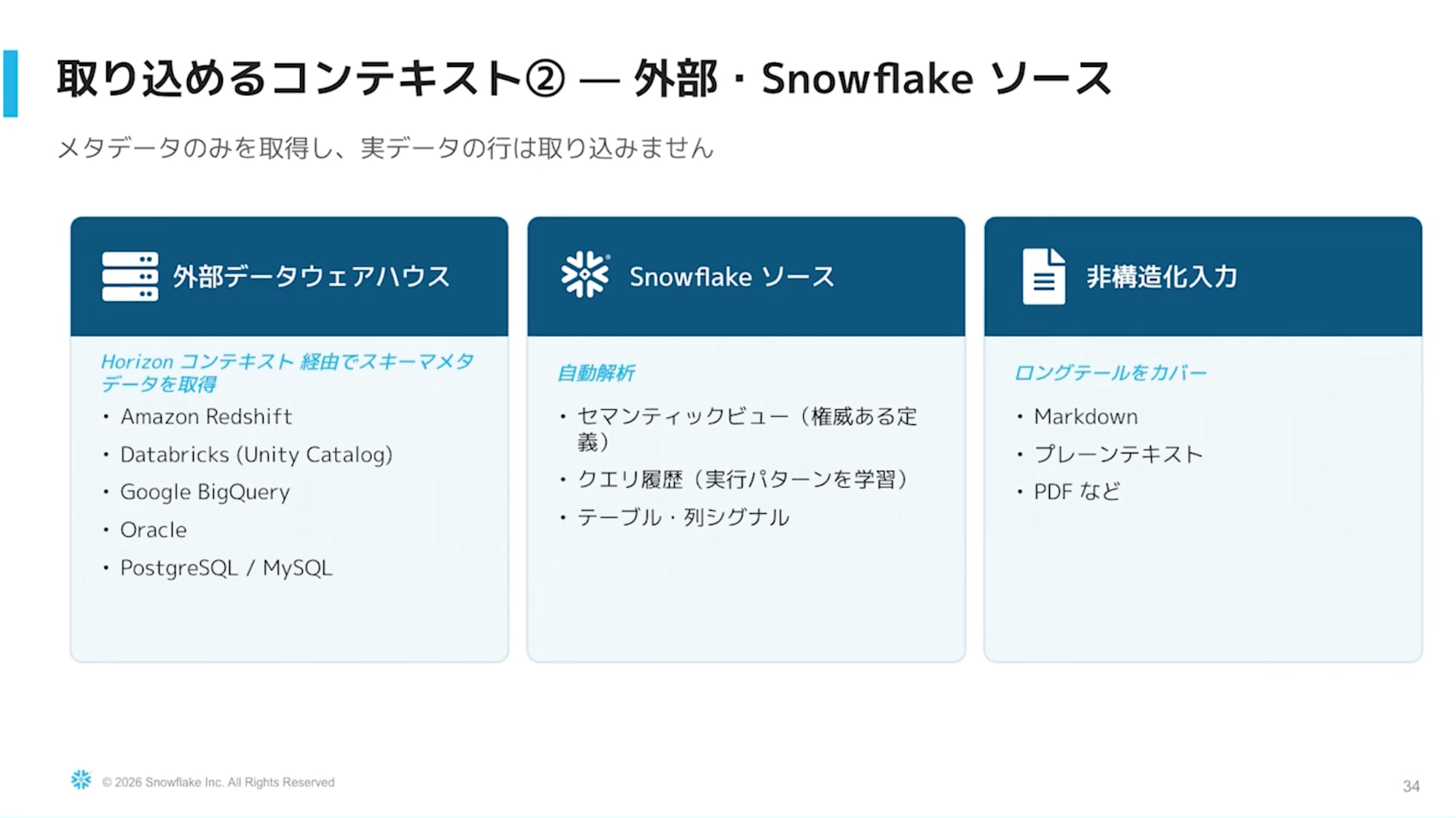
Based on the current assumption, Cortex Sense will automatically ingest context information triggered by CoCo's Skills execution, and will become available from CoCo and Cortex Agents. At the end of the session, a demo of using it from Cortex Agents with current features was also introduced.
One point I was personally curious about was the difference from semantic views, and this was also addressed.
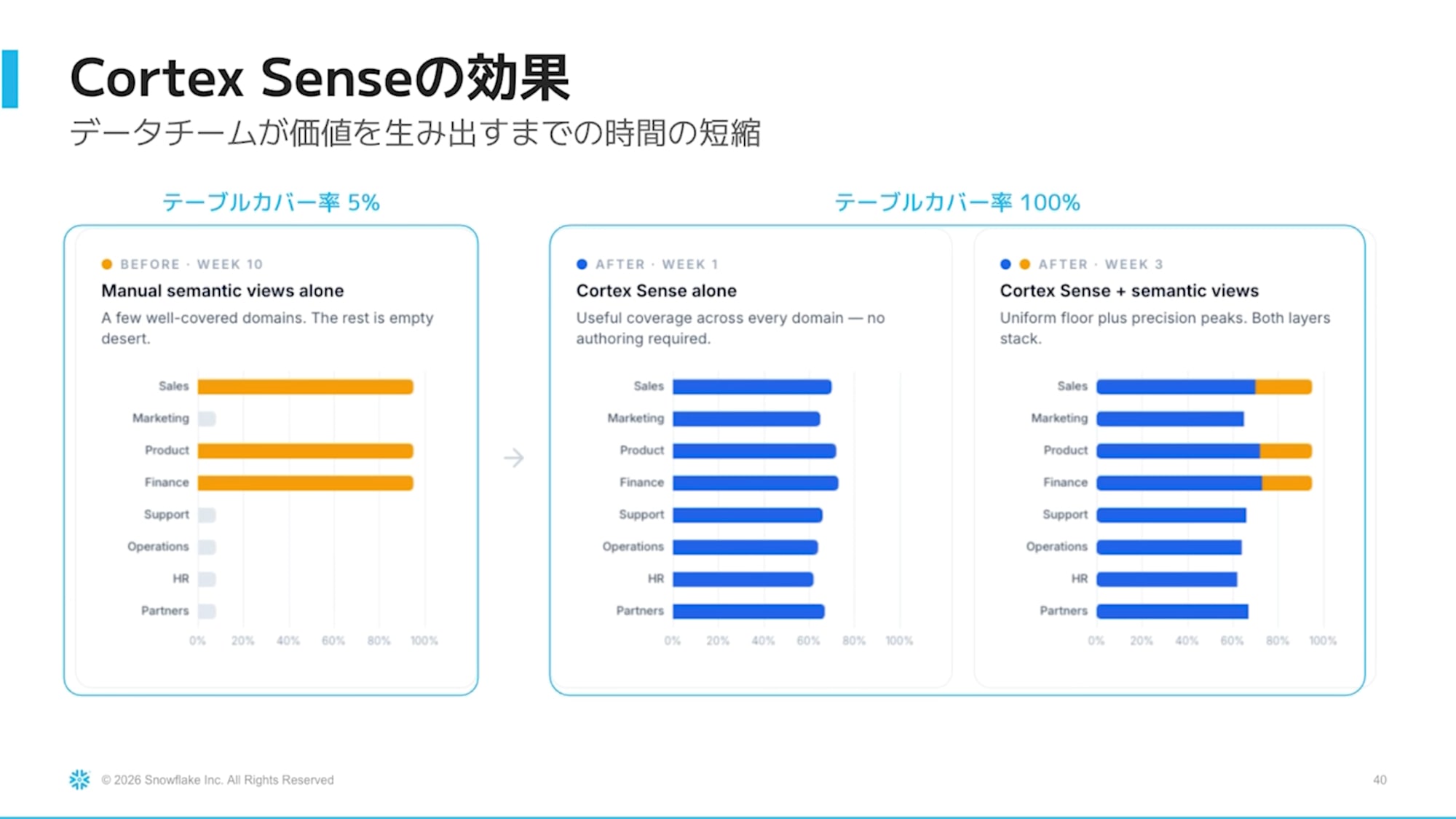
In terms of analytical accuracy, semantic views, which directly reference raw data, can be used with higher accuracy; however, Cortex Sense automatically supports many tables and automatically follows schema changes, so combining the two can further improve agent performance.
Impressions After Attending the Session
I was able to learn about the direction of Cortex Sense in a very easy-to-understand way.
I have also started hearing discussions about how to build the context layer when constructing analytical features using AI agents, and I was able to understand the direction Snowflake is heading in terms of how to approach this going forward.
This was a must-see session for anyone currently or planning to build analytical features using Cortex Agents.