AI Cowork Skill for Supporting As-Is and To-Be Creation to Drive Company-Wide AI Transformation

This page has been translated by machine translation. View original
1. Introduction
At Classmethod Operations, Inc., we are working on a project to incorporate AI and automation and transform our operations centered around AI (hereinafter referred to as "AI Renewal"). Within this initiative, our BGU (BPO Promotion Unit) provides accompanying support for organizing and improving operations across various departments.
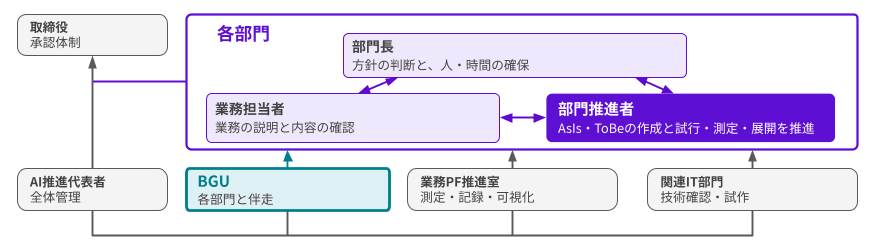
As shown in the figure, BGU plays a role in supporting AI Renewal across departments. The department promoters appointed by each department are responsible for creating the AsIs, which organizes current operations, and the ToBe, which designs the improved operations.
BGU's first initiative was therefore to make it easier for department promoters to start organizing AsIs and creating ToBe.
This article introduces the current state of company-wide AI Renewal efforts and two Cowork skills we developed. It also explains the remaining challenges in the skills under development and future improvement goals.
In connection with this article, we are scheduled to present at a DevelopersIO mini session on 2026/10/24 under the title "Company-wide AI Renewal and Accompanying Support Using Cowork Skills."
2. Company-wide AI Renewal and Current Efforts
In AI Renewal, each department organizes its key operations, selects areas for improvement, and designs improved operations. Following that, prototyping and effectiveness measurement will be conducted, with plans to establish operations and expand to other tasks.
There are methods for reviewing operations beyond simply replacing them with AI. We refer to the ECRS framework: eliminating unnecessary tasks, combining similar tasks, changing the order or assignment of tasks, and simplifying tasks. Automation through AI or existing systems is a means chosen based on those considerations.
For such reviews, it is first necessary to organize current operations in a way that stakeholders can confirm. We share who does what, what information is used for decisions, and where waiting or rework occurs, and then consider improved operations.
In terms of company-wide AI Renewal progress, we are currently in the stage of organizing current operations (AsIs) while beginning to create the appropriate flow for our operations (ToBe).

3. Background of Cowork Skill Development
The first thing we considered when creating the skills was how to reduce the burden on department promoters.
We developed Cowork skills because we believed that drawing a map on a blank sheet of paper is the most difficult part.
Staff in each department understand the flow and procedures of their own work. However, even with that understanding, writing out an entire business flow or improvement plan from scratch is not easy. Moreover, time to work on this is limited while keeping up with daily tasks.
Those unfamiliar with organizing operations or designing improvements may be unsure where to start writing and how detailed the organization needs to be. As a result, we thought it would become difficult to take that first step.
Therefore, BGU decided to develop skills where AI creates a draft based on existing manuals and other materials, allowing department promoters to proceed while reviewing and revising the content.
The approach involves looking at the organized proposals and hypotheses generated by AI and thinking about "what is it actually like" and "what do we want to change." Rather than thinking about what to write, it shifts to thinking about how to revise this proposal to reflect actual operations, making it easier to proceed.
4. Details of the AsIs Skill
The first thing we tackled was the AsIs skill.
In creating the skill, we incorporated knowledge BGU gained from past operational improvement support, as well as methods for creating AsIs and ToBe that we learned from the Business Transformation Division members at Classmethod.
In working sessions, we learned how to organize operations and express flows using materials actually used in operational improvements. Using these as references, we considered the creation procedures and output format for the skill, and reflected them in the shapes and annotations of operational flow diagrams, page structure, and more.
We also adopted an approach where manuals and task lists held by each department are used as input materials, AI organizes the draft, and department promoters confirm and revise it.
Classmethod Operations is primarily remote-work-based, and materials explaining current operations—such as manuals, procedure documents, and task lists—are available as data or online. From such materials, AI organizes operational information and presents hypotheses and items to confirm for missing parts.
Department promoters respond and make corrections to the AI.
Confirming What Cannot Be Understood from Manuals Alone
However, manuals and task lists do not necessarily represent the full flow of operations.
For example, even if screen operations are described in detail, the operations handled by other departments, approval conditions, or exception handling may be omitted. Also, manuals may be outdated and differ from current practices.
Therefore, in developing the skill, we placed importance on not treating AI output as confirmed information as-is, but having people review and approve the content.
The following is an explanatory example using a fictitious application reception task.
Suppose a manual states: "Open email," "Check application content," "Open management ledger," "Enter required items and save," and "Send email to approver."
Placing each of these in separate boxes results in a diagram listing operational steps. The skill organizes these into task units for operations, while confirming the person in charge, judgments, and information inputs and outputs.
| Manual Description | AsIs Task Candidate |
|---|---|
| Open email and check application content | Check application content |
| Open management ledger, enter required items, and save | Register in management ledger |
| Send email to approver | Request approval |
However, this organization alone does not reveal how to handle applications with deficiencies, or what processing occurs after approval. AI therefore organizes the items to confirm, and the department promoter verifies the content with the operational staff.
For example: "Who does it go back to if there are deficiencies?" "Is it reviewed again after correction?" "What constitutes completion of reception?" Tasks and branches are added or modified based on the answers.
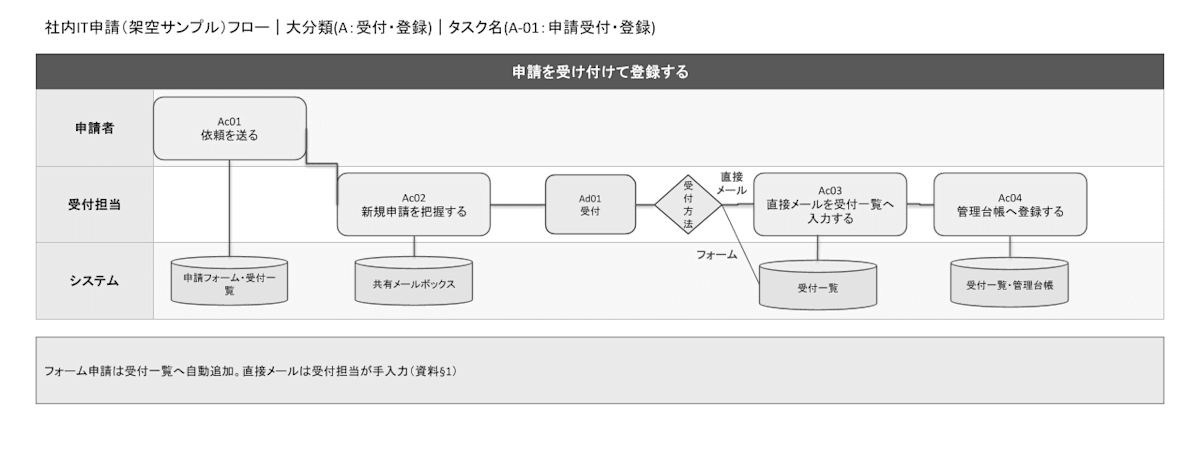
An example of a swimlane output from Cowork
(The skill outputs two types: an overall operational flow + swimlane)
The above is an output example of a swimlane.
Department promoters look at the proposed output and confirm with operational staff: "Does this task actually exist?" "Is the person in charge correct?" "What happens under this condition?" People judge whether their operations are correctly represented.
Content directly stated in the materials and content inferred by AI are also recorded separately. This ensures that information not yet confirmed by actual operational staff is not treated as confirmed fact.
Confirming Content in Text Before Creating a Diagram
In the AsIs skill, rather than drawing a swimlane diagram from the start, we structured it to first organize the operational content in Markdown text format and confirm that content.
This is because while swimlane diagrams, which divide areas by person in charge or department and show who performs which tasks, are easy to understand, once turned into a diagram, it becomes difficult to grasp "why that flow exists."
There was also the intention to reduce token usage by organizing the information exchanged, and that having organized text content makes it easier for AI to understand and allows it to be utilized in the ToBe skill as well.
Therefore, after department promoters confirm and approve the content organized in text form first, it is then converted into a flow diagram in PowerPoint or similar tools.

It should be noted that challenges remain with the diagrams produced, and this point will be explained in a later section.
5. Details of the ToBe Skill
Next, in creating the ToBe skill, we considered reviewing operations according to the ECRS principles first, without deciding in advance on replacement with AI or automation.
It may seem contradictory not to assume AI implementation for a purpose called AI Renewal. However, we believe AI and automation are means to improve operations.
If a task itself is unnecessary, it is more appropriate to eliminate the task rather than continue processing it with AI or automation. Introducing a new system also generates maintenance and management tasks. AI and systems also incur costs the more they are used.
Therefore, for the improvement proposals created by AI as well, we structured the order to first review tasks and then consider the roles of AI and automation.
Reviewing Tasks Before Considering Role Assignments
Improvement proposals are considered in the following order, in line with the ECRS framework.
| Principle | What to Consider |
|---|---|
| E: Eliminate | Can the task be eliminated in the first place? |
| C: Combine | Can similar tasks be combined? |
| R: Rearrange | Can the order or assignment be changed? |
| S: Simplify | Can the task be made simpler? |
Rather than replacing all current tasks with AI as they are, we first consider whether each task is necessary. Then we examine how the remaining tasks should be divided among people, AI, and standard automation.
Comparing the Realistic Proposal and the Ideal Proposal
The skill creates two proposals in principle: a "Realistic/Phased Introduction Proposal" and an "AI Maximum Utilization/Ideal Proposal."
This is to compare a proposal that is easy to proceed with using the current structure and systems, with a proposal that utilizes AI agents and similar tools to reduce human input, transcription, and confirmation as much as possible.
For the fictitious application reception task from earlier, the following directions can be considered.
| Comparison Perspective | Example of Realistic/Phased Proposal | Example of AI Maximum/Ideal Proposal |
|---|---|---|
| Reception & Recording | Standardize reception method and recording destination | Have AI extract application information and create a draft record |
| Content Confirmation | People confirm | Incorporate AI confirmation and return to people based on defined conditions |
| Approval | Retain necessary approvals | Retain necessary approvals |
| Main Items to Confirm | Existing system functions, operational rules | Data, decision criteria, authority, technical feasibility, exception handling |
These are candidate explanations. Actual proposals are created after confirming the facts and constraints of the target operations.
We do not recommend the ideal proposal simply because it uses more AI. In addition to the expected effects, we compare costs, implementation period, coordination with other departments, and operational risks.
Rather than selecting just one option, we also envision making the ideal proposal a future goal and proceeding incrementally from the realistic proposal.
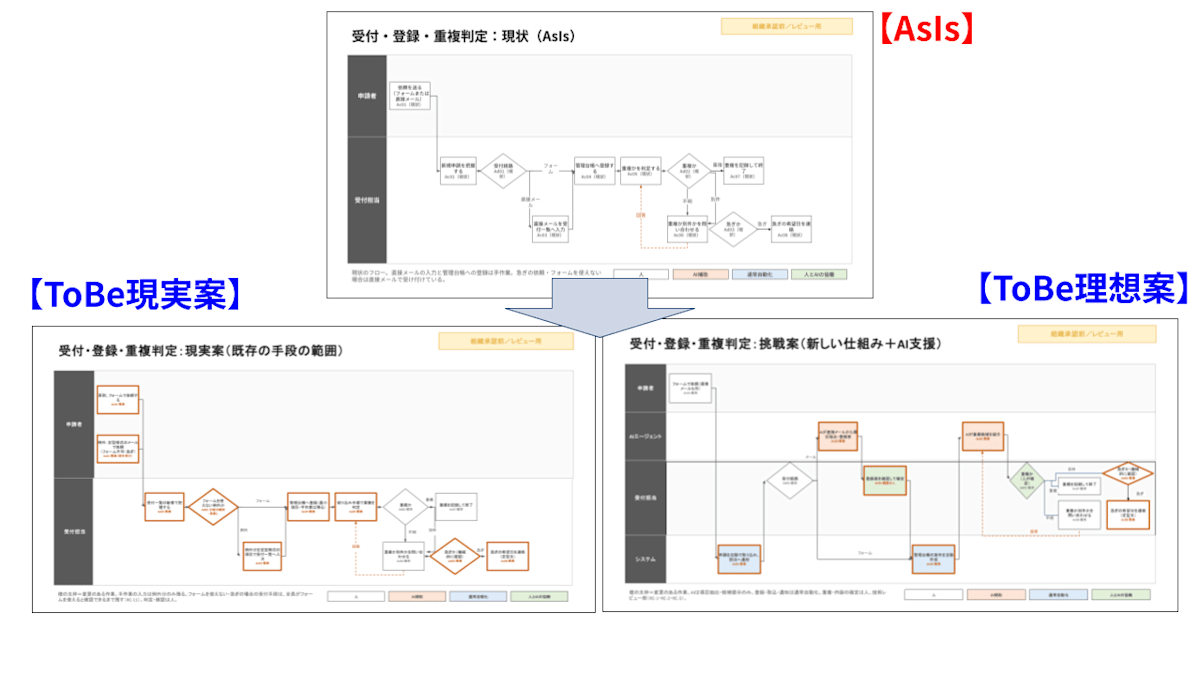
AI outputs two ToBe proposals from the AsIs flow. The assumption is that departments and stakeholders will also confirm whether the AI proposals are feasible.
Creating Materials for Stakeholders to Make Decisions Before the Final Flow
In the ToBe skill as well, we first organize the review content in text. Furthermore, before creating the final ToBe flow, we create PowerPoint materials for comparing proposals and having stakeholders confirm them.
This is because ToBe cannot be decided by the department promoter alone.
Coordination within the department and with related departments will be necessary for changes to assignments, operational rules, and similar matters.
Swimlane diagrams are useful for understanding operational flow.
On the other hand, for multiple people to judge improvement proposals, they also need to confirm the "purpose," "current issues," "reasons for change," and "conditions required for implementation."
Therefore, we structured the order to create materials allowing confirmation of these points, and after selecting the direction to aim for, create the detailed ToBe flow diagram. If necessary, we also confirm technical implementation methods with related IT departments and others.
We distinguish between confirming content on the skill and proceeding to the next step, and having it approved organizationally. For both AsIs and ToBe, we place importance on having people judge "whether this content is acceptable."
6. Skill Challenges and Future Improvement Goals
At present, the output of the two skills is provided as a draft for department promoters to confirm and revise.
The positioning as a draft has two meanings.
One is that the operational content and improvement proposals organized by AI need to be confirmed by department promoters and operational staff. This confirmation is something we believe will remain necessary in the creation process going forward.
The other is that there are challenges with the flow diagram output—such as branching lines overlapping and text overflowing from boxes—requiring human correction. The part of clearly expressing operations with complex conditions using shapes and connecting lines in a readable way is still not sufficient.
Even when content is organized in Markdown, there remains the task of confirming whether that content is appropriately reflected in the diagram and revising the diagram as necessary.
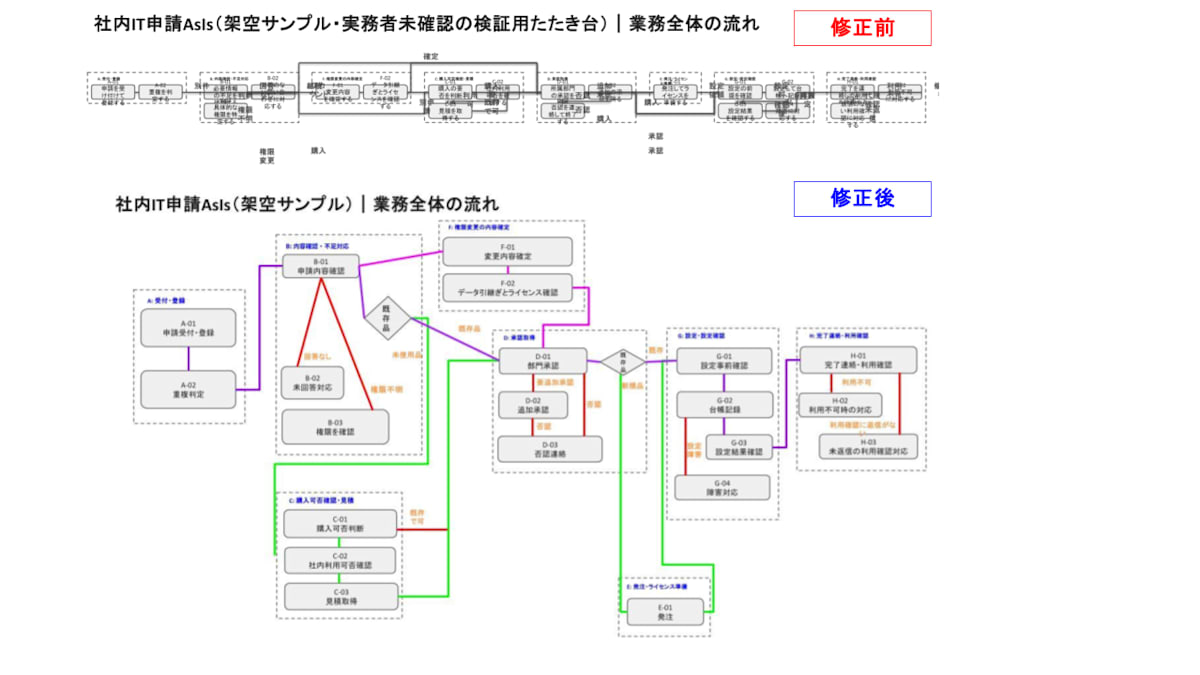
As shown above, the directly output items have layout issues, and they are revised and color-coded for clarity.
Reflecting Content Revised Through Dialogue in the Diagram
Going forward, we would like to improve the skill so that content confirmed and revised through dialogue can be appropriately reflected in flow diagrams, even for operations involving complex conditions.
The goal is a form where, if the user communicates revisions to tasks or branches, the shapes and connecting lines are updated accordingly, reducing the burden of manually revising them one by one in PowerPoint.
To that end, we will use examples of operations involving complex branches and returns to confirm whether the organized specifications and the generated diagram match, and whether stakeholders can follow the flow.
We will also review the content and manner of questions. Rather than requesting a large amount of information from the start, we want to show what can be organized from the materials at hand and sequentially confirm missing points.
7. For Each Department to Advance Operational Reform
BGU's first initiative was to make it easier for department promoters in each department to start creating AsIs and ToBe.
AI organizes a draft from existing materials, and department promoters confirm and revise it with operational staff. Improvement proposals are also made by stakeholders selecting the direction to aim for while comparing candidates. We have developed two Cowork skills to support this approach.
Currently, there are challenges with the diagram output, and the skills have not yet reached the stage where the materials can be used as-is without further work.
Going forward, while maintaining the principle that people perform the confirmation of operational content and review of improvement proposals, we will continue to improve so that the skill can handle as much of the formatting and redrawing of materials as possible.
Presentation Materials
The presentation materials for 10/24 (Sat.) are as follows.
About Classmethod Operations, Inc.
We are an operations company in the Classmethod Group.
We are a group of experts with specialized teams in operations, maintenance development, support, information systems, and back office, providing everything from business process outsourcing to issue resolution and high-value-added services for our clients through "systems" that make full use of IT and AI.
We are recruiting members for various positions.
If you are interested in our culture, systems, and work style that realize both "Operational Excellence" and "Working and living as yourself," please visit the Classmethod Operations, Inc. Corporate Site. ※ The company name was changed from Annotation Inc. in January 2026.