
Japan's technical information to foreign countries as well. The reasons and mechanisms for DevelopersIO starting automatic translation with Bedrock

This page has been translated by machine translation. View original
Introduction
DevelopersIO has begun providing an automatic English translation feature for articles using generative AI since the end of 2025.
We want to deliver technical articles written in Japanese to English-speaking developers. We want to increase the international recognition of Classmethod and its authors. With this background, we have started this initiative as a small step.
In this article, I will introduce the specifications and features of DevelopersIO's translation function.
Translation Feature Specifications
Display of English Articles
Articles eligible for automatic translation display a "文/A" icon, allowing users to select their preferred language.
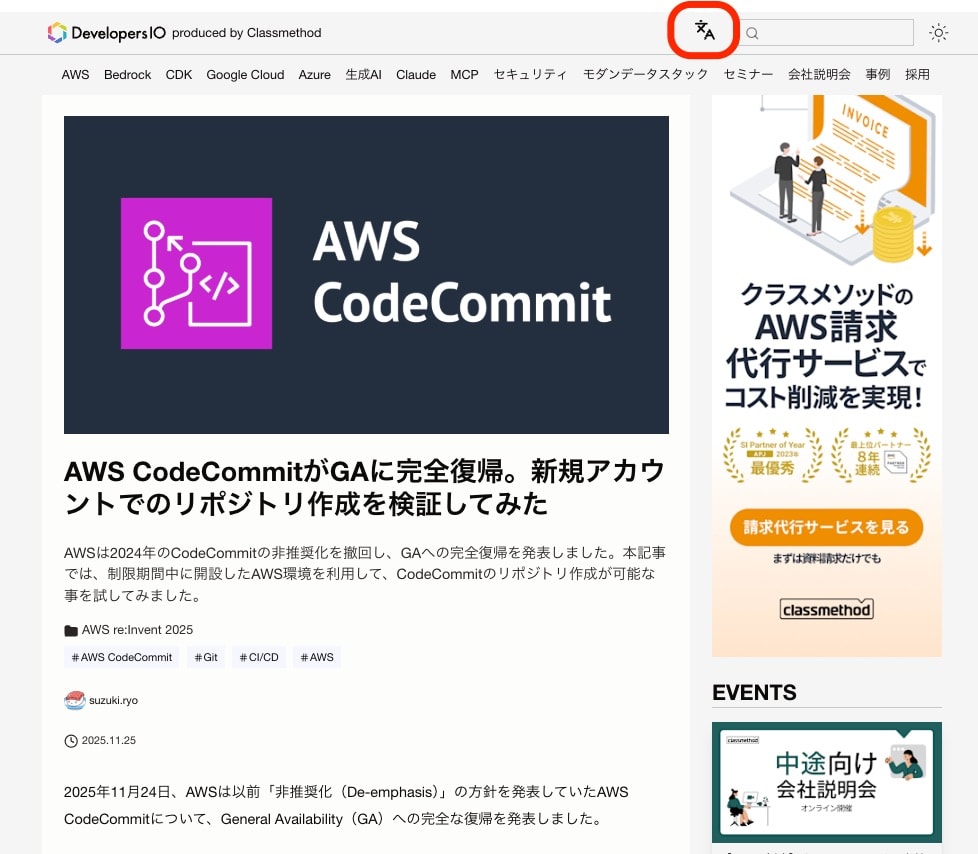
When "English" is selected via the translation button, the English article is displayed with "/en/" included in the URL path.
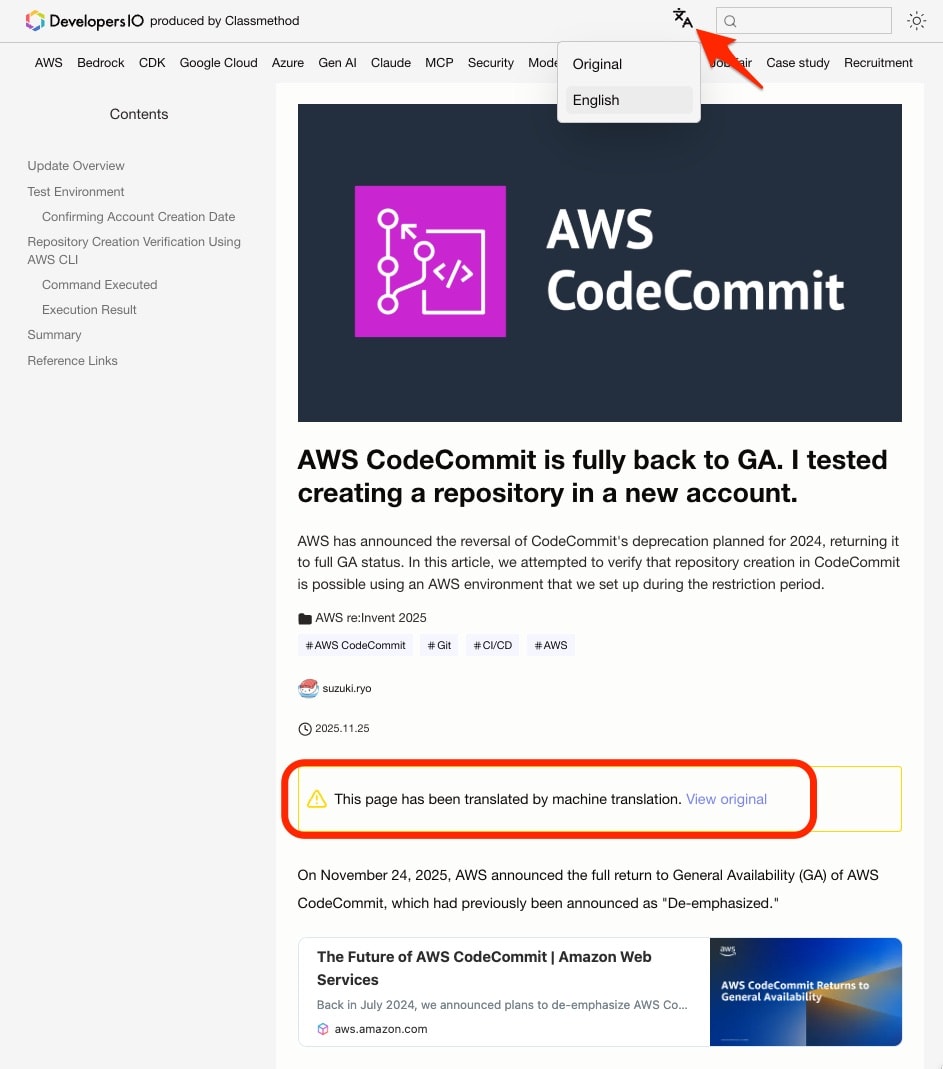
- A notice indicating that the article is automatically translated and a link to the original article ("View original") are automatically inserted at the top of the translated article.
Opt-in by Authors
DevelopersIO's translation feature currently adopts an opt-in approach by authors, targeting only articles where automatic translation has been requested.
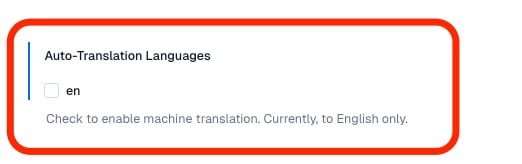
By allowing authors themselves to determine whether their content should be translated, we aim to respect authors' intentions while gradually expanding the service.
Technical Features
We use the Claude series models on Amazon Bedrock for translation.
We take care to prevent information loss in machine translation. In particular, we have implemented special handling for code blocks, which are especially susceptible to information loss in technical articles.
We hope to publish a detailed explanation article by the implementation team in the near future.
SEO Support: Metadata Normalization
To ensure translated articles are properly evaluated by search engines and crawlers, we normalize and add metadata prior to automatic translation.
Key Metadata Items
| Item | Description |
|---|---|
| canonical_url | Canonical URL (specifying the original Japanese article) |
| alternate_urls | Language-specific URLs (hreflang: x-default, en, etc.) |
| author | Original author's information (from E-E-A-T perspective, indicating human authorship) |
| og:title / og:description | Translated title and description for social media sharing |
| structured_data | Schema.org compliant structured data (Article type) |
Combined Use of hreflang and canonical
We declare the original Japanese article URL in the canonical tag and the English translation URL in the alternate tag (hreflang). This helps search engines understand the relationship between "which is the original and which is the translation."
Implementation Example
Here is an example of metadata added to an actual translated article:
{
  "basic_meta": {
    "canonical_url": "https://dev.classmethod.jp/articles/aws-codecommit-returns-to-ga/",
    "alternate_urls": {
      "x-default": "https://dev.classmethod.jp/articles/aws-codecommit-returns-to-ga/",
      "en": "https://dev.classmethod.jp/en/articles/aws-codecommit-returns-to-ga/"
    },
    "author": "suzuki.ryo"
  },
  "structured_data": {
    "@type": "Article",
    "headline": "AWS CodeCommit is fully back to GA...",
    "author": {
      "@type": "Person",
      "name": "suzuki.ryo",
      "url": "https://dev.classmethod.jp/author/suzuki-ryo/"
    },
    "about": [
      { "@type": "Thing", "name": "AWS CodeCommit" },
      { "@type": "Thing", "name": "AWS" }
    ]
  }
}
UI/UX for English Readers
Translated articles provide the following multilingual UI support:
English Menu Display
-
Header

-
Footer
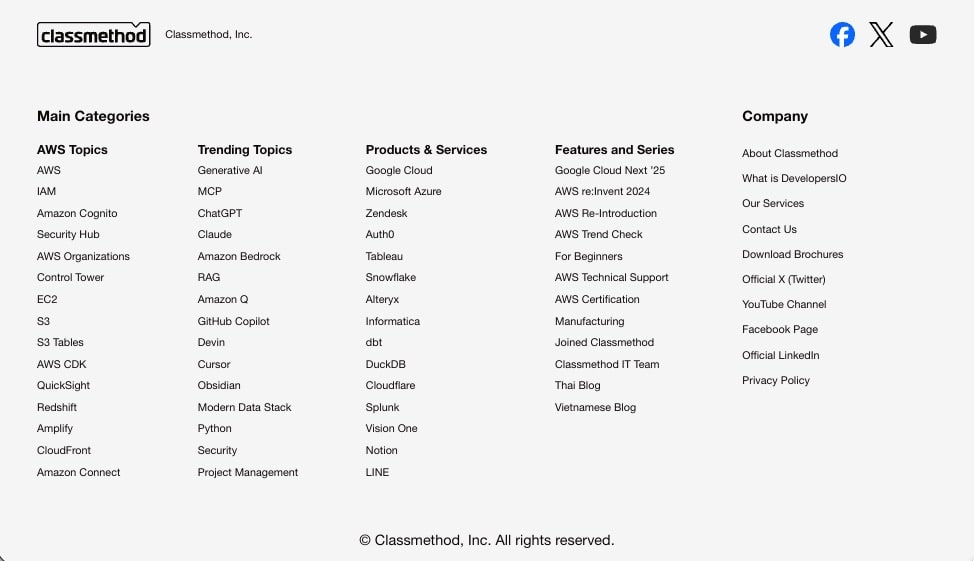
Side menus and event announcements in Japanese are omitted in English articles.
Measuring Effectiveness
SEO Effect Verification
To verify the SEO effect of translated articles, we checked Google search results using a browser on an EC2 instance (English Windows environment) in North America (California region).
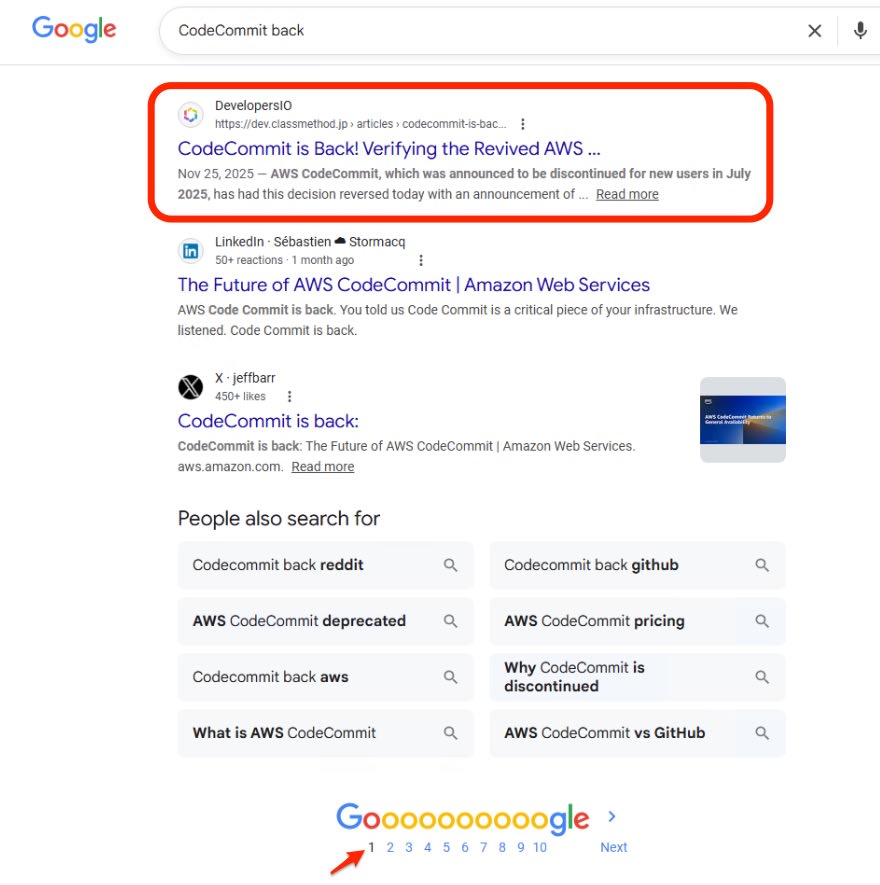
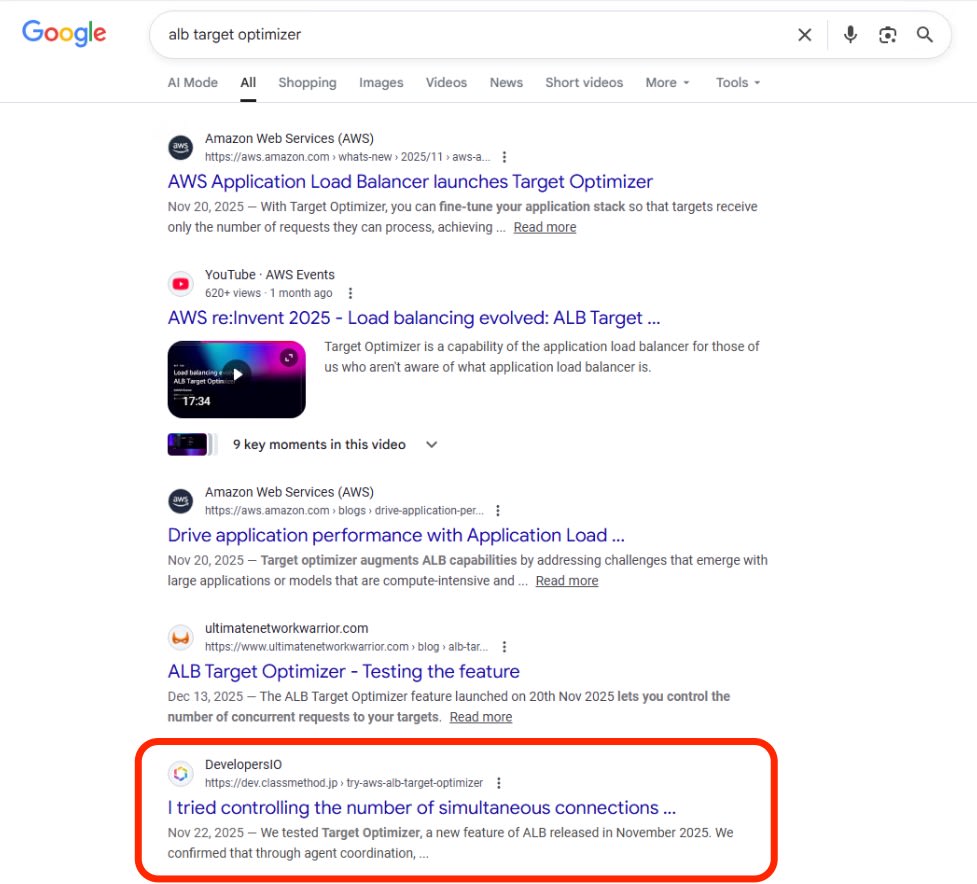
We confirmed that multiple translated articles appear on the first page of Google search results for AWS-related terms.
- For "CodeCommit back", the article introducing CodeCommit's full return to GA appeared on the first page of Google search, in 7th position.
- For "alb target optimizer", the article introducing the November 2025 update for ELB that enables control of maximum concurrent requests appeared on the first page, in 5th position.
Future Outlook
For the time being, we will only provide Japanese-to-English translated articles. We will continue to improve translation quality through evaluation and implementation of the latest models and prompt optimization.
Expansion to Classmethod's overseas offices (Korea, Thailand, Germany, etc.), creation of portal pages in various languages, and translation of text within images will be considered based on the response and needs from this release.
Please submit requests for article translations or report issues with translations via our SNS or contact channels. We look forward to feedback from readers that will help us improve in the future.
Summary
DevelopersIO's translation feature is our first step in delivering Japanese technical expertise to English-speaking audiences and to the world through LLMs (Large Language Models).
As a step toward global technical information dissemination, we hope to deliver valuable information to more people through this feature.