EC2 M9g instances (Graviton5) have become GA, so I tried checking CPU information and other details

This page has been translated by machine translation. View original
Introduction
On June 10, 2026, Amazon EC2 M9g and M9gd instances powered by AWS Graviton5 processors became generally available (GA).
Graviton5 is the 5th-generation Arm processor designed in-house by AWS. It adopts the Arm Neoverse V3 core and is said to deliver up to 25% better compute performance compared to the previous generation Graviton4.
M9g was previewed at re:Invent in December 2025, and we also introduced it on our company blog.
Now that it has reached GA, I actually launched an instance and checked the CPU information using OS commands.
The main specification differences between M9g and the previous generation M8g are summarized below.
| Item | M8g (Graviton4) | M9g (Graviton5) |
|---|---|---|
| Core Architecture | Neoverse V2 | Neoverse V3 |
| Architecture Family | ARMv9 | ARMv9 |
| Maximum cores per processor | 96 | 192 (doubled) ※1 |
| Clock frequency | 2800 MHz | 3300 MHz (+18%) |
| L2 cache | 2 MiB | 2 MiB |
| L3 cache (lscpu display) | 36 MiB | 48 MiB (+33%) |
| L3 cache (entire chip) | ~36 MB | ~180 MB (5x) ※2 |
| SVE vector length | 128 bit | 128 bit |
| Memory | DDR5 | DDR5-8800 ※2 |
| PCIe | Gen5 | Gen6 ※2 |
| Nitro System | v5 | v6 + Nitro Isolation Engine ※2 |
| Process | 5nm | 3nm ※2 |
| Compute performance | Baseline | Up to 25% improvement ※2 |
| Network bandwidth (max) | 50 Gbps | 100 Gbps (doubled) ※1 |
| EBS bandwidth (max) | 40 Gbps | 72 Gbps ※1 |
| EBS IOPS (max) | 160,000 | 288,000 ※1 |
- ※1 Official documentation
- ※2 Official blog
- Items without special notes are values confirmed through OS command verification (dmidecode, lscpu, etc.) on both M8g and M9g.
※ L1d/L1i cache (64 KiB), L2 cache (2 MiB), and SVE vector length (128 bit) are equivalent to M8g. NitroTPM, Nitro Enclaves, EFA, and Encryption in transit are also the same.
Available regions are us-east-1, us-east-2, us-west-2, and eu-central-1.
Launching an Instance
On the EC2 launch screen, typing "m9g" in the instance type field displays a list of candidates.
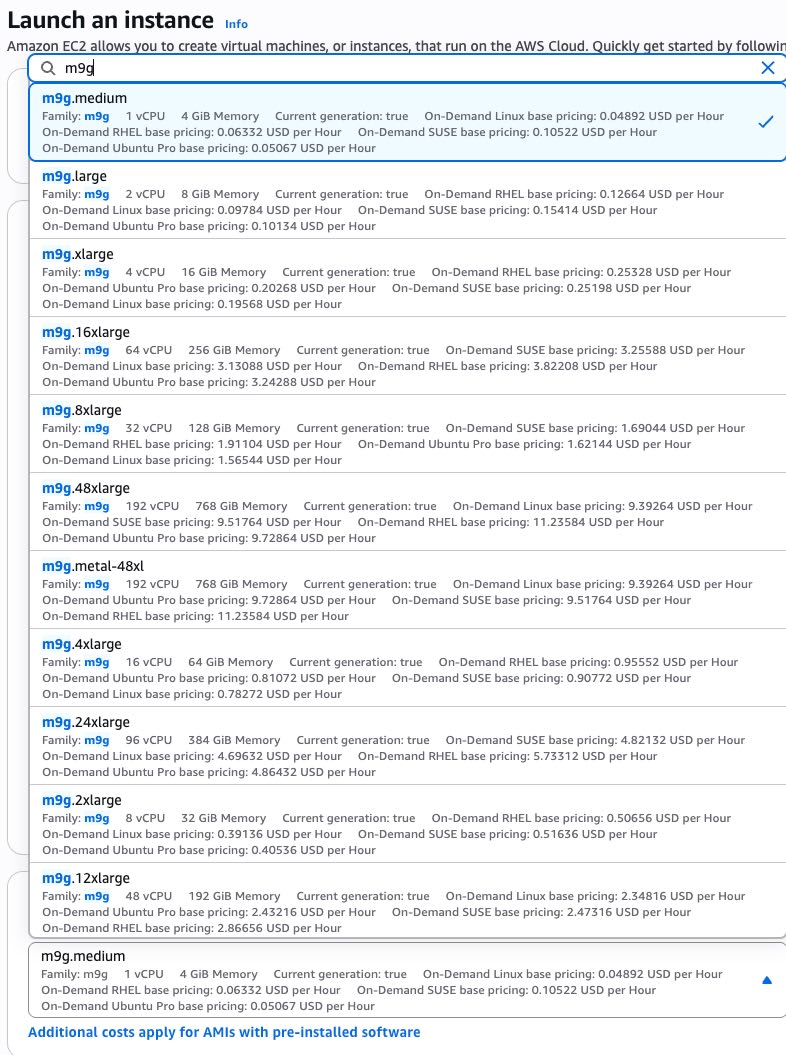
This time I selected the smallest size, m9g.medium (1 vCPU, 4 GiB).
The verification environment is as follows.
- Instance type: m9g.medium (1 vCPU, 4 GiB)
- Region: us-east-1
- AMI: Amazon Linux 2023 (arm64)
- Kernel: 6.1.174-217.345.amzn2023.aarch64
Checking CPU Information with OS Commands
lscpu
Architecture:                            aarch64
CPU op-mode(s):                          64-bit
Byte Order:                              Little Endian
CPU(s):                                  1
On-line CPU(s) list:                     0
Vendor ID:                               ARM
BIOS Vendor ID:                          AWS
BIOS Model name:                         AWS Graviton5
Model:                                   1
Thread(s) per core:                      1
Core(s) per socket:                      1
Socket(s):                               1
Stepping:                                r0p1
BogoMIPS:                                2000.00
Flags:                                   fp asimd evtstrm aes pmull sha1 sha2 crc32 atomics fphp asimdhp cpuid asimdrdm jscvt fcma lrcpc dcpop sha3 asimddp sha512 sve asimdfhm dit uscat ilrcpc flagm sb paca pacg dcpodp sve2 sveaes svepmull svebitperm svesha3 flagm2 frint svei8mm svebf16 i8mm bf16 dgh rng bti ecv afp wfxt
L1d cache:                               64 KiB (1 instance)
L1i cache:                               64 KiB (1 instance)
L2 cache:                                2 MiB (1 instance)
L3 cache:                                48 MiB (1 instance)
NUMA node(s):                            1
NUMA node0 CPU(s):                       0
lscpu Vulnerabilities section
Vulnerability Gather data sampling:      Not affected
Vulnerability Indirect target selection: Not affected
Vulnerability Itlb multihit:             Not affected
Vulnerability L1tf:                      Not affected
Vulnerability Mds:                       Not affected
Vulnerability Meltdown:                  Not affected
Vulnerability Mmio stale data:           Not affected
Vulnerability Reg file data sampling:    Not affected
Vulnerability Retbleed:                  Not affected
Vulnerability Spec rstack overflow:      Not affected
Vulnerability Spec store bypass:         Mitigation; Speculative Store Bypass disabled via prctl
Vulnerability Spectre v1:                Mitigation; __user pointer sanitization
Vulnerability Spectre v2:                Mitigation; CSV2, BHB
Vulnerability Srbds:                     Not affected
Vulnerability Tsa:                       Not affected
Vulnerability Tsx async abort:           Not affected
Vulnerability Vmscape:                   Not affected
Mitigations for Spectre v1/v2 are enabled, and x86-specific vulnerabilities (Meltdown, MDS, L1TF, etc.) are all Not affected.
- BIOS Model name: AWS Graviton5 — The processor name is displayed directly
- Thread(s) per core: 1 — The Graviton series does not use SMT; 1 vCPU = 1 physical core
- L2 cache: 2 MiB — Same value as Graviton4
- L3 cache: 48 MiB — In the verification environment (1 vCPU), 48 MiB is displayed as L3 cache (Graviton4 shows 36 MiB)
- sve2 in Flags — SVE2 (Scalable Vector Extension v2) is supported. Machine learning instruction sets such as bf16 and i8mm are also confirmed. Compared to M8g, flags newly added in M9g include ecv, afp, and wfxt
- Stepping: r0p1 — This is the initial revision of Neoverse V3
dmidecode -t processor
# dmidecode 3.6
Getting SMBIOS data from sysfs.
SMBIOS 3.0.0 present.

Handle 0x0004, DMI type 4, 42 bytes
Processor Information
	Socket Designation: CPU0
	Type: Central Processor
	Family: ARMv9
	Manufacturer: AWS
	ID: 41 D8 0F 41 00 00 00 00
	Signature: Implementor 0x41, Variant 0x0, Architecture 15, Part 0xd84, Revision 1
	Version: AWS Graviton5
	Voltage: Unknown
	External Clock: Unknown
	Max Speed: 3300 MHz
	Current Speed: 3300 MHz
	Status: Populated, Enabled
	Upgrade: None
	L1 Cache Handle: Not Provided
	L2 Cache Handle: Not Provided
	L3 Cache Handle: Not Provided
	Serial Number: AWS Graviton5
	Asset Tag: AWS Graviton5
	Part Number: AWS Graviton5
	Core Count: 1
	Core Enabled: 1
	Thread Count: 1
	Characteristics: None
- Family: ARMv9 — Same ARMv9 family as Graviton4. While lscpu displays the architecture as aarch64, this is because the Linux kernel treats ARMv9 as a superset of ARMv8. The "CPU architecture: 8" in
/proc/cpuinfoand "Architecture 15" in dmidecode are not contradictions of ARMv9 - Max Speed / Current Speed: 3300 MHz — An improvement of 500 MHz (+18%) from Graviton4's 2800 MHz
- Part 0xd84 — This is the CPU part number for Arm Neoverse V3
- Manufacturer: AWS — Indicates that this is an AWS in-house design
/proc/cpuinfo
The same information can also be confirmed from /proc/cpuinfo. CPU part 0xd84 indicates Neoverse V3.
processor	: 0
BogoMIPS	: 2000.00
Features	: fp asimd evtstrm aes pmull sha1 sha2 crc32 atomics fphp asimdhp cpuid asimdrdm jscvt fcma lrcpc dcpop sha3 asimddp sha512 sve asimdfhm dit uscat ilrcpc flagm sb paca pacg dcpodp sve2 sveaes svepmull svebitperm svesha3 flagm2 frint svei8mm svebf16 i8mm bf16 dgh rng bti ecv afp wfxt
CPU implementer	: 0x41
CPU architecture: 8
CPU variant	: 0x0
CPU part	: 0xd84
CPU revision	: 1
dmesg (CPU-related)
CPU-related kernel messages were extracted using sudo dmesg | grep -i 'cpu\|booting\|QARMA\|SVE'.
[    0.000000] Booting Linux on physical CPU 0x0000000000 [0x410fd841]
[    0.000000] Detected PIPT I-cache on CPU0
[    0.000000] CPU features: detected: Address authentication (architected QARMA3 algorithm)
[    0.000000] CPU features: detected: GIC system register CPU interface
[    0.000000] CPU features: detected: Hardware dirty bit management
[    0.000000] CPU features: detected: Spectre-v4
[    0.000000] CPU features: detected: Spectre-BHB
[    0.000493] smp: Bringing up secondary CPUs ...
[    0.000494] smp: Brought up 1 node, 1 CPU
[    0.000496] CPU features: detected: Branch Target Identification
[    0.000499] CPU features: detected: CRC32 instructions
[    0.000500] CPU features: detected: Enhanced Counter Virtualization
[    0.000501] CPU features: detected: Generic authentication (architected QARMA3 algorithm)
[    0.000502] CPU features: detected: LSE atomic instructions
[    0.000503] CPU features: detected: RAS Extension Support
[    0.000503] CPU features: detected: Random Number Generator
[    0.000506] CPU features: detected: Scalable Vector Extension
[    0.000535] CPU: All CPU(s) started at EL1
- [0x410fd841] — The boot CPU ID. It can be broken down as: 0x41 = ARM, 0xd84 = Neoverse V3, revision 1
- QARMA3 algorithm — The pointer authentication (PAC) algorithm is QARMA3. In Graviton4 it was QARMA5
- Scalable Vector Extension — SVE detection is confirmed
- Branch Target Identification — Security enhancement through BTI (restriction of indirect branch targets)
lstopo-no-graphics
The cache hierarchy confirmed with lscpu was also visualized using lstopo (hwloc).
lstopo-no-graphics output
Machine (3782MB total)
  Package L#0
    NUMANode L#0 (P#0 3782MB)
    L3 L#0 (48MB) + L2 L#0 (2048KB) + L1d L#0 (64KB) + L1i L#0 (64KB) + Core L#0 + PU L#0 (P#0)
  HostBridge
    PCI 00:04.0 (NVMExp)
      Block(Disk) "nvme0n1"
  HostBridge
    PCIBridge
      PCIBridge
        PCIBridge
          PCI 27:00.0 (Ethernet)
            Net "ens34"
The hierarchy L3 48MB → L2 2048KB → L1d/L1i 64KB, and the fact that NVMe and Ethernet are connected via PCIe (Nitro System), can be confirmed.
nvme id-ctrl (EBS NVMe Controller)
NVME Identify Controller:
vid       : 0x1d0f
ssvid     : 0x1d0f
mn        : Amazon Elastic Block Store
fr        : 2.0
rab       : 32
ieee      : a002dc
mdts      : 6
cntlid    : 0
ver       : 0x10400
- vid: 0x1d0f — Amazon's PCI Vendor ID
- fr: 2.0 — The EBS NVMe firmware revision. The same value of 2.0 has been confirmed on M8g (Graviton4) as well
- ver: 0x10400 — Complies with NVMe spec 1.4
SVE Vector Length
The default SVE vector length was confirmed from /proc/sys/abi/sve_default_vector_length.
$ cat /proc/sys/abi/sve_default_vector_length
16
16 bytes = 128 bits. The same 128 bits have been confirmed on M8g (Graviton4) as well, and from Graviton4 onwards the width is standardized at 128 bits. 256 bits was used in Graviton3 (Neoverse V1).
Neoverse V3 implements SVE at 128-bit width. The SVE2 instruction set itself is available (sveaes, svepmull, svebitperm, svesha3).
Cost Comparison
On-demand prices for M9g and M8g were compared. These are us-east-1 / Linux / On-Demand prices obtained from the AWS Pricing API (GetProducts) (retrieved: June 11, 2026).
| Size | M9g (USD/hour) | M8g (USD/hour) | Difference |
|---|---|---|---|
| medium | 0.04892 | 0.04488 | +9.0% |
| large | 0.09784 | 0.08976 | +9.0% |
| xlarge | 0.19568 | 0.17952 | +9.0% |
| 2xlarge | 0.39136 | 0.35904 | +9.0% |
| 4xlarge | 0.78272 | 0.71808 | +9.0% |
| 8xlarge | 1.56544 | 1.43616 | +9.0% |
| 12xlarge | 2.34816 | 2.15424 | +9.0% |
| 16xlarge | 3.13088 | 2.87232 | +9.0% |
| 24xlarge | 4.69632 | 4.30848 | +9.0% |
| 48xlarge | 9.39264 | 8.61696 | +9.0% |
| metal-48xl | 9.39264 | 8.61696 | +9.0% |
All sizes are uniformly priced at +9.0% compared to M8g. A simple calculation applying the officially announced performance improvement (up to 25%) would suggest that performance per dollar improves by up to approximately 15% (1.25 / 1.09 ≒ 1.147). Actual cost-effectiveness will vary depending on the workload.
※ metal-48xl and 48xlarge have the same price, which is common practice for the Graviton series, and the values are posted as retrieved from the Pricing API.
Summary
I launched an M9g instance and confirmed the Graviton5 / Neoverse V3 CPU information using OS commands.
Compared to M8g (Graviton4), the CPU core changed from Neoverse V2 to Neoverse V3, and the clock frequency improved from 2800 MHz to 3300 MHz. The L3 cache displayed by lscpu also increased from 36 MiB to 48 MiB, and the pointer authentication algorithm changed from QARMA5 to QARMA3.
On the other hand, the L2 cache (2 MiB), SVE vector length (128 bit), and EBS NVMe firmware (2.0) were the same as M8g. The Graviton series characteristic of "1 vCPU = 1 physical core" without SMT also remains the same.
The price was a uniform +9.0% compared to M8g across all sizes. Since the official announcement indicates up to 25% compute performance improvement over Graviton4, improved performance per dollar can be expected depending on the workload. However, since the actual cost-effectiveness depends on application characteristics, it would be best to obtain benchmarks with actual workloads before considering migration.
At the time of writing, M9g is not yet available in the Tokyo region, but it has the potential to become a strong candidate for future Graviton-based instance selection. Even for those anticipating availability in the Tokyo region, it would be beneficial to proceed with operational verification and performance testing of actual workloads in already-available regions, making migration decisions easier once the region becomes available.