
[Report] "A Challenge That Starts in the Rice Paddy ~A Novice Farmer's First Year~" and "Reducing Rice Paddy Patrols with IoT! Trial and Error from Water Level Monitoring to Battery-Powered Cameras" #jawsfesta2026 #jawsug #jawsfesta #jawsfesta2026_a

This page has been translated by machine translation. View original
I'm emi, a coffee lover.
I attended JAWS FESTA 2026 in Akita, held on Saturday, 2026/11/07.
I listened to two consecutive sessions on the Classmethod Track, "A Challenge That Starts from the Rice Paddy ~A New Farmer's First Year~" and "I Want to Reduce Rice Paddy Patrols with IoT! Trial and Error from Water Level Monitoring to Battery-Powered Cameras", so I'll report on them together.
The rice distributed as a novelty at this JAWS FESTA 2026 in Akita was rice that the JAWS FESTA PR team watched over from planting to harvest and shared as the "Rice Diary", and the people who grew it are "Agri Kanaashi", who spoke in this session.
The passion behind this novelty is incredible…!!!
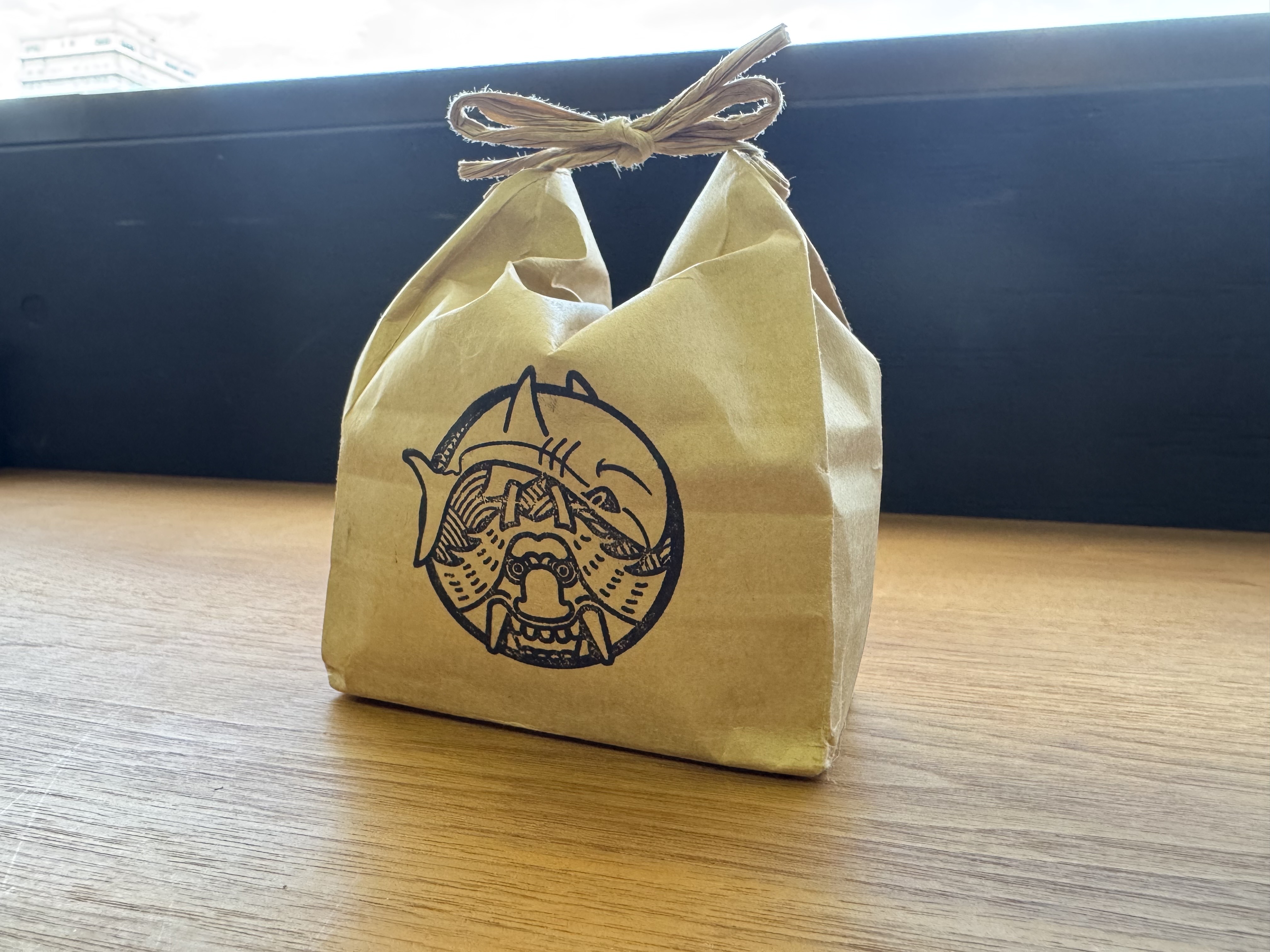
Quoted from Introducing the visitor novelty for JAWS FESTA 2026 in AKITA! | JAWS FESTA 2026 in AKITA
JAWS FESTA is held every October, but this time it was moved to November because of the rice harvest… or so I heard at the venue. Seriously?!
Session Information
- Session 1: A Challenge That Starts from the Rice Paddy ~A New Farmer's First Year~
- Time: 11:00–11:20
- Speakers: Koji Iwamoto of Agri Kanaashi Agricultural Production Cooperative, Kazuki Miura of Heptagon Co., Ltd.
- Track: Classmethod Track (Middle Hall)
In his first year as a farmer, Mr. Iwamoto joined an agricultural corporation and took on the challenge of growing rice.
From his first rice planting to daily paddy management and then harvest, we'll look back on actual photos and hear about the joys and hardships of rice farming and what prompted him to take up the challenge.
This is the story of how the Akita rice delivered to JAWS FESTA participants was made, told from the farming front line.
- Session 2: I Want to Reduce Rice Paddy Patrols with IoT! Trial and Error from Water Level Monitoring to Battery-Powered Cameras
- Time: 11:30–11:50
- Speakers: Katsuyoshi Ito of Ito Software Design Co., Ltd. / Kamikawara Farm Agricultural Production Cooperative, Yuki Matsuda of Hokuryo Denko Co., Ltd.
- Track: Classmethod Track (Middle Hall)
The two of us will talk about our water level monitoring efforts to reduce rice paddy patrols and the IoT camera combined with it. In the first half, we'll introduce the construction and operation of a water level monitoring system, the "Paddy Watchman". In the second half, we'll explain techniques for keeping a device running on batteries for a long time, such as IoT camera sleep control, optimizing the number of communications, and reducing data volume through lower resolution.
A Challenge That Starts from the Rice Paddy ~A New Farmer's First Year~
Mr. Iwamoto is in his first year as a farmer, having joined the Agri Kanaashi Agricultural Production Cooperative and taking on the challenge of growing rice. Agri Kanaashi grows rice and soybeans.
Agri Kanaashi is an agricultural corporation, and the number of agricultural corporations is apparently increasing year by year.
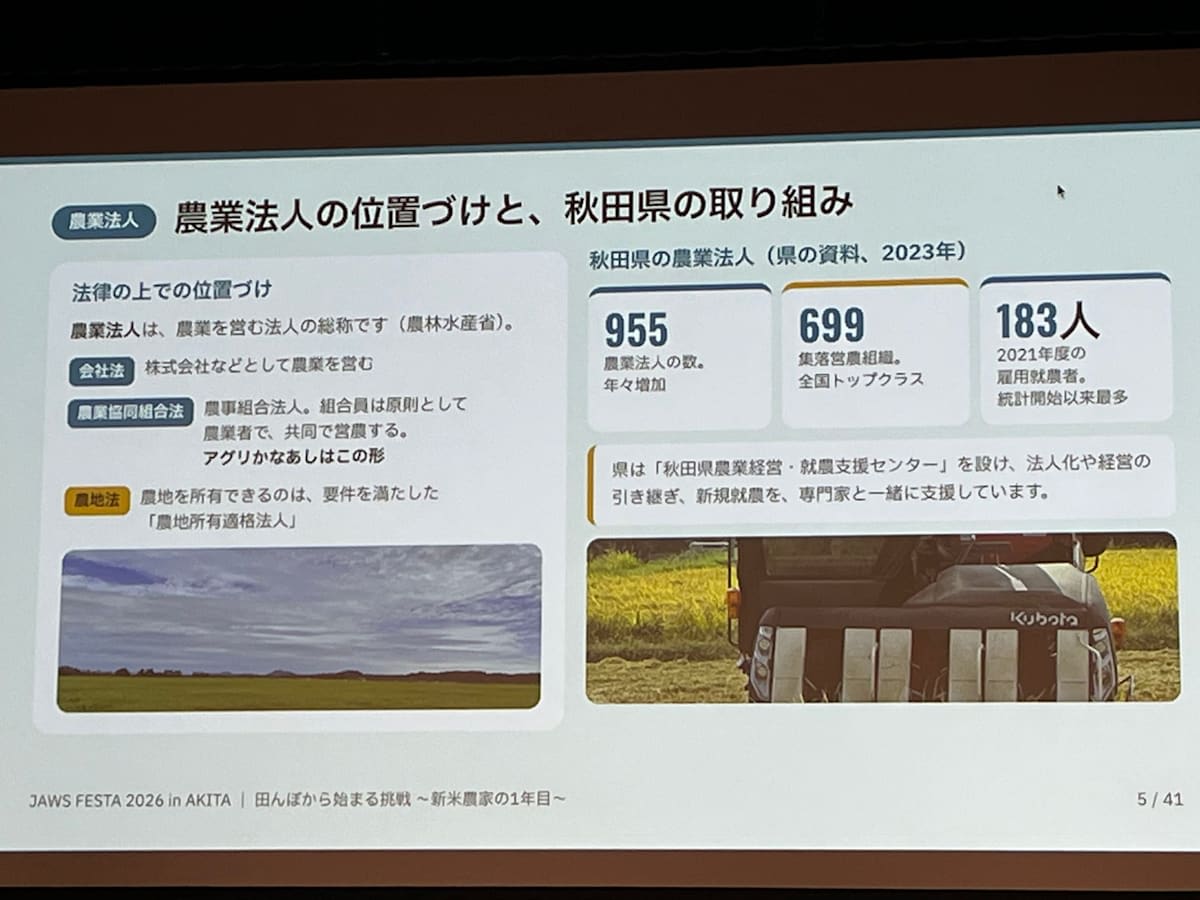
Rice Growing from May to October
These are the monthly tasks for the first year.
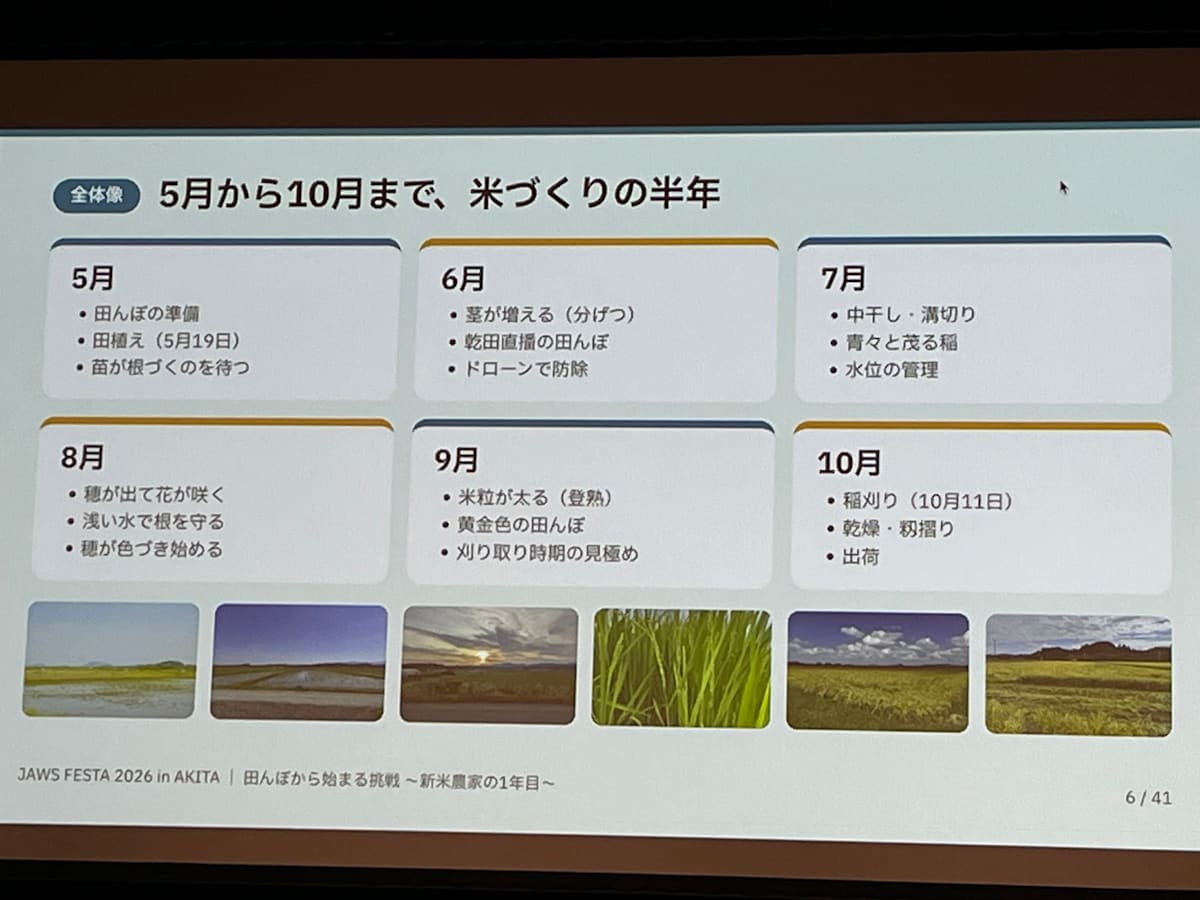
There is apparently a lot of preparation even before rice planting.
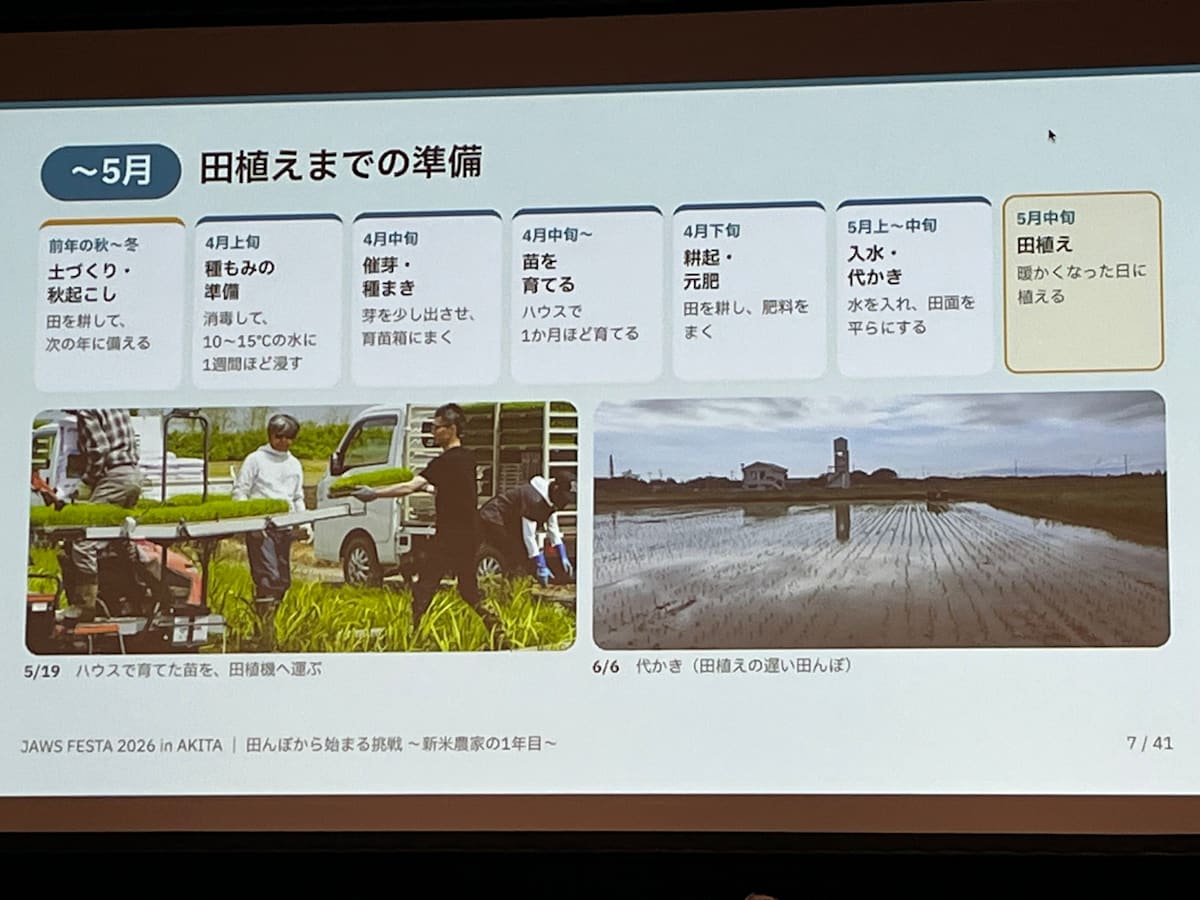
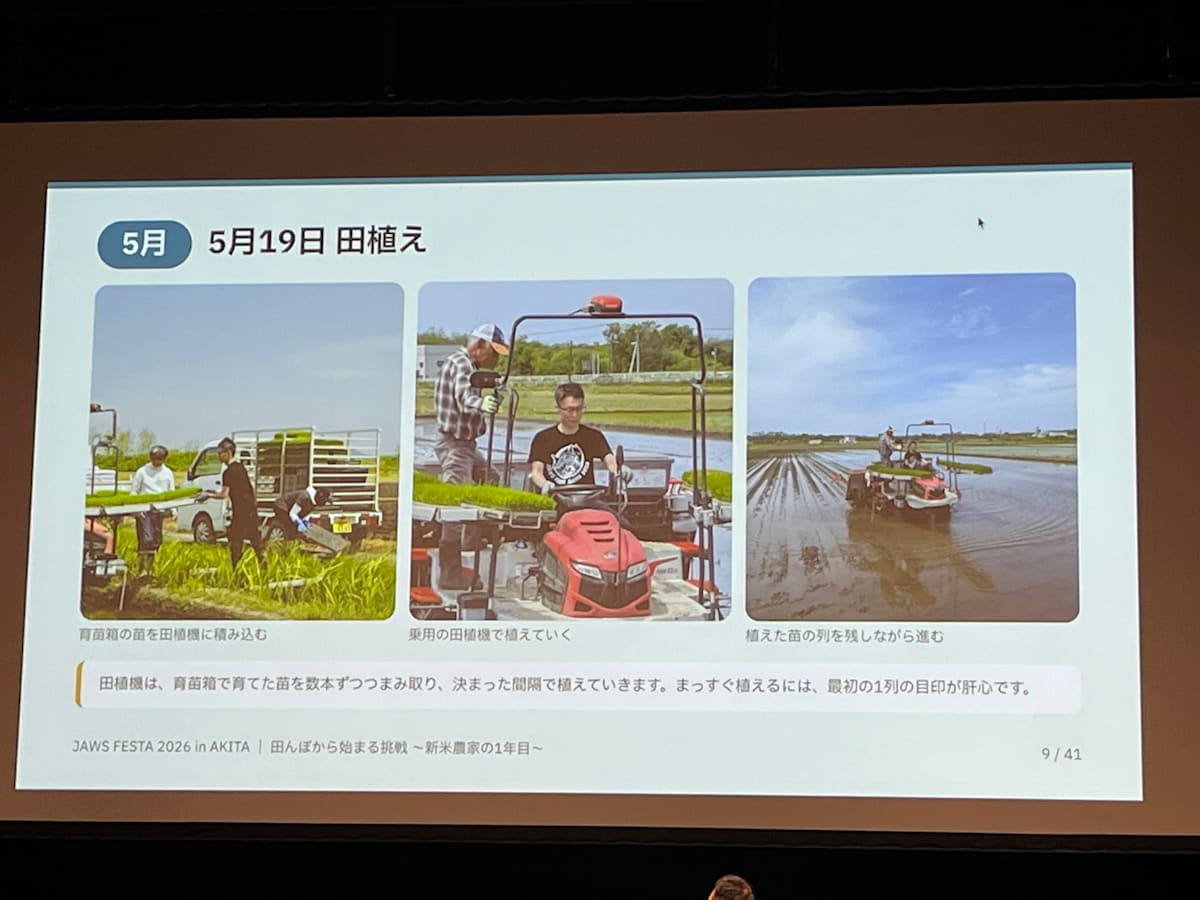
Rice planting takes a whole month. The photo shows Mr. Takeda, the executive committee chair.
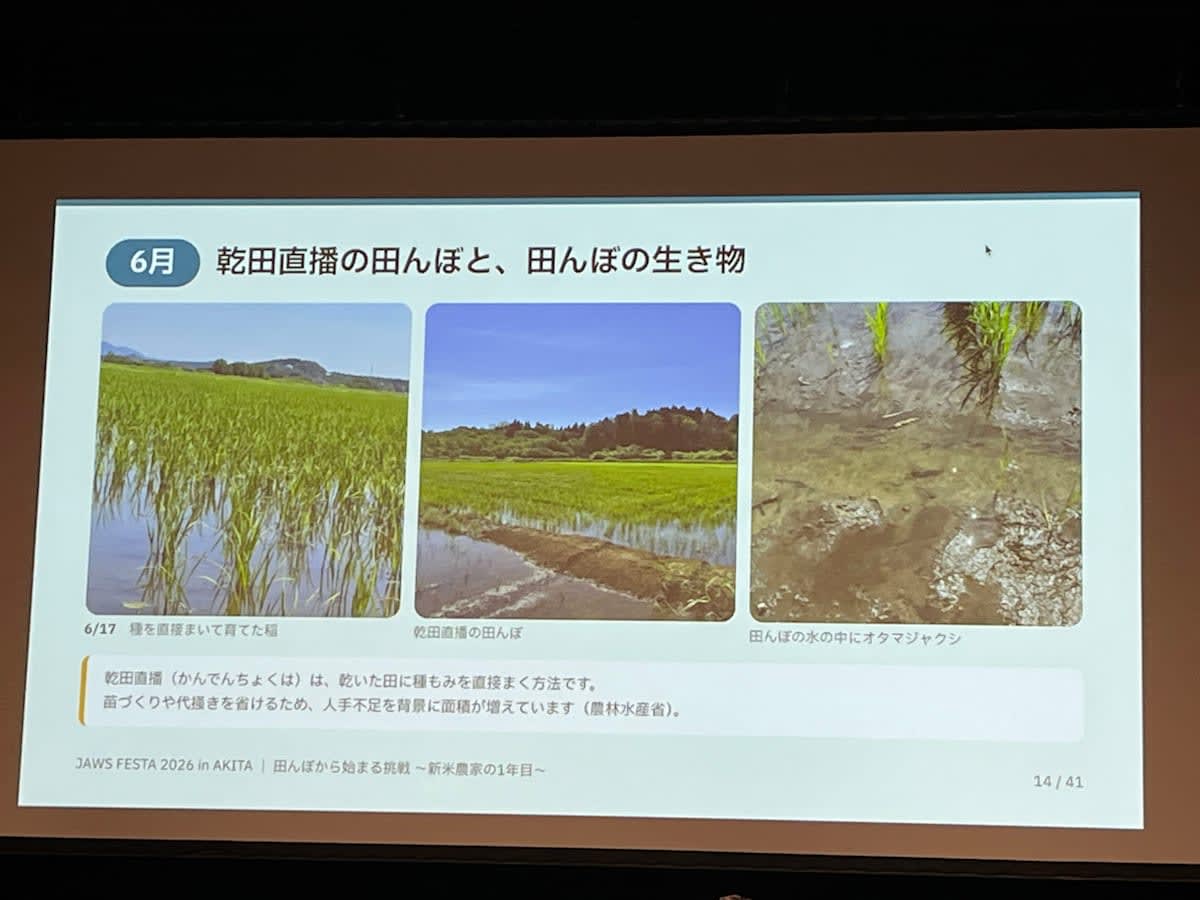
By the way, recently there is also a method called dry-paddy direct seeding (kanden chokuha), where seed rice is sown directly into a dry paddy. Since it lets you skip seedling preparation and puddling, it is reportedly increasing against the backdrop of labor shortages.
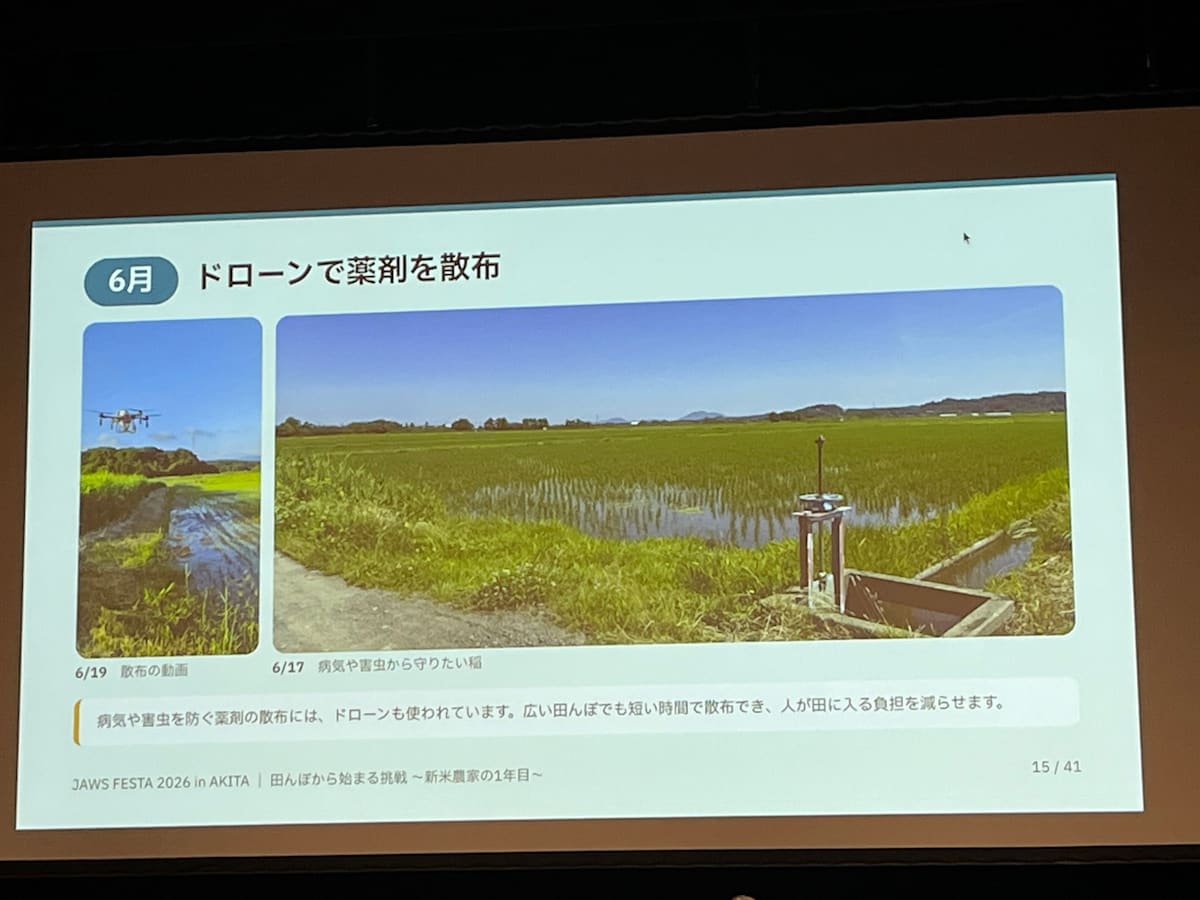
A drone is used to spray chemicals. He obtained a drone piloting qualification for this.
- Without a drone
- Spread by hand
- Ask a contractor
- Benefits
- Can spray even a large paddy in a short time
- Reduces the burden of people entering the paddy
It isn't done once; several applications are needed.
As the season progresses, water management becomes harder.
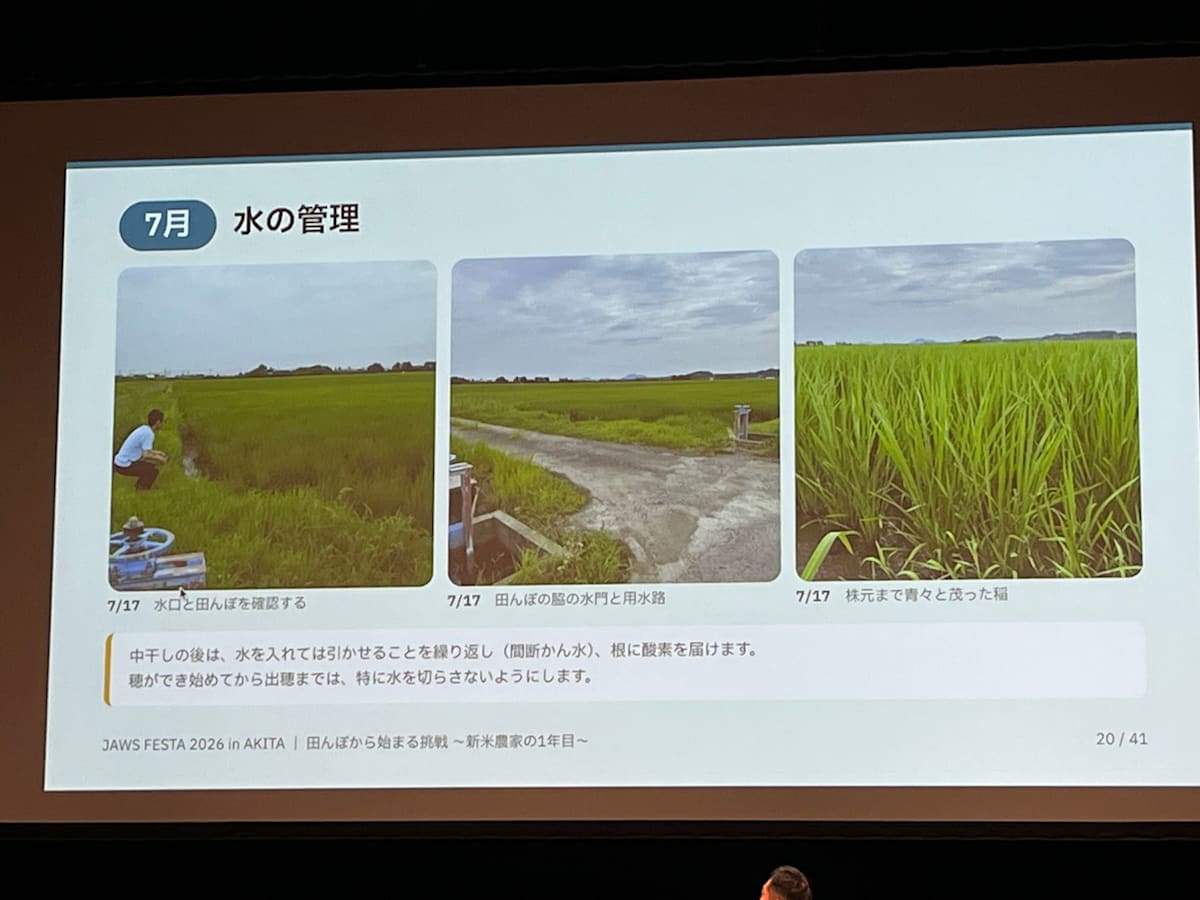
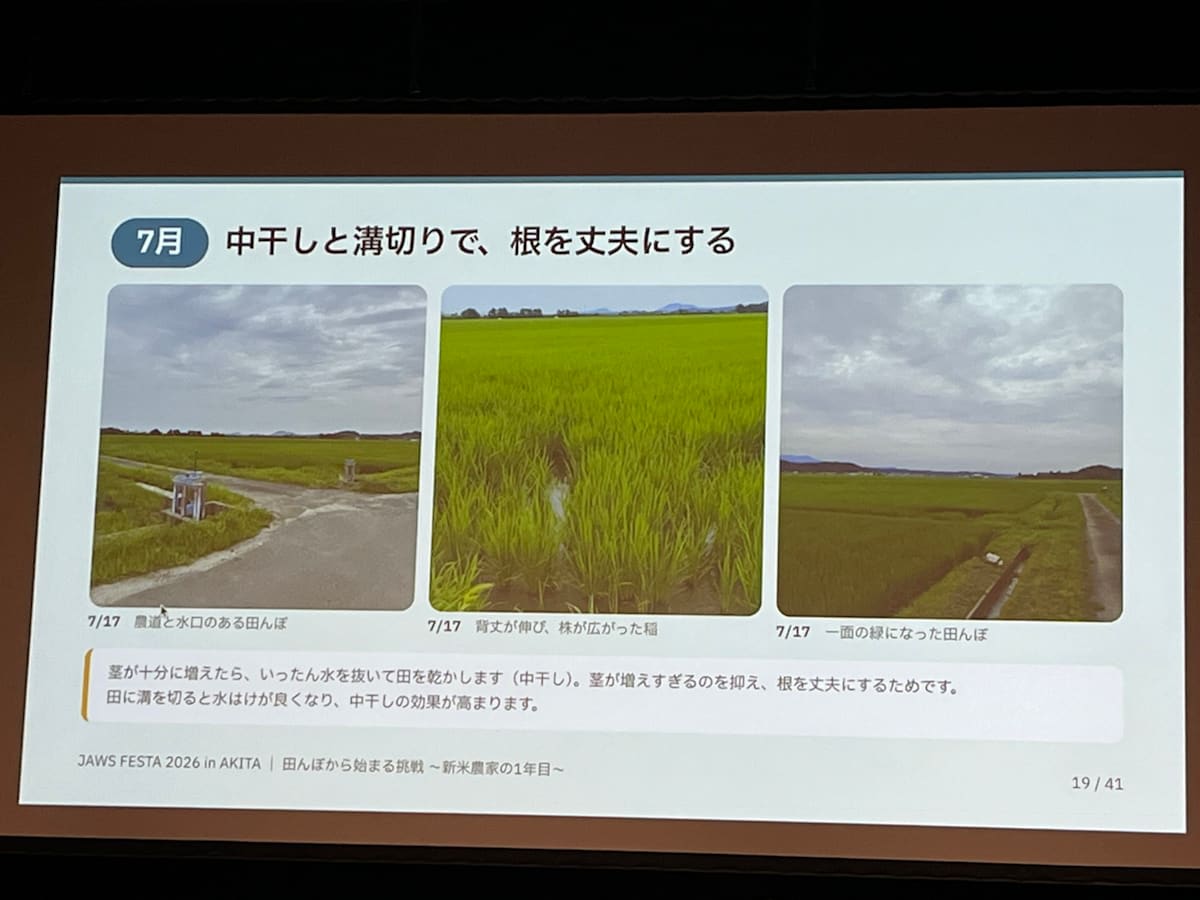
- Mid-season drainage (nakaboshi)
- Once the stems have increased enough, drain the water and let the paddy dry
- Prevents the stems from increasing too much
- Strengthens the roots
- Ditch cutting (mizogiri)
- Cutting ditches in the paddy improves drainage
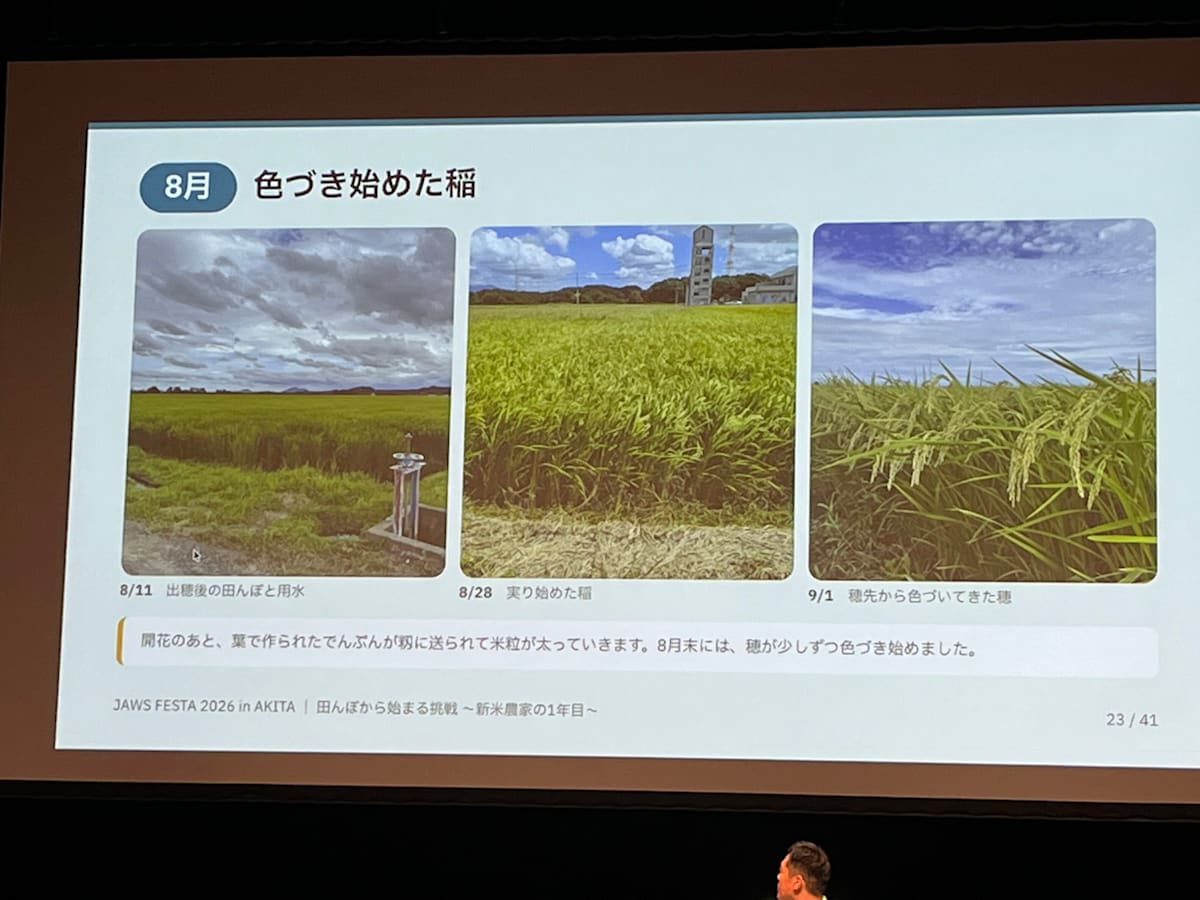
The flowering period is a critical time, because insects such as stink bugs can suck out the grains inside.
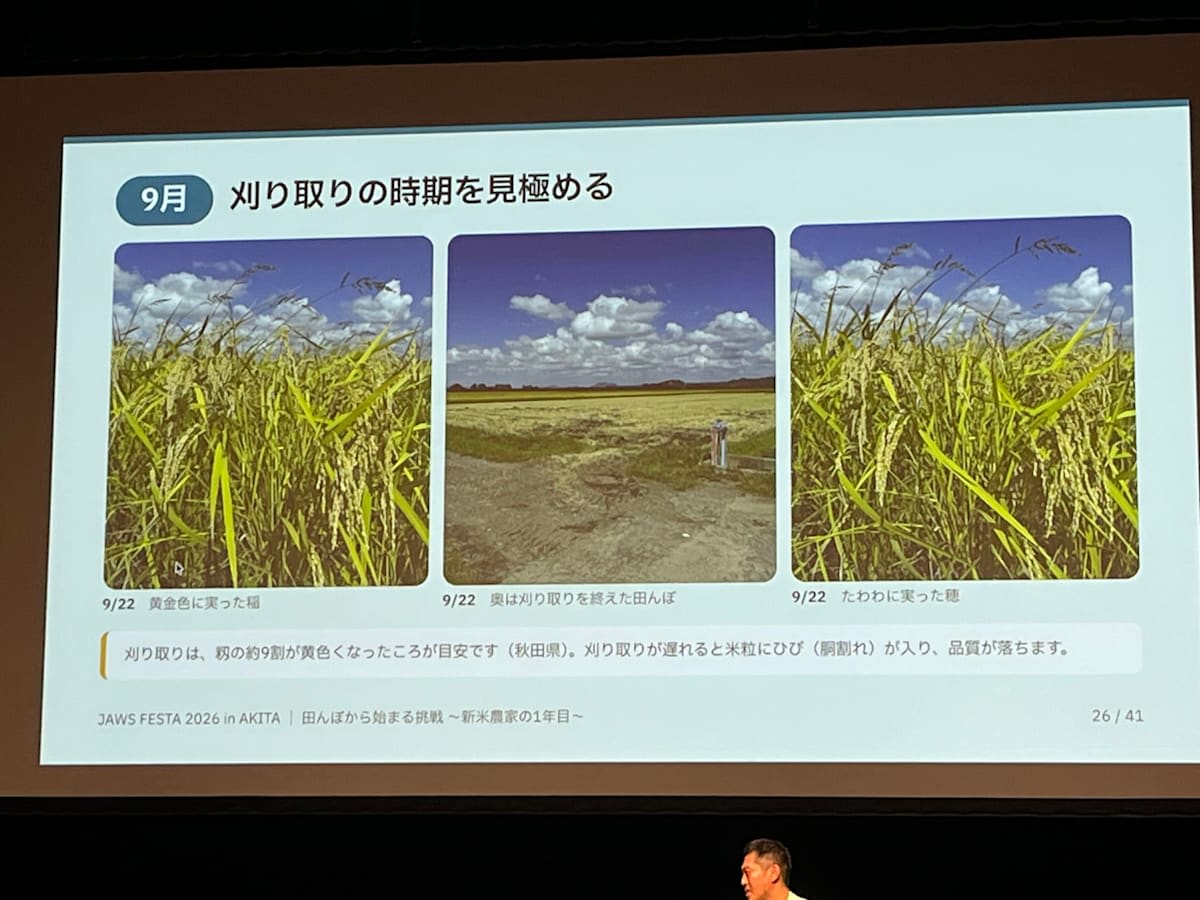
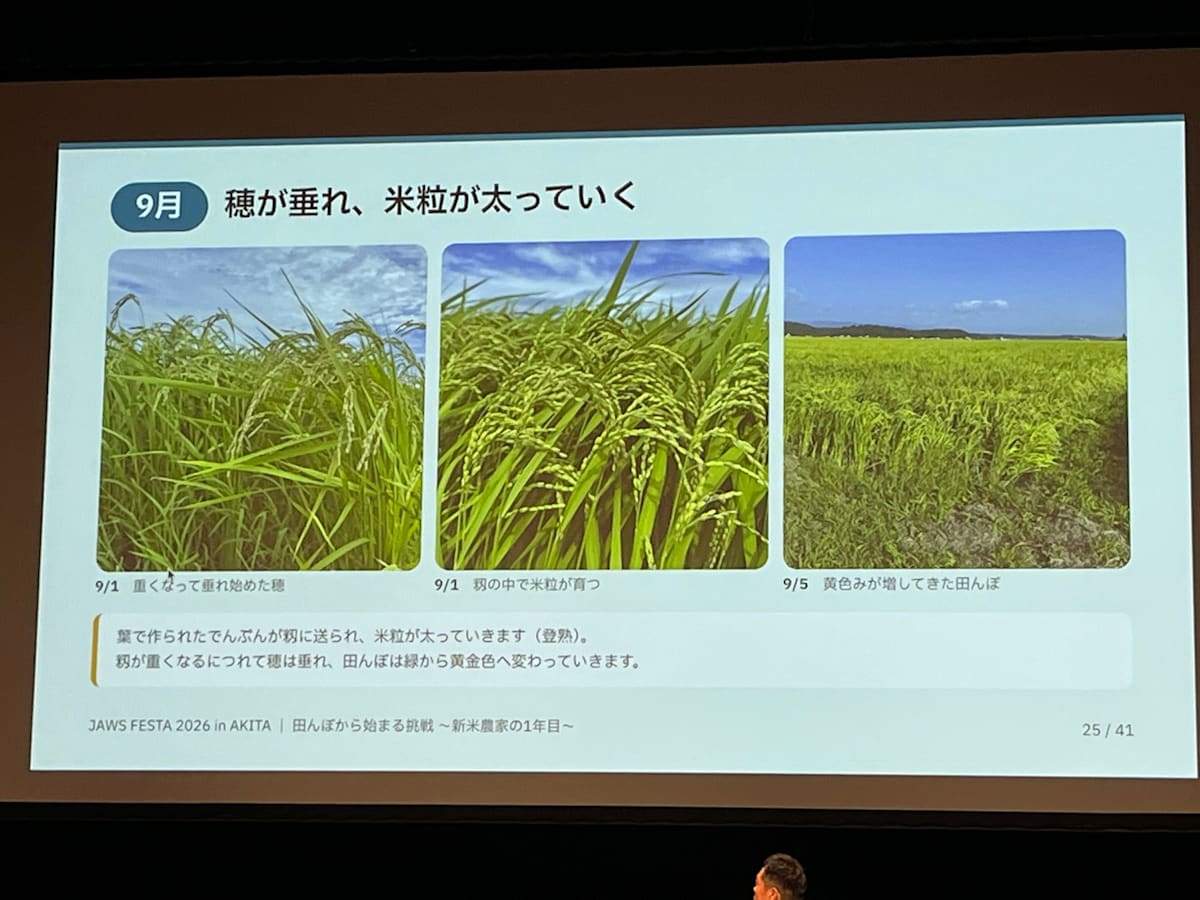
There is a guideline for the harvest timing, but the senior farmers judge by a feeling of "it's about time." They decide by adjusting while watching how other regions are doing.
JAWS FESTA executive committee members also took part in the rice harvest. A combine harvester is used for reaping.
When the wind is strong, the rice plants fall over and the combine can't reap smoothly. In that case, people have to handle it manually, for example by standing the plants back up.
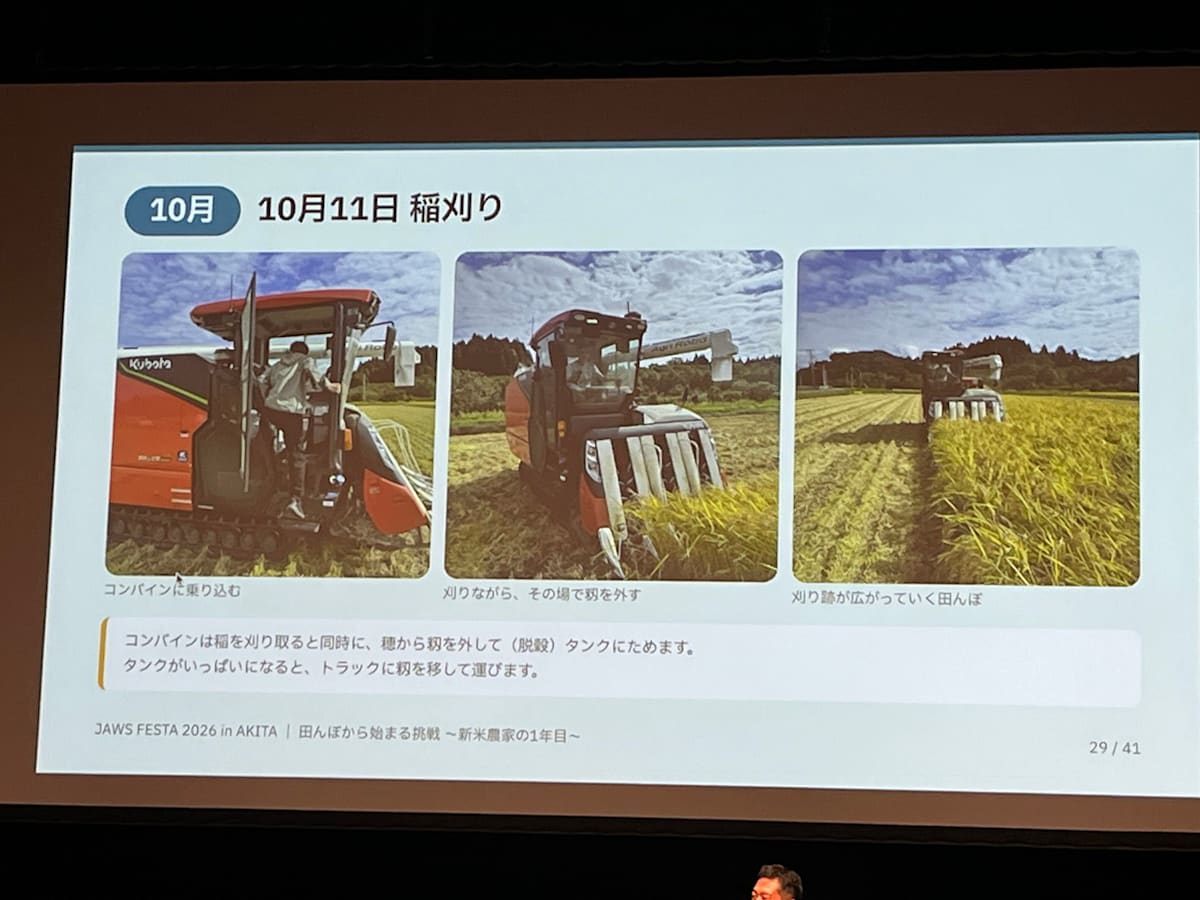
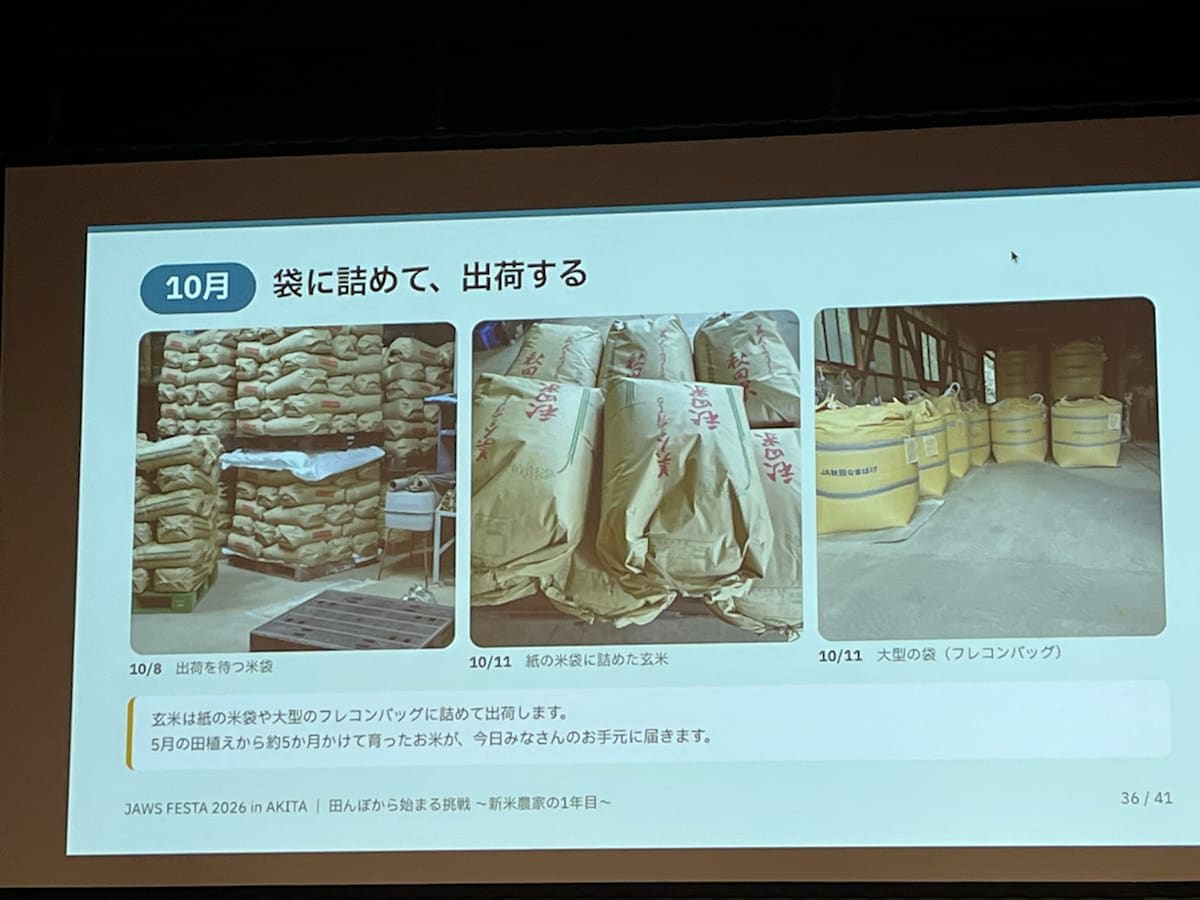
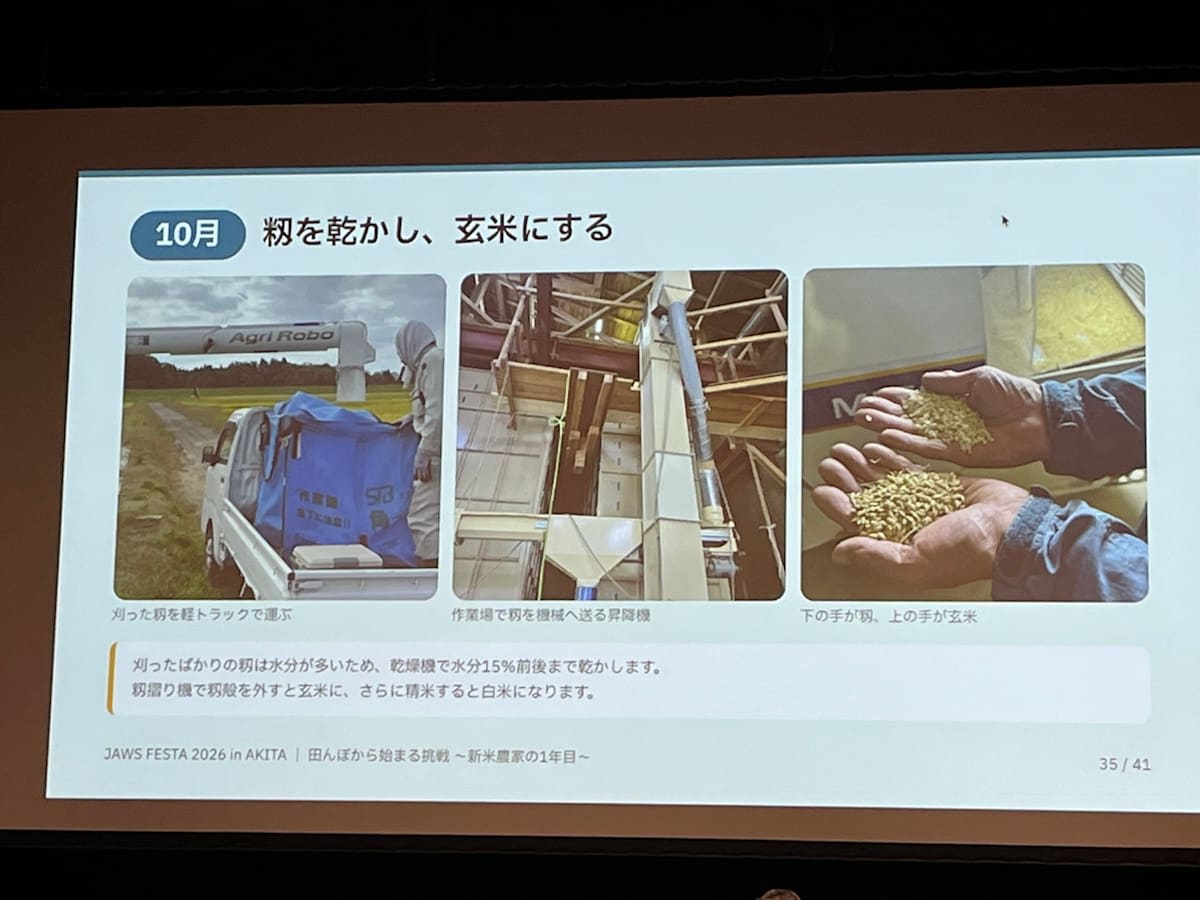
The rice distributed as the novelty has already been polished, so please eat it within about a month!
Hardships and Water Level Sensors
The hardships mentioned were mowing the grass on the paddy ridges and adjusting for muddy ground and water levels.
As for water levels, they are managing somehow using sensors through the IoT specialist branch. There are various methods, and the sensor you choose changes depending on the situation you want to manage. The sensors used in May–June differ from those used during the period when the paddy is dried. The talk was that even "water level management" covers many different things.
Cameras are also an option, but there is the issue of power supply, and sensors can do it with lower power consumption.
I Want to Reduce Rice Paddy Patrols with IoT! Trial and Error from Water Level Monitoring to Battery-Powered Cameras
The following session, "I Want to Reduce Rice Paddy Patrols with IoT! Trial and Error from Water Level Monitoring to Battery-Powered Cameras", was about water level monitoring and battery-powered cameras.
First Half: Building and Operating the Water Level Monitoring System "Paddy Watchman"
The first half was Mr. Ito's presentation.
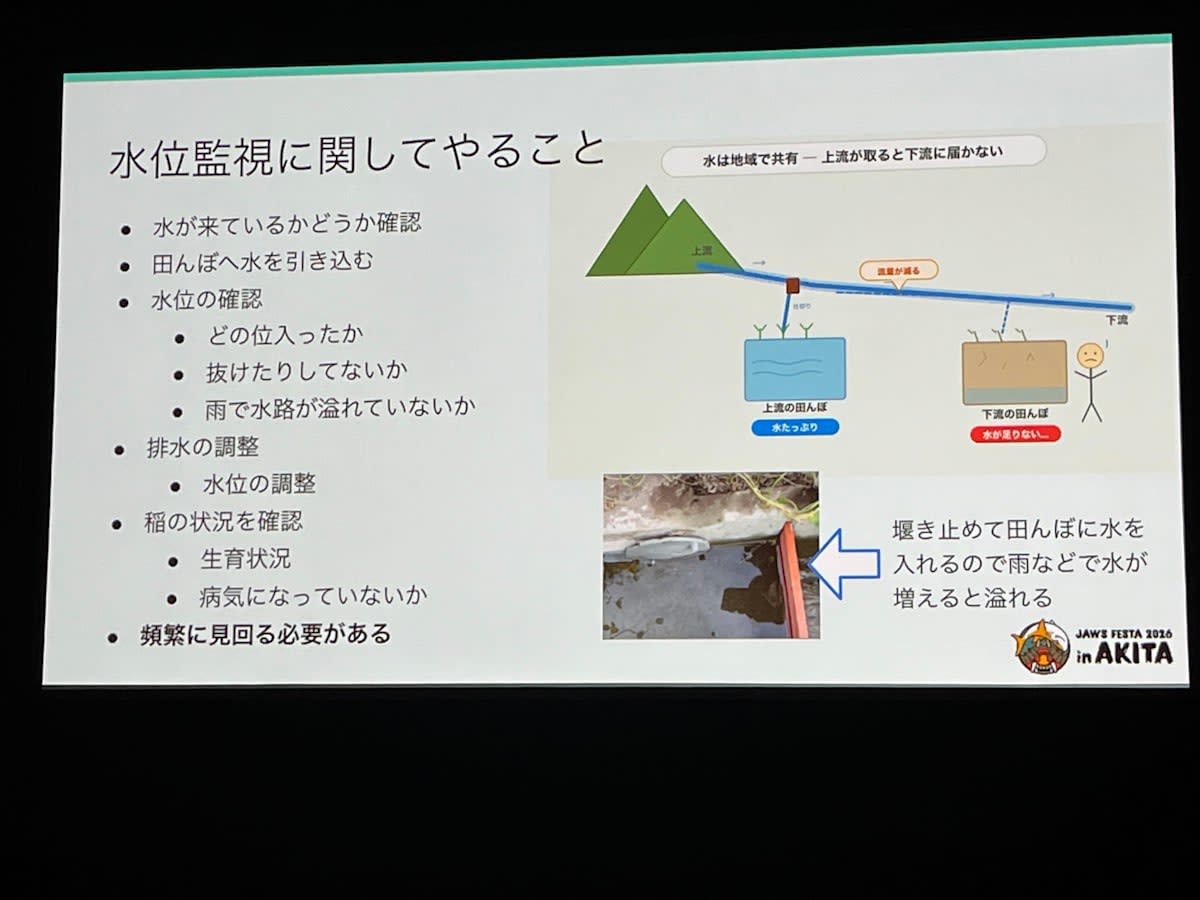
What You Do in Paddy Water Level Monitoring
- What you do in water level monitoring
- Check whether water is coming in
- Draw water into the paddy
- Check the water level and adjust drainage
- What you look at when checking the water level
- How much has come in
- Whether it is draining away (water can drain through mole or rat holes)
- Whether the waterways are overflowing from rain
Beyond water level, you also need to check the growth condition of the rice and for diseases.
You insert boards into the waterway to dam it up, raise the water level, and let water into the paddy, so when rain increases the water, it overflows. In that case, you remove the boards or stop letting water in, adjusting the outflow as well. You apparently need to go check these several times a day.
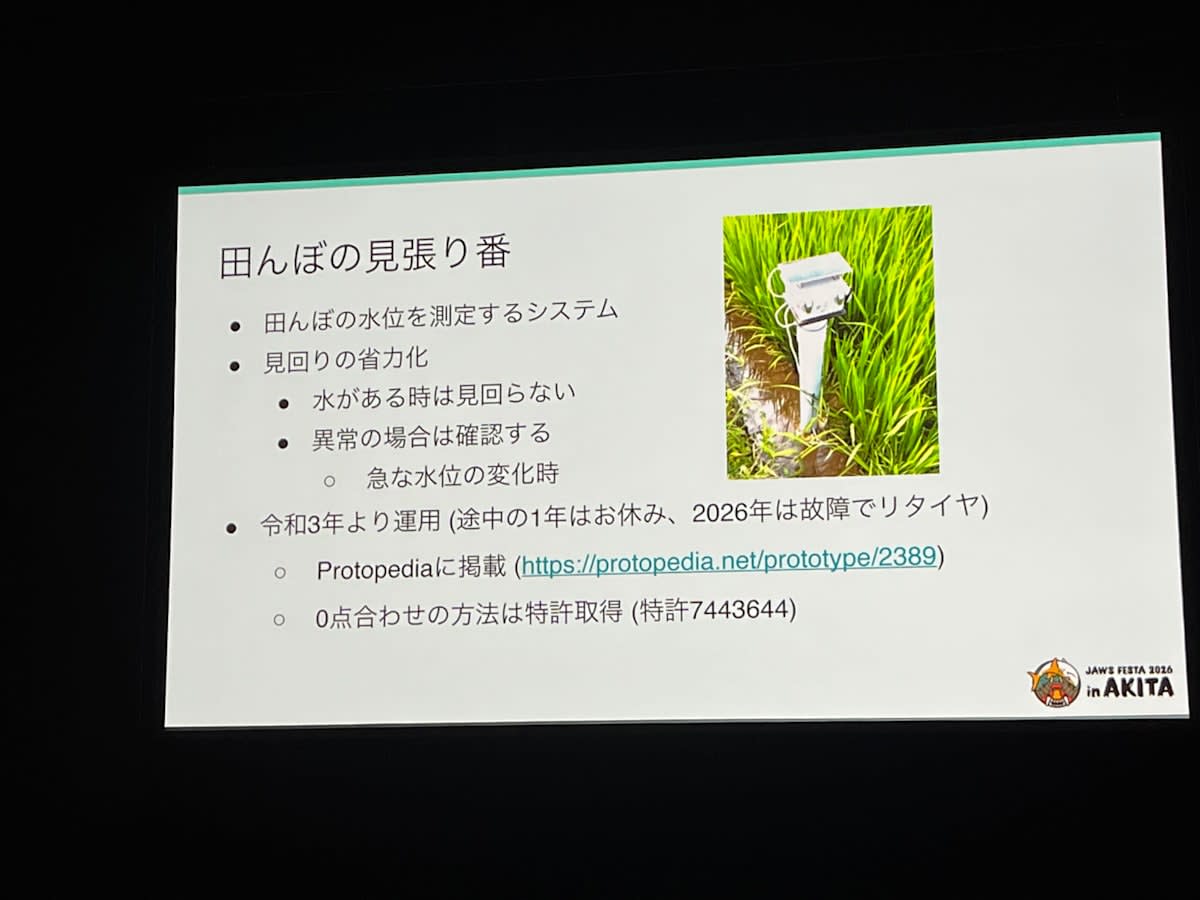
"Paddy Watchman"
So they built the "Paddy Watchman", which confirms that there is an appropriate amount of water and notifies of sudden water level changes, so that you only need to go look when something is abnormal.
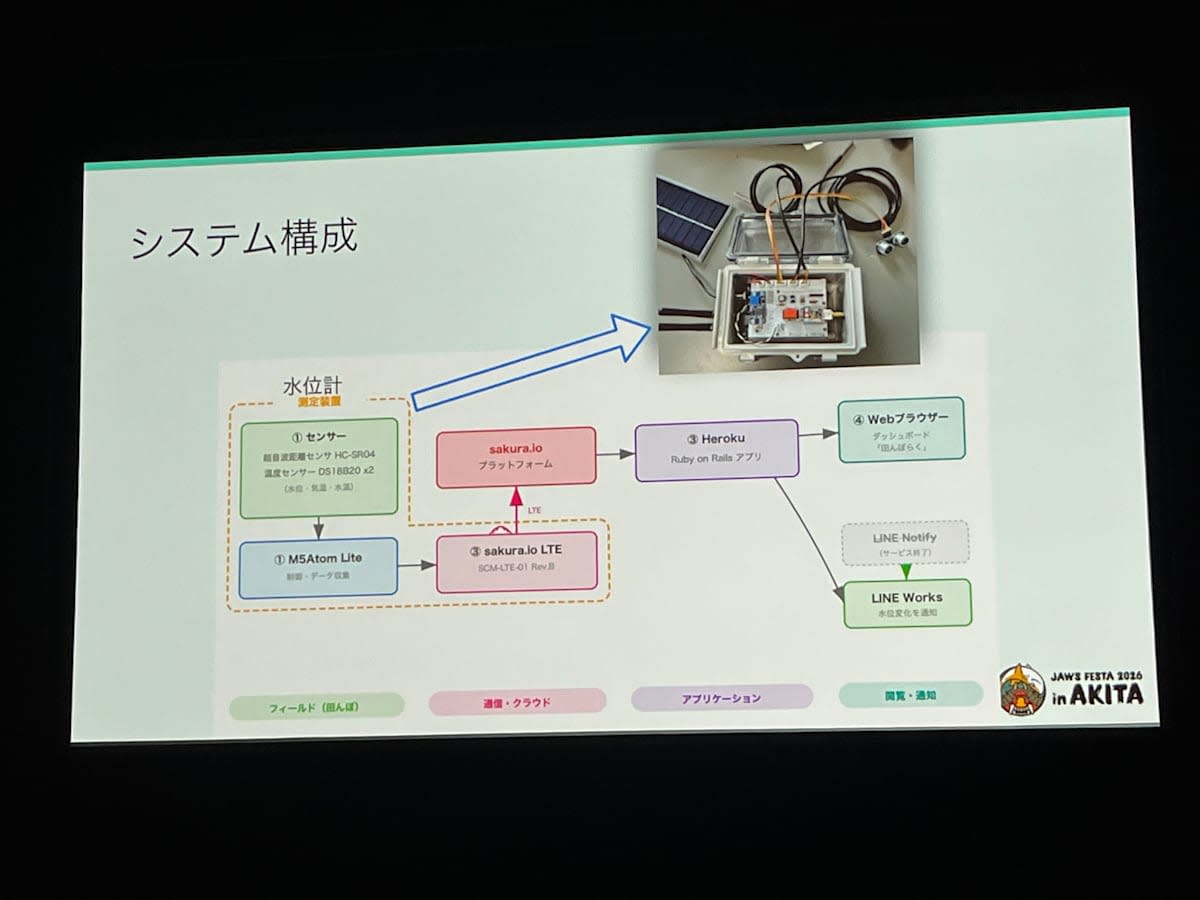
This is the flow from the sensors on the paddy side to notification.
- Paddy side
- Connect an ultrasonic distance sensor (HC-SR04) and two temperature sensors (DS18B20) to an M5Atom Lite
- Measure water level, air temperature, and water temperature
- Charged by a solar panel
- Communication and cloud
- Sent from a sakura.io LTE module to the sakura.io platform
- A Ruby on Rails app on Heroku receives it
- Viewing and notification
- Display the dashboard "Tanboraku" in a web browser
- Water level changes are notified to LINE Works
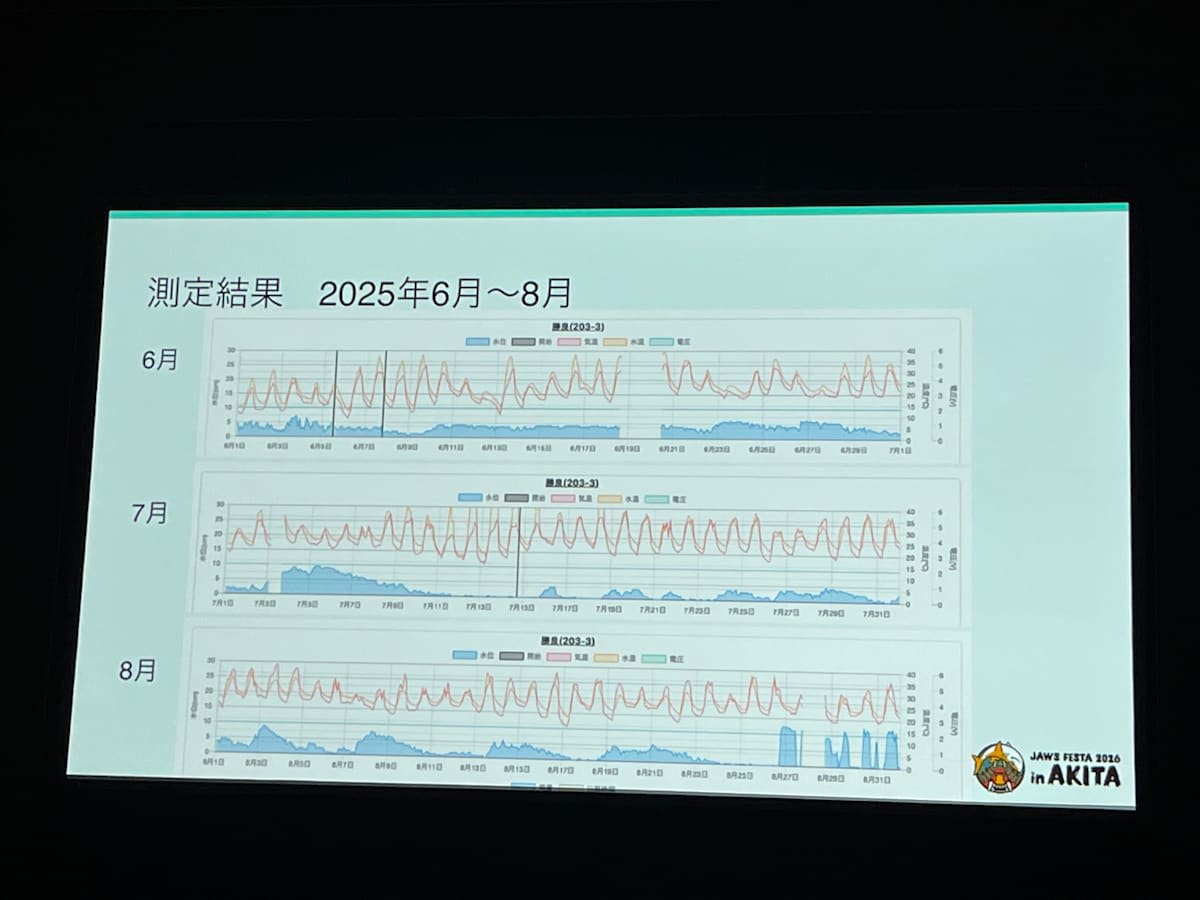
Water Level Change Graphs and Issues
These are the measurement results from June to August 2025. In the graph, red is air temperature and blue is water level.
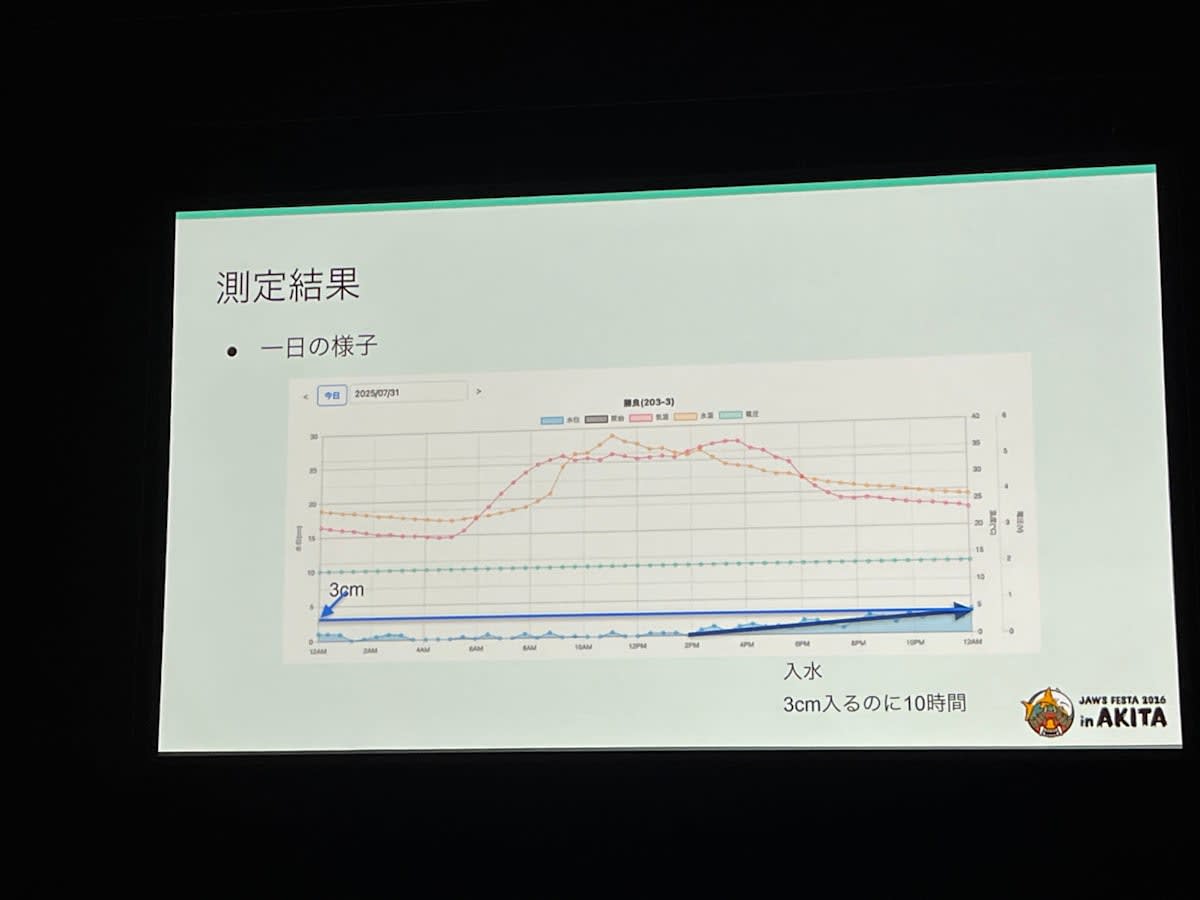
This shows a single day.
Three issues were raised.
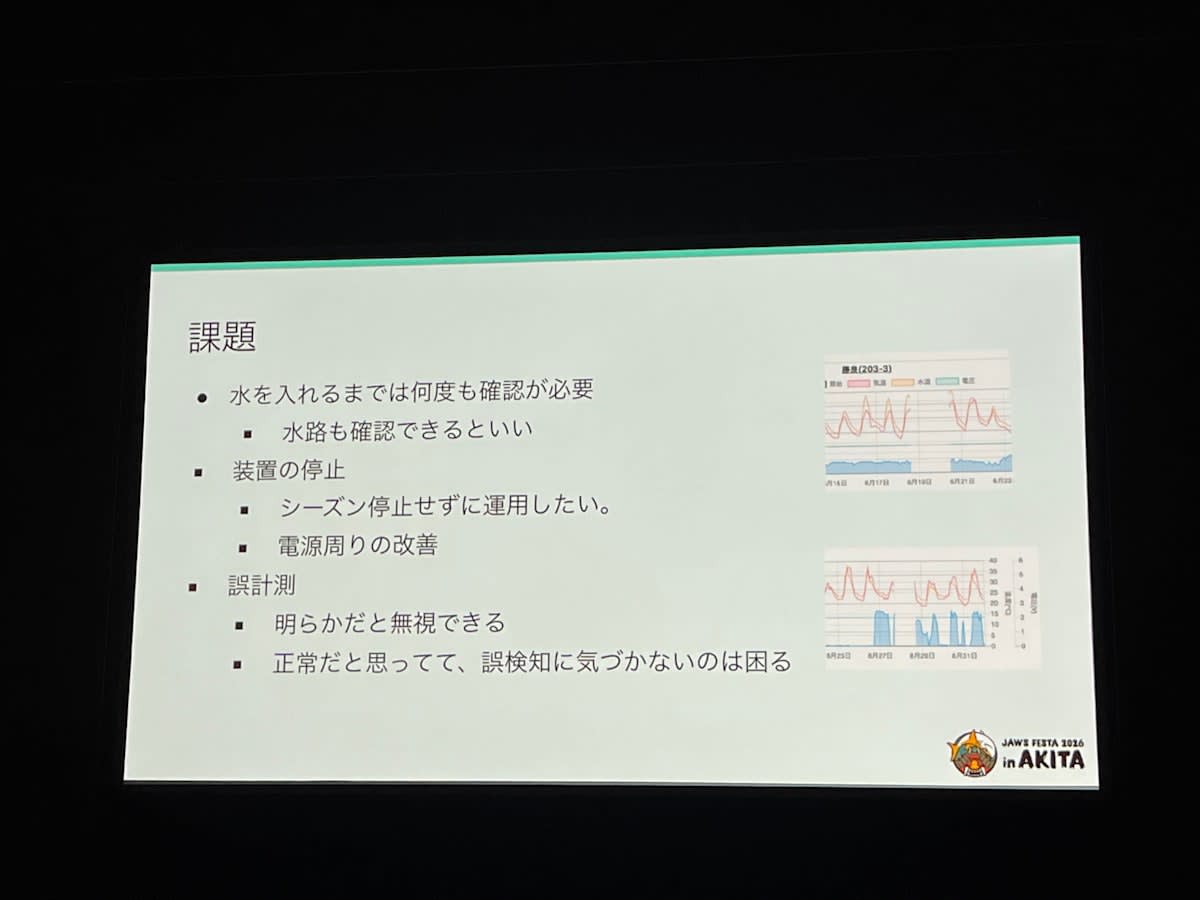
- Repeated checks are needed until water is let in
- Measurement can't start unless water is actually coming, so getting to that point is hard
- It would be nice to be able to see the waterway as well
- Device stoppages
- We want to operate without stopping during the season
- Even charged by a solar panel, it stops about 3 times during the season
- The power supply needs improvement
- We want to operate without stopping during the season
- Incorrect measurements
- Even when there is no water, it shows as if there is a water level
- For example, the device sticking together because of water
- Even when there is no water, it shows as if there is a water level
Condensation Countermeasures for the Battery-Powered Camera
For the issue of wanting to see the waterway and paddy, they use a battery-powered camera. The camera was installed by Kazunari Takeda, the executive committee chair of JAWS FESTA 2026 in AKITA.
The camera's problem is condensation: the inside of the lens fogs up so distant views look whitish, and water droplets form on the inside of the dome-shaped lens cover.
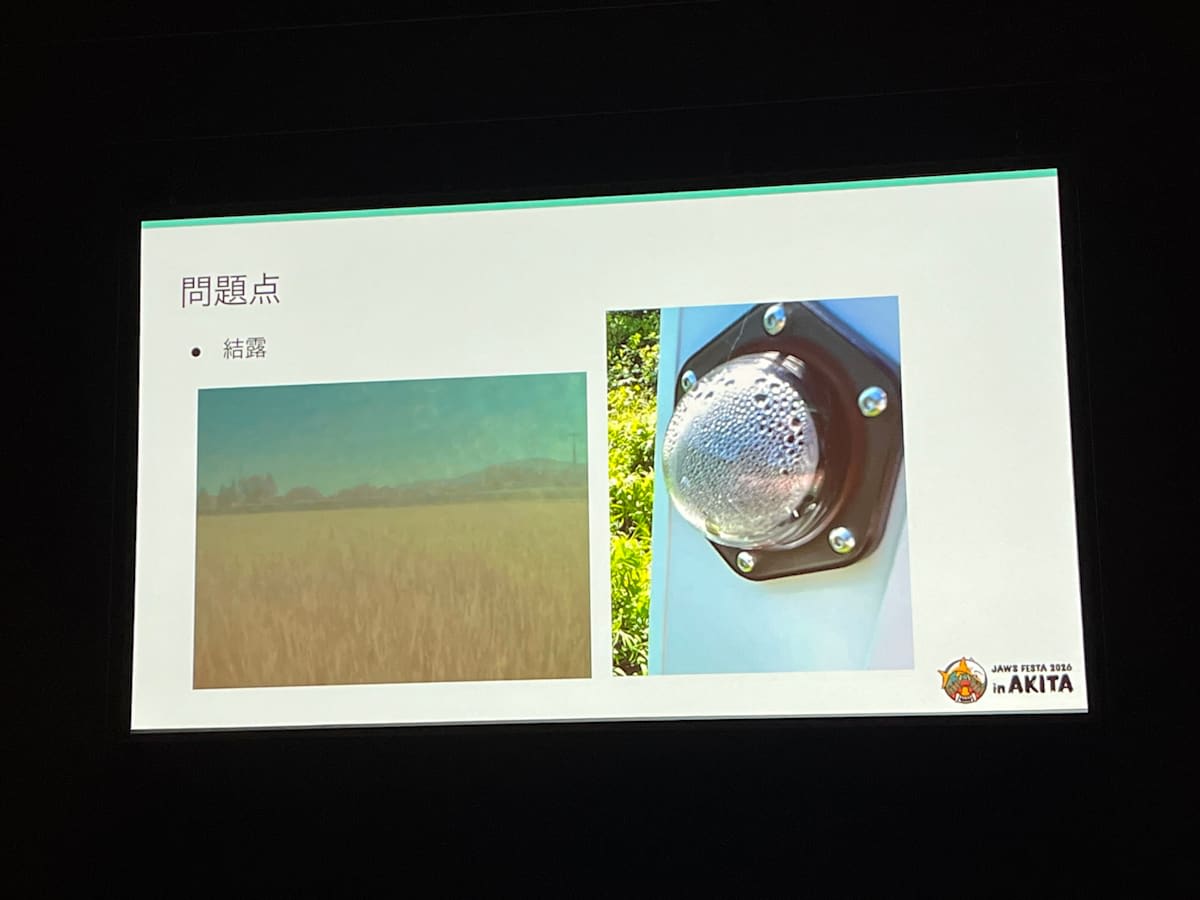
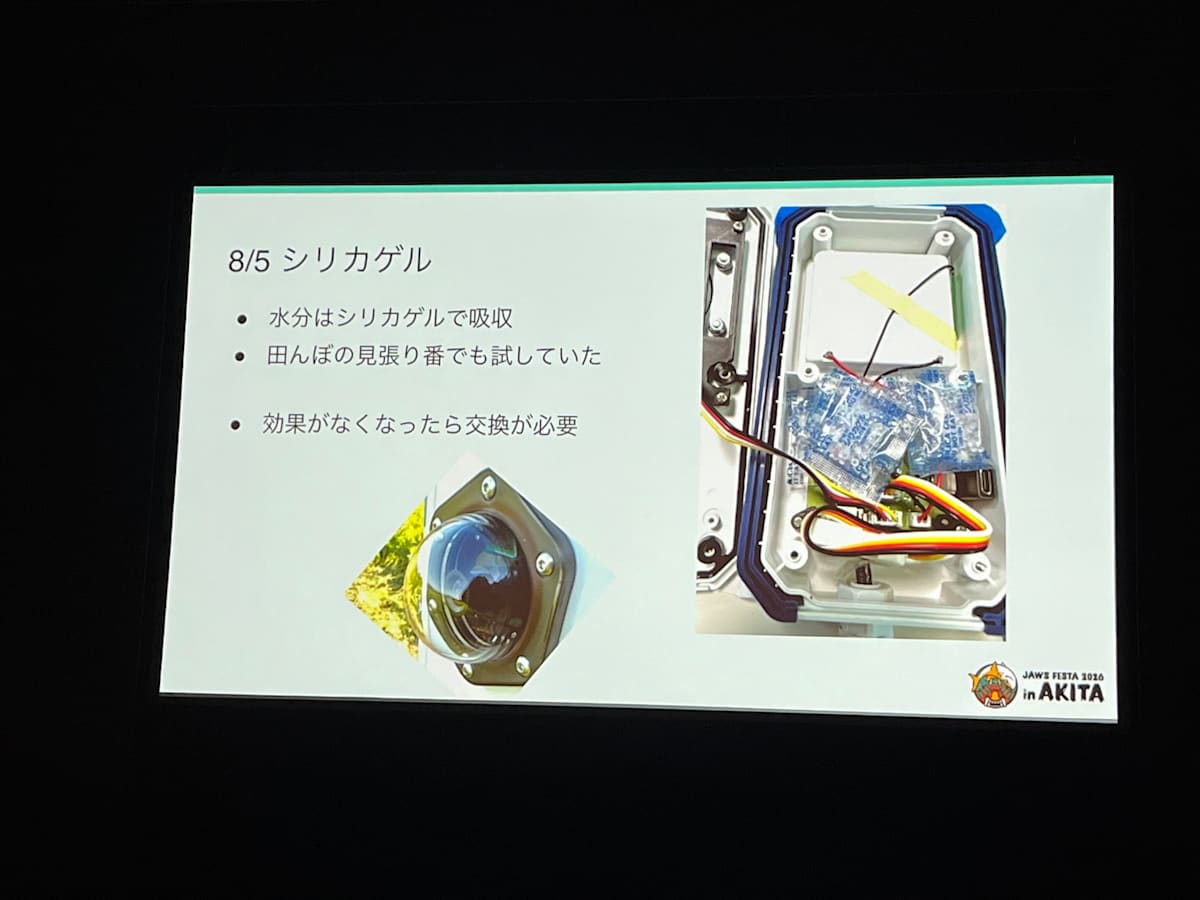
As a first countermeasure, they put in silica gel.
- Silica gel
- A method of absorbing moisture with silica gel
- Also tried with the Paddy Watchman
- Once it has absorbed all it can, it needs to be replaced, so the maintenance burden remains
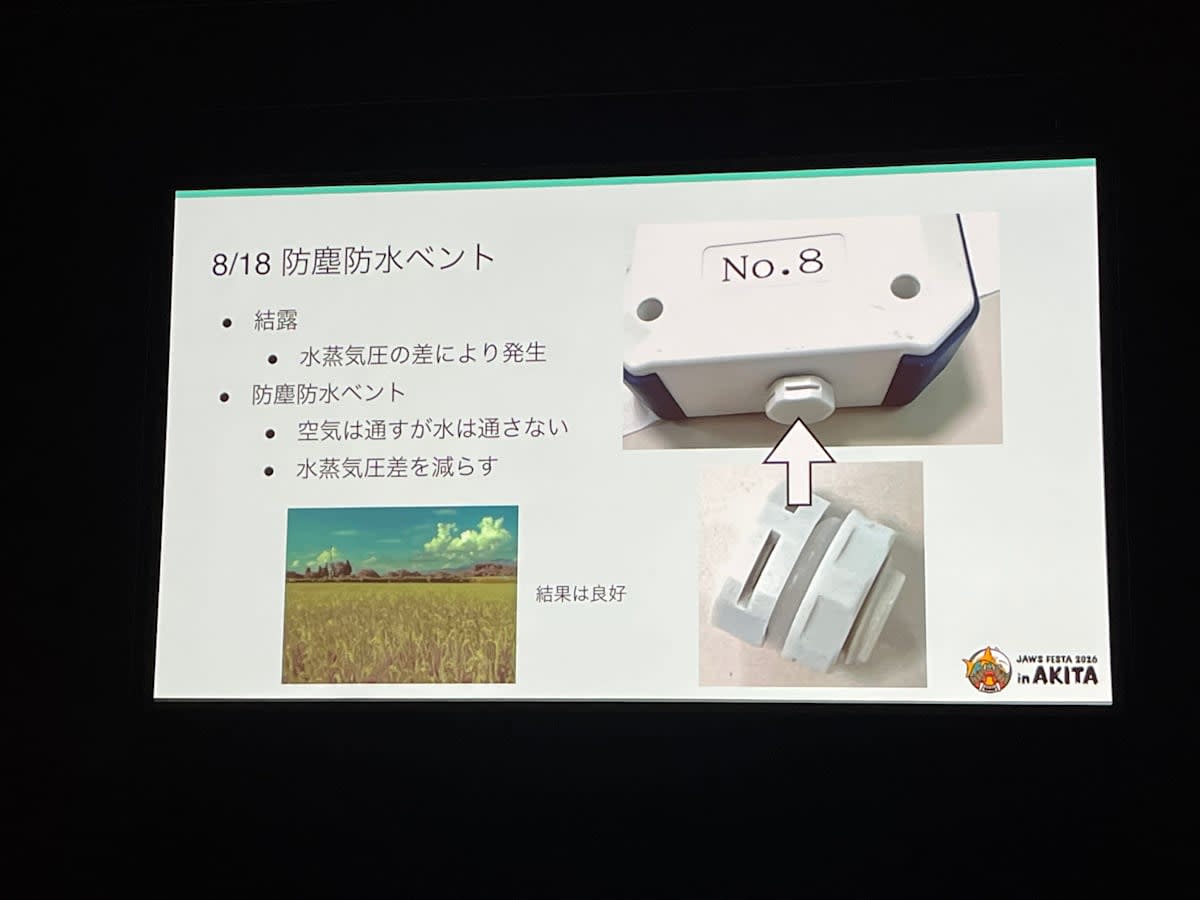
As the next countermeasure, they introduced a dustproof and waterproof vent.
- Dustproof and waterproof vent
- Lets air through but not water
- Reduces the water vapor pressure difference
- Results were good
Patrols Decreased, but Device Maintenance Increased
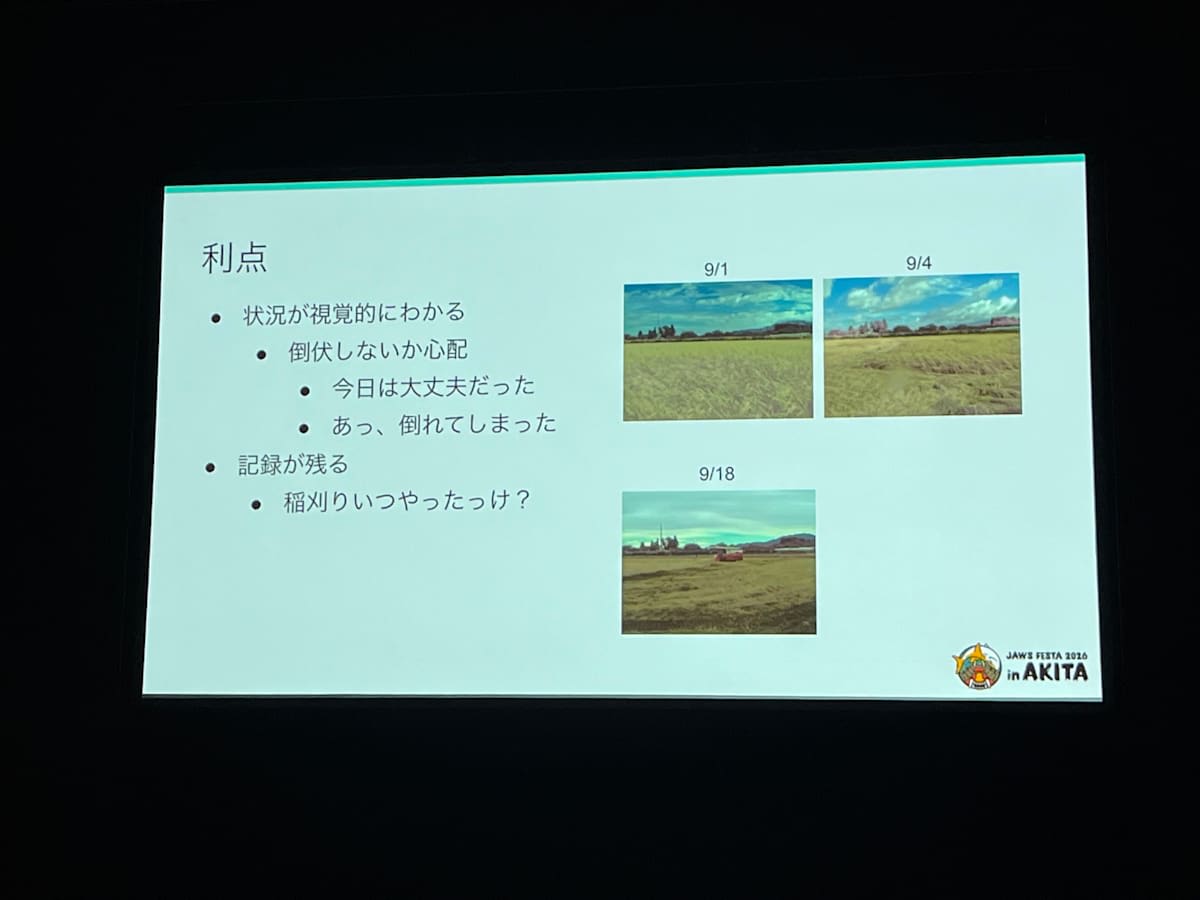
- Benefits of the camera
- You can see the situation visually
- When you're worried about lodging (plants falling over), you can tell from the image that today it was fine, or that they fell over
- Records remain
- It can also be used as a record of when the rice was harvested
- You can see the situation visually
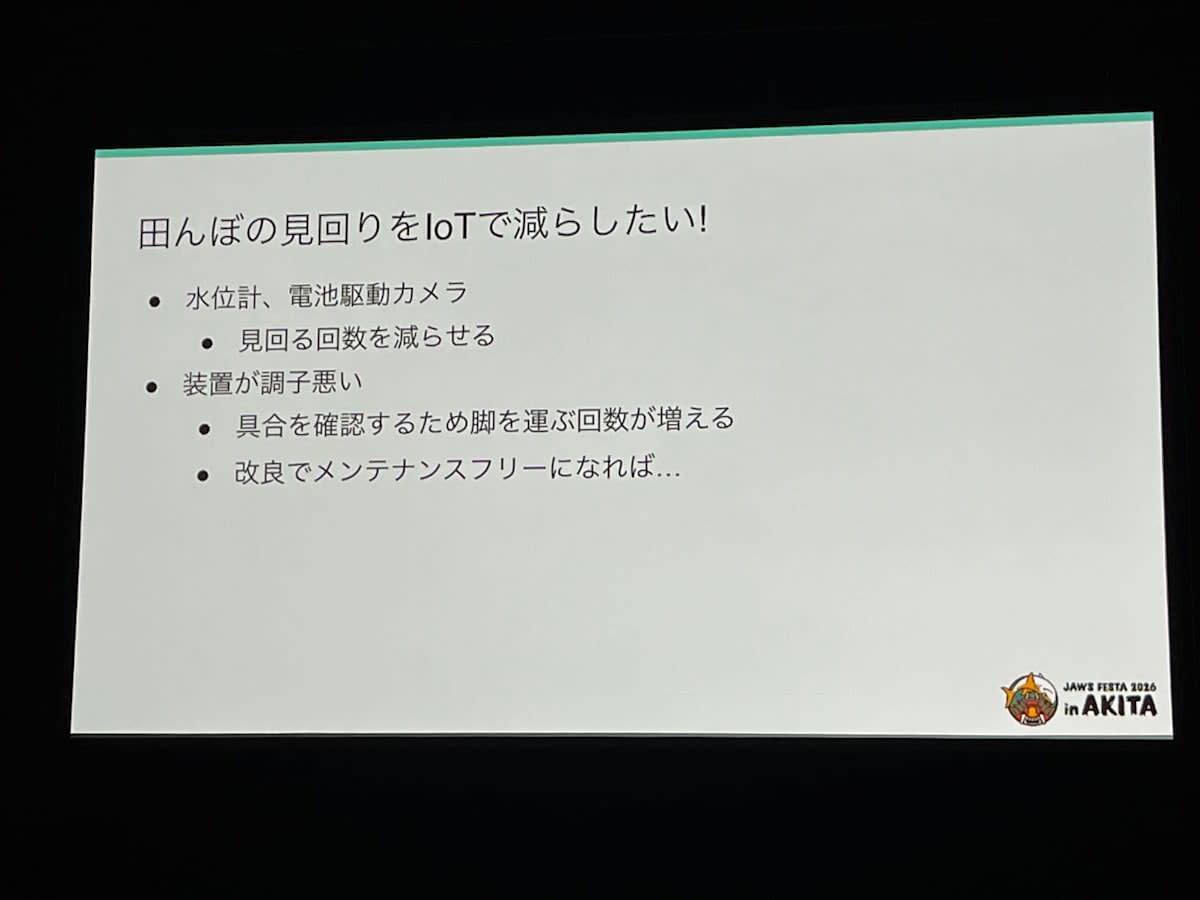
- A water level gauge and a battery-powered camera can reduce the number of patrols
- When a device isn't working well, the number of trips to check on it increases
- The number of watch-overs decreased, but device maintenance and patrols became necessary
In terms of numbers, it comes out about even. The first half ended with the hope that improvements might make it maintenance-free.

Second Half: Techniques for Running on Batteries for a Long Time, Such as IoT Camera Sleep Control, Optimizing Communication Counts, and Reducing Data Volume with Lower Resolution
The second half was Mr. Matsuda's implementation section on the battery-powered camera.
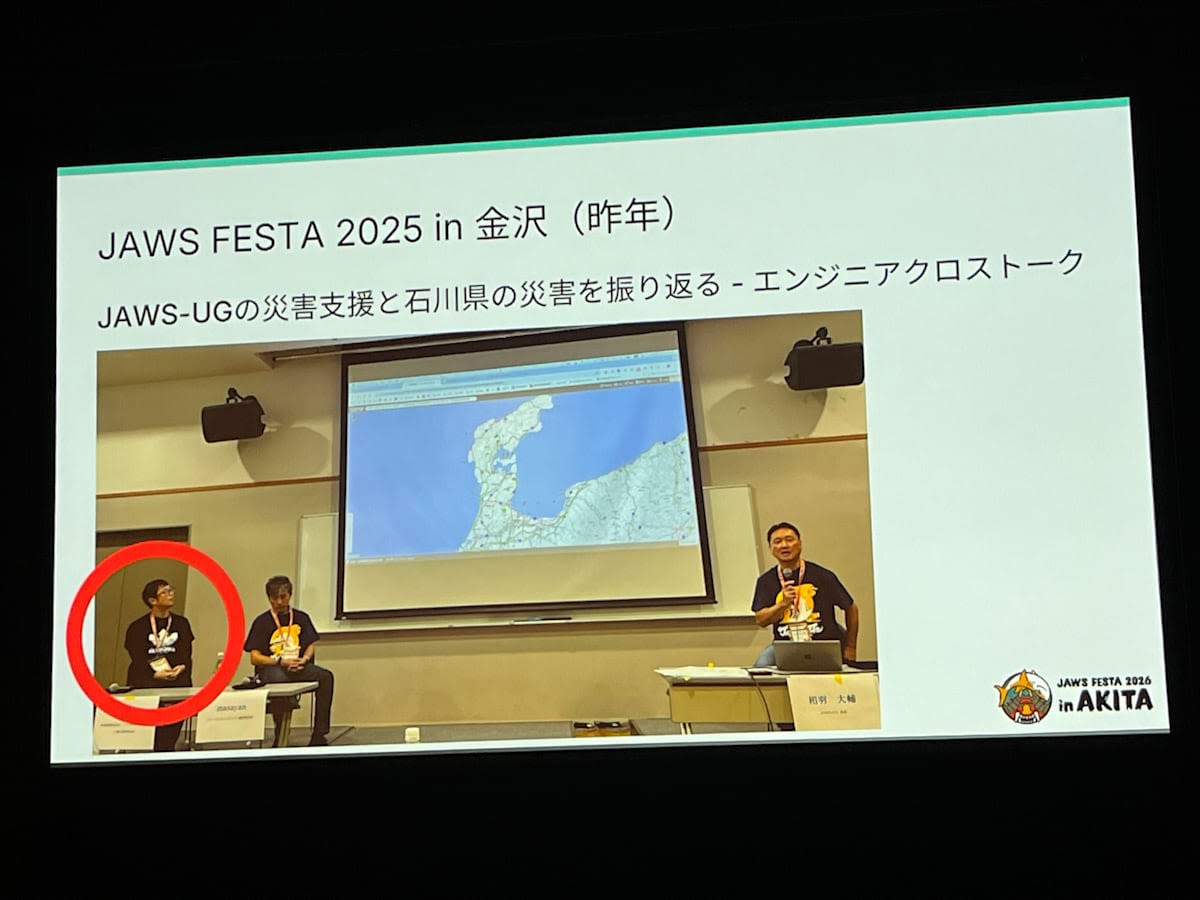
When I heard that Mr. Matsuda is from Kanazawa, Ishikawa Prefecture, I thought "Hm?", and sure enough, as I remembered, he was the Mr. Matsuda who spoke at JAWS FESTA 2025 in Kanazawa last year!
Now, the IoT camera for the paddy was something that had been exhibited at a SORACOM event, and it was actually deployed in Akita.
There are no power outlets in a paddy.
You need to check the situation of a place with neither power nor Wi-Fi remotely, using dry cell batteries.
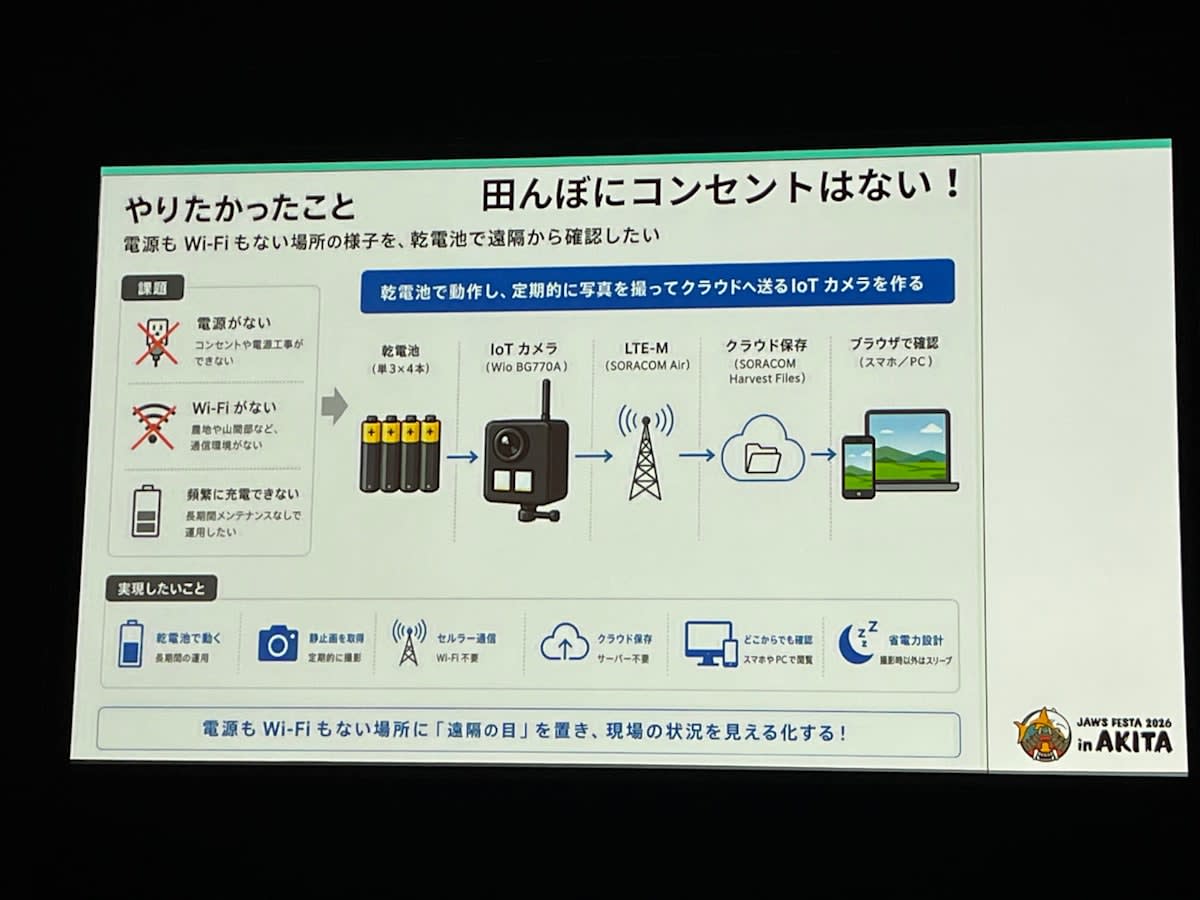
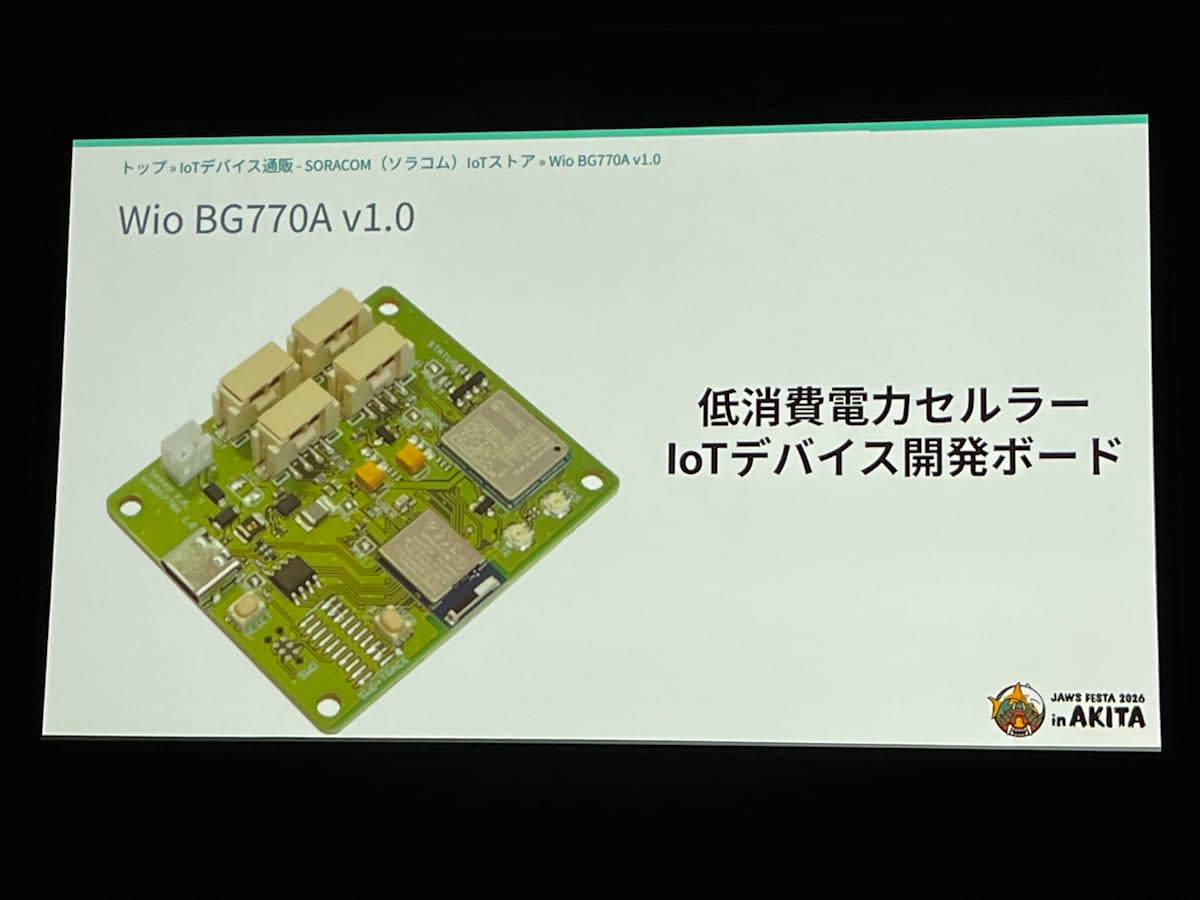
What they use is the Wio BG770A, a low-power cellular IoT device development board. It's read "Wai-o", apparently. Wai-o.

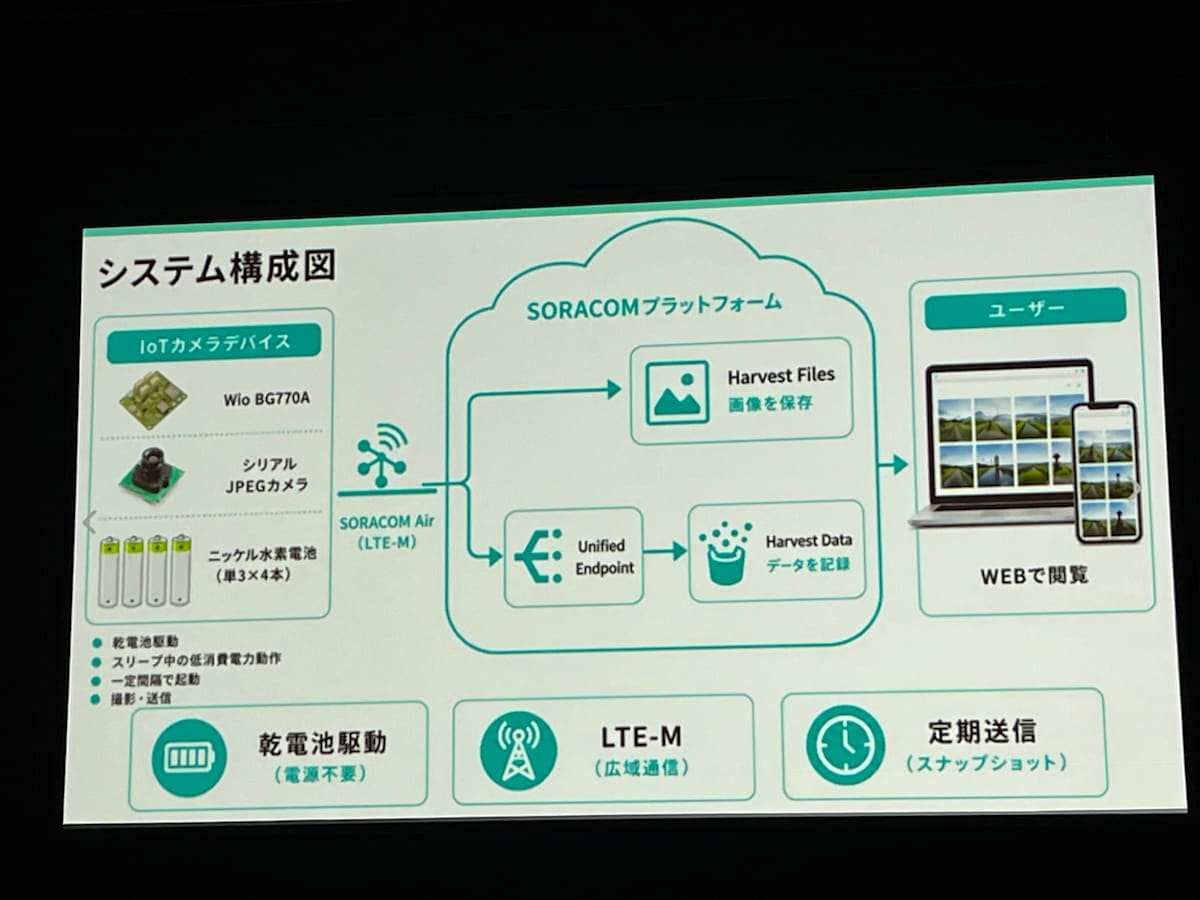
- Device side
- Connect a serial JPEG camera and nickel-metal hydride batteries (4 AA cells) to the Wio BG770A
- Sensors can also be attached
- Cloud side
- Sent to the SORACOM platform via SORACOM Air (LTE-M)
- Images are stored in Harvest Files
- Sensor values are stored in Harvest Data via Unified Endpoint
- Users view them on the web
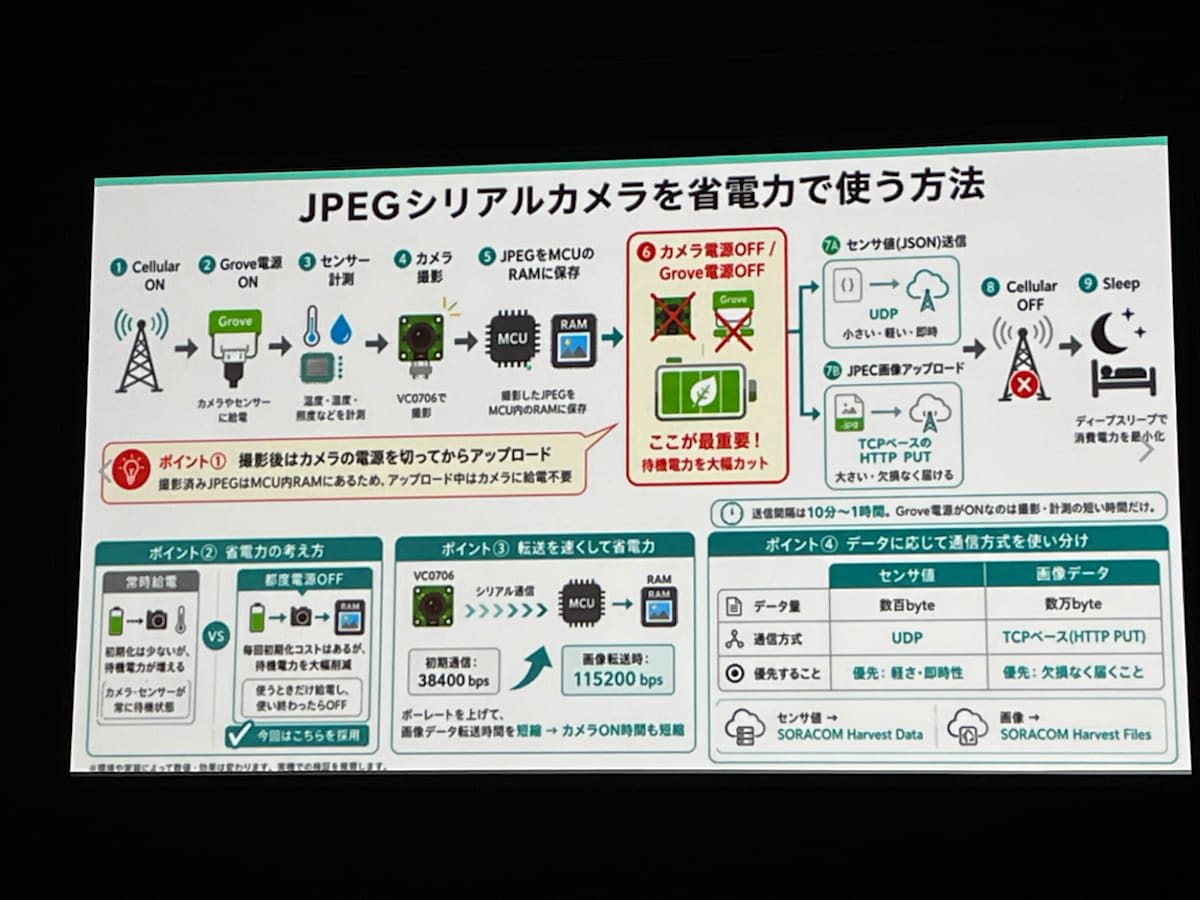
Using a JPEG Serial Camera with Low Power Consumption
To use the JPEG serial camera with low power consumption, the device side frequently turns the power off when it isn't being used.
Because the captured JPEG is in the microcontroller's RAM, the camera doesn't need to be powered during upload. The configuration keeps the microcontroller awake while the camera side is off.
This is the analysis result of the power-saving configuration.
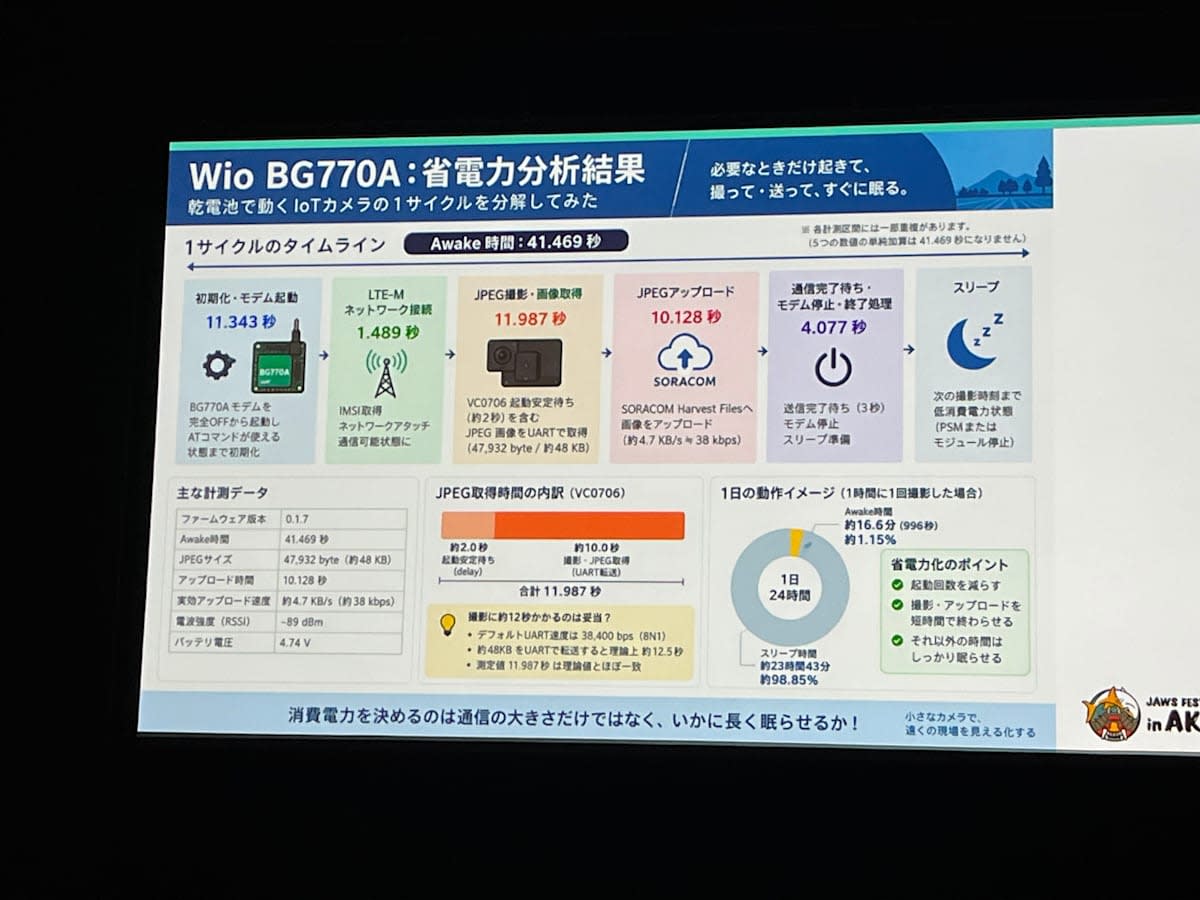
It takes 10 seconds to convert the image to JPEG, and with connecting, uploading, and so on, the total is about 40 seconds.
What determines power consumption isn't just the communication size, but how long you can keep the device asleep.
This is the measured result running a Wio BG770A and a VC0706 camera on 4 AA alkaline dry cells.
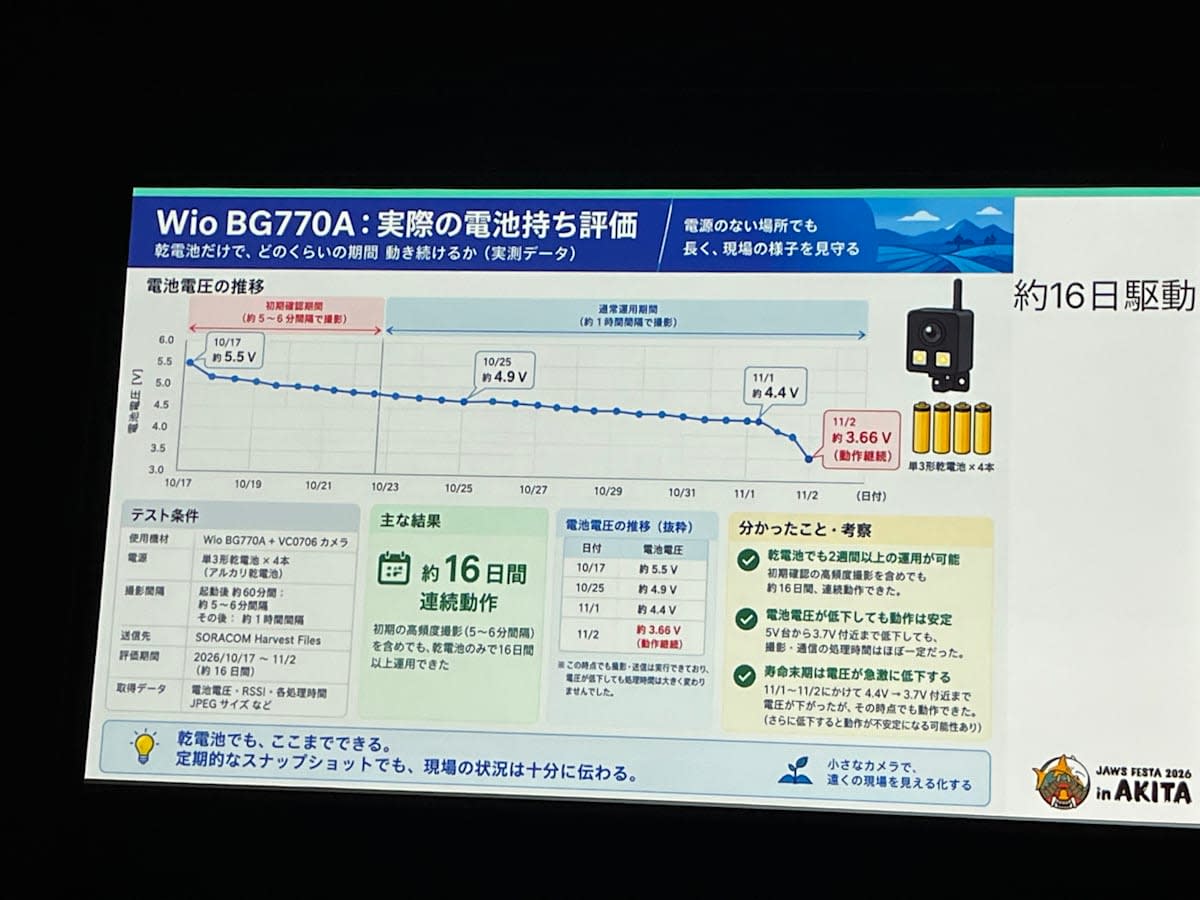
- Test conditions
- For about 60 minutes after startup, shoot at intervals of about 5–6 minutes
- After that, shoot at intervals of about 1 hour
- It kept running for about 16 days
Three improvement points were given.
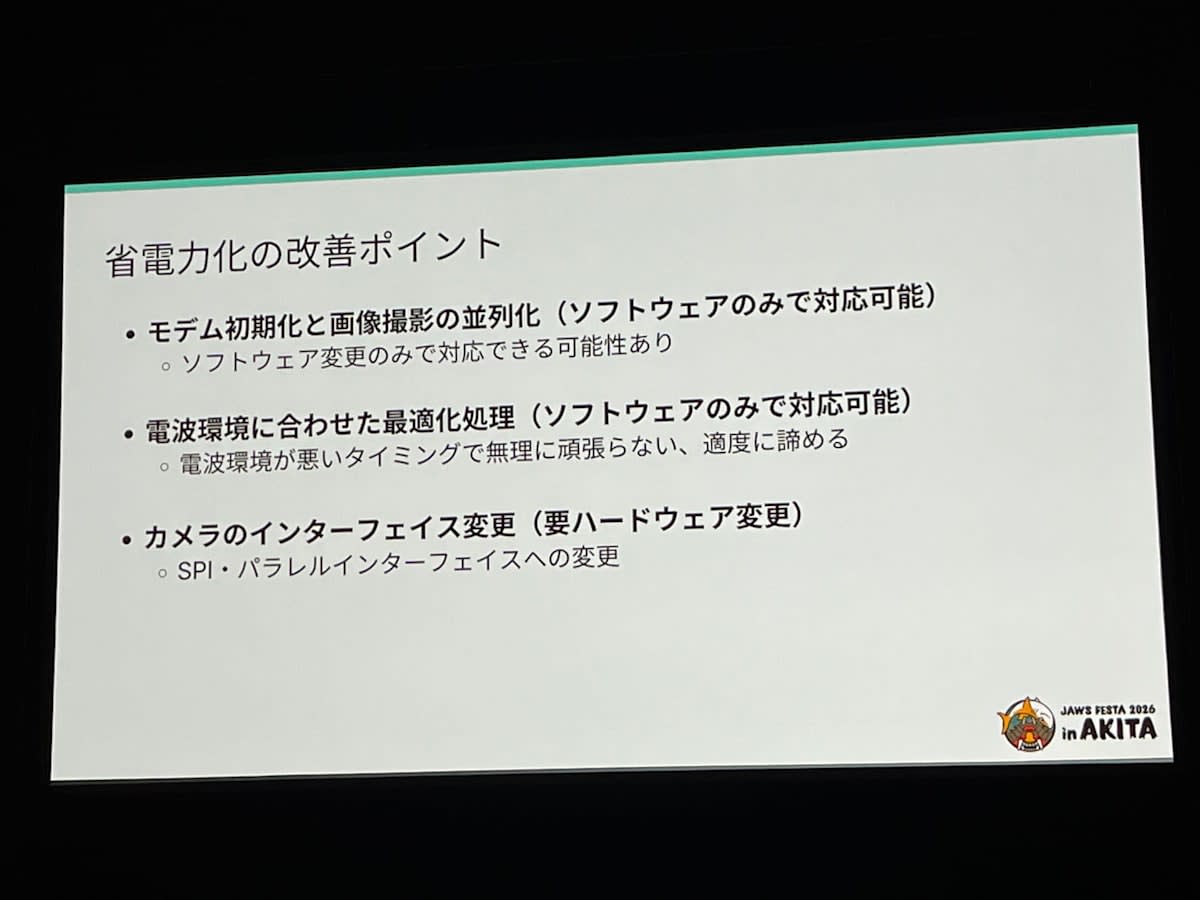
- Modem initialization and image capture take time, so parallelizing them might make things a bit more efficient
- Retry processing when the signal is poor drains the battery, so optimize it, for example by waiting up to an hour depending on the radio environment
- Change the camera interface to SPI or parallel; this requires hardware modification, so it may be difficult
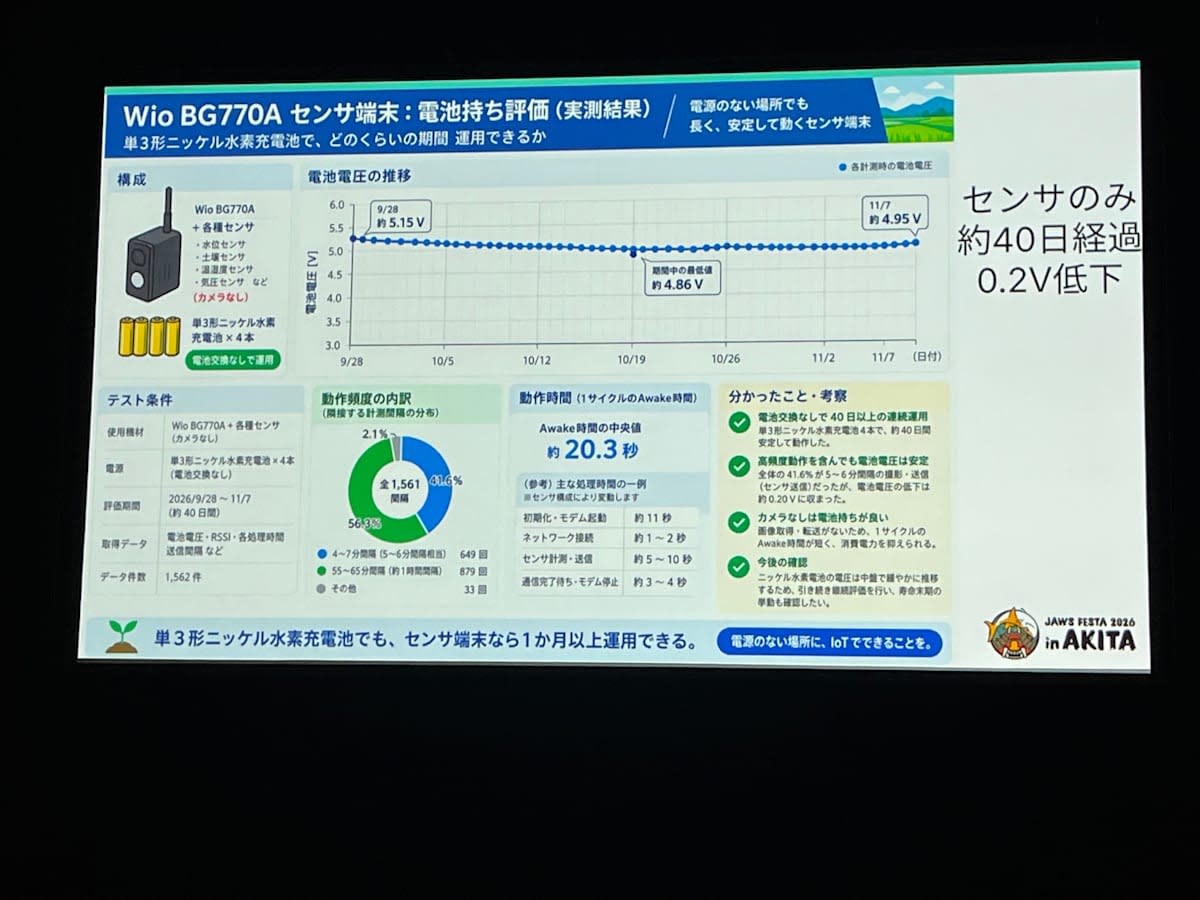
There was also an evaluation of a sensor terminal without a camera.
Without the camera, it runs for 40 days and can restart in 20 seconds.
Summary
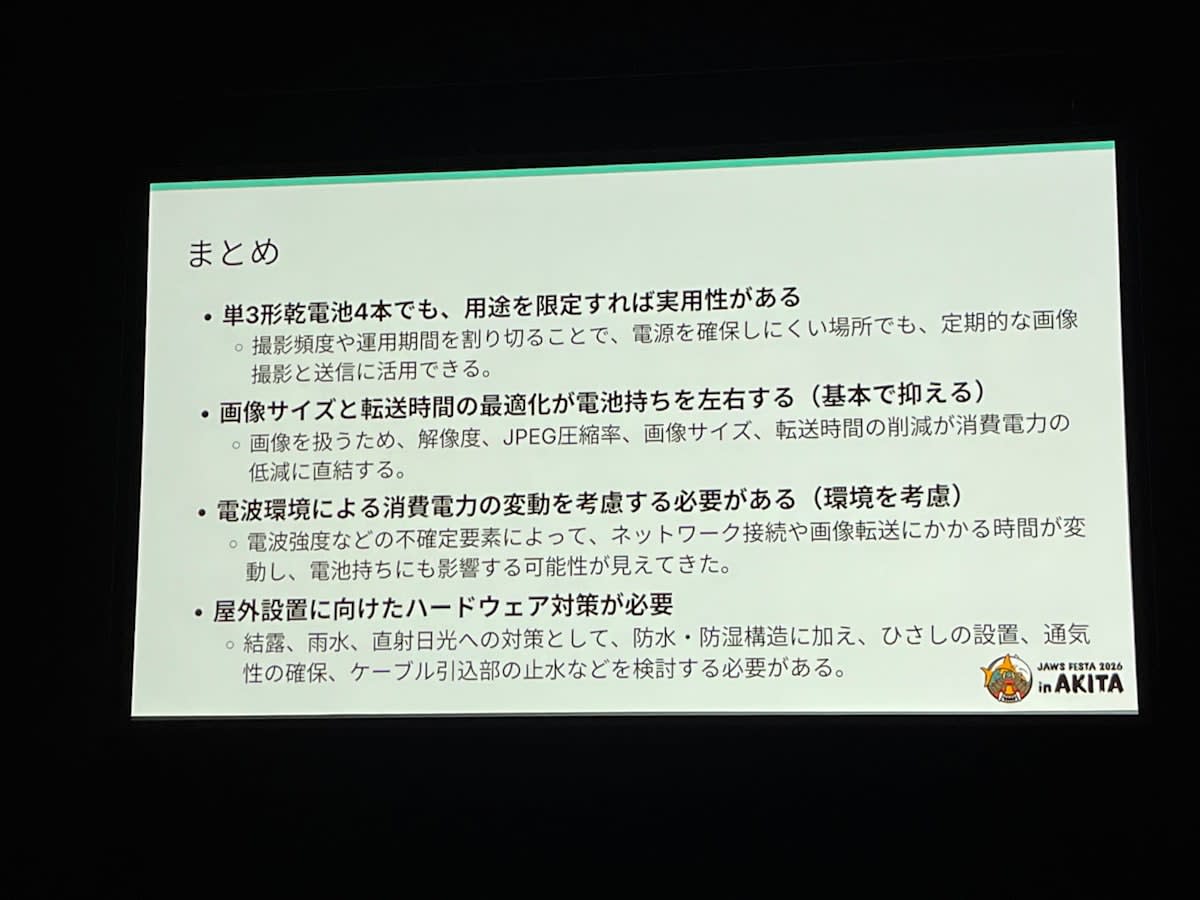
- Even with 4 AA dry cells, it is practical if you limit the use case
- Optimizing image size and transfer time determines battery life
- Power consumption changes with the radio environment
- Outdoor installation requires hardware countermeasures
Closing
It was interesting to be learning about rice farming at an IT study event. I also learned about the recent state of agriculture, such as the increase in agricultural corporations and dry-paddy direct seeding, and thought "I see~".
Mr. Miura said, "When I was a kid I played around doing xxx in the paddy and got scolded harshly, but I realized it really was something you shouldn't do," which was funny. My maternal grandfather also farmed rice paddies, and as a child you don't understand how hard rice farming is, so you end up messing up, right?
Through FESTA 2026 I got to hear quite a few talks about agricultural IoT, and there really are aspects where agriculture and IoT go well together, so I feel the potential. Of course it's a fight against nature so compromises have to be made, but I thought there is still a lot that engineers can do to prepare for disasters and an aging population.
I went home right after the event ended, but I heard that at the social gathering, Akitakomachi rice balls were served and it was a great success.
For questions or requests about this article, please contact us via "About DevelopersIO" in the inquiry section at the bottom of the screen. You can send inquiries regarding the article there.