"Business handover" and "introducing generative AI into operations" are similar topics

This page has been translated by machine translation. View original
Recently, while making heavy use of LLMs in my work, serving as a training instructor, and listening to clients' struggles with generative AI adoption, I've been noticing something.
"This feels remarkably similar to the challenges people face when working with each other."
Among the similarities I notice, what strikes me most is how closely the struggles of "handing off work to a successor" resemble those of "asking generative AI to produce deliverables."
Having personally experienced both handing off work and receiving underwhelming outputs from generative AI, and having puzzled over why things go wrong each time, I've concluded that these two situations are "similar" in nature.
In this article, I'd like to explain the structural parallels I've noticed between these two points.
Why the Challenges of Work Handoffs and Generative AI Adoption Are Similar
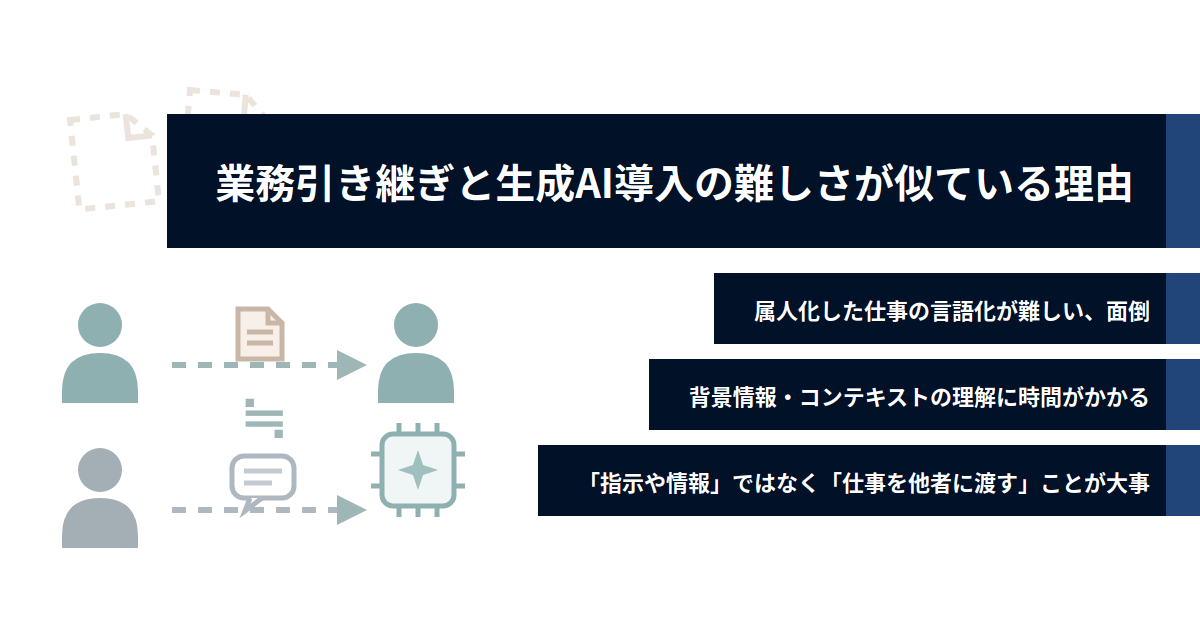
First, have you ever felt that "a handoff just isn't going smoothly"? Even though you were sure you explained the project properly. Even though you were sure you walked them through the workflow.
And have you ever run into a situation where you tried to incorporate generative AI into your work, but employees just couldn't quite reach the point of actual efficiency gains? Even though you wrote out the prompts properly. Even though you provided the structure.
At first glance, these two problems seem unrelated, but to get straight to the point: I believe the core difficulty is fundamentally the same in both cases.
Let me explain why in detail.
Putting Knowledge Tied to One Person Into Words Is Hard—and Tedious
Work, at its core, does not proceed according to manuals or design documents.
It almost invariably depends on the knowledge and skills of the person responsible, as well as everything they have experienced and observed over time. Edge cases and small judgment calls that aren't written in any manual are almost certainly being filled in unconsciously by that person, drawing on past experience. That's precisely why "that particular person" can handle the work—knowledge concentration isn't the result of laziness, but something that naturally emerges from the very nature of work itself.
So why does this concentrated knowledge remain unwritten? I think there are essentially two reasons.
- The first is that putting it into words is genuinely difficult
- Tacit knowledge is hard even for the person themselves to recognize, and translating "I just kind of make this judgment" into written form takes far more effort than one might expect.
- The second is that the effort required to document it is greater than anticipated
- When everyday work keeps you busy, carving out a solid block of time to create a manual is no easy feat.
As a result, documentation gets pushed back, and work remains concentrated in a single person.
Understanding Background Information and Context Takes Time
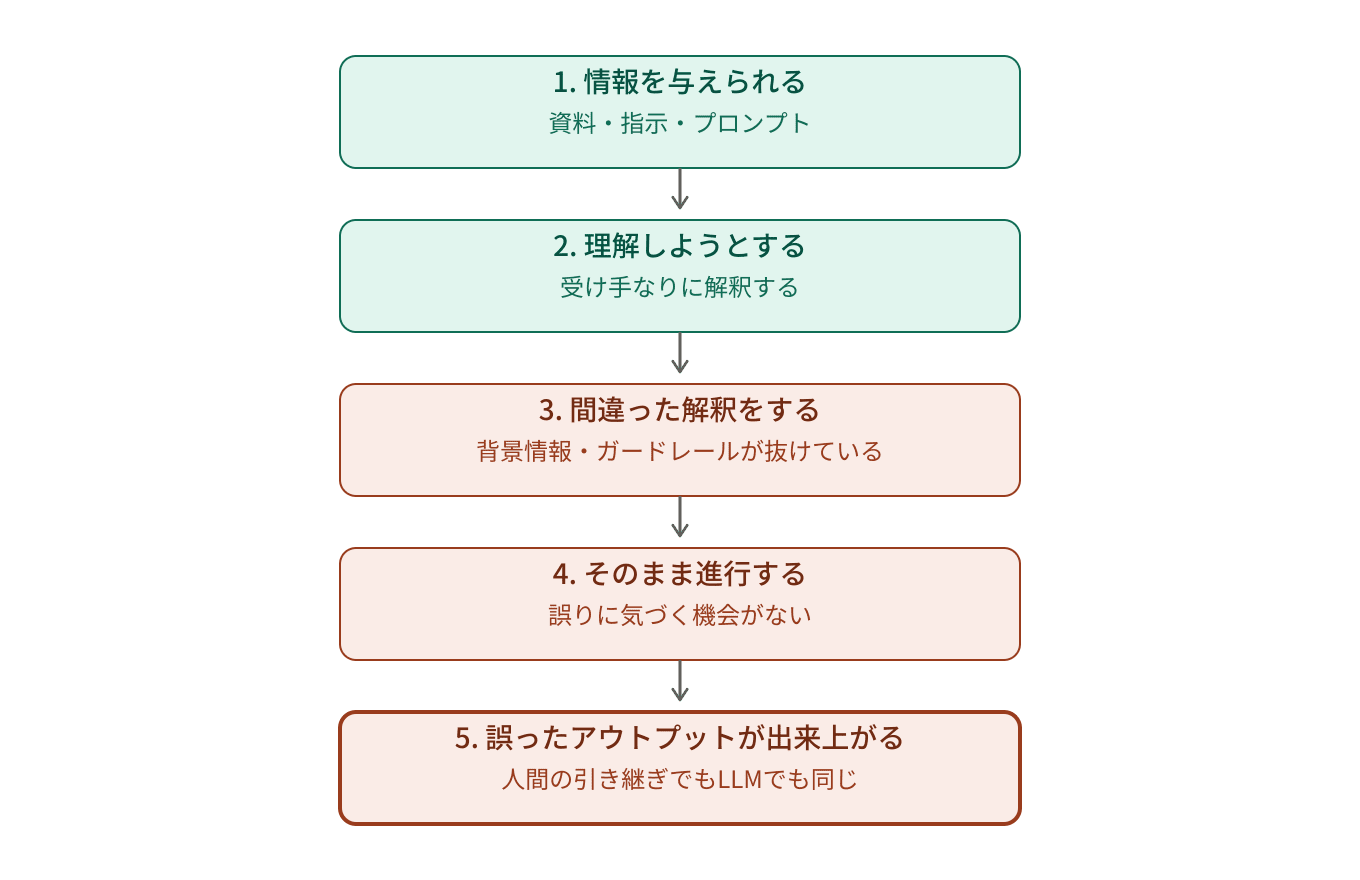
I'm not trying to say that the fault lies solely with the person doing the handing off. There are barriers on the receiving side—and on the AI's side—as well.
No matter how well-structured and high-quality the information you hand over may be, understanding the context that cuts across individual pieces of information—the background and the sequence of events that led to the current state of things—takes time.
Accepting this fact is important. Understanding takes time, and real barriers to understanding genuinely exist. If you skip over that and assume "I gave them the documents, so we're fine," you will absolutely, certainly, without question, 100% stumble later. (Slight exaggeration.)
At the same time, those who provide the information—those doing the handoff, or those giving instructions to AI—must also understand this difficulty. Before blaming the other party with "I gave them the materials" or "I put it in the prompt," keep in mind that there's a separate wall called understanding context.
What Matters Is "Passing Your Work to Someone Else," Not Just "Handing Over Instructions or Information"
Putting together what we've covered so far, one conclusion emerges. For the person handing off, the job isn't simply "passing along instructions and information." For the person using AI, the job isn't simply "handing over a prompt." That's not where the work ends.
What matters is having the mindset that you are passing your actual work itself to someone else.
Concretely, this means setting aside time upfront to help the other person retrace the background and process you went through, not treating a single handoff as the finish line but holding repeated meetings, and building in checks to gauge the other person's level of understanding.
These kinds of efforts are what's needed. The same applies to AI: giving context in stages, verifying outputs, refining prompts—the point is not to treat the handoff as done the moment you hit send.
Both Your Successor and Generative AI Are a "Mirror" of Your Own Work
I hope you've come to see, at least to some degree, that work handoffs and generative AI adoption share a common core difficulty.
So, how do we hand off work successfully?
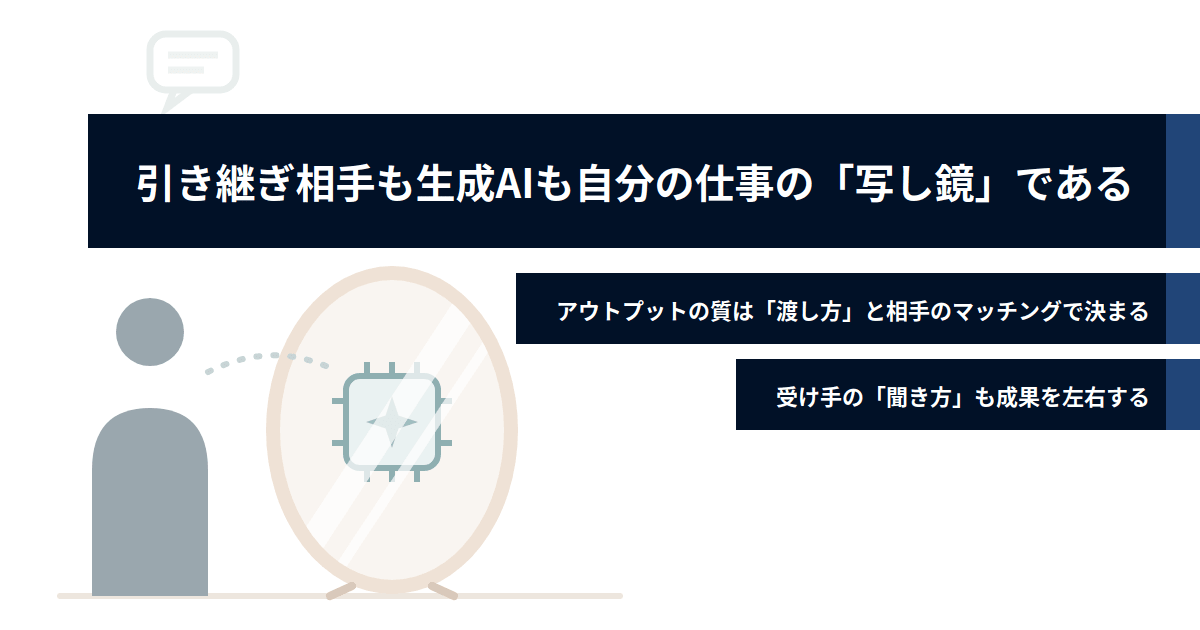
I believe the key is to think of both your successor and generative AI as a "mirror reflecting your own work."
The Quality of Output Is Determined by How You Hand It Off and How Well It Matches the Recipient
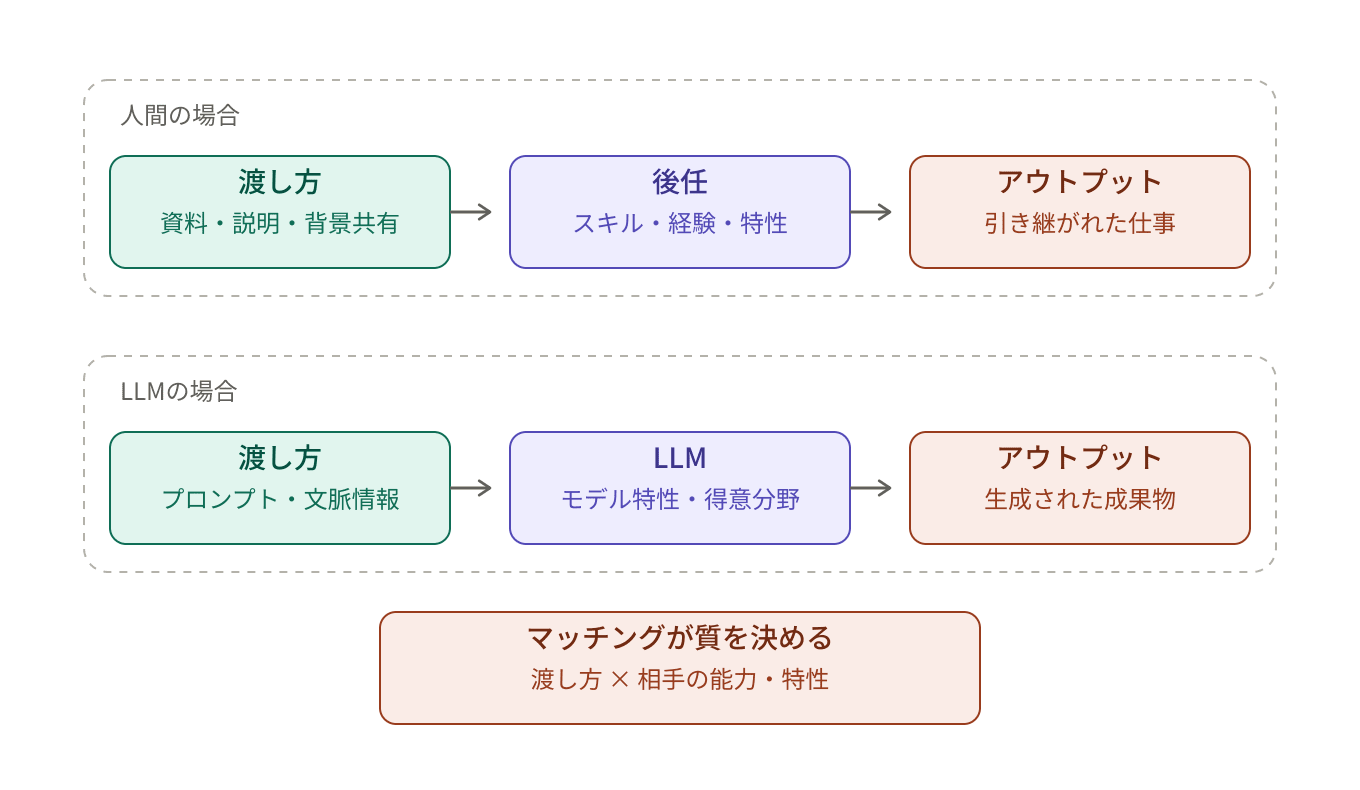
When the output from a successor or AI falls short, writing it off as "the other party lacks ability" is too hasty. That said, going to the other extreme and taking on "it was entirely the fault of how I handed it off" is equally unbalanced.
What matters is whether the other party's abilities and characteristics are matched by how you hand things off. Even with the same handoff approach, results will differ depending on the successor's skill set, or the AI model and its areas of strength. Adjusting how you hand things off to suit the other party is precisely where the skill of the person doing the handing off comes into play.
This is also the meaning behind the word "mirror." What's reflected in the output is not just the other party's capabilities. It also reflects how well you understood the other party and how you handed things off. That shows up in the results.
The Recipient's "Way of Asking" Also Shapes the Outcome
That said, it's not solely the problem of the person handing things off. The attitude of the recipient also has a major impact on the results.
Not leaving things you don't understand unaddressed, and asking questions freely whenever something is unclear—that's a perfectly valid approach.
And another important thing is clearly conveying "where your current understanding stands." What you understand and what you don't—showing that to the person handing things off allows them to judge what to supplement next.
This can also be applied to interactions with AI.
Including instructions like "please ask if there's anything unclear," or having it summarize its understanding to confirm where things currently stand—the structure is the same as with a human.
Both Humans and Generative AI Require Designed Dialogue
Whether it's a work handoff or generative AI adoption, the core difficulty lies in "passing work to someone else."
If that's the case, then treating "the handoff" as a one-time event is the wrong approach. Handing over documents and calling it done, or throwing a prompt and calling it done, won't get you where you want to go.
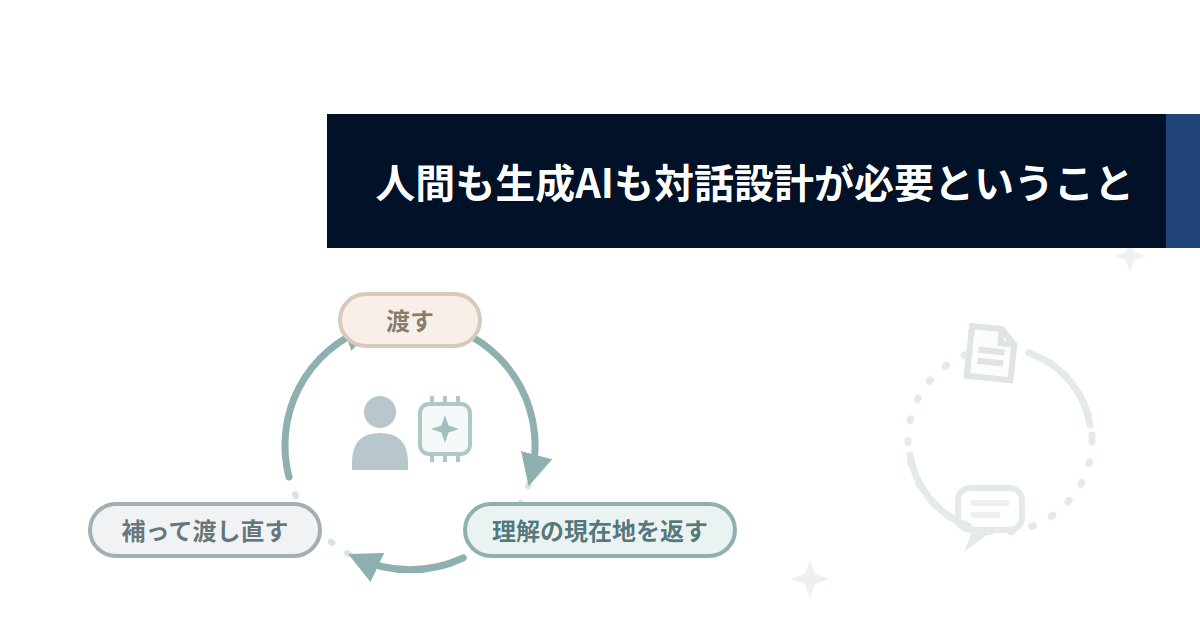
Hand things off. Have the recipient return their current state of understanding. Fill in the gaps and hand things off again. Designing this loop from the outset—that is what "dialogue design" means.
With humans, that looks like regular meetings and creating an environment where questions are easy to ask; with AI, it looks like confirming understanding through summaries and iteratively refining prompts. The form differs, but the structure is the same.