A Story About Trying to Streamline GuardDuty Detection Response with DevOps Agent #opsmethod Presentation Slides

This page has been translated by machine translation. View original
I presented a talk titled "A Story About Trying to Streamline GuardDuty Detection Response with DevOps Agent" at the Study Session opsmethod #3 "Operations × Security" held on 2026/09/04.
Thank you to everyone who attended!
I will share the slides and content from the presentation on this blog.
Slides
The following is an introduction to the slide content.
Topics Covered
This is a story about having AWS DevOps Agent assist with GuardDuty detection response. I built a mechanism that automatically runs an initial investigation triggered by a detection.
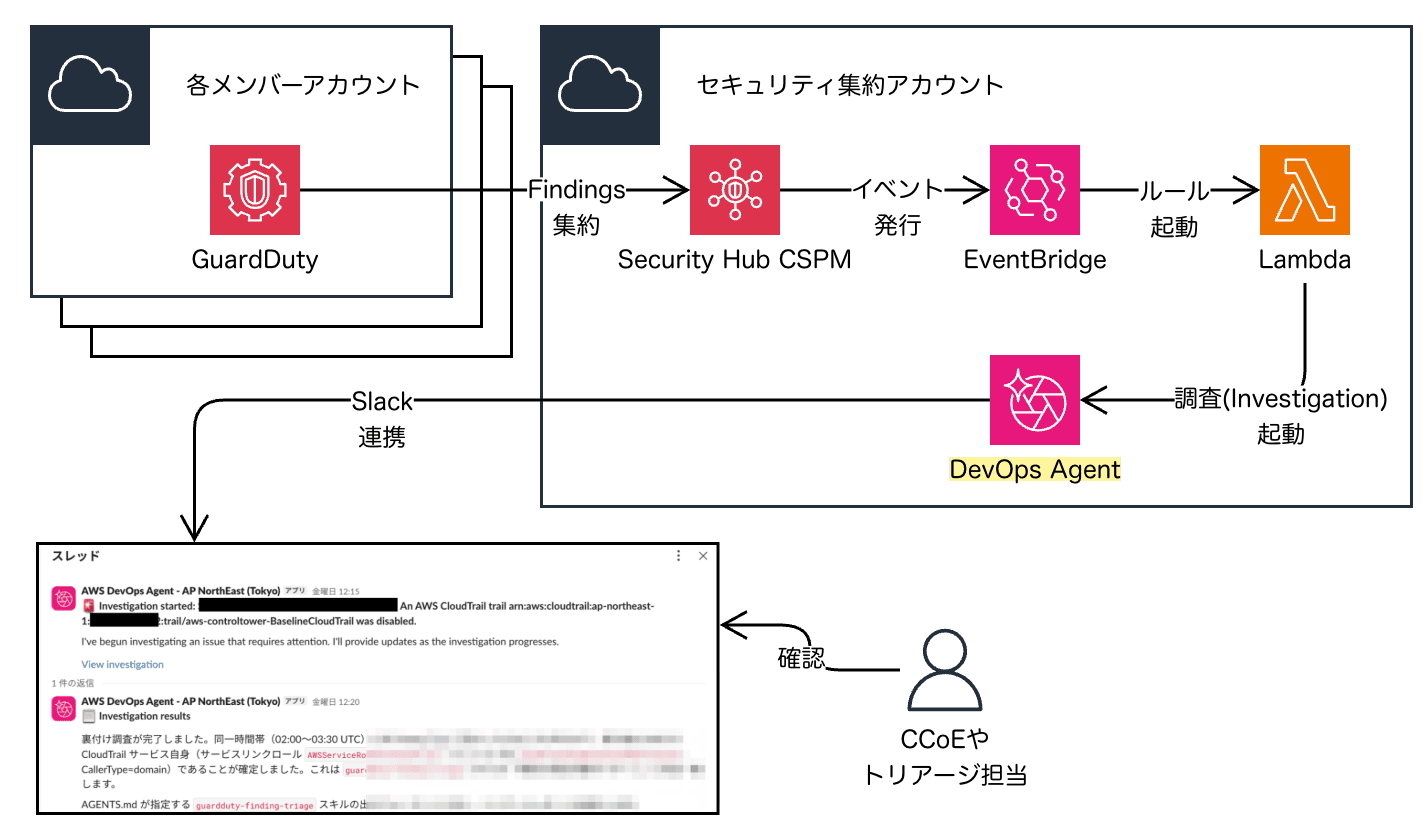
Overview of the flow from a GuardDuty detection triggering a DevOps Agent investigation to the results arriving in Slack
About GuardDuty and Detection Operations
Amazon GuardDuty
It is AWS's threat detection service. It detects suspicious activity from audit trails and network logs.
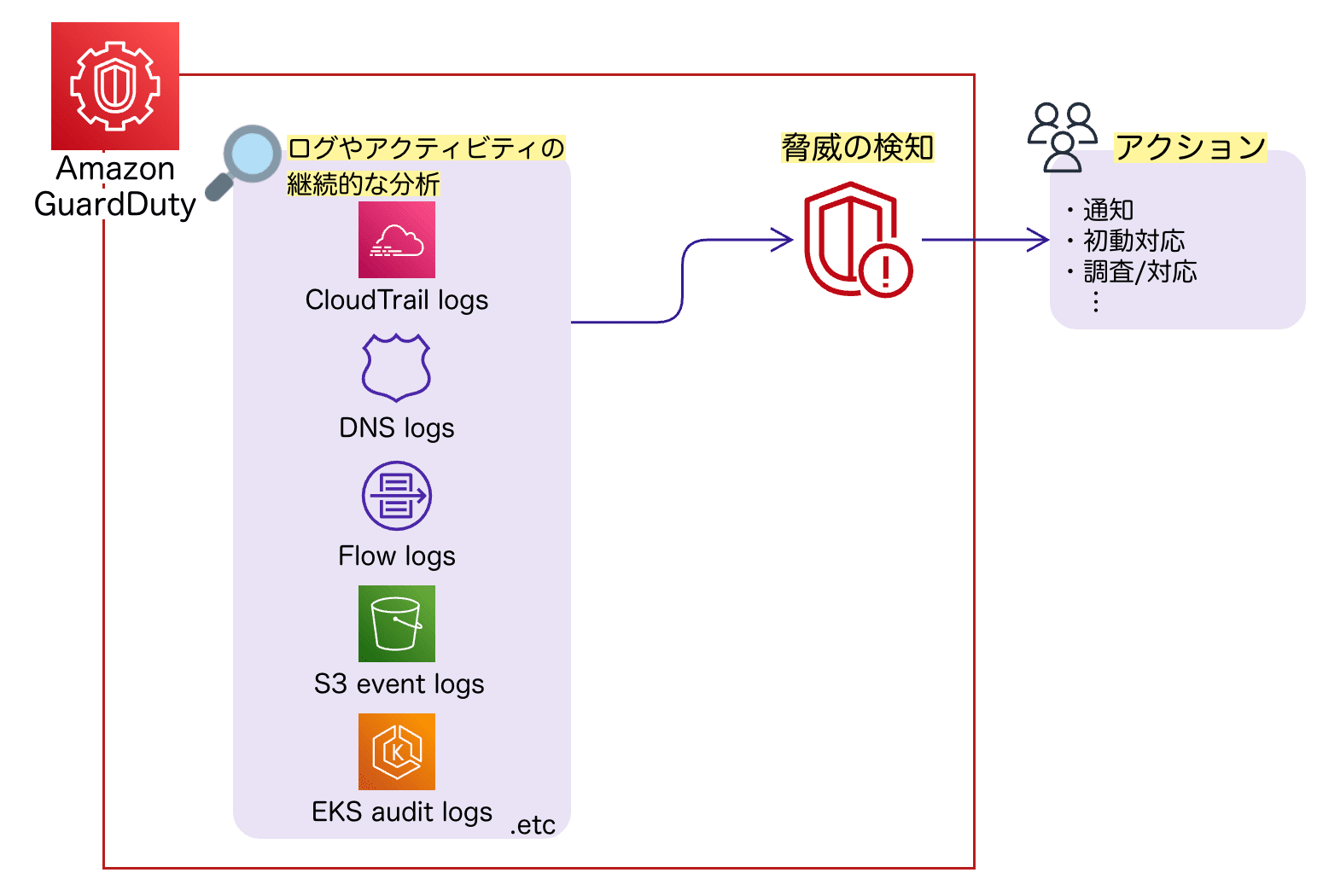
Continuously analyzes logs such as CloudTrail and DNS to detect threats
Response Flow After Detection
I tried DevOps Agent to make the "Investigation" phase faster and bring it closer to a consistent standard regardless of who performs it.
What Is AWS DevOps Agent
AWS DevOps Agent
It is a managed AI operations agent provided by AWS.
Triggered by alerts from CloudWatch alarms and monitoring tools, it investigates across logs, metrics, and configuration information to provide an assessment of what is happening and candidate responses.
Its behavior is principally limited to read-only operations and does not modify resources.
※ A feature that allows resource updates with approval was recently added.
Key Terms and Features
| Term/Feature | Brief Description |
|---|---|
| Agent Space | Logical container/boundary in which DevOps Agent operates |
| Web App | Dedicated web interface for operating the agent |
| Web App > Chat | Query infrastructure status in natural language |
| Web App > Incidents | Create investigations and review results and action plans |
| Web App > Improvements | Review improvement proposals for recurrence prevention |
| Web App > Topology | Architecture diagram visualizing resources and relationships |
Sample Chat Screen
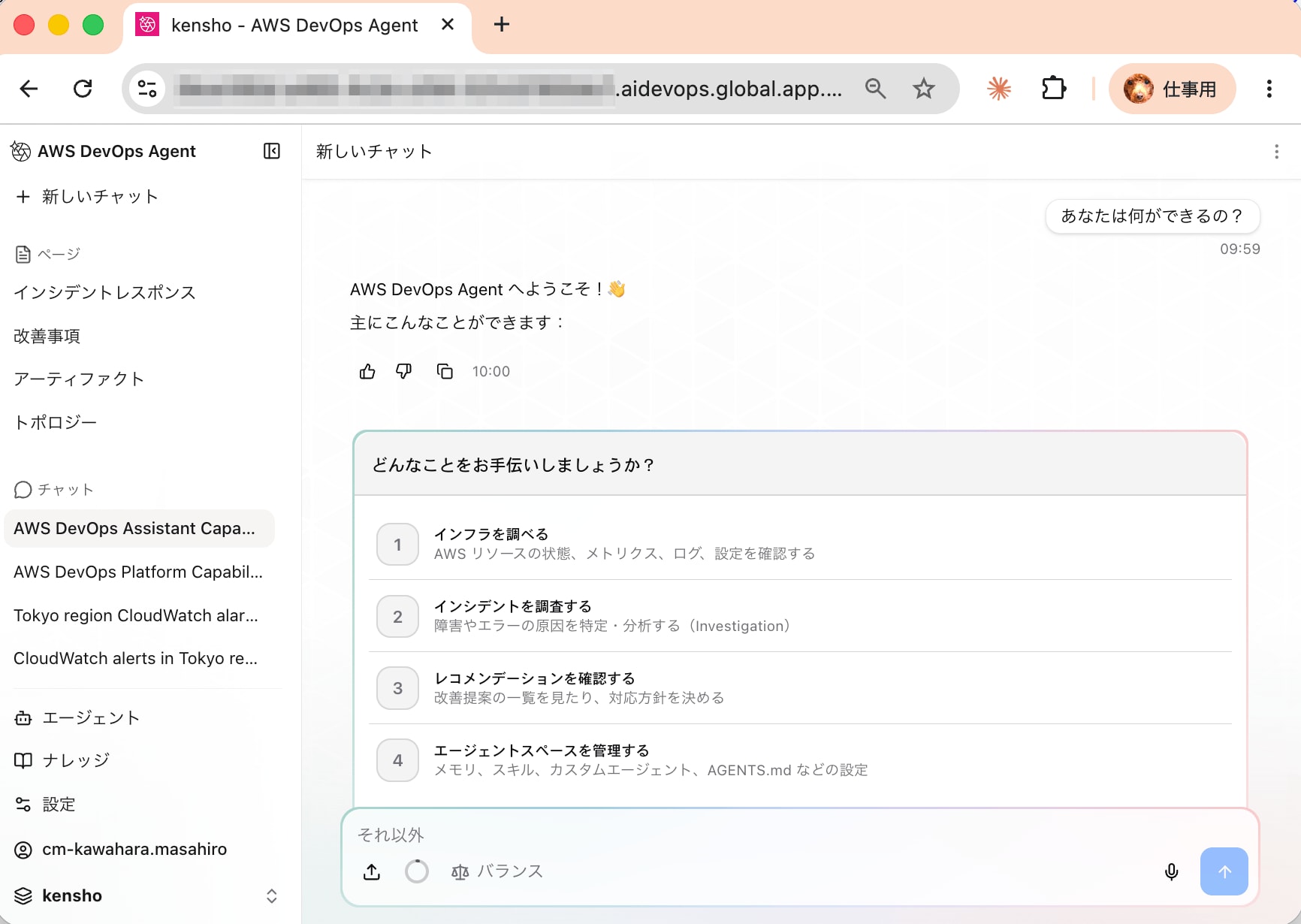
DevOps Agent Web app. You can query infrastructure status via chat
What Kind of Mechanism Was Built
Architecture Diagram
I built a mechanism that automatically runs a DevOps Agent investigation triggered by a GuardDuty detection.
Receives Findings in a security aggregation account and launches the investigation from Lambda
Utilizing Skills
Skills are used to standardize investigation procedures and output format.
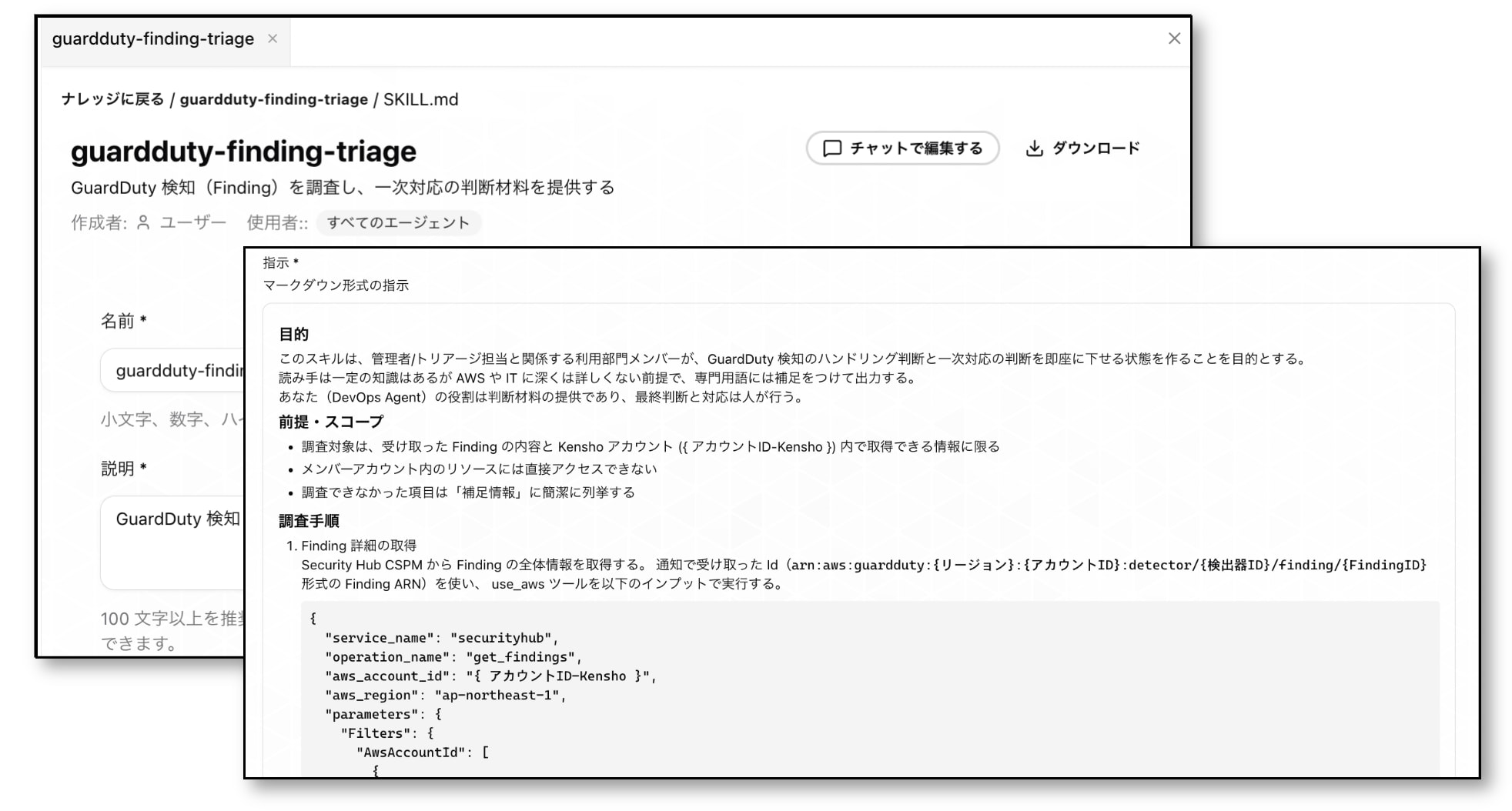
Skill guardduty-finding-triage describing investigation procedures and output format
Slack Integration
With Slack integration, investigation results are posted to a channel.
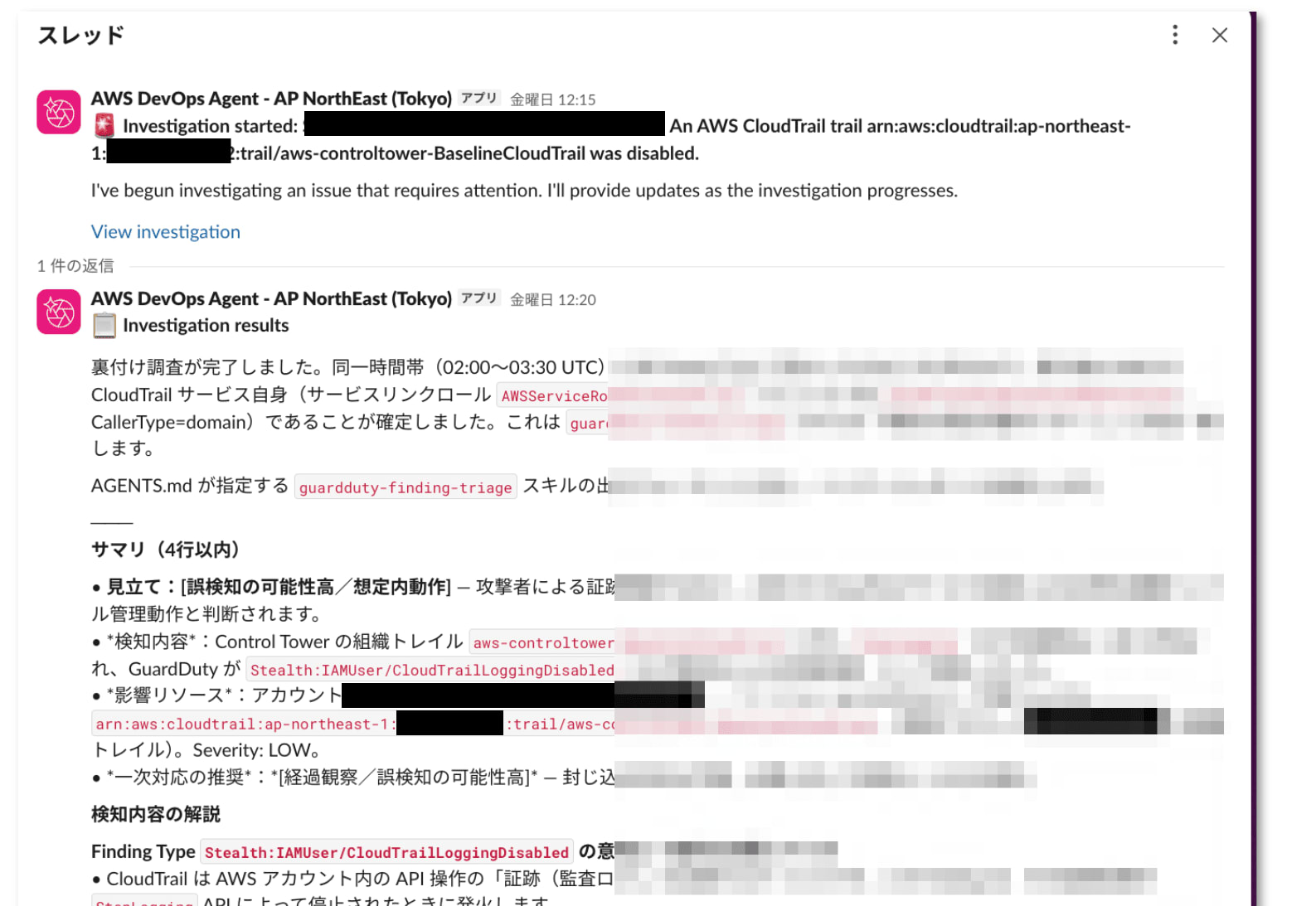
Investigation start and investigation results are posted in a thread
Closing Thoughts / Impressions
It produces a nicely structured summary! Since the meaning of the Finding Type, the estimated situation, and recommended actions are delivered in a structured format, I felt it eases the initial triage investigation to a reasonable degree.
However, for those who have been handling initial investigations for a long time, there is no small amount of content where the reaction is "the investigation results are helpful, but honestly I already knew that." If the only value is seen as reducing the time spent on initial investigations, the assessment could be that the impact of introducing DevOps Agent is not that significant.
What I felt is truly important is documenting the investigation flow and judgment criteria that existed only in the minds of the people responsible. Writing Agent Skills requires articulating "what procedure is used for investigation" and "which patterns are false positives," and through that process, tacit knowledge becomes explicit knowledge.
I believe DevOps Agent is also valuable as a catalyst for turning knowledge into explicit form.
References
- AWS DevOps Agent
- Agent Spaces - AWS DevOps Agent User Guide
- Agent Instructions - AWS DevOps Agent User Guide
- Agent Skills - AWS DevOps Agent User Guide
- I Presented a Talk Titled "AWS Operations Starting with DevOps Agent" | DevelopersIO
- A Story About Trying to Streamline GuardDuty Detection Operations in a Multi-Account Environment as CCoE with AWS DevOps Agent - DevelopersIO