
PowerShell 7 to Become the Built-in Shell for Windows (Windows PowerShell 5.1 to Be Deprecated)

This page has been translated by machine translation. View original
I'm Shibata.
In conjunction with Microsoft Ignite 2026, which began a few days ago, it was announced that PowerShell 7 will become a built-in shell for Windows clients and Windows Server.
It may be simple news, but for people like me who have been following PowerShell, it is also major news in that one of our long-cherished wishes is coming true.
In this article, I will explain this announcement.
Details and Timeline
When PowerShell 7.0 was released in 2020, building it into the Windows OS was set as the ultimate goal, but until now this point was hardly ever discussed...
In 2024, as if someone had suddenly remembered, a GitHub discussion titled "Should PowerShell 7.x ship inbox in Windows?" was started, but it ended up being mostly community hearings, and no concrete progress was made.
From there we arrived at the recent announcement, so my impression is that it was quite a sudden announcement.
Traditionally, the following two factors were cited as major obstacles to building it into the OS.
- Compatibility with Windows PowerShell 5.1, especially ensuring compatibility with the various official modules used in Windows Server, was difficult
- The modern lifecycle policy of PowerShell 7 (and the underlying .NET) does not match the OS support cycle
This announcement does not mean these points have been resolved; rather, the situation is closer to "we decided the schedule first, so now we'll get serious about it."
Regarding compatibility, the plan is to address it by making Windows PowerShell 5.1 and PowerShell 7 usable side by side, but in PowerShell 7.7, released last week, the MSI installer version was discontinued and changed to an MSIX package version, and the MSIX package version has feature limitations for security reasons.
The announcement also only states that the feature limitations of the MSIX package version will be "resolved going forward."
Timeline (Deprecation of Windows PowerShell 5.1)
The future timeline is summarized in a separate document, KB5137172.
With the publication of this KB, Windows PowerShell 5.1 is deprecated, active development is stopped, and only security updates will be provided.
(That said, in reality active development had already stopped quite a long time ago...)
The future timeline is as follows.
- As of 2026: Windows PowerShell 5.1 is deprecated, and Windows Server 2025 and Windows 11 26H2 become the final versions that include Windows PowerShell 5.1 as standard
- Next version of Windows: Windows PowerShell 5.1 becomes a Feature on Demand (FOD) and is enabled by default (both PowerShell 7 and Windows PowerShell 5.1 will be usable by default)
- Since it is a FOD, it should be possible to disable Windows PowerShell 5.1 later... but this has not been stated explicitly yet
- For Windows Server, this starts with the next release, Windows Server 2028
- For Windows clients, the next release has not yet been confirmed (I predict it will probably be Windows 11 27H2 (tentative))
- Future versions of Windows: Windows PowerShell 5.1 will become unavailable
- As of 2026, the specific version and schedule for its removal have not been decided
There are still parts whose details are not yet clear, but I think it is enough to grasp that PowerShell 7 will be built into the OS as standard in the next major release.
Migrating from Windows PowerShell 5.1 to PowerShell 7
Migration from Windows PowerShell 5.1 to PowerShell 7 is summarized in the following document... but at present it only explains the feature differences and does not provide a concrete explanation of how to migrate.
As mentioned above, building it into the OS is itself in the "now we'll get serious" phase, so it is probably better for users to do actual verification a bit later.
That said, I think it doesn't hurt to do some light operation checks with PowerShell 7 in the meantime.
Trying It Out
At Microsoft Ignite 2026, Windows Server 2028, the next Windows Server, was officially announced, and a preview version is available to try.
When I tried this Windows Server 2028, PowerShell 7 (Ver. 7.7.0) was indeed already installed and could be used alongside PowerShell 5.1.
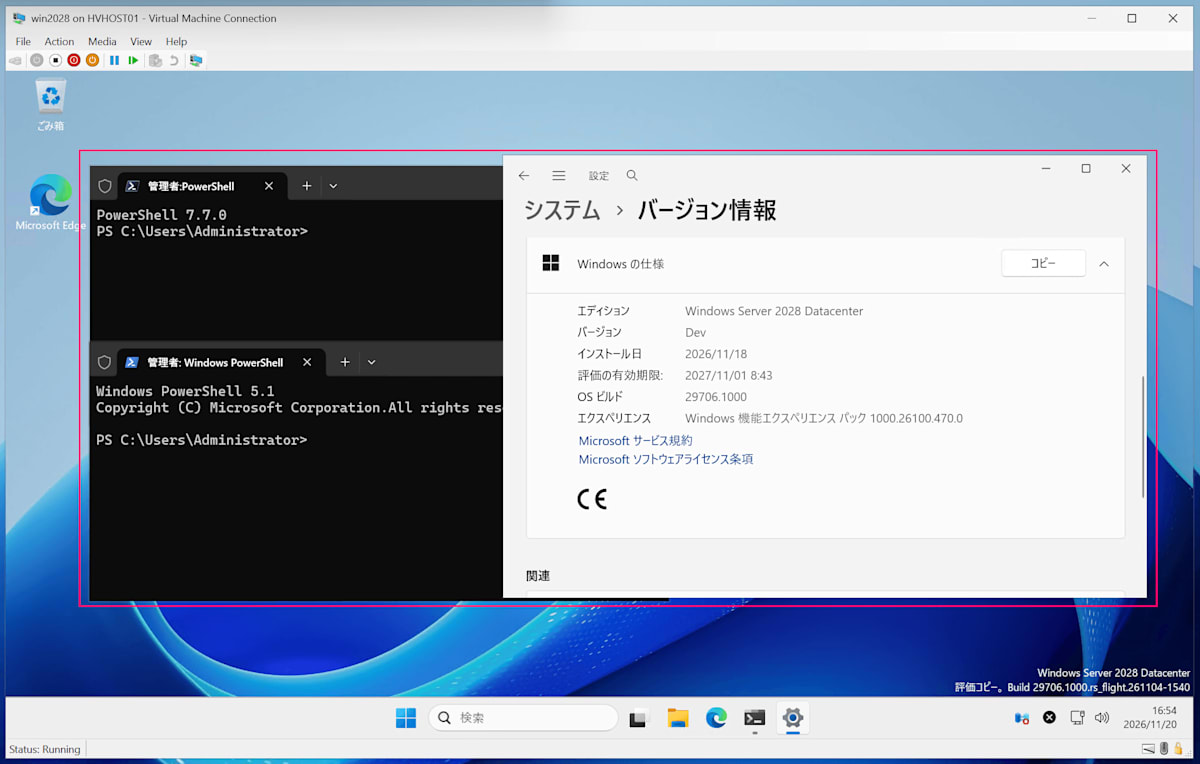
Windows Server 2028 preview on Hyper-V
# Get-AppxProvisionedPackage で標準組み込みであることを確認
PS C:\> Get-AppxProvisionedPackage -Online | Where-Object DisplayName -eq 'Microsoft.PowerShell'

DisplayName  : Microsoft.PowerShell
Version      : 2026.1110.418.0
Architecture : neutral
ResourceId   : ~
PackageName  : Microsoft.PowerShell_2026.1110.418.0_neutral_~_8wekyb3d8bbwe
Regions      : all
I was not able to remove PowerShell 5.1.
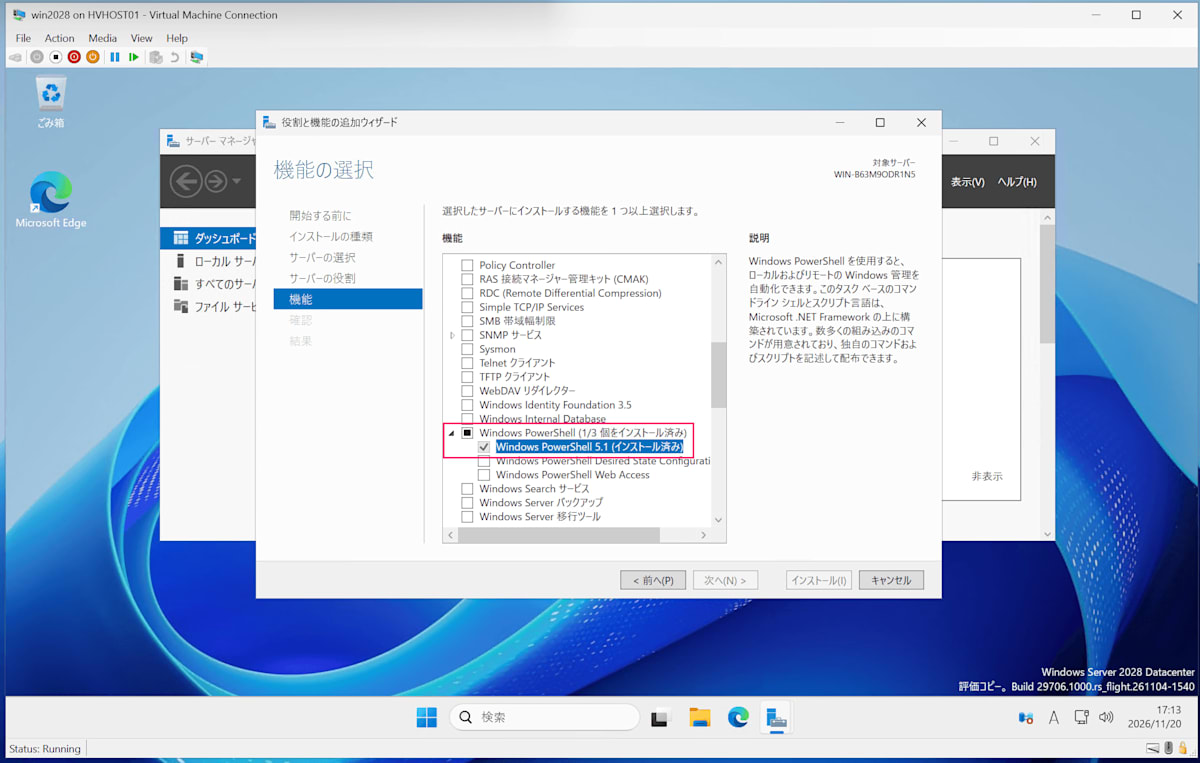
Cannot be deselected from feature selection
Side note: Windows PowerShell 2.0 has already ended
It didn't get much attention, but Windows PowerShell 2.0, which had been deprecated for some time, was removed in a security update around September 2025 and has completely ended.
I didn't write a blog post about it, but I personally confirmed at the time that Windows PowerShell 2.0 had been removed from EC2 Windows Server.
Conclusion
That's all, in brief.
I'm happy that a personal long-cherished wish is coming true, but since there are still many challenges remaining, I'd like to look forward to future developments.