![[Preview] AWS Interconnect is now available, making it easy to provision resilient, high-speed private network connections between AWS and other cloud service providers.](https://images.ctfassets.net/ct0aopd36mqt/33a7q65plkoztFWVfWxPWl/a718447bea0d93a2d461000926d65428/reinvent2025_devio_update_w1200h630.png?w=3840&fm=webp)
[Preview] AWS Interconnect is now available, making it easy to provision resilient, high-speed private network connections between AWS and other cloud service providers.

This page has been translated by machine translation. View original
I Want to Easily Provision Fast Private Connections Between AWS and Other Clouds
Hello, I'm Nonpi (@non____97).
Have you ever wanted to easily provision fast private connections between AWS and other clouds? I have.
These days, multi-cloud environments are not uncommon. In such cases, you may want AWS to communicate with other cloud service providers (hereafter CSPs) such as Google Cloud or Azure for system integration purposes.
In some cases, you can expose systems built on each CSP to the internet and integrate them via APIs, but organizational policies may require that connections between CSPs use private communication such as VPN.
There are two main approaches to address this:
- Establish a direct Site-to-Site VPN connection between CSPs
- Connect on-premises and each CSP using services like Direct Connect or Express Route, with on-premises acting as a hub to route traffic between CSPs
For the former approach, the following articles have been introduced on DevelopersIO as well.
On the other hand, while Site-to-Site VPN is easy to implement, the following concerns arise:
- Are there performance impacts such as latency and jitter due to routing through the internet?
- Is it acceptable from a security policy standpoint to route traffic through the internet?
For the latter approach, since it does not go through the internet, it is preferable from a security policy perspective.
However, it increases architectural complexity and raises the introduction/operational costs of routers and other equipment. Also, even if existing Direct Connect and Express Route connections are in place, there may be situations where you want to minimize the impact on existing circuit bandwidth, especially when large-scale communication between CSPs is expected for use cases such as data analysis.
This time, although in preview, AWS Interconnect has been introduced, enabling simple and resilient high-speed private network connections between AWS and other cloud service providers.
Two articles were also posted on the Google Cloud blog.
This makes it possible to alleviate the challenges mentioned earlier.
Reviewing the Specifications from the Documentation
Overview
Let's review the specifications from the following documentation.
AWS Interconnect is a service that establishes managed, high-speed network connections between private networks of different CSPs.
On the AWS side, you simply select the source region, the target CSP's region, and the bandwidth, then enter an activation key on the target CSP side.
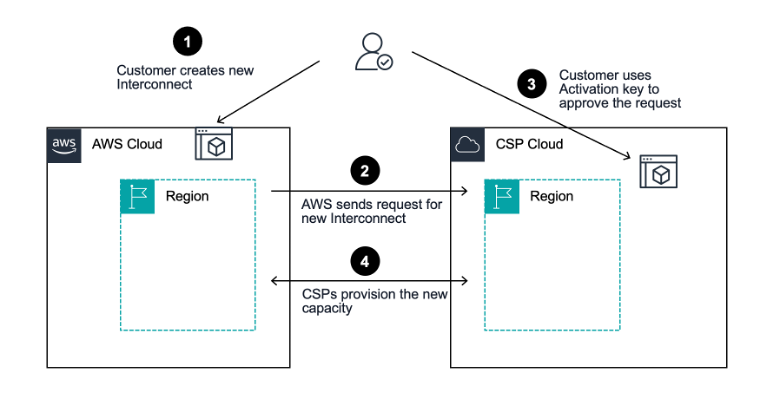
Not only are there fewer steps, but the connection between AWS and Google Cloud can reportedly be established in just a few minutes. That's impressive.
Fast provisioning and scaling
New Multicloud interconnects between AWS and Google Cloud are provisioned and configured in minutes. On General Availability, customers will be able to increase or decrease the bandwidth of a specific Multicloud connection by modifying that attribute, without the need to recreate the connection.
It's also convenient that you don't need to recreate the connection when changing bandwidth.
According to the Google Cloud blog, it will be possible to scale up to 100 Gbps at GA.
on-demand bandwidth starting at 1 Gbps during preview and scaling up to 100 Gbps at general availability.
How It Works
The mechanism involves communication through a facility that can connect to both AWS and Google Cloud.
You might think "In the end, routing through on-premises each time means more hops = increased latency," but clouds also have a physical layer. If this physical layer is optimized for AWS Interconnect, it should be possible to reduce performance impact compared to setting up your own on-premises hub for routing.
Also, as befitting a managed service, AWS Interconnect is distributed across multiple network devices spread across at least two physically separate buildings, each with independent power and network. It's great that the difficult parts of designing this yourself on-premises are covered.

A clear diagram was also posted in the Google Cloud blog article.
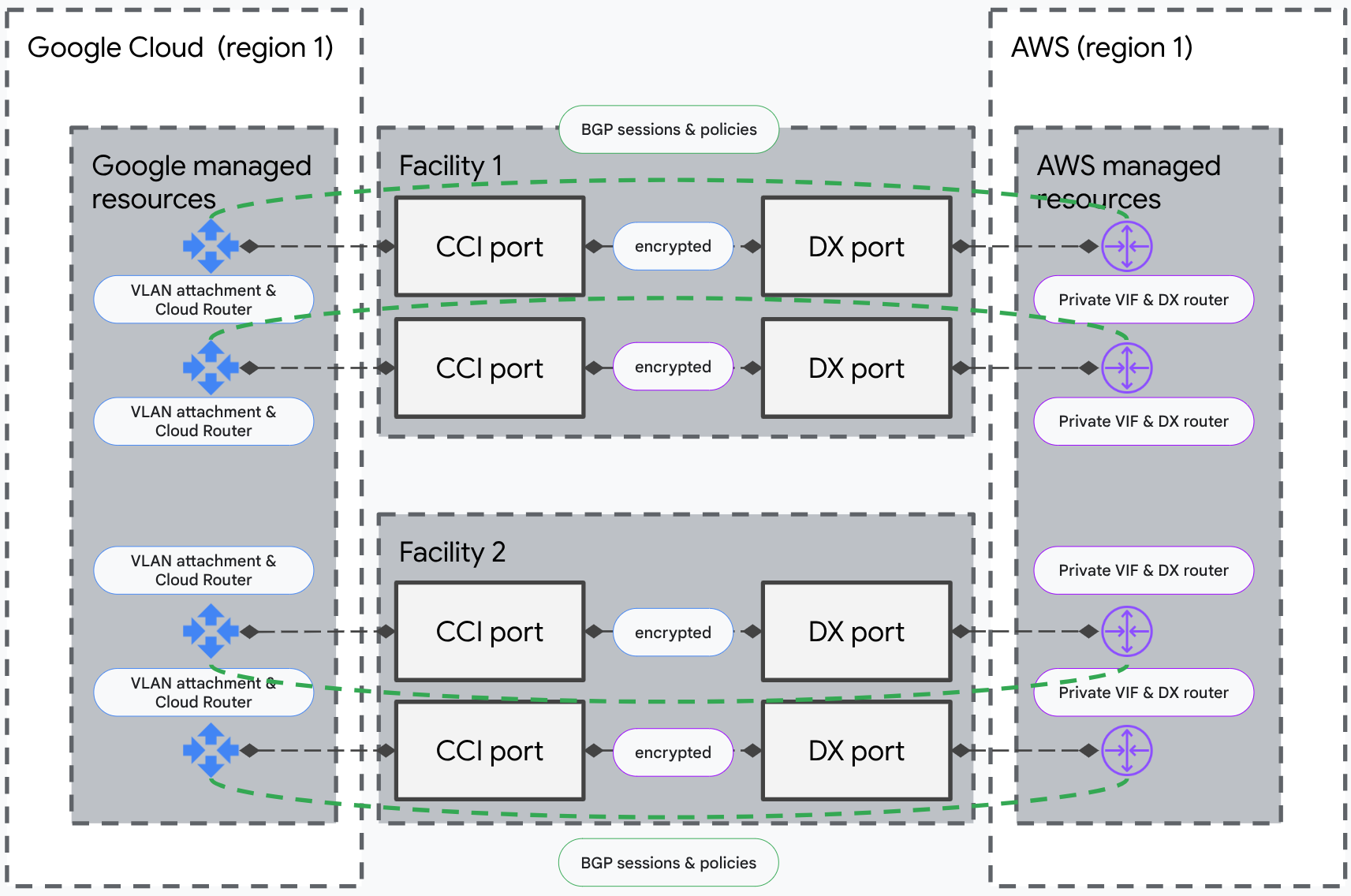
In terms of Direct Connect, it's easy to see that there are two Direct Connect Connections at each of two locations, making it quadruple-redundant.
The edge devices of CSPs connected via AWS Interconnect are encrypted using MACsec. To use MACsec with Direct Connect, you need to clear the following hurdles:
- You have a 10 Gbps, 100 Gbps, or 400 Gbps dedicated Direct Connect connection
- The endpoint router supports MACsec
- Only 256-bit MACsec keys are supported
- SCI must be enabled
Reference: MAC Security on Direct Connect - AWS Direct Connect
It's great that this is handled in a managed fashion.
Integration with AWS Network Services
Connections created by AWS Interconnect communicate via Direct Connect.
Therefore, it is possible to enable communication between VPCs and other CSP networks through VGW, Transit Gateway, or Cloud WAN.
Note that the regions of VGW and Transit Gateway connected to Direct Connect Gateway must be in specific combinations with the target CSP region.
Supported Regions
The available region combinations during preview are as follows:
| AWS | Google Cloud |
|---|---|
| us-east-1 | us-east4 |
| us-west-1 | us-west2 |
| us-west-2 | us-west1 |
| eu-west-2 | europe-west2 |
| eu-central-1 | europe-west3 |
Note that you cannot connect AWS us-east-1 with Google Cloud us-west-1.
Also, Azure support is expected in the second half of 2026, so let's look forward to that.
Pricing
During the public preview period, a 1 Gbps connection is available for free.
Pricing after GA will be announced at a later date.
However, the mention of being free during the public preview period was only found in the AWS documentation.
The name of the feature in Google Cloud equivalent to AWS Interconnect is Cross-Cloud Interconnect. This is a service that has existed for some time.
The pricing for this service is as follows, and it is not free.
| Resource | Price |
|---|---|
| Cross-Cloud Interconnect connection | $5.60/hour per 10 Gbps circuit |
| Cross-Cloud Interconnect connection | $30/hour per 100 Gbps circuit |
| 50, 100, 200, 300, 400, 500 Mbps VLAN attachments | $0.10/hour per VLAN attachment |
| 1, 2, 5, 10 Gbps VLAN attachments | $0.10/hour per VLAN attachment |
| 20 Gbps VLAN attachments | $0.20/hour per VLAN attachment |
| 50 Gbps VLAN attachments | $0.50/hour per VLAN attachment |
| 100 Gbps VLAN attachments | $1.00/hour per VLAN attachment |
| Connection Location | VLAN Attachment Region | Price |
|---|---|---|
| Asia* | Asia* | $0.042/GiB |
※ Data transfer pricing is excerpted only for cases where both the source and destination of communication are in Asia
Excerpt: Pricing | Google Cloud
The minimum bandwidth per circuit starts at $5.60/h, and if you want quadruple redundancy, that would be $22.40/h. The pricing for connections extending from AWS Interconnect may be introduced at GA, but it doesn't seem highly likely that prices will drop dramatically from this.
Let's keep an eye on the pricing when the service is carved out as Cross-Cloud Interconnect for AWS.
Tried to Give It a Go
Now let's actually try it out.
The implementation method is introduced in the following official AWS documentation.
Go to the AWS Direct Connect Console and navigate to AWS Interconnect on the left side navigation menu.
From this, it seems that AWS Interconnect is a feature within Direct Connect.
Let's open the Direct Connect management console.
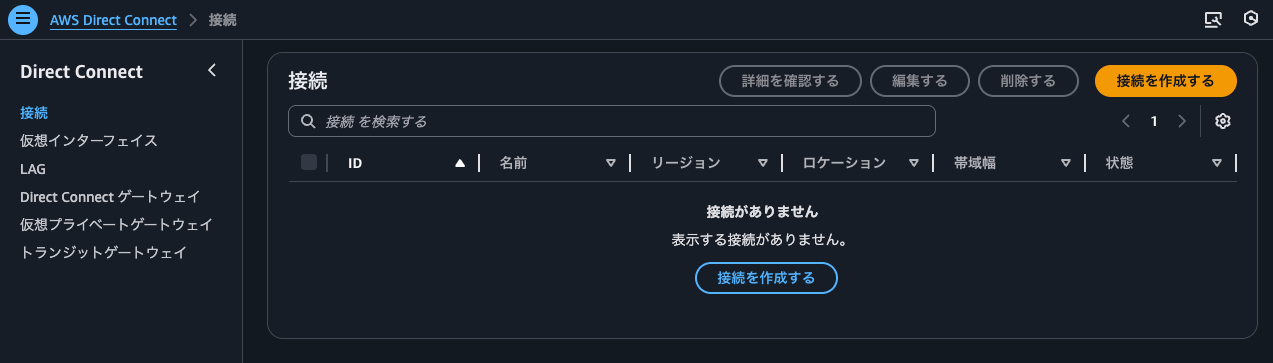
Yes, there is no AWS Interconnect item.
I checked with other AWS accounts and tried changing the language from Japanese to English, but could not find any mention of AWS Interconnect.
Searching through the documentation, it appears that onboarding will be held within a few weeks after re:Invent 2025.
AWS Interconnect was announced in Preview at re:Invent 2025 with Google Cloud. Customers will be able to begin onboarding to the new service in the weeks immediately following the event.
I'll wait.
When You Want Managed, Resilient, High-Speed Private Network Connections Between AWS and Other CSPs
I introduced AWS Interconnect.
This is a very welcome feature when you want managed, resilient, high-speed private network connections between AWS and other CSPs.
Once I'm able to actually get my hands on it, I plan to post another verification article.
I hope this article is helpful to someone.
That's all from Nonpi (@non____97) of the Cloud Business Division, Consulting Department!