I tried running Qwen3.6-35B-A3B on Amazon SageMaker and getting streaming responses

This page has been translated by machine translation. View original
Introduction
When you want to try large LLMs, you may not have enough GPU memory on hand. On the other hand, setting up a GPU server just for verification and managing the OS and CUDA is also a hassle.
So, I embedded the 21 GB-class Q4_K_M GGUF of Qwen3.6-35B-A3B and a pinned llama.cpp into a custom container, and ran it on SageMaker Real-time Inference using ml.g5.2xlarge. The model is not included in the container; instead, it is deployed to SageMaker from Amazon S3.
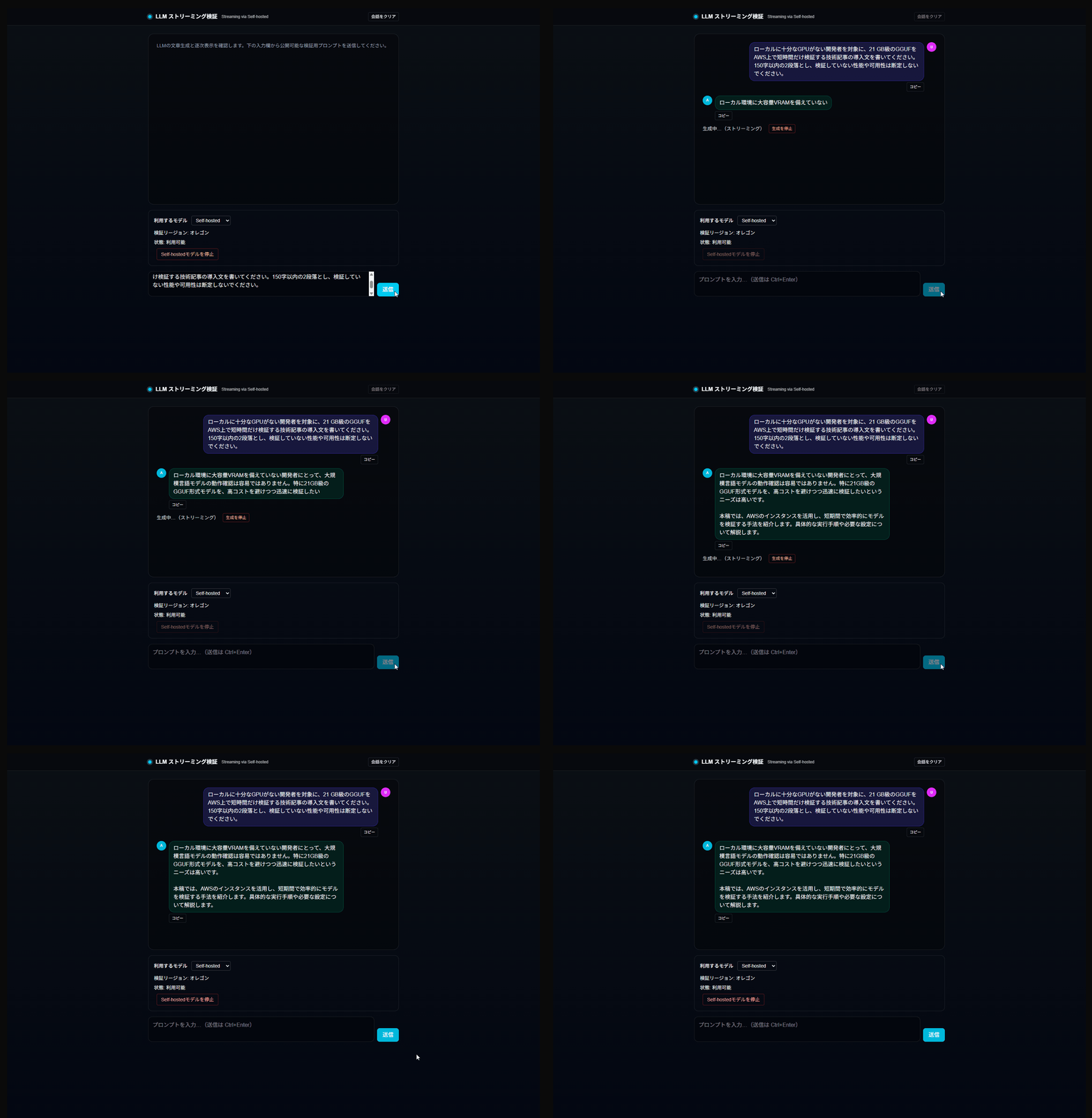
The following GIF shows the responses from Qwen3.6 being displayed sequentially after calling the SageMaker endpoint from a Next.js verification app.
What is SageMaker Real-time Inference
SageMaker Real-time Inference is a feature that hosts inference containers as always-on endpoints. It supports custom containers and also supports Response Streaming.
What is Qwen3.6
Qwen3.6 is an open-weight model published by the Qwen team. The Qwen3.6-35B-A3B used in this article is a MoE model with a total of 35B parameters and 3B effective parameters during inference. Rather than the official model weights, I verified the Q4_K_M GGUF distributed by LM Studio Community.
Verification Environment
- Region:
us-west-2 - Instance:
ml.g5.2xlarge - GPU: NVIDIA A10G, 24 GB
- Model:
lmstudio-community/Qwen3.6-35B-A3B-GGUF - GGUF:
Qwen3.6-35B-A3B-Q4_K_M.gguf - GGUF Size: 21,166,757,728 bytes
- Context Length: 16,384
- Parallel Slots: 1
- llama.cpp:
86a9c79f866799eb0e7e89c03578ccfbcc5d808e - Image digest at time of verification:
sha256:bbc7ad869bc41d90644e170e3d077aa5ff93a1cf93333cfe9b3ad9789519bedc - CUDA: 12.4.1
- Terraform: 1.15.8
- AWS Provider: 6.49.0
ml.g5.2xlarge is equipped with 24 GB of GPU memory, 8 vCPUs, and 32 GiB of host memory. Instance specifications can be checked at Amazon EC2 G5 Instances.
Before running, set ml.g5.2xlarge for endpoint usage in Service Quotas to 1 or more. The quota code at the time of verification was L-9614C779.
Target Audience
- Those who want to try LLMs that don't fit in their local GPU on AWS
- Those who want to run GGUF and llama.cpp in a SageMaker custom container
- Those who want to receive generation results sequentially using SageMaker Response Streaming
References
- Custom Inference Code with Hosting Services
- Deploying uncompressed models
- InvokeEndpointWithResponseStream
- Invoke models for real-time inference
- SageMaker Pricing
- Hugging Face Hub CLI
- Qwen3.6-35B-A3B
- Qwen3.6-35B-A3B-GGUF
Verification Architecture and Technology Choices
The requirements are the following three:
- Be able to use any GGUF with a pinned llama.cpp
- Be able to receive generation results sequentially
- Be able to stop the GPU after verification
The architecture is as follows.
You cannot bring GGUF and llama.cpp directly into Amazon Bedrock. GPU-equipped Amazon EC2 requires managing the OS and inference processes. Since Processing Jobs and Asynchronous Inference are asynchronous, I chose Real-time Inference, which supports Response Streaming.
Preparing the Model and Container
Pinning the GGUF
For third-party distributed GGUFs, the exact revision of the source and the quantization command are not publicly available. Therefore, I pinned the revision of the distribution repository, the file size, and the SHA-256 of the actual file.
| Item | Value |
|---|---|
| Distributor | lmstudio-community/Qwen3.6-35B-A3B-GGUF |
| Revision | c7ed48a94a6a082167b768bab350745695824e0a |
| File | Qwen3.6-35B-A3B-Q4_K_M.gguf |
| Quantization | Q4_K_M |
| Size | 21,166,757,728 bytes |
| SHA-256 | 4ac6a06bce551257267f49ad2226f8671a22519ccc1a4dde9d5b433d1f2a410d |
| License Metadata | Apache-2.0 |
stat --format='%s' ./Qwen3.6-35B-A3B-Q4_K_M.gguf
sha256sum ./Qwen3.6-35B-A3B-Q4_K_M.gguf
After confirming the SHA-256 match, I placed it in a private S3 bucket with versioning and Block Public Access enabled. In SageMaker's ModelDataSource, a single uncompressed object is specified. According to AWS specifications, when S3DataType = "S3Object" and CompressionType = "None", the file is placed at /opt/ml/model.
llama.cpp Container
The container includes llama.cpp compiled for CUDA with a pinned commit hash, and a SageMaker adapter. To avoid rebuilding the large image every time the model changes, the GGUF is not included.
The llama.cpp commit hash is pinned and llama-server is built with CUDA enabled.
ARG LLAMA_CPP_COMMIT=86a9c79f866799eb0e7e89c03578ccfbcc5d808e

WORKDIR /src
RUN git init llama.cpp \
    && cd llama.cpp \
    && git remote add origin https://github.com/ggml-org/llama.cpp.git \
    && git fetch --depth 1 origin "${LLAMA_CPP_COMMIT}" \
    && git checkout --detach FETCH_HEAD \
    && test "$(git rev-parse HEAD)" = "${LLAMA_CPP_COMMIT}"

RUN cmake -S /src/llama.cpp -B /src/llama.cpp/build -G Ninja \
        -DCMAKE_BUILD_TYPE=Release \
        -DCMAKE_CUDA_ARCHITECTURES="86;89" \
        -DGGML_CUDA=ON \
        -DLLAMA_BUILD_SERVER=ON \
    && cmake --build /src/llama.cpp/build --target llama-server --parallel
The adapter's responsibilities are as follows:
- Provide
/pingand/invocationson port8080as required by SageMaker - Verify the GGUF file size and SHA-256 before starting llama.cpp
- Forward llama.cpp's OpenAI-compatible SSE as an HTTP chunked response
- Do not write prompts and generated content to regular logs
/ping returns 200 after llama.cpp's /health succeeds. /invocations forwards llama.cpp's SSE as a chunked response. The full code including input validation and error handling is in the appendix.
def do_GET(self) -> None:
    request_id = self.headers.get("X-Request-Id") or str(uuid.uuid4())
    if self.path != "/ping":
        self.send_json(404, {"error": "not_found"}, request_id)
        return
    ready = upstream_ready()
    self.send_json(
        200 if ready else 503,
        {"status": "ok" if ready else "unavailable"},
        request_id,
    )

def do_POST(self) -> None:
    # Input validation and upstream_request assembly omitted
    ...
    with request.urlopen(upstream_request, timeout=UPSTREAM_TIMEOUT_SECONDS) as response:
        if response.headers.get_content_type() != "text/event-stream":
            self.send_json(502, {"error": "model_server_invalid_content_type"}, request_id)
            return

        self.send_response(response.status)
        self.send_header("Content-Type", "text/event-stream")
        self.send_header("Transfer-Encoding", "chunked")
        self.end_headers()

        while chunk := response.read1(64 * 1024):
            self.wfile.write(f"{len(chunk):X}\r\n".encode("ascii"))
            self.wfile.write(chunk)
            self.wfile.write(b"\r\n")
            self.wfile.flush()
        self.wfile.write(b"0\r\n\r\n")
Creating the Endpoint with Terraform
In Terraform, I created a log group, execution role, SageMaker Model, EndpointConfig, and endpoint. The S3 VersionId and ECR image digest are pinned as input values and verified against the current objects during terraform plan.
The EndpointConfig starts one ml.g5.2xlarge instance. The timeouts for model download and health check are 1,800 seconds each.
The model is placed as an uncompressed S3 object, and the file name, size, and SHA-256 are passed to the container. The EndpointConfig pins the instance and timeout used for verification.
resource "aws_sagemaker_model" "llama" {
  name                     = "${var.name_prefix}-model"
  execution_role_arn       = aws_iam_role.sagemaker.arn
  enable_network_isolation = true

  primary_container {
    image = var.container_image_uri
    mode  = "SingleModel"

    model_data_source {
      s3_data_source {
        compression_type = "None"
        s3_data_type     = "S3Object"
        s3_uri           = "s3://${var.artifact_bucket_name}/${var.model_object_key}"
      }
    }

    environment = {
      MODEL_FILE                = "Qwen3.6-35B-A3B-Q4_K_M.gguf"
      MODEL_ARTIFACT_SIZE_BYTES = tostring(var.model_size_bytes)
      MODEL_ARTIFACT_SHA256     = var.model_sha256
      CONTEXT_SIZE              = "16384"
      PARALLEL                  = "1"
      GPU_LAYERS                = "999"
    }
  }
}

resource "aws_sagemaker_endpoint_configuration" "realtime" {
  name = "${var.name_prefix}-config"

  production_variants {
    variant_name           = "AllTraffic"
    model_name             = aws_sagemaker_model.llama.name
    initial_instance_count = 1
    instance_type          = "ml.g5.2xlarge"

    model_data_download_timeout_in_seconds            = 1800
    container_startup_health_check_timeout_in_seconds = 1800
  }
}

resource "aws_sagemaker_endpoint" "realtime" {
  name                 = var.name_prefix
  endpoint_config_name = aws_sagemaker_endpoint_configuration.realtime.name
}
Because initial_instance_count = 1, GPU preparation begins at the same time the endpoint is created. Even if the Service Quotas API applied value is 1 or more, InsufficientInstanceCapacity may occur due to insufficient capacity.
Streaming Inference
The container returns llama.cpp's SSE as an HTTP chunked response. On the caller side, I used the AWS SDK for JavaScript's InvokeEndpointWithResponseStreamCommand.
The PayloadPart returned by the AWS SDK is not guaranteed to have the same boundaries as the chunks on the container side. Each byte array is passed sequentially to a streaming TextDecoder, which reconstructs them even if they are split in the middle of a UTF-8 character or SSE event.
async function* readSse(
  chunks: AsyncIterable<Uint8Array>,
): AsyncGenerator<string> {
  const decoder = new TextDecoder("utf-8");
  let buffer = "";

  for await (const chunk of chunks) {
    buffer += decoder.decode(chunk, { stream: true });

    while (true) {
      const match = buffer.match(/\r?\n\r?\n/);
      if (!match || match.index === undefined) break;

      const block = buffer.slice(0, match.index);
      buffer = buffer.slice(match.index + match[0].length);

      const data = block
        .split(/\r?\n/)
        .map((line) => line.match(/^data:\s?(.*)$/)?.[1])
        .filter((line): line is string => line !== undefined)
        .join("\n");

      if (data) yield data;
    }
  }

  buffer += decoder.decode();
  if (buffer.trim()) {
    const data = buffer
      .split(/\r?\n/)
      .map((line) => line.match(/^data:\s?(.*)$/)?.[1])
      .filter((line): line is string => line !== undefined)
      .join("\n");
    if (data) yield data;
  }
}
Only PayloadPart.Bytes is extracted from the InvokeEndpointWithResponseStreamCommand response and passed to the above function. If reading is aborted, the AWS SDK call is also aborted using AbortController.
const response = await client.send(
  new InvokeEndpointWithResponseStreamCommand({
    EndpointName: endpointName,
    ContentType: "application/json",
    Accept: "text/event-stream",
    Body: new TextEncoder().encode(JSON.stringify(requestBody)),
  }),
  { abortSignal: abortController.signal },
);

if (!response.Body) throw new Error("response body is missing");

const payloads = (async function* () {
  for await (const event of response.Body!) {
    if (!isPayloadPart(event) || !event.PayloadPart.Bytes) {
      throw new Error("SageMaker response stream failed");
    }
    yield event.PayloadPart.Bytes;
  }
})();

for await (const data of readSse(payloads)) {
  if (data === "[DONE]") break;
  const event = JSON.parse(data);
  const delta = event?.choices?.[0]?.delta?.content;
  if (typeof delta === "string") process.stdout.write(delta);
}
The complete code including request body construction is in the appendix.
Results
Input and Output
Using publicly shareable synthetic data, I sent the following message.
system:
You are a concise and safe Japanese assistant.

user:
Please suggest three creative activities to enjoy at home on a rainy day, one sentence each.
The raw generated output is as follows. No modifications including wording have been made.
1. 好きな曲に合わせて、その日の気分や雨の音をイメージした短歌や詩を書いてみましょう。
2. 家に転がっている古紙や布を使って、自分だけのオリジナルカードや小物を作ってみましょう。
3. 窓から見える雨景色をスケッチしたり、写真に収めたりして、アート作品に仕上げてみましょう。
Streaming Verification from the Next.js App
The same configuration was called from the Next.js verification app, converting SageMaker events into display deltas for the screen.
The following GIF shows the screen from sending the prompt after the endpoint becomes available, through the sequential display of the response, until completion. The measurements in the next section were obtained by calling the AWS SDK directly.
Measurements
Using this input, I confirmed both successful completion and client abort against the same endpoint. Generation settings are max_tokens = 192, temperature = 0.2, top_p = 0.9, seed = 42, thinking disabled.
| Item | Measured Value |
|---|---|
Endpoint creation to InService |
302.771 seconds |
| Adapter startup | Approximately 245.7 seconds after endpoint creation |
| SHA-256 verification inside container | 20.019 seconds |
| llama.cpp model load | Approximately 3.95 seconds |
| Warm TTFT | 2,058 ms |
| Time to successful completion | 2,601 ms |
PayloadPart count |
92 |
| Non-empty display deltas | 76 |
| Generated tokens | 77 |
| Generation speed recorded by llama.cpp | 123.71 tokens/second |
| Client abort | Completed in 578 ms after receiving the first delta |
terraform destroy |
17.280 seconds |
The 302.771 seconds from endpoint creation to InService includes instance preparation, model placement from S3, container startup, SHA-256 verification, and model loading. The llama.cpp model load itself took approximately 3.95 seconds.
The unit price for ml.g5.2xlarge in us-west-2 at the time of verification was 1.515 USD/hour. Calculating approximately 910 seconds from the start of terraform apply to the completion of terraform destroy as fully billed time, the cost is approximately 0.383 USD.
The measurements are results from a single run of a short, single prompt.
Deletion Results
terraform destroy completed in 17.280 seconds. I cross-checked the SageMaker listing against the Terraform state and confirmed that no endpoint, EndpointConfig, or SageMaker Model remained. The S3 model and ECR image are retained for reuse.
Discussion
From endpoint creation to InService was 302.771 seconds, the model load inside the container was approximately 3.95 seconds, and the warm TTFT was 2,058 ms. When used from a stopped state, the wait time is likely more strongly influenced by instance preparation and model placement than by the model inference itself. When integrating into a web app, treating endpoint startup and prompt submission as separate operations would make it easier for users to understand the wait time.
By separating the model into S3 and llama.cpp into ECR, the GGUF can be swapped out without rebuilding the container image. Since the same llama.cpp commit and inference conditions can be maintained, this approach could also be used to compare multiple quantized models in the same execution environment.
I was also able to display responses sequentially from the Next.js verification app. SageMaker Real-time Inference seems usable not only for verifying model loading, but also as a prototyping environment for web apps that use custom models.
Summary
I was able to load the 21 GB-class Q4_K_M GGUF of Qwen3.6 onto ml.g5.2xlarge and receive responses sequentially via SageMaker Response Streaming. The warm TTFT was 2,058 ms, the time from endpoint creation to InService was 302.771 seconds, and the estimated cost from creation to deletion was approximately 0.383 USD.
While you can try any GGUF without managing the GPU host OS, maintaining custom containers and creating/deleting endpoints is still necessary. For short-term verification where this operational overhead is acceptable, SageMaker Real-time Inference is a viable option.
Appendix
From here, I present the pinned values and code needed for reproduction. AWS account IDs, actual ARNs, bucket names, ECR repository names, and S3 VersionIds are replaced with placeholders.
Retrieving and Placing the Model
The Hugging Face CLI target is pinned by revision and file name. If the size and SHA-256 do not match after downloading, do not upload to S3.
python -m pip install --upgrade huggingface_hub

hf download \
  lmstudio-community/Qwen3.6-35B-A3B-GGUF \
  Qwen3.6-35B-A3B-Q4_K_M.gguf \
  --revision c7ed48a94a6a082167b768bab350745695824e0a \
  --local-dir ./model

sha256sum ./model/Qwen3.6-35B-A3B-Q4_K_M.gguf

aws s3 cp \
  ./model/Qwen3.6-35B-A3B-Q4_K_M.gguf \
  s3://<PRIVATE_MODEL_BUCKET>/models/Qwen3.6-35B-A3B-Q4_K_M.gguf \
  --region us-west-2

aws s3api head-object \
  --bucket <PRIVATE_MODEL_BUCKET> \
  --key models/Qwen3.6-35B-A3B-Q4_K_M.gguf \
  --region us-west-2 \
  --query '{VersionId:VersionId,ContentLength:ContentLength}'
Container
Full Dockerfile
# syntax=docker/dockerfile:1.7
ARG CUDA_DEVEL_IMAGE=nvidia/cuda:12.4.1-devel-ubuntu22.04@sha256:5645fec64549cc35930eee9d85aafd2b0006c0c3f22632be5a1d85e2604e9749
ARG CUDA_RUNTIME_IMAGE=nvidia/cuda:12.4.1-runtime-ubuntu22.04@sha256:cff3a0d82d2c2b47bab252d67fa9b34a20ef4c50781d98501b5c7367ea9afd10

FROM ${CUDA_DEVEL_IMAGE} AS builder

ARG LLAMA_CPP_COMMIT=86a9c79f866799eb0e7e89c03578ccfbcc5d808e
ARG CUDA_ARCHITECTURES=86;89

RUN apt-get update \
    && DEBIAN_FRONTEND=noninteractive apt-get install -y --no-install-recommends \
        build-essential ca-certificates cmake git ninja-build \
    && rm -rf /var/lib/apt/lists/*

WORKDIR /src
RUN git init llama.cpp \
    && cd llama.cpp \
    && git remote add origin https://github.com/ggml-org/llama.cpp.git \
    && git fetch --depth 1 origin "${LLAMA_CPP_COMMIT}" \
    && git checkout --detach FETCH_HEAD \
    && test "$(git rev-parse HEAD)" = "${LLAMA_CPP_COMMIT}"

RUN cmake -S /src/llama.cpp -B /src/llama.cpp/build -G Ninja \
        -DCMAKE_BUILD_TYPE=Release \
        -DCMAKE_CUDA_ARCHITECTURES="${CUDA_ARCHITECTURES}" \
        -DGGML_CUDA=ON \
        -DGGML_NATIVE=OFF \
        -DBUILD_SHARED_LIBS=OFF \
        -DLLAMA_CURL=OFF \
        -DLLAMA_BUILD_TESTS=OFF \
        -DLLAMA_BUILD_EXAMPLES=ON \
        -DLLAMA_BUILD_SERVER=ON \
    && cmake --build /src/llama.cpp/build --target llama-server --parallel

RUN printf '%s\n' "${LLAMA_CPP_COMMIT}" > /src/llama.cpp/build/LLAMA_CPP_COMMIT

FROM builder AS metadata-inspector

RUN apt-get update \
    && DEBIAN_FRONTEND=noninteractive apt-get install -y --no-install-recommends \
        python3 python3-numpy python3-yaml \
    && rm -rf /var/lib/apt/lists/*

FROM ${CUDA_RUNTIME_IMAGE} AS runtime

ARG LLAMA_CPP_COMMIT=86a9c79f866799eb0e7e89c03578ccfbcc5d808e
ARG CUDA_ARCHITECTURES=86;89

RUN apt-get update \
    && DEBIAN_FRONTEND=noninteractive apt-get install -y --no-install-recommends \
        ca-certificates libgomp1 python3 util-linux \
    && rm -rf /var/lib/apt/lists/* \
    && groupadd --system --gid 10001 model-server \
    && useradd --system --uid 10001 --gid 10001 --create-home --home-dir /home/model-server model-server

COPY --from=builder /src/llama.cpp/build/bin/llama-server /opt/llama/bin/llama-server
COPY --from=builder /src/llama.cpp/build/LLAMA_CPP_COMMIT /opt/llama/LLAMA_CPP_COMMIT
COPY adapter.py /opt/program/adapter.py
COPY --chmod=0755 processing-entrypoint.sh /opt/program/processing-entrypoint.sh

ENV PYTHONUNBUFFERED=1 \
    PORT=8080 \
    LLAMA_SERVER_URL=http://127.0.0.1:8081 \
    START_LLAMA_SERVER=1 \
    MODEL_DIR=/opt/ml/model \
    CONTEXT_SIZE=16384 \
    PARALLEL=1 \
    GPU_LAYERS=999 \
    LLAMA_CPP_COMMIT=${LLAMA_CPP_COMMIT} \
    CUDA_ARCHITECTURES=${CUDA_ARCHITECTURES}

LABEL org.opencontainers.image.source="https://github.com/ggml-org/llama.cpp" \
      org.opencontainers.image.revision="${LLAMA_CPP_COMMIT}" \
      aws-llm.model-in-image="false"

USER 0
EXPOSE 8080
ENTRYPOINT ["/opt/program/processing-entrypoint.sh"]
CMD ["python3", "/opt/program/adapter.py", "serve"]
Full processing-entrypoint.sh
#!/bin/sh
set -eu

runtime_uid=10001
runtime_gid=10001
processing_output=/opt/ml/processing/output

if [ "$(id -u)" -ne 0 ]; then
    echo "processing entrypoint must start as root" >&2
    exit 70
fi

if [ "${PREPARE_PROCESSING_OUTPUT:-0}" = "1" ]; then
    if [ "${SPIKE_OUTPUT_DIR:-$processing_output}" != "$processing_output" ]; then
        echo "refusing to prepare an unexpected output path" >&2
        exit 70
    fi

    mkdir -p "$processing_output"
    chown "$runtime_uid:$runtime_gid" "$processing_output"
    chmod 0750 "$processing_output"
fi

# SageMaker Hosting replaces the image command with the single argument
# `serve`. Convert only that exact invocation; Processing commands remain
# unchanged.
if [ "$#" -eq 1 ] && [ "$1" = "serve" ]; then
    set -- python3 /opt/program/adapter.py serve
fi

exec setpriv \
    --reuid="$runtime_uid" \
    --regid="$runtime_gid" \
    --init-groups \
    -- "$@"
Save the following complete version as adapter.py for the adapter.
Full adapter.py
"""Minimal SageMaker /ping and /invocations adapter for a local llama-server.

Request and generated text are deliberately excluded from application logs.
"""

from __future__ import annotations

import hashlib
import http.client
import json
import logging
import os
import re
import signal
import subprocess
import threading
import time
import uuid
from http.server import BaseHTTPRequestHandler, ThreadingHTTPServer
from pathlib import Path
from urllib import error, request

logging.basicConfig(
    level=os.environ.get("LOG_LEVEL", "INFO"),
    format="%(asctime)s %(levelname)s %(message)s",
)
LOG = logging.getLogger("sagemaker-llama-adapter")

PORT = int(os.environ.get("PORT", "8080"))
UPSTREAM = os.environ.get("LLAMA_SERVER_URL", "http://127.0.0.1:8081").rstrip("/")
START_LLAMA_SERVER = os.environ.get("START_LLAMA_SERVER", "1") == "1"
UPSTREAM_TIMEOUT_SECONDS = int(os.environ.get("UPSTREAM_TIMEOUT_SECONDS", "1800"))
MAX_REQUEST_BYTES = int(os.environ.get("MAX_REQUEST_BYTES", "1048576"))
REQUEST_LOCK = threading.Lock()
CHILD: subprocess.Popen[bytes] | None = None
SHUTTING_DOWN = threading.Event()

def mount_point_for(path: Path, mountinfo: str | None = None) -> Path:
    """Resolve the longest Linux mountinfo entry containing path."""
    resolved = path.resolve(strict=True)
    if mountinfo is None:
        try:
            mountinfo = Path("/proc/self/mountinfo").read_text(encoding="utf-8")
        except OSError:
            mountinfo = ""
    candidates: list[Path] = []
    for line in mountinfo.splitlines():
        fields = line.split()
        if len(fields) < 5:
            continue
        decoded = re.sub(r"\\([0-7]{3})", lambda match: chr(int(match.group(1), 8)), fields[4])
        candidate = Path(decoded)
        try:
            resolved.relative_to(candidate)
        except ValueError:
            continue
        candidates.append(candidate)
    if candidates:
        return max(candidates, key=lambda candidate: len(str(candidate)))

    candidate = resolved.parent
    while candidate.parent != candidate and not os.path.ismount(candidate):
        candidate = candidate.parent
    return candidate

def storage_telemetry(model_path: Path) -> dict[str, int | str]:
    """Return non-content storage evidence for the SageMaker model mount."""
    resolved = model_path.resolve(strict=True)
    mount_point = mount_point_for(resolved)
    stats = os.statvfs(resolved)
    block_size = stats.f_frsize or stats.f_bsize
    return {
        "model_path": str(resolved),
        "mount_point": str(mount_point),
        "model_size_bytes": resolved.stat().st_size,
        "filesystem_total_bytes": stats.f_blocks * block_size,
        "filesystem_free_bytes": stats.f_bfree * block_size,
        "filesystem_available_bytes": stats.f_bavail * block_size,
    }

def log_storage_telemetry(model_path: Path) -> None:
    telemetry = storage_telemetry(model_path)
    LOG.info(
        "event=model_storage model_path=%s mount_point=%s model_size_bytes=%s "
        "filesystem_total_bytes=%s filesystem_free_bytes=%s filesystem_available_bytes=%s",
        telemetry["model_path"],
        telemetry["mount_point"],
        telemetry["model_size_bytes"],
        telemetry["filesystem_total_bytes"],
        telemetry["filesystem_free_bytes"],
        telemetry["filesystem_available_bytes"],
    )

def configured_model_path() -> Path:
    model_file = os.environ.get("MODEL_FILE", "").strip()
    if not model_file:
        raise ValueError("MODEL_FILE must be configured")
    if Path(model_file).name != model_file:
        raise ValueError("MODEL_FILE must contain only a filename")
    return Path(os.environ.get("MODEL_DIR", "/opt/ml/model")) / model_file

def llama_command() -> list[str]:
    model_path = configured_model_path()
    if not model_path.is_file():
        raise FileNotFoundError(f"model file not found at configured MODEL_DIR/MODEL_FILE")
    log_storage_telemetry(model_path)
    verify_model(model_path)
    return [
        "/opt/llama/bin/llama-server",
        "--model",
        str(model_path),
        "--host",
        "127.0.0.1",
        "--port",
        "8081",
        "--ctx-size",
        os.environ.get("CONTEXT_SIZE", "16384"),
        "--parallel",
        os.environ.get("PARALLEL", "1"),
        "--n-gpu-layers",
        os.environ.get("GPU_LAYERS", "999"),
        "--jinja",
        "--metrics",
        "--no-webui",
    ]

def verify_model(model_path: Path) -> None:
    expected_size = int(os.environ.get("MODEL_ARTIFACT_SIZE_BYTES", "0"))
    expected_sha256 = os.environ.get("MODEL_ARTIFACT_SHA256", "").lower()
    if expected_size <= 0 or len(expected_sha256) != 64:
        raise ValueError("model size and SHA-256 must be configured")
    actual_size = model_path.stat().st_size
    if actual_size != expected_size:
        raise ValueError("model size verification failed")
    started = time.monotonic()
    digest = hashlib.sha256()
    with model_path.open("rb") as handle:
        while block := handle.read(64 * 1024 * 1024):
            if SHUTTING_DOWN.is_set():
                raise InterruptedError("shutdown requested during model verification")
            digest.update(block)
    if digest.hexdigest() != expected_sha256:
        raise ValueError("model SHA-256 verification failed")
    LOG.info("event=model_artifact_verified bytes=%s elapsed_ms=%s", actual_size, round((time.monotonic() - started) * 1000))

def start_child() -> None:
    global CHILD
    if not START_LLAMA_SERVER:
        LOG.info("event=llama_child_external")
        return
    try:
        CHILD = subprocess.Popen(llama_command())
        LOG.info("event=llama_child_started pid=%s", CHILD.pid)
    except Exception as exc:  # startup failure must remain visible without prompt data
        LOG.error("event=llama_child_start_failed type=%s", type(exc).__name__)

def upstream_ready(timeout: float = 2.0) -> bool:
    if START_LLAMA_SERVER and (CHILD is None or CHILD.poll() is not None):
        return False
    try:
        with request.urlopen(f"{UPSTREAM}/health", timeout=timeout) as response:
            return response.status == 200
    except (error.URLError, TimeoutError, OSError):
        return False

def validate_payload(value: object) -> dict:
    if not isinstance(value, dict):
        raise ValueError("request body must be a JSON object")
    messages = value.get("messages")
    if not isinstance(messages, list) or not messages:
        raise ValueError("messages must be a non-empty array")
    for item in messages:
        if not isinstance(item, dict):
            raise ValueError("each message must be an object")
        if item.get("role") not in {"system", "user", "assistant"}:
            raise ValueError("message role is invalid")
        if not isinstance(item.get("content"), str) or not item["content"]:
            raise ValueError("message content must be a non-empty string")

    result = {
        "messages": messages,
        "stream": True,
        "max_tokens": int(value.get("max_tokens", 256)),
        "temperature": float(value.get("temperature", 0.7)),
        "top_p": float(value.get("top_p", 0.9)),
    }
    if "seed" in value:
        result["seed"] = int(value["seed"])
    if "enable_thinking" in value:
        result["chat_template_kwargs"] = {
            "enable_thinking": bool(value["enable_thinking"])
        }
    return result

class Handler(BaseHTTPRequestHandler):
    server_version = "sagemaker-llama-adapter/1"
    protocol_version = "HTTP/1.1"

    def log_message(self, _format: str, *_args: object) -> None:
        return

    def send_json(self, status: int, payload: dict, request_id: str) -> None:
        body = json.dumps(payload, separators=(",", ":")).encode("utf-8")
        self.send_response(status)
        self.send_header("Content-Type", "application/json")
        self.send_header("Content-Length", str(len(body)))
        self.send_header("X-Request-Id", request_id)
        self.end_headers()
        self.wfile.write(body)

    def do_GET(self) -> None:
        request_id = self.headers.get("X-Request-Id") or str(uuid.uuid4())
        if self.path != "/ping":
            self.send_json(404, {"error": "not_found"}, request_id)
            return
        ready = upstream_ready()
        self.send_json(200 if ready else 503, {"status": "ok" if ready else "unavailable"}, request_id)

    def do_POST(self) -> None:
        started = time.monotonic()
        request_id = self.headers.get("X-Request-Id") or str(uuid.uuid4())
        status = 500
        response_started = False
        try:
            if self.path != "/invocations":
                status = 404
                self.send_json(status, {"error": "not_found"}, request_id)
                return
            if self.headers.get_content_type() != "application/json":
                status = 415
                self.send_json(status, {"error": "content_type_must_be_json"}, request_id)
                return
            try:
                length = int(self.headers.get("Content-Length", "0"))
            except ValueError:
                length = -1
            if length <= 0 or length > MAX_REQUEST_BYTES:
                status = 413
                self.send_json(status, {"error": "invalid_request_size"}, request_id)
                return
            try:
                payload = validate_payload(json.loads(self.rfile.read(length)))
            except (json.JSONDecodeError, UnicodeDecodeError, ValueError, TypeError, OverflowError):
                status = 400
                self.send_json(status, {"error": "invalid_request"}, request_id)
                return
            if not upstream_ready():
                status = 503
                self.send_json(status, {"error": "model_server_unavailable"}, request_id)
                return
            if not REQUEST_LOCK.acquire(blocking=False):
                status = 429
                self.send_json(status, {"error": "request_in_progress"}, request_id)
                return
            try:
                upstream_request = request.Request(
                    f"{UPSTREAM}/v1/chat/completions",
                    data=json.dumps(payload).encode("utf-8"),
                    headers={"Content-Type": "application/json", "X-Request-Id": request_id},
                    method="POST",
                )
                with request.urlopen(upstream_request, timeout=UPSTREAM_TIMEOUT_SECONDS) as response:
                    status = response.status
                    content_type = response.headers.get_content_type()
                    if content_type != "text/event-stream":
                        status = 502
                        self.send_json(status, {"error": "model_server_invalid_content_type"}, request_id)
                        return
                    self.send_response(status)
                    self.send_header("Content-Type", "text/event-stream")
                    self.send_header("Cache-Control", "no-cache")
                    self.send_header("Transfer-Encoding", "chunked")
                    self.send_header("X-Request-Id", request_id)
                    self.end_headers()
                    response_started = True
                    while chunk := response.read1(64 * 1024):
                        self.wfile.write(f"{len(chunk):X}\r\n".encode("ascii"))
                        self.wfile.write(chunk)
                        self.wfile.write(b"\r\n")
                        self.wfile.flush()
                    self.wfile.write(b"0\r\n\r\n")
                    self.wfile.flush()
            except error.HTTPError as exc:
                status = 502
                self.send_json(status, {"error": "model_server_error", "upstream_status": exc.code}, request_id)
            except (BrokenPipeError, ConnectionResetError, http.client.IncompleteRead, http.client.RemoteDisconnected) as exc:
                LOG.warning("event=stream_interrupted request_id=%s type=%s", request_id, type(exc).__name__)
                self.close_connection = True
            except (error.URLError, TimeoutError, OSError) as exc:
                if response_started:
                    LOG.warning("event=stream_interrupted request_id=%s type=%s", request_id, type(exc).__name__)
                    self.close_connection = True
                else:
                    status = 504
                    self.send_json(status, {"error": "model_server_timeout_or_unavailable"}, request_id)
            finally:
                REQUEST_LOCK.release()
        finally:
            elapsed_ms = round((time.monotonic() - started) * 1000)
            LOG.info("event=invocation request_id=%s status=%s elapsed_ms=%s", request_id, status, elapsed_ms)

def shutdown(_signum: int, _frame: object) -> None:
    if SHUTTING_DOWN.is_set():
        return
    SHUTTING_DOWN.set()
    LOG.info("event=shutdown_requested")
    if CHILD is not None and CHILD.poll() is None:
        CHILD.terminate()
        try:
            CHILD.wait(timeout=20)
        except subprocess.TimeoutExpired:
            CHILD.kill()

def main() -> None:
    signal.signal(signal.SIGTERM, shutdown)
    signal.signal(signal.SIGINT, shutdown)
    server = ThreadingHTTPServer(("0.0.0.0", PORT), Handler)
    server.daemon_threads = True
    server.timeout = 1
    LOG.info("event=adapter_started port=%s", PORT)
    startup_thread = threading.Thread(target=start_child, name="llama-startup", daemon=True)
    startup_thread.start()
    child_exit_reported = False
    try:
        while not SHUTTING_DOWN.is_set():
            server.handle_request()
            if START_LLAMA_SERVER and CHILD is not None and CHILD.poll() is not None and not child_exit_reported:
                LOG.error("event=llama_child_stopped exit_code=%s", CHILD.returncode)
                child_exit_reported = True
    finally:
        server.server_close()
        shutdown(signal.SIGTERM, None)
        LOG.info("event=adapter_stopped")

if __name__ == "__main__":
    main()
After building the container and pushing it to ECR, retrieve the digest rather than the tag.
aws ecr create-repository \
  --region us-west-2 \
  --repository-name <ECR_REPOSITORY_NAME>

aws ecr get-login-password --region us-west-2 \
  | docker login --username AWS --password-stdin <ACCOUNT_ID>.dkr.ecr.us-west-2.amazonaws.com

docker build --platform linux/amd64 -t <ECR_REPOSITORY_URI>:qwen36 .
docker push <ECR_REPOSITORY_URI>:qwen36

aws ecr describe-images \
  --region us-west-2 \
  --repository-name <ECR_REPOSITORY_NAME> \
  --image-ids imageTag=qwen36 \
  --query 'imageDetails[0].imageDigest'
Terraform
The execution role grants permissions only for the target model object, ECR repository, and CloudWatch Logs. The principal running Terraform separately requires permissions to operate SageMaker resources and iam:PassRole restricted to this execution role.
Full Terraform content
terraform {
  required_version = "= 1.15.8"

  required_providers {
    aws = {
      source  = "hashicorp/aws"
      version = "= 6.49.0"
    }
  }

  backend "s3" {}
}
variable "aws_region" {
  type    = string
  default = "us-west-2"
}

variable "aws_profile" {
  type = string
}

variable "name_prefix" {
  type    = string
  default = "qwen36-gguf-poc"
}

variable "artifact_bucket_name" {
  type = string
}

variable "artifact_bucket_arn" {
  type = string
}

variable "model_object_key" {
  type = string
}

variable "model_s3_version_id" {
  type = string
}

variable "model_sha256" {
  type    = string
  default = "4ac6a06bce551257267f49ad2226f8671a22519ccc1a4dde9d5b433d1f2a410d"
}

variable "model_size_bytes" {
  type    = number
  default = 21166757728
}

variable "ecr_repository_name" {
  type = string
}

variable "ecr_repository_arn" {
  type = string
}

variable "container_image_uri" {
  type = string

  validation {
    condition     = can(regex("@sha256:[0-9a-f]{64}$", var.container_image_uri))
    error_message = "container_image_uri must be pinned by digest."
  }
}
provider "aws" {
  region  = var.aws_region
  profile = var.aws_profile
}

data "aws_s3_object" "model" {
  bucket     = var.artifact_bucket_name
  key        = var.model_object_key
  version_id = var.model_s3_version_id
}

data "aws_s3_object" "current_model" {
  bucket = var.artifact_bucket_name
  key    = var.model_object_key
}

data "aws_ecr_image" "container" {
  repository_name = var.ecr_repository_name
  image_digest    = split("@", var.container_image_uri)[1]
}

check "immutable_inputs" {
  assert {
    condition = (
      data.aws_s3_object.model.version_id == var.model_s3_version_id &&
      data.aws_s3_object.model.content_length == var.model_size_bytes &&
      data.aws_s3_object.current_model.version_id == var.model_s3_version_id &&
      data.aws_s3_object.current_model.content_length == var.model_size_bytes &&
      data.aws_ecr_image.container.image_digest == split("@", var.container_image_uri)[1]
    )
    error_message = "The current model object or image differs from the reviewed input."
  }
}

resource "aws_cloudwatch_log_group" "endpoint" {
  name              = "/aws/sagemaker/Endpoints/${var.name_prefix}"
  retention_in_days = 7
}

data "aws_iam_policy_document" "assume" {
  statement {
    actions = ["sts:AssumeRole"]

    principals {
      type        = "Service"
      identifiers = ["sagemaker.amazonaws.com"]
    }
  }
}

resource "aws_iam_role" "sagemaker" {
  name               = "${var.name_prefix}-execution"
  assume_role_policy = data.aws_iam_policy_document.assume.json
}

data "aws_iam_policy_document" "execution" {
  statement {
    actions   = ["s3:GetObject"]
    resources = ["${var.artifact_bucket_arn}/${var.model_object_key}"]
  }

  statement {
    actions   = ["s3:GetBucketLocation"]
    resources = [var.artifact_bucket_arn]
  }

  statement {
    actions   = ["ecr:GetAuthorizationToken"]
    resources = ["*"]
  }

  statement {
    actions = [
      "ecr:BatchCheckLayerAvailability",
      "ecr:BatchGetImage",
      "ecr:GetDownloadUrlForLayer",
    ]
    resources = [var.ecr_repository_arn]
  }

  statement {
    actions = [
      "logs:CreateLogStream",
      "logs:DescribeLogStreams",
      "logs:PutLogEvents",
    ]
    resources = [
      aws_cloudwatch_log_group.endpoint.arn,
      "${aws_cloudwatch_log_group.endpoint.arn}:*",
    ]
  }
}

resource "aws_iam_role_policy" "execution" {
  name   = "${var.name_prefix}-execution"
  role   = aws_iam_role.sagemaker.id
  policy = data.aws_iam_policy_document.execution.json
}

resource "aws_sagemaker_model" "llama" {
  name                     = "${var.name_prefix}-model"
  execution_role_arn       = aws_iam_role.sagemaker.arn
  enable_network_isolation = true

  primary_container {
    image = var.container_image_uri
    mode  = "SingleModel"

    model_data_source {
      s3_data_source {
        compression_type = "None"
        s3_data_type     = "S3Object"
        s3_uri           = "s3://${var.artifact_bucket_name}/${var.model_object_key}"
      }
    }

    environment = {
      MODEL_FILE                = "Qwen3.6-35B-A3B-Q4_K_M.gguf"
      MODEL_ARTIFACT_SIZE_BYTES = tostring(var.model_size_bytes)
      MODEL_ARTIFACT_SHA256     = var.model_sha256
      CONTEXT_SIZE              = "16384"
      PARALLEL                  = "1"
      GPU_LAYERS                = "999"
      UPSTREAM_TIMEOUT_SECONDS  = "480"
    }
  }

  depends_on = [aws_iam_role_policy.execution]
}

resource "aws_sagemaker_endpoint_configuration" "realtime" {
  name = "${var.name_prefix}-config"

  production_variants {
    variant_name           = "AllTraffic"
    model_name             = aws_sagemaker_model.llama.name
    initial_instance_count = 1
    instance_type          = "ml.g5.2xlarge"

    model_data_download_timeout_in_seconds            = 1800
    container_startup_health_check_timeout_in_seconds = 1800
  }
}

resource "aws_sagemaker_endpoint" "realtime" {
  name                 = var.name_prefix
  endpoint_config_name = aws_sagemaker_endpoint_configuration.realtime.name

  depends_on = [aws_cloudwatch_log_group.endpoint]
}

output "endpoint_name" {
  value = aws_sagemaker_endpoint.realtime.name
}
aws_profile          = "<AWS_PROFILE>"
artifact_bucket_name = "<PRIVATE_MODEL_BUCKET>"
artifact_bucket_arn  = "arn:aws:s3:::<PRIVATE_MODEL_BUCKET>"
model_object_key     = "models/Qwen3.6-35B-A3B-Q4_K_M.gguf"
model_s3_version_id  = "<S3_VERSION_ID>"
ecr_repository_name  = "<ECR_REPOSITORY_NAME>"
ecr_repository_arn   = "arn:aws:ecr:us-west-2:<ACCOUNT_ID>:repository/<ECR_REPOSITORY_NAME>"
container_image_uri  = "<ACCOUNT_ID>.dkr.ecr.us-west-2.amazonaws.com/<ECR_REPOSITORY_NAME>@sha256:<IMAGE_DIGEST>"
This is an example backend configuration when using remote state. Create the state bucket in advance and enable versioning, encryption, and Block Public Access.
bucket       = "<TERRAFORM_STATE_BUCKET>"
key          = "qwen36-gguf-poc/terraform.tfstate"
region       = "us-west-2"
encrypt      = true
use_lockfile = true
terraform init -backend-config=backend.s3.tfbackend
terraform fmt -check
terraform validate
terraform plan -out=realtime.tfplan
terraform apply realtime.tfplan
Streaming Invocation
Uses @aws-sdk/client-sagemaker-runtime from AWS SDK for JavaScript v3.
Full invoke-stream.ts content
import {
  InvokeEndpointWithResponseStreamCommand,
  SageMakerRuntimeClient,
  type ResponseStream,
} from "@aws-sdk/client-sagemaker-runtime";

function isPayloadPart(
  event: ResponseStream,
): event is ResponseStream.PayloadPartMember {
  return "PayloadPart" in event;
}

async function* readSse(
  chunks: AsyncIterable<Uint8Array>,
): AsyncGenerator<string> {
  const decoder = new TextDecoder("utf-8");
  let buffer = "";

  for await (const chunk of chunks) {
    buffer += decoder.decode(chunk, { stream: true });
    while (true) {
      const match = buffer.match(/\r?\n\r?\n/);
      if (!match || match.index === undefined) break;
      const block = buffer.slice(0, match.index);
      buffer = buffer.slice(match.index + match[0].length);

      const data = block
        .split(/\r?\n/)
        .map((line) => line.match(/^data:\s?(.*)$/)?.[1])
        .filter((line): line is string => line !== undefined)
        .join("\n");
      if (data) yield data;
    }
  }
  buffer += decoder.decode();
  if (buffer.trim()) {
    const data = buffer
      .split(/\r?\n/)
      .map((line) => line.match(/^data:\s?(.*)$/)?.[1])
      .filter((line): line is string => line !== undefined)
      .join("\n");
    if (data) yield data;
  }
}

const endpointName = process.env.SAGEMAKER_ENDPOINT_NAME;
if (!endpointName) throw new Error("SAGEMAKER_ENDPOINT_NAME is required");

const client = new SageMakerRuntimeClient({ region: "us-west-2" });
const abortController = new AbortController();

try {
  const response = await client.send(
    new InvokeEndpointWithResponseStreamCommand({
      EndpointName: endpointName,
      ContentType: "application/json",
      Accept: "text/event-stream",
      Body: new TextEncoder().encode(JSON.stringify({
        messages: [
          {
            role: "system",
            content: "You are a concise and safe Japanese assistant.",
          },
          {
            role: "user",
            content: "Please suggest three creative activities to enjoy at home on a rainy day, one sentence each.",
          },
        ],
        stream: true,
        max_tokens: 192,
        temperature: 0.2,
        top_p: 0.9,
        seed: 42,
        enable_thinking: false,
      })),
    }),
    { abortSignal: abortController.signal },
  );

  if (!response.Body) throw new Error("response body is missing");

  const payloads = (async function* () {
    for await (const event of response.Body!) {
      if (!isPayloadPart(event) || !event.PayloadPart.Bytes) {
        throw new Error("SageMaker response stream failed");
      }
      yield event.PayloadPart.Bytes;
    }
  })();

  for await (const data of readSse(payloads)) {
    if (data === "[DONE]") break;
    const event = JSON.parse(data);
    const delta = event?.choices?.[0]?.delta?.content;
    if (typeof delta === "string") process.stdout.write(delta);
  }
} finally {
  client.destroy();
}
Deletion
After verification, confirm the resources to be deleted using the current Terraform configuration and state rather than the saved plan.
terraform plan -destroy
terraform destroy

aws sagemaker list-endpoints \
  --region us-west-2 \
  --name-contains qwen36-gguf-poc

aws sagemaker list-endpoint-configs \
  --region us-west-2 \
  --name-contains qwen36-gguf-poc

aws sagemaker list-models \
  --region us-west-2 \
  --name-contains qwen36-gguf-poc