![[New Feature] Since Feature Policy Rules became generally available, I tried blocking only the creation of TEMPORARY tables and serverless tasks](https://images.ctfassets.net/ct0aopd36mqt/wp-refcat-img-3610e3c1ff5961bdb7b464e17f8bf06d/90b168b240005ead852ec1d474bb74fb/snowflake-logo-1200x630-1.png?w=3840&fm=webp)
[New Feature] Since Feature Policy Rules became generally available, I tried blocking only the creation of TEMPORARY tables and serverless tasks

This page has been translated by machine translation. View original
This is Kawabata.
On August 16, 2026, Feature Policy Rules became generally available.
In this article, we will verify conditional blocking of object creation using rules, and the output of DESC FEATURE POLICY, which also became GA at the same time.
[Official Documentation]
Feature Policy Rules
Overview of Feature Policy Rules
Feature Policy is a governance feature that controls "which objects can be created within a container." The unit of application is not users or roles, but containers such as databases, Personal Databases, and Native Apps (account-level bulk application is also possible).
With this GA release, in addition to the conventional type-level blocking, you can now write conditional blocking using rules.
| Conventional: BLOCKED_OBJECT_TYPES_FOR_CREATION | New: rules (YAML body) | |
|---|---|---|
| Granularity | All-or-nothing per object type | Conditional based on request attributes |
| Example | Prohibit creating any tasks | Prohibit only serverless tasks |
| Target types | 12 types including TASKS, DATABASES, WAREHOUSES | Expanded to TABLE, VIEW, STAGE, FUNCTION, PROCEDURE, etc. |
Rules are written in YAML in the AS $$ ... $$ of the policy definition. Creation requests where the block_when SQL expression evaluates to TRUE are blocked.
CREATE FEATURE POLICY <name>
  [ BLOCKED_OBJECT_TYPES_FOR_CREATION = ( <type> [ , ... ] ) ]
  AS $$
    blocked_creation_rules:
      - object_type: <OBJECT_TYPE>
        block_when: "<SQL expression>"
  $$;
Within the expression, SYS_CONTEXT('SNOWFLAKE$REQUEST', 'GET_OBJECT_PROPERTY', '<property>') is used to reference attributes of the creation request. There are 6 types of properties: IS_TEMPORARY / IS_TRANSIENT / WAREHOUSE / EXTERNAL_VOLUME / DATABASE / SCHEMA, and all return values are strings (Boolean types are compared with = 'TRUE').
Prerequisites
- Policy creation:
CREATE FEATURE POLICYprivilege on the schema where the policy is stored - Policy application:
APPLY FEATURE POLICYprivilege on the account, andAPPLYorOWNERSHIPprivilege on the Feature Policy to be applied - Edition requirements are not explicitly stated in the documentation (operation has been verified on a trial account)
Verification was conducted on August 21 and 23, 2026 (Japan time) on an account in the AWS Tokyo region. The role used throughout is ACCOUNTADMIN.
Preparation
Create a DB for storing policies and a DB to be targeted for application.
USE ROLE ACCOUNTADMIN;

CREATE OR REPLACE DATABASE FP_POLICY_DB;   -- For storing policies
CREATE SCHEMA FP_POLICY_DB.POLICIES;
CREATE OR REPLACE DATABASE FP_TEST_DB;     -- Target for application
CREATE OR REPLACE DATABASE FP_TEST_DB2;    -- For priority verification
Tried It Out
Conventional: All-or-nothing per type
For comparison, let's first use the conventional BLOCKED_OBJECT_TYPES_FOR_CREATION to prohibit task creation.
CREATE FEATURE POLICY FP_POLICY_DB.POLICIES.BLOCK_TASKS_ALL
  BLOCKED_OBJECT_TYPES_FOR_CREATION = (TASKS)
  COMMENT = 'Block all task creation (legacy style)';

ALTER DATABASE FP_TEST_DB
  SET FEATURE POLICY FP_POLICY_DB.POLICIES.BLOCK_TASKS_ALL;
Let's try creating a task with a warehouse specification.
CREATE TASK FP_TEST_DB.PUBLIC.T_WH
  WAREHOUSE = COMPUTE_WH SCHEDULE = '60 MINUTE' AS SELECT 1;
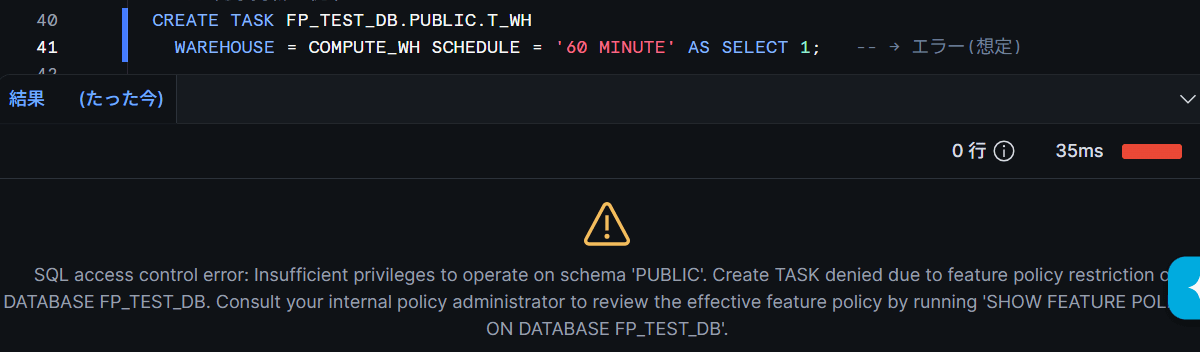
Serverless tasks (without WAREHOUSE specification) were blocked with the same error, while table creation succeeded. Since control is at the type level, tasks are an all-or-nothing control.
Notably, even ACCOUNTADMIN is blocked. Since Feature Policy applies to the DB container rather than roles, administrator operations are no exception.
Let's remove it before the next verification.
ALTER DATABASE FP_TEST_DB UNSET FEATURE POLICY;
Rules: Block only TEMPORARY tables
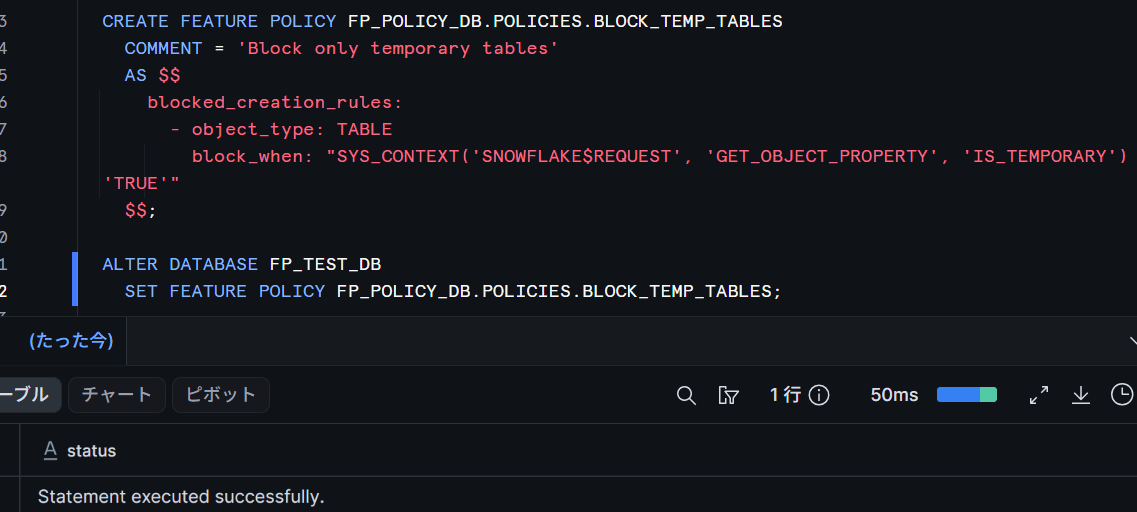
Let's try rules, the highlight of this GA release. Using the IS_TEMPORARY property as a condition, we prohibit only the creation of TEMPORARY tables.
CREATE FEATURE POLICY FP_POLICY_DB.POLICIES.BLOCK_TEMP_TABLES
  COMMENT = 'Block only temporary tables'
  AS $$
    blocked_creation_rules:
      - object_type: TABLE
        block_when: "SYS_CONTEXT('SNOWFLAKE$REQUEST', 'GET_OBJECT_PROPERTY', 'IS_TEMPORARY') = 'TRUE'"
  $$;

ALTER DATABASE FP_TEST_DB
  SET FEATURE POLICY FP_POLICY_DB.POLICIES.BLOCK_TEMP_TABLES;
Here are the results of creating three types of tables.
CREATE TABLE FP_TEST_DB.PUBLIC.T2 (ID INT);            -- Success
CREATE TEMPORARY TABLE FP_TEST_DB.PUBLIC.T3 (ID INT);  -- Blocked (003001)
CREATE TRANSIENT TABLE FP_TEST_DB.PUBLIC.T4 (ID INT);  -- Success
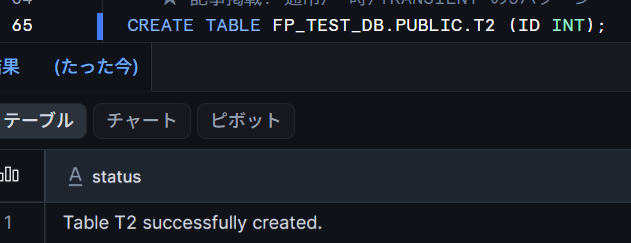
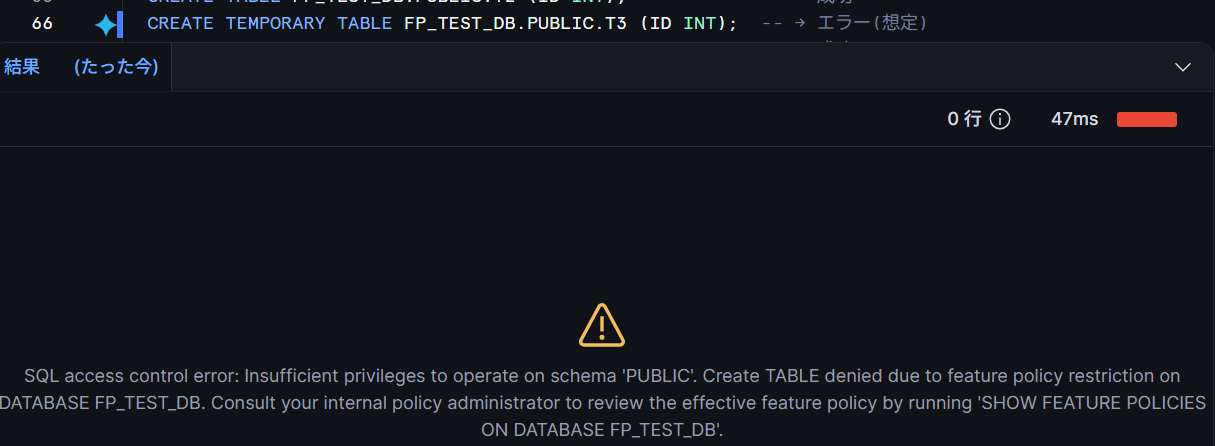
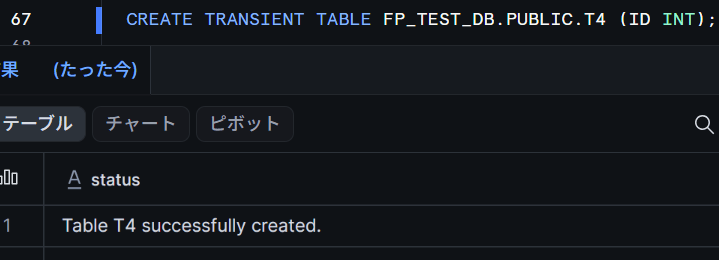
Only TEMPORARY was blocked. TRANSIENT does not fall under IS_TEMPORARY, so it succeeds (to also block TRANSIENT, add an IS_TRANSIENT condition). What was impossible with the conventional approach — "allow tables, but prohibit only temporary tables" — has been achieved.
Rules: Block only serverless tasks
The WAREHOUSE property of a task is NULL for serverless tasks without a warehouse specification. Using this as a condition, we can implement the popular cost-control requirement: "prohibit only serverless tasks."
CREATE FEATURE POLICY FP_POLICY_DB.POLICIES.BLOCK_SERVERLESS_TASKS
  COMMENT = 'Block only serverless tasks'
  AS $$
    blocked_creation_rules:
      - object_type: TASK
        block_when: "SYS_CONTEXT('SNOWFLAKE$REQUEST', 'GET_OBJECT_PROPERTY', 'WAREHOUSE') IS NULL"
  $$;
When attempting to apply it, an error occurred.
ALTER DATABASE FP_TEST_DB
  SET FEATURE POLICY FP_POLICY_DB.POLICIES.BLOCK_SERVERLESS_TASKS;
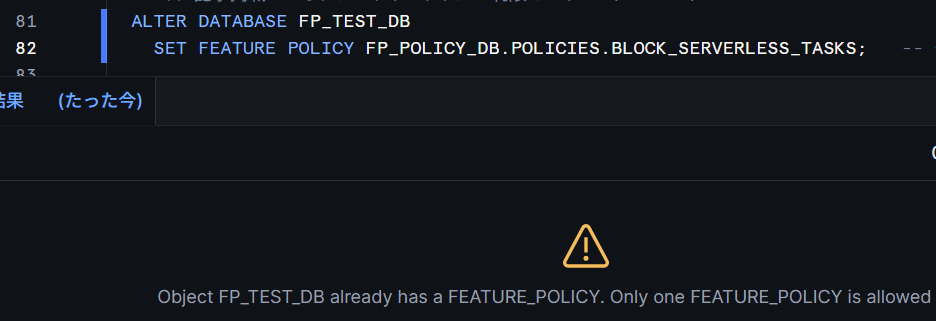
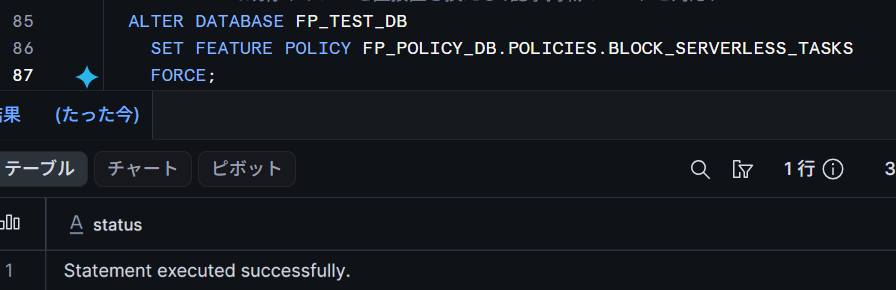
Only one Feature Policy can be directly bound to a single database. Setting without FORCE when an existing DB-level policy is present results in an error. This time, we specify FORCE to directly replace it.
-- Directly replace the existing DB-level policy with FORCE
ALTER DATABASE FP_TEST_DB
  SET FEATURE POLICY FP_POLICY_DB.POLICIES.BLOCK_SERVERLESS_TASKS
  FORCE;
Here are the results of creating two patterns of tasks.
-- Task with warehouse specification → Success
CREATE TASK FP_TEST_DB.PUBLIC.T_WH
  WAREHOUSE = COMPUTE_WH SCHEDULE = '60 MINUTE' AS SELECT 1;

-- Serverless task → Blocked (003001)
CREATE TASK FP_TEST_DB.PUBLIC.T_SERVERLESS
  SCHEDULE = '60 MINUTE' AS SELECT 1;
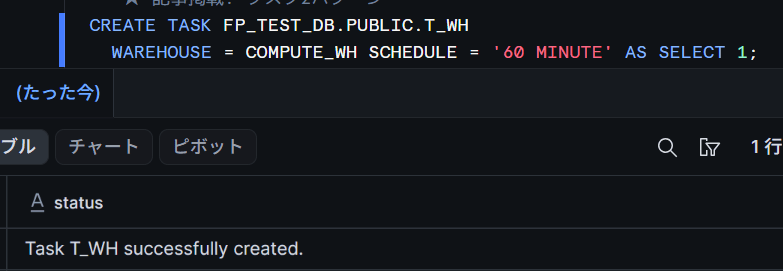
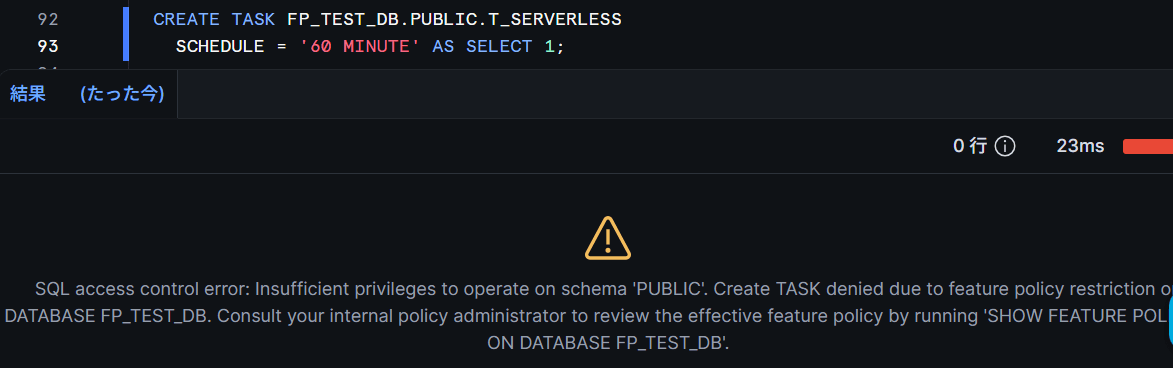
As intended, tasks with warehouse specification could be created, and only serverless tasks were blocked.
Named conditions allow reusing the same condition across multiple types
Expressions named with conditions can be referenced from multiple rules using block_when_any. Combining with conventional parameters is also possible.
CREATE FEATURE POLICY FP_POLICY_DB.POLICIES.BLOCK_TEMP_AND_WH
  COMMENT = 'Named condition + legacy param combined'
  BLOCKED_OBJECT_TYPES_FOR_CREATION = (WAREHOUSES)
  AS $$
    conditions:
      - name: is_temp
        expression: "SYS_CONTEXT('SNOWFLAKE$REQUEST', 'GET_OBJECT_PROPERTY', 'IS_TEMPORARY') = 'TRUE'"
    blocked_creation_rules:
      - object_type: TABLE
        block_when_any:
          - is_temp
      - object_type: STAGE
        block_when_any:
          - is_temp
  $$;

ALTER DATABASE FP_TEST_DB UNSET FEATURE POLICY;
ALTER DATABASE FP_TEST_DB
  SET FEATURE POLICY FP_POLICY_DB.POLICIES.BLOCK_TEMP_AND_WH;
CREATE TEMPORARY TABLE FP_TEST_DB.PUBLIC.T6 (ID INT);  -- Blocked
CREATE TEMPORARY STAGE FP_TEST_DB.PUBLIC.S_TEMP;       -- Blocked (Create STAGE denied)
CREATE STAGE FP_TEST_DB.PUBLIC.S1;                     -- Success
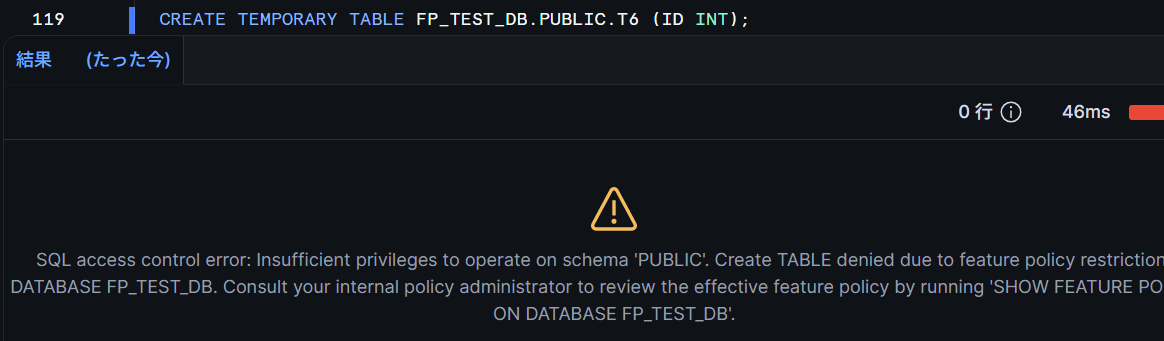
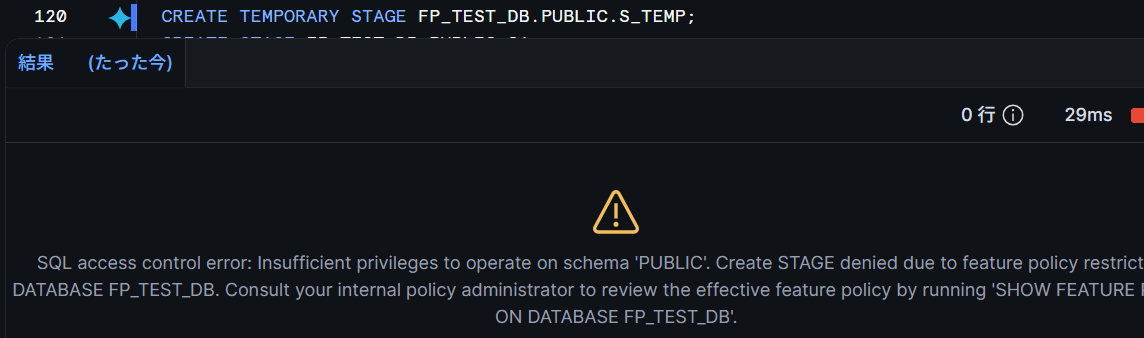
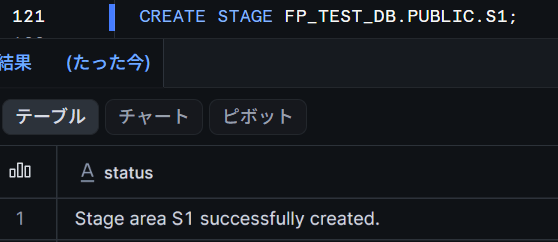
Only TEMPORARY was blocked for both tables and stages. On the other hand, the combined WAREHOUSES did not take effect.
CREATE WAREHOUSE FP_TEST_WH WITH WAREHOUSE_SIZE = 'XSMALL' INITIALLY_SUSPENDED = TRUE;
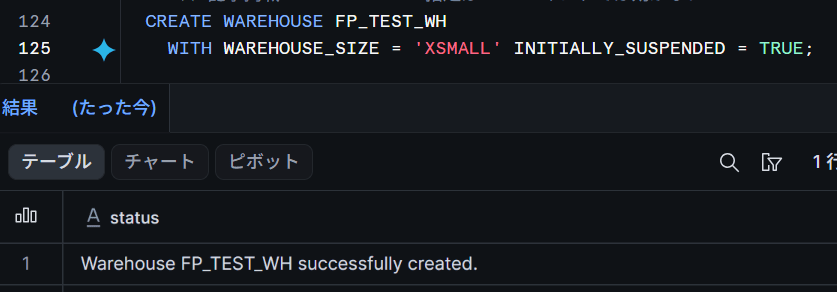
Warehouses are account-level objects, and creating them is an operation outside the DB container. Therefore, they are not controlled by a policy bound to a DB. The documentation also states that account-level object types are only effective when bound to a Native App.
DESC FEATURE POLICY: YAML is displayed in policy_definition
Let's check the rules using DESC FEATURE POLICY, which also became GA at the same time.
DESC FEATURE POLICY FP_POLICY_DB.POLICIES.BLOCK_SERVERLESS_TASKS;
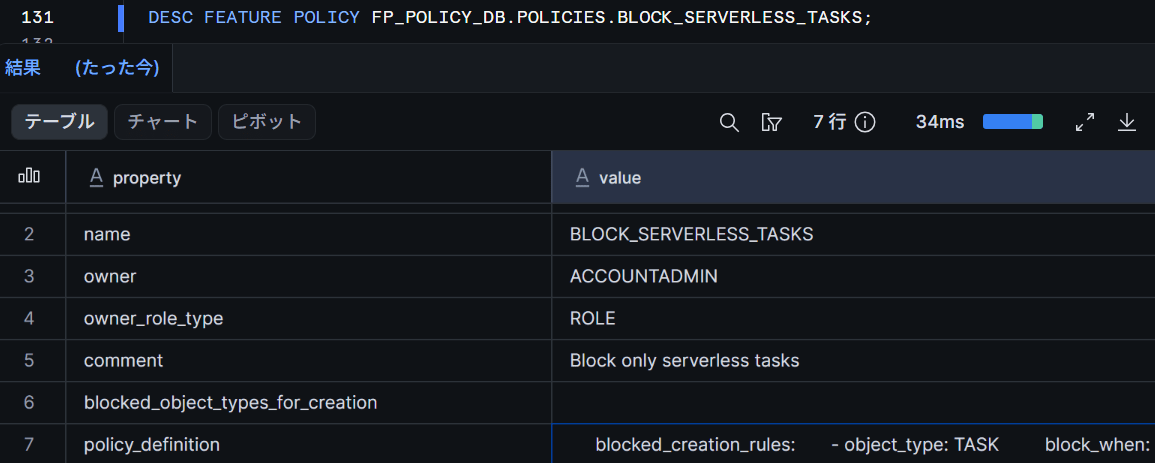
The configured YAML policy definition is displayed in the policy_definition property. In the current verification environment, when DESC-ing a policy without rules, the policy_definition row itself was not displayed.
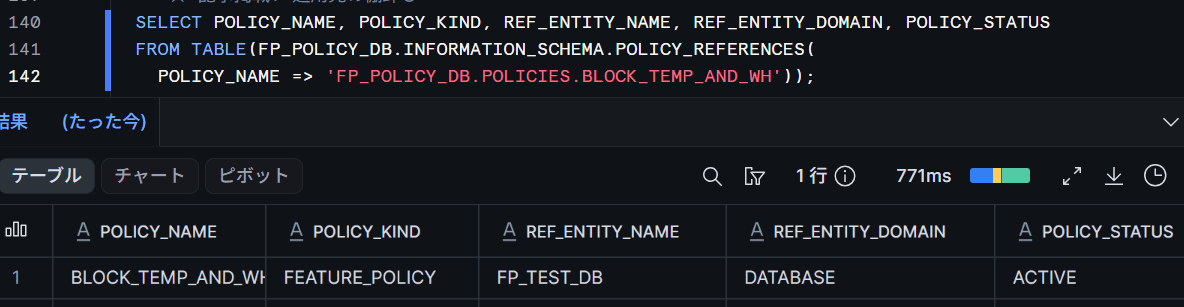
For checking application status, use SHOW and POLICY_REFERENCES. IN refers to "policies created in that location," and ON refers to "policies applied to that location," with the ON results including a set_on column indicating where they are applied.
SHOW FEATURE POLICIES IN DATABASE FP_POLICY_DB;  -- Lists all 4 created policies
SHOW FEATURE POLICIES ON DATABASE FP_TEST_DB;    -- Only the 1 currently applied policy (set_on = DATABASE)

SELECT POLICY_NAME, POLICY_KIND, REF_ENTITY_NAME, REF_ENTITY_DOMAIN, POLICY_STATUS
FROM TABLE(FP_POLICY_DB.INFORMATION_SCHEMA.POLICY_REFERENCES(
  POLICY_NAME => 'FP_POLICY_DB.POLICIES.BLOCK_TEMP_AND_WH'));
Verifying Application Priority
For regular databases, DB-level policies take priority over account-level (FOR ALL DATABASES) policies. Let's try the officially documented technique of applying an account-wide restriction while releasing the restriction on a specific DB using an empty policy.
ALTER DATABASE FP_TEST_DB UNSET FEATURE POLICY;

-- Apply TEMPORARY table prohibition to all regular DBs in the account
ALTER ACCOUNT
  SET FEATURE POLICY FP_POLICY_DB.POLICIES.BLOCK_TEMP_TABLES FOR ALL DATABASES;

CREATE TEMPORARY TABLE FP_TEST_DB.PUBLIC.T8 (ID INT);
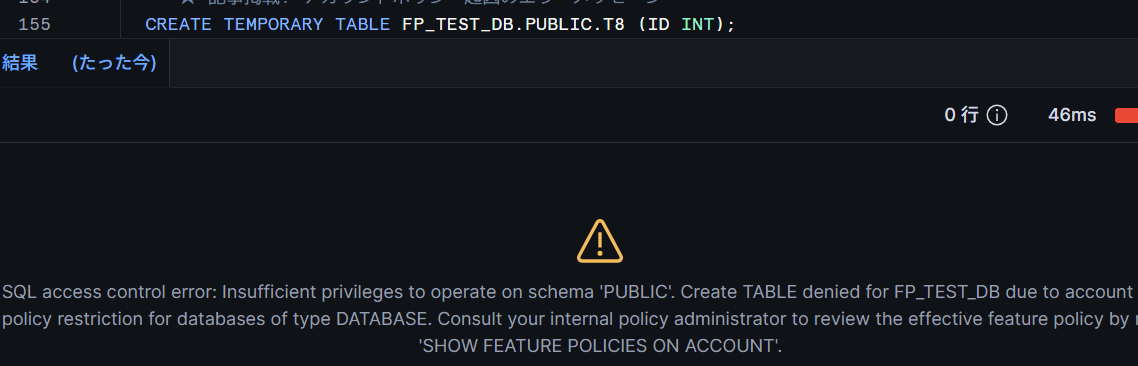
The same error occurred in FP_TEST_DB2 as well. The message is different from when applied at the DB level, indicating that it originates from an account policy and showing a confirmation command.
Next, we create an empty policy that "blocks nothing" and apply it only to FP_TEST_DB. It could be created with an empty list ().
CREATE FEATURE POLICY FP_POLICY_DB.POLICIES.BLOCK_NOTHING
  BLOCKED_OBJECT_TYPES_FOR_CREATION = ()
  COMMENT = 'Empty policy to lift account-level restrictions';

ALTER DATABASE FP_TEST_DB
  SET FEATURE POLICY FP_POLICY_DB.POLICIES.BLOCK_NOTHING;

CREATE TEMPORARY TABLE FP_TEST_DB.PUBLIC.T8 (ID INT);   -- Success
CREATE TEMPORARY TABLE FP_TEST_DB2.PUBLIC.T9 (ID INT);  -- Still blocked
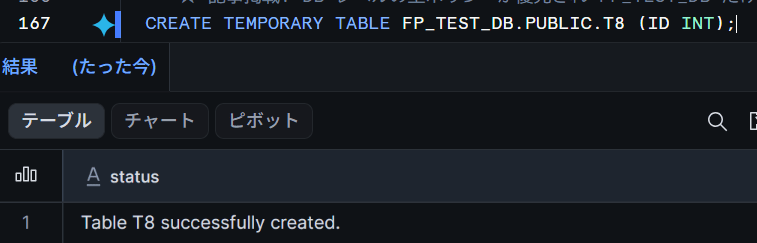
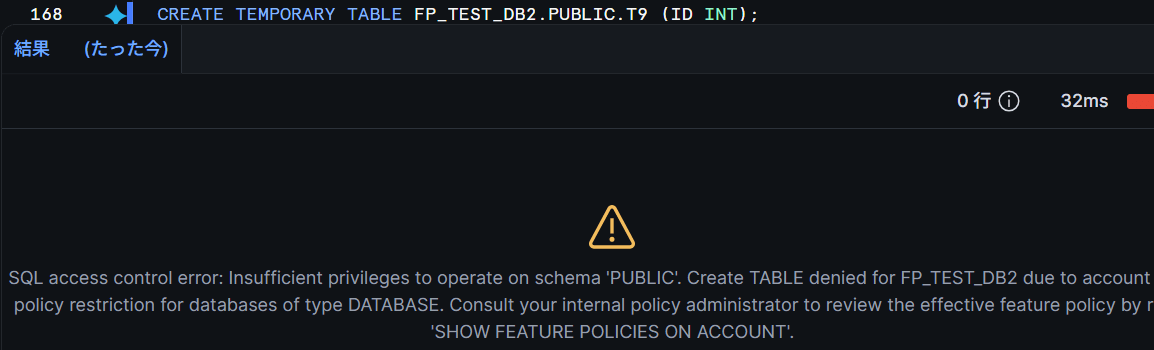
The DB-level empty policy took priority over the account level, and the restriction was lifted only for FP_TEST_DB. In the current verification environment, while the account-level policy was applied, {"target_scopes":["ALL_DATABASES"]} was displayed in the options column of SHOW FEATURE POLICIES ON ACCOUNT.
After verification, remove the account-level application.
ALTER ACCOUNT UNSET FEATURE POLICY FOR ALL DATABASES;
Pitfalls
Expressions that cannot be evaluated are rejected at creation time
The WAREHOUSE property is always NULL for creation requests of objects other than TASK. Using it in an equality comparison in a TABLE rule results in rejection not at runtime, but at policy creation time.
CREATE FEATURE POLICY FP_POLICY_DB.POLICIES.NULL_TRAP2
  AS $$
    blocked_creation_rules:
      - object_type: TABLE
        block_when: "SYS_CONTEXT('SNOWFLAKE$REQUEST', 'GET_OBJECT_PROPERTY', 'WAREHOUSE') = 'COMPUTE_WH'"
  $$;
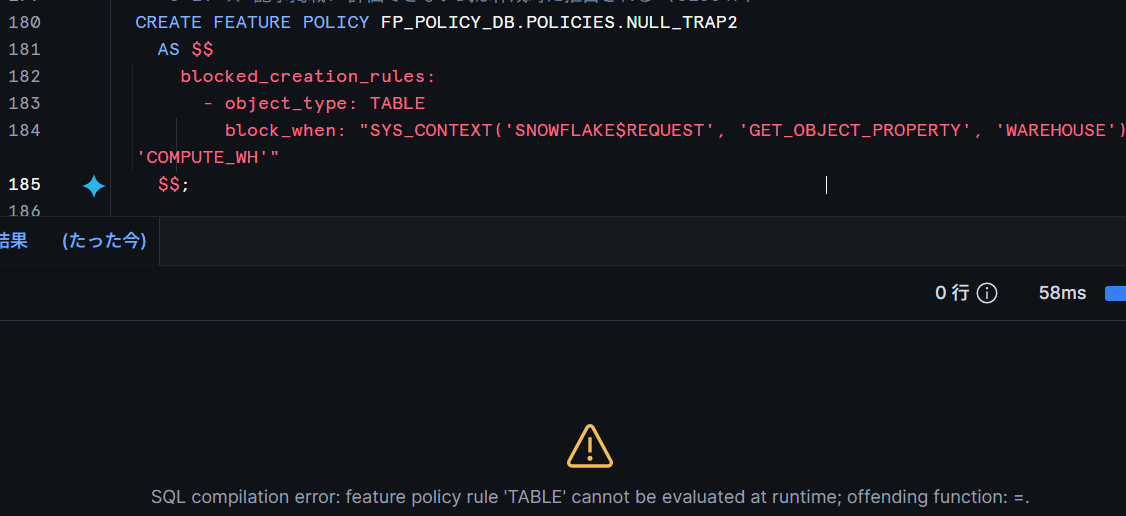
The same error occurs with object_type: ALL. Expressions that cannot be evaluated for the target type are rejected at the creation stage.
NULL evaluation is fail-closed and results in blocking
Even expressions that pass creation-time validation may evaluate to NULL at runtime. When creating a serverless task with a condition of WAREHOUSE = 'COMPUTE_WH' on a TASK, NULL = 'COMPUTE_WH' becomes NULL.
CREATE FEATURE POLICY FP_POLICY_DB.POLICIES.NULL_TRAP3
  AS $$
    blocked_creation_rules:
      - object_type: TASK
        block_when: "SYS_CONTEXT('SNOWFLAKE$REQUEST', 'GET_OBJECT_PROPERTY', 'WAREHOUSE') = 'COMPUTE_WH'"
  $$;

-- (After applying to FP_TEST_DB)
CREATE TASK FP_TEST_DB.PUBLIC.T_B SCHEDULE = '60 MINUTE' AS SELECT 1;
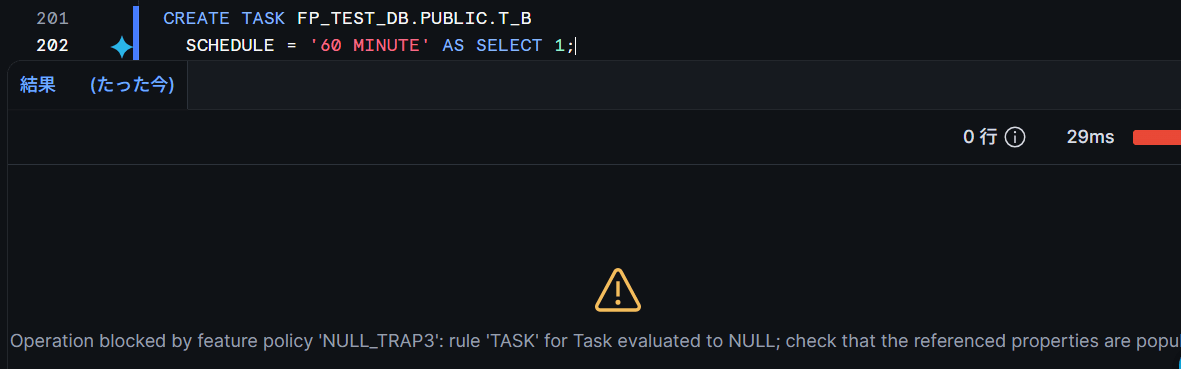
The behavior is fail-closed: only FALSE allows through, while TRUE and NULL are blocked, and NULL cases result in a dedicated error message. In practice, COMPUTE_WH specification (TRUE) was blocked, and a different warehouse specification (FALSE) succeeded. Writing with the assumption that "if the condition doesn't match, it should be allowed" can lead to unintentional blocking on the NULL branch, so caution is needed.
Limitations and Notes
Limitations and Notes
- Policies that are bound cannot be
CREATE OR REPLACE/DROP. UseALTER FEATURE POLICYfor modifications, and remove the application first before deleting - The
CLONEclause cannot be used in policy definitions - DB objects such as tables or functions with side effects cannot be referenced in rule expressions
- When replicating account-level policy references, the policy storage DB must be included in the replication group, otherwise it will not be enforced on the replication target
Closing
With Feature Policy Rules, control over object creation has evolved from "entire type" to "conditional." Practical governance and cost-control policies — such as prohibiting only serverless tasks or temporary tables — can now be enforced on all users, including ACCOUNTADMIN. The only thing to be careful about during policy design is that NULL evaluation is fail-closed and results in blocking.
I hope this article proves useful to someone!