![[Claude Fable 5] Explaining the Performance, Pricing, and How to Use the Model Called Mythos-Class! [Latest Version: June 2026]](https://devio2024-media.developers.io/image/upload/f_auto,q_auto,w_3840/v1781063592/user-gen-eyecatch/d5a8a1xcw8wt2wzkxo2h.png)
[Claude Fable 5] Explaining the Performance, Pricing, and How to Use the Model Called Mythos-Class! [Latest Version: June 2026]

This page has been translated by machine translation. View original
On June 9, 2026, Anthropic finally released a new Mythos-class model, "Claude Fable 5," to the general public.
This marks the first time the highest-tier model — previously restricted to government agencies and cybersecurity partners — has become available to everyone.
In this article, we'll explain Claude Fable 5's capabilities, pricing, and how to use it in a clear and accessible way, based on the latest information.
What is Claude Fable 5?
Claude Fable 5 has already been generating considerable buzz online since its release.
The reason is that it belongs to Anthropic's new highest tier, called "Mythos-class," which surpasses the conventional Opus class.
Until now, Anthropic's lineup consisted of three tiers: the small and fast Haiku, the balanced Sonnet, and the reasoning model Opus.
Claude Fable 5 is positioned in the newly established "Mythos-class" tier above all of these, making it the first model in the fifth-generation model family.
Technically, it shares the same base model as "Claude Mythos 5," the most powerful model available under limited access. The difference between the two lies in their safety measures (safeguards) — Fable 5 includes additional safeguards for general public release.
Anthropic positions it as a model capable of tackling complex, asynchronous tasks spanning multiple days — long-running tasks that previous models could not complete from start to finish.
In this section, we'll take a closer look at just how powerful Fable 5 actually is.
Performance That Surpasses Claude Opus
The standout feature of Claude Fable 5 is that it clearly outperforms Claude Opus 4.8 — previously the highest-performing publicly available model — on virtually every benchmark.
Anthropic describes it as "state-of-the-art on nearly every capability benchmark tested."
Reference: Evaluating Claude Fable 5 and Claude Mythos 5 - Anthropic official website
To cite some representative figures: on SWE-bench Verified, which measures coding ability, it scores 95.0% (compared to 88.6% for Opus 4.8); on the more challenging SWE-bench Pro, it achieves approximately 80% (versus 69.2% for Opus 4.8). In Spatial Reasoning, it reaches 38.6% compared to 14.5% for Opus 4.8 — more than double the score.
Top-Ranking Model on Major Benchmarks
Claude Fable 5 also leads across all major benchmarks.
It has achieved the best score on "CursorBench," a benchmark measuring model performance by Cursor, and has received high praise from companies with early access, including GitHub.
Reference: Early feedback for Claude Fable 5 - Anthropic official website
It is considered top-tier not only in coding and knowledge work, but across a wide range of domains — making its well-rounded, general-purpose capability one of Fable 5's key strengths.
Excels at Coding and Agentic Work
While Claude Fable 5 dominates many benchmarks, it truly shines in long-duration coding tasks and agentic workflows.
When operating in an agentic environment, it can run autonomously for multiple days, progressing through planning to coding while performing self-verification at each step.
Reference: Claude Fable Coding - Anthropic official website
Claude Fable 5 Pricing and Limitations

While performance has improved significantly, Claude Fable 5 is priced at a considerably high level.
When considering adoption, it's important to understand both the pricing structure and the usage limits.
In this section, we'll break down the pricing and rate limits.
Pricing Set at Twice That of Opus
Claude Fable 5's API pricing is $10 per million input tokens and $50 per million output tokens. This is exactly twice the cost of Claude Opus 4.8, making it the most expensive publicly available frontier model.
However, cost-saving mechanisms are available as before. Using prompt caching reduces the input cost for cache reads by 90% (to $1 per million tokens).
We recommend careful usage, weighing the per-token cost against the expected outcomes.
Reference: Model pricing - Claude API Docs
The pricing table officially announced by Anthropic is provided below for your reference. Please note that the pricing and limits reflect information available at the time this article was created (2026/06/10), so be sure to check for any updates.
| Model | Base Input Tokens | 5m Cache Writes | 1h Cache Writes | Cache Hits & Refreshes | Output Tokens |
|---|---|---|---|---|---|
| Claude Fable 5 | $10 / MTok | $12.50 / MTok | $20 / MTok | $1 / MTok | $50 / MTok |
| Claude Mythos 5 (limited availability) | $10 / MTok | $12.50 / MTok | $20 / MTok | $1 / MTok | $50 / MTok |
| Claude Opus 4.8 | $5 / MTok | $6.25 / MTok | $10 / MTok | $0.50 / MTok | $25 / MTok |
| Claude Opus 4.7 | $5 / MTok | $6.25 / MTok | $10 / MTok | $0.50 / MTok | $25 / MTok |
| Claude Opus 4.6 | $5 / MTok | $6.25 / MTok | $10 / MTok | $0.50 / MTok | $25 / MTok |
| Claude Opus 4.5 | $5 / MTok | $6.25 / MTok | $10 / MTok | $0.50 / MTok | $25 / MTok |
| Claude Opus 4.1 (deprecated) | $15 / MTok | $18.75 / MTok | $30 / MTok | $1.50 / MTok | $75 / MTok |
| Claude Opus 4 (deprecated) | $15 / MTok | $18.75 / MTok | $30 / MTok | $1.50 / MTok | $75 / MTok |
| Claude Sonnet 4.6 | $3 / MTok | $3.75 / MTok | $6 / MTok | $0.30 / MTok | $15 / MTok |
| Claude Sonnet 4.5 | $3 / MTok | $3.75 / MTok | $6 / MTok | $0.30 / MTok | $15 / MTok |
| Claude Sonnet 4 (deprecated) | $3 / MTok | $3.75 / MTok | $6 / MTok | $0.30 / MTok | $15 / MTok |
| Claude Haiku 4.5 | $1 / MTok | $1.25 / MTok | $2 / MTok | $0.10 / MTok | $5 / MTok |
| Claude Haiku 3.5 (retired, except on Bedrock and Vertex AI) | $0.80 / MTok | $1 / MTok | $1.60 / MTok | $0.08 / MTok | $4 / MTok |
Limits Are Not Much Different from Opus
The rate limit framework for Claude Fable 5 is not significantly different from previous models.
The API follows the same structure where the limits on requests per minute (RPM) and input/output token counts (ITPM/OTPM) are determined by the account's usage tier (Tier 1–4).
There is also a distinctive behavior related to safety measures. Input queries determined to involve cybersecurity or biology are automatically fallen back (redirected) to Claude Opus 4.8.
Reference: Rate limits - Claude API Docs
How to Use Claude Fable 5

Using Claude Fable 5 is not much different from previous models.
Essentially, you just select "Claude Fable 5" from the model selection menu in your usual interface.
In this section, we'll introduce how to use it across the three main environments.
How to Use with Claude Code (CLI)
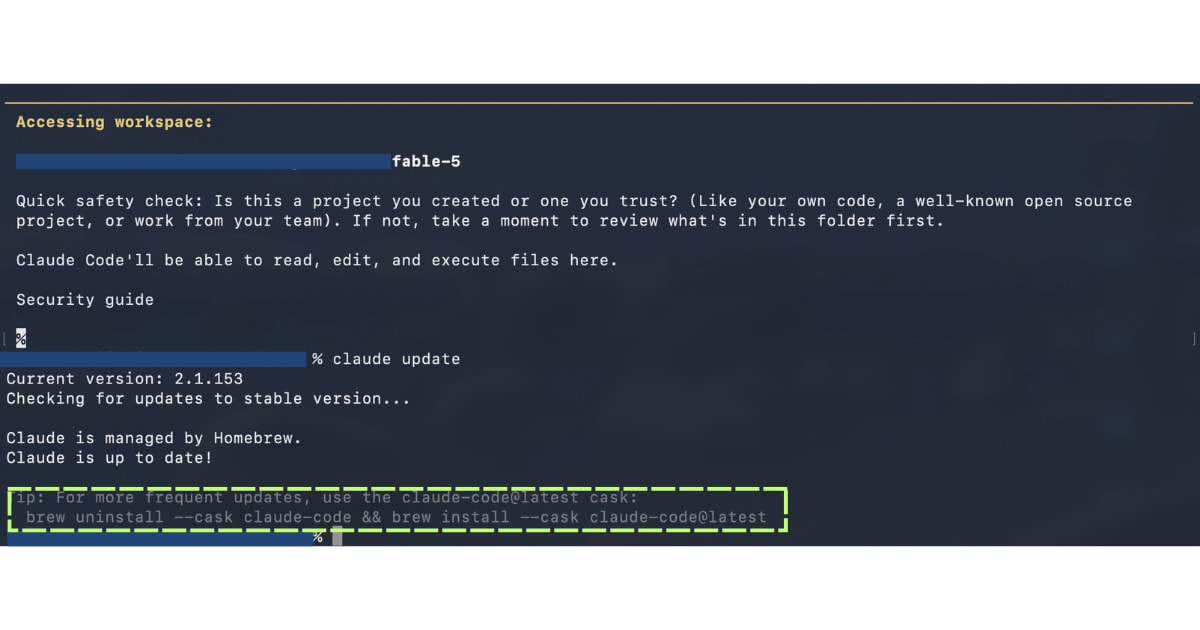
For Claude Code, which lets you delegate coding tasks from the terminal, start by updating the CLI to the latest version.
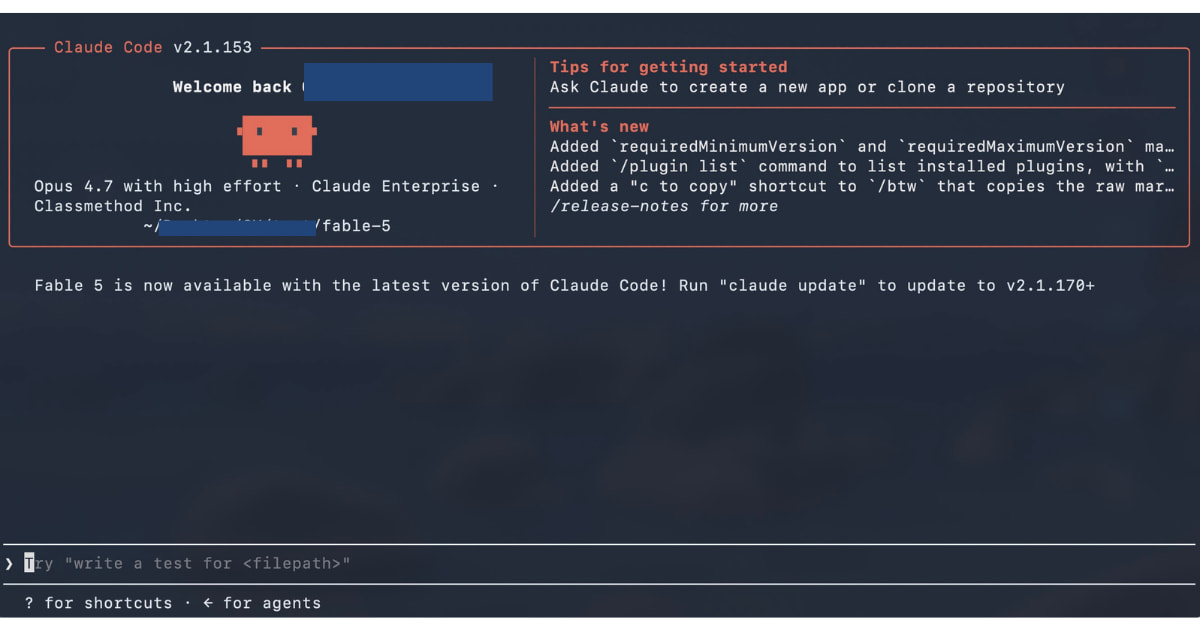
If your CLI version is outdated, you should see a message like "Fable 5 is now available with the l..." on the terminal screen when you launch it, so please update according to your installation method. For reference, I installed it via Homebrew.
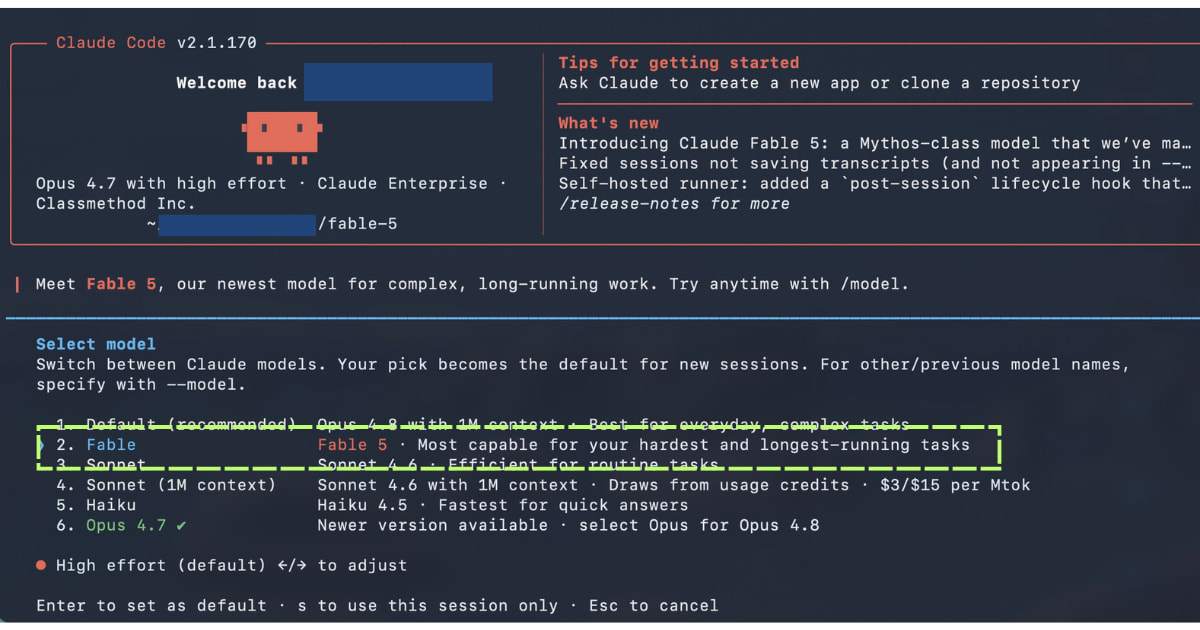
After that, you can switch to Fable 5 by using the in-session model switch command (/model).
How to Use with Claude Desktop
In the desktop app (Claude Desktop), select "Claude Fable 5" from the model selection menu located near the top of the chat screen or the message input area. Once selected, you can simply proceed with chat and tasks as usual — no special configuration is required.
A link to the download page is included in this section, so if you'd like to download the desktop version, please access it from the link below.
How to Use with Claude Web
In the browser version (claude.ai), the process is the same — simply select "Claude Fable 5" from the model switch menu on the screen to start using it.
Summary

Claude Fable 5 is a frontier model that will make coding work and agentic tasks even more efficient than before, while also coming with a pricing structure that exceeds previous models.
It makes delegating long-running tasks easier, but personally, I'd recommend using it mindfully and in appropriate ways.