Why can tacit knowledge of veterans not be passed on even when documented?
This page has been translated by machine translation. View original
What is Tacit Knowledge?
Tacit knowledge refers to knowledge that a person can apply in practice but cannot fully explain in words. Beneath "what can be written in a manual" lies a hidden layer of "judgment acquired through experience."
When you ask people on the front lines, you typically get answers like this: "When there's trouble, I can tell from the sound or the atmosphere. But I don't know how to convey that."
The key point is that tacit knowledge is not "difficult knowledge" — it is knowledge that the person themselves considers "obvious" and doesn't even recognize as knowledge. That's why it doesn't surface unless someone asks, and the person doesn't think they can produce it either.
Why Can't Knowledge Be Passed On Even When Documented?
There are three reasons.
1. The person is only aware of the "upper layer"
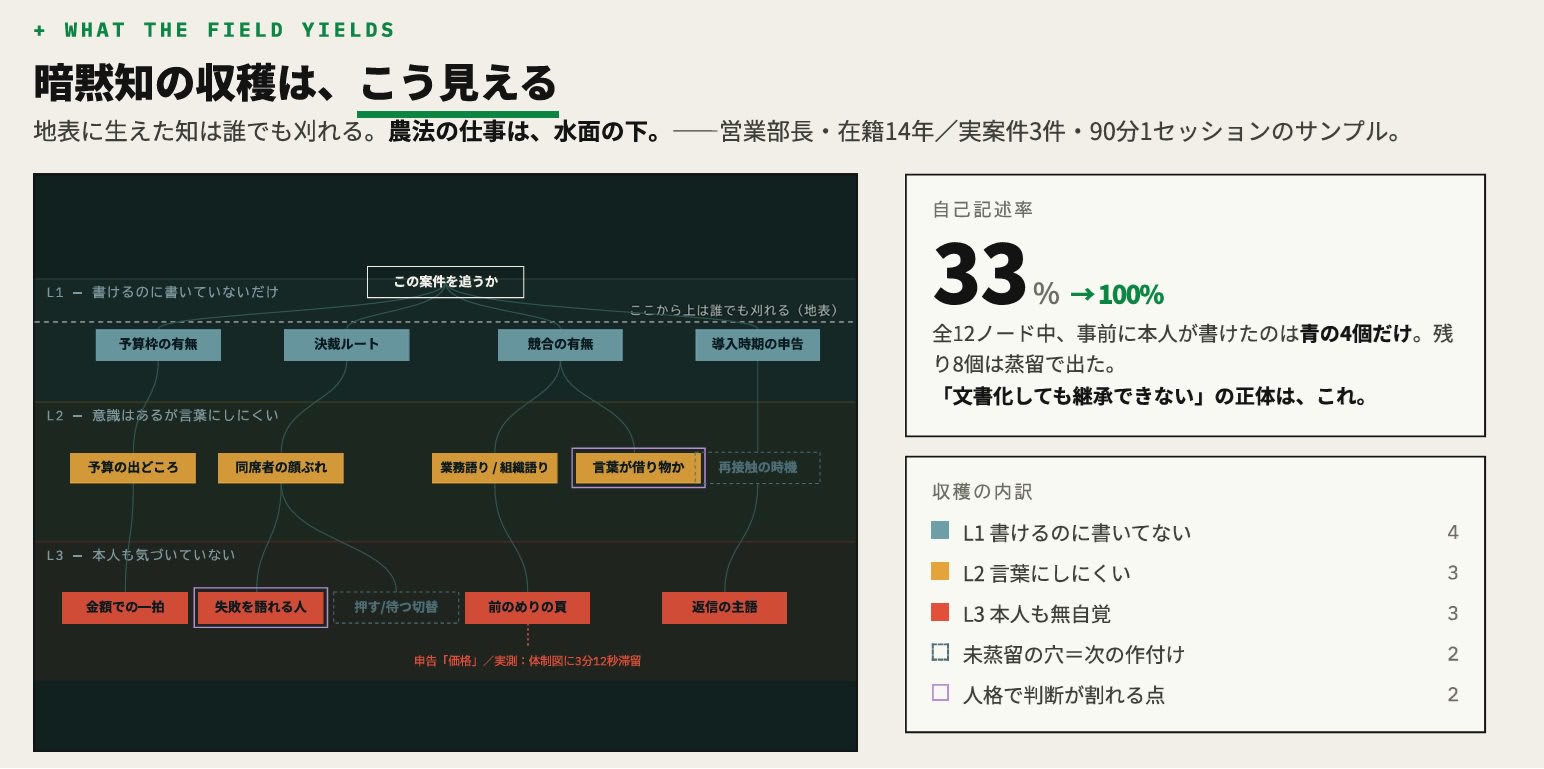
When someone tries to put their judgment into a document, they can only write down the surface level. When you dig into "why did you decide that," differences in unspoken "obvious" assumptions keep emerging. Those differences are not captured in the initial document.
2. Static documents become outdated without being updated
A manual written once is never updated even as the workplace changes. Judgment is updated daily, but the document freezes at the moment it was written.
3. It isn't read when it matters most
No one re-reads a thick manual in the middle of an emergency or a crisis response. At the very moment it's most needed, it goes unused the most. This is the structural limitation of the documentation approach.
Why Hasn't This Been Solved Until Now?
Methods for drawing out tacit knowledge have existed for a long time. The approach involves a skilled interviewer spending dozens of hours repeatedly questioning a person to uncover the reasoning behind their judgments. In fields where "reproducing judgment" is a matter of life and death — such as the military, medicine, and emergency services — this has actually been practiced.
However, this method had a decisive weakness.
- It doesn't scale. The skilled interviewer's time becomes a bottleneck, and it takes an enormous amount of effort to document even one person.
- It can't be updated. Even once documented, the ongoing changes cannot be continuously tracked.
- The output remains static. It ultimately ends up as a document, bringing us back to the "not being read" problem mentioned earlier.
In other words, the reality is that things had been stuck for years in a state of "it can be drawn out, but it isn't worth the effort."
What Is Changing Now with LLMs?
What has changed here is that LLMs have become capable of scaling the work of repeatedly posing questions.
The core of what is being done is as follows. By looking at the "difference" between daily work history and accumulated past judgments, it identifies "where in the past week did you make a judgment that differed from usual." It then poses a brief question — "why did you decide that" — and the person answers. The answer is reflected in the judgment data. This continues for about ten minutes per week.
The machine handles the "question-generating" part of the work that skilled interviewers used to spend dozens of hours on, and the person only needs to answer. Because it can be continued, it doesn't become outdated the way static documents do.
To summarize: what used to be "a skilled interviewer spending many hours, one time only, with the output stopping at a document" is now becoming "questions are automatically generated from differences, the person simply answers in a short time, and the content continues to be updated."
To draw an honest line here: this does not mean all tacit knowledge can be handled. It is effective for "knowledge in the head (cognitive knowledge)" such as judgment and logic, but "knowledge in the body (embodied knowledge)" — judgment based on the sound of machinery, temperature, or the feel of one's hands — cannot be captured with this method. That falls under a different approach, such as sensors. It is more realistic to think separately about what falls within scope and what does not.
Frequently Asked Questions (FAQ)
Q. Is this ultimately about having AI take over the work?
No. The goal is not replacement but to bring out, together with the person, the judgments they had not been able to put into words, and to preserve them. The person remains the agent of judgment.
Q. Does this involve training (fine-tuning) the model?
No. Rather than retraining the model itself, think of it as accumulating that person's judgments as context.
Q. What types of roles does this work well for?
It works well for roles where judgment and rules of thumb matter — for example, skilled veterans, specialists, top salespeople, reviewers, and designers. Conversely, as mentioned above, hands-on work that relies heavily on physical sensation is outside the scope.
Summary
- The reason tacit knowledge cannot be passed on is that the core of its value lies in judgments the person doesn't even recognize as such, treating them as "obvious"
- Documentation doesn't work for three reasons: only the upper layer can be written, it doesn't get updated, and it isn't read when it matters most
- Methods for "drawing out" tacit knowledge have existed for a long time, but they didn't scale and weren't worth the effort
- LLMs are beginning to scale the work of "repeatedly posing questions," making it a reality to simply answer and have content continuously updated
- However, effectiveness extends only to "cognitive knowledge." Plan on combining a separate approach for "embodied knowledge"
We have shaped this kind of system — "drawing out unspoken judgments together with the person and leaving them within the organization" — into a service called ghoost. If you have a challenge like "I want to preserve that person's judgment for the organization," please take a look.