![[Update] Claude Opus 4.8 is now available on Amazon Bedrock](https://images.ctfassets.net/ct0aopd36mqt/wp-thumbnail-e3065182082062711612153bbdcf1d96/c04359de689df2f56eb066576ab63fb5/amazon-bedrock?w=3840&fm=webp)
[Update] Claude Opus 4.8 is now available on Amazon Bedrock

This page has been translated by machine translation. View original
This is Ishikawa from the Cloud Business Division. On May 28, 2026, Anthropic's latest model Claude Opus 4.8 became available on AWS. It can be accessed from both Amazon Bedrock and Claude Platform on AWS.
This update comes approximately one and a half months after the previous version Claude Opus 4.7 (available since April 16, 2026), with enhancements focused on agentic use cases, coding, and long-duration autonomous tasks. In this article, in addition to the What's New content, we summarize the improvements from Opus 4.7.
What is Claude Opus 4.8
Claude Opus 4.8 is the latest generation large language model in the Opus series provided by Anthropic. Anthropic positions it as "the highest-performing generally available (GA) model at this time," handling complex reasoning, long-duration autonomous agentic processing (agentic coding), and tasks requiring high autonomy.
Key application areas include coding, agentic tasks, knowledge work (document creation and analysis), financial analysis, cybersecurity, and computer use.
Update Details
With this update, Claude Opus 4.8 is now available via Amazon Bedrock.
The main features are as follows.
- Supports long-duration autonomous execution, handling multi-stage projects and complex dependencies with minimal supervision
- Reads codebases like an expert and formulates a plan before editing. Retains context even in long sessions
- Improved ability to avoid failures and self-recover from errors
- Supports cross-document synthesis of long documents, self-verification of output, and generation of structured deliverables
Model Basic Specifications
The information available in the Amazon Bedrock model catalog (Tokyo region) is as follows.
| Item | Details |
|---|---|
| Model ID | anthropic.claude-opus-4-8 |
| Provider | Anthropic |
| Deployment Type | Serverless |
| Inference Type | Cross-region inference |
| Maximum Input | 1M (1 million) tokens |
| Maximum Output | 128K tokens |
| Input Modalities | Text, images |
| Output Modalities | Text |
| Supported Languages | English, Japanese, Chinese, Spanish, German, and many others |
| Release Date | May 28, 2026 |
Supported Regions
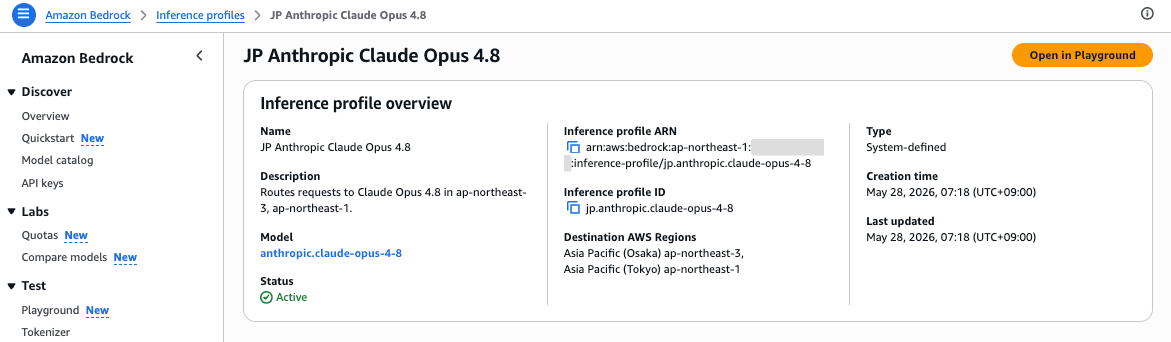
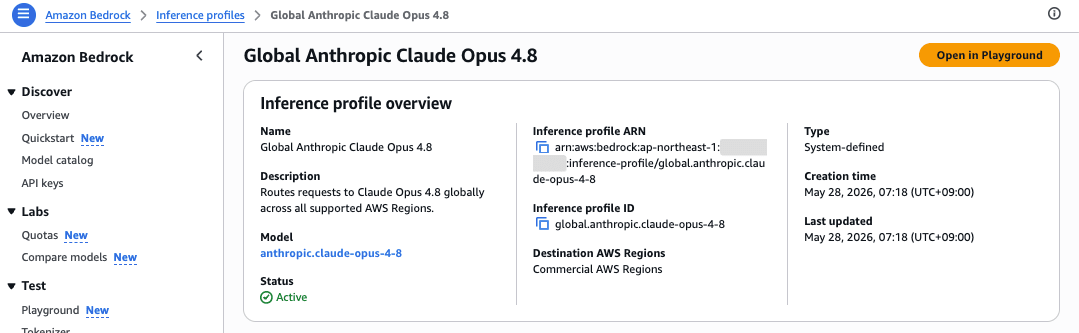
At the time of writing this article, Claude Opus 4.8 was confirmed in the Amazon Bedrock model catalog in the Tokyo region (ap-northeast-1). In addition to cross-region inference, Japan domestic inference profiles are also supported.
For an accurate list of supported regions and inference profiles, please refer to the official Amazon Bedrock documentation. At the time of writing, individual model cards and region lists on the AWS side may still be in the process of being updated, so please check the latest information before production use.
Pricing
In Amazon Bedrock, charges are based on the amount of input and output tokens for model inference and customization, as well as whether Provisioned Throughput is purchased.
At this time, the AWS Pricing page has not been updated, but according to Anthropic's official (Claude API) standard pricing, Claude Opus 4.8 is priced at 5 USD per 1 million tokens (MTok) for input and 25 USD per MTok for output. This is the same price as Claude Opus 4.7. Please check the AWS pricing page for the exact pricing via Amazon Bedrock. Note that Claude Platform on AWS charges in CCU (Claude Consumption Unit) units.
Evolution of Claude Opus 4.8
This is the main subject of this article. We summarize what has changed from Claude Opus 4.7 to Claude Opus 4.8.
Benchmark Comparison
The benchmark comparison published by Anthropic officially is as follows. It compares against Claude Opus 4.7, GPT-5.5, and Gemini 3.1 Pro.
| Benchmark | Opus 4.8 | Opus 4.7 | GPT-5.5 | Gemini 3.1 Pro |
|---|---|---|---|---|
| Agentic coding (SWE-Bench Pro) | 69.2% | 64.3% | 58.6% | 54.2% |
| Agentic terminal coding (Terminal-Bench 2.1) | 74.6% | 66.1% | 78.2% | 70.3% |
| Multidisciplinary reasoning (Humanity's Last Exam, no tools) | 49.8% | 46.9% | 41.4% | 44.4% |
| Multidisciplinary reasoning (Humanity's Last Exam, with tools) | 57.9% | 54.7% | 52.2% | 51.4% |
| Agentic computer use (OSWorld-Verified) | 83.4% | 82.8% | 78.7% | 76.2% |
| Knowledge work (GDPval-AA) | 1890 | 1753 | 1769 | 1314 |
| Agentic financial analysis (Finance Agent v2) | 53.9% | 51.5% | 51.8% | 43.0% |
※Source: Benchmarks from official Anthropic announcements. Values are based on Anthropic internal evaluations. GDPval-AA is a score value; all others are accuracy rates (%).
On SWE-Bench Pro, a coding benchmark close to real-world scenarios, the score improved from Claude Opus 4.7's 64.3% to Claude Opus 4.8's 69.2%. While Claude Opus 4.8 outperforms Claude Opus 4.7 in many categories, GPT-5.5 achieved the highest result on Terminal-Bench 2.1 at 78.2%, so it is worth noting that strengths and weaknesses vary depending on the use case.
Main New Features and Improvements
According to the official Anthropic documentation, the following features have been added or changed from Claude Opus 4.7 to Claude Opus 4.8.
- Mid-conversation system messages: It is now possible to insert a
role: "system"message immediately after a user turn. This allows adding instructions during long conversations without resending the entire system prompt, while maintaining prompt cache hits for earlier turns. This contributes to reducing input costs in agent loops - The default for the effort parameter is now
high: Across all surfaces including the Claude API and Claude Code, the default for the effort parameter is nowhigh(no change if explicitly set) - Fast mode (research preview): Specifying
speed: "fast"allows you to get up to 2.5x more output tokens per second from the same model (premium pricing, Claude API only) - Lower minimum token count for prompt caching: The minimum cacheable prompt length has been reduced to 1,024 tokens. Short prompts that could not be cached in Claude Opus 4.7 can now create cache entries without any code changes
- Official documentation of refusal stop details: The
stop_detailsobject when a request is refused has been officially documented, making it easier to handle according to the type of refusal
In terms of capabilities, the following improvements have been made compared to Claude Opus 4.7.
- Long-horizon agentic coding: Handling of long-context has improved, compaction (context compression) occurs less frequently, and the quality of recovery after compression has improved
- Calibration of reasoning effort: Behavior at each effort level is more stable
- Improved tool triggering: Cases where necessary tool calls for a task are skipped have decreased (this was a behavior partially reported in Claude Opus 4.7)
- Efficiency of adaptive thinking: The need for thinking is determined per turn, reducing unnecessary thinking tokens even at the same effort level
Notes on Migration
According to Anthropic's migration guide, there are no breaking API changes when migrating from Claude Opus 4.7 to Claude Opus 4.8, and in principle it should work simply by replacing the model ID. However, the following constraints carried over from Claude Opus 4.7 apply.
- Setting
temperature/top_p/top_kto non-default values will result in a 400 error (control behavior via prompts) - Only adaptive thinking is supported;
thinking: {"type": "enabled", "budget_tokens": N}will result in a 400 error
How to Use
There are two ways to access Claude Opus 4.8.
When using Amazon Bedrock, enable model access from Amazon Bedrock in the AWS Management Console. You can use it in combination with AWS managed features such as Guardrails and Knowledge Bases while keeping data within the AWS infrastructure.
Claude Platform on AWS is a platform operated by Anthropic, accessible from the AWS Management Console, and supports consolidated billing via AWS Marketplace (billed in CCU units).
Important Notes
- The benchmark figures in this article are based on official Anthropic announcements (internal evaluations). We recommend verifying performance on actual workloads in your own environment
- The pricing stated is the standard pricing for the Anthropic Claude API (first-party). Please check the AWS pricing page for pricing via Amazon Bedrock, and the CCU-based billing structure for Claude Platform on AWS
- At the time of writing, individual model cards and region lists on the AWS side may still be in the process of being updated. Please check the official Amazon Bedrock documentation for the latest information before production use
In Closing
Claude Opus 4.8 is a practically oriented update built on top of Claude Opus 4.7, with improvements to long-horizon agentic coding, tool triggering, and handling of compaction. If you are using Amazon Bedrock or Claude Platform on AWS, you can try it simply by replacing the model ID with anthropic.claude-opus-4-8. Why not start by experiencing the differences from Claude Opus 4.7 in a test environment?