![[Presentation Report] I participated as a developer in DevRev's panel discussion "Key Points of Future AI Technology and the Appeal of DevRev"](https://devio2024-media.developers.io/image/upload/f_auto,q_auto,w_3840/v1780017467/user-gen-eyecatch/ewziacq8plibek9oq6oe.jpg)
[Presentation Report] I participated as a developer in DevRev's panel discussion "Key Points of Future AI Technology and the Appeal of DevRev"

This page has been translated by machine translation. View original
Introduction
On May 28, 2026, I spoke as a developer on a panel discussion at "AI Innovators Circle Vol. 6," an event hosted by Synthesy Co., Ltd.. This article reports on the content of that event.
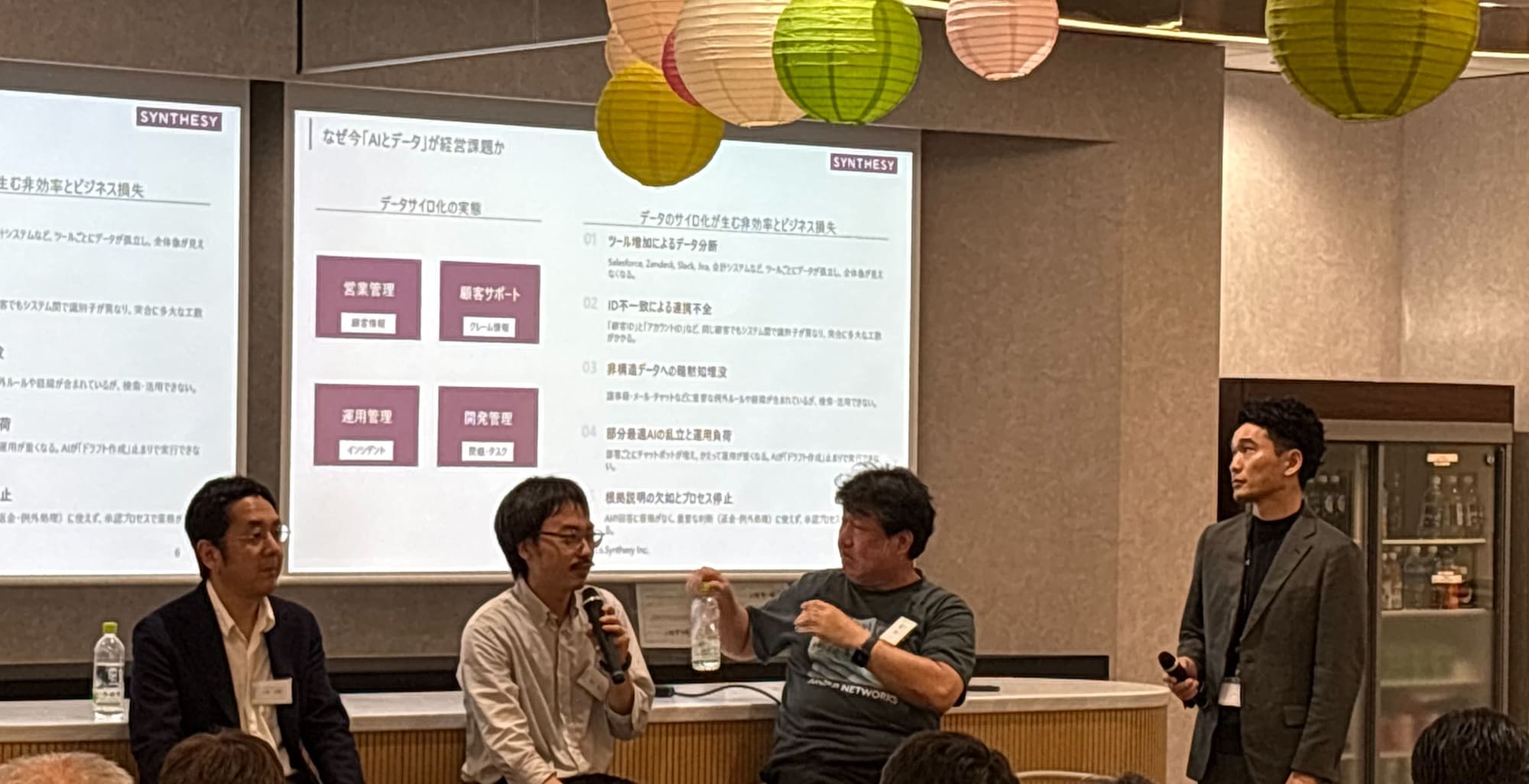
About the Event
The event was held under the theme "How to Break Through the PoC Deadlock in Generative AI," hosted by Synthesy Co., Ltd., with cooperation from DevRev, Classmethod, and the Okinawa Open Laboratory General Incorporated Association. The venue was the Synthesy office in Nihonbashi, with approximately 30 attendees. The event consisted of three parts — a keynote, a dialogue session, and a panel discussion — with an emphasis on two-way interaction.
- Official page: https://synthesy.co.jp/ai-innovators-circle06/
Panel Discussion Structure
The panel discussion I participated in was titled "Key Points of Future AI Technology and the Appeal of DevRev." The four panelists were as follows:
- Moderator: Norio Shirafuji (Synthesy)
- Satohito Yamazaki (Okinawa Open Laboratory)
- Daisuke Nakajima (DevRev)
- Takumi Koshii (Classmethod / the author)
I was responsible for the developer perspective, sharing my hands-on experience from the standpoint of someone implementing generative AI.
What I Talked About
The panel covered three main topics.
The first was the difficulty of RAG. I touched on how significantly trimming information based on semantics makes it far from easy to retrieve the intended documents, and how ongoing update operations also require considerable effort.
The second was the difficulty of supervising multiple AI agents. I shared my honest thoughts that having a managed system handle context sharing, job management, and various connections is extremely helpful, and that implementing all of this from scratch is an area I would genuinely prefer to avoid.
The third was the difficulty of access control. I shared that achieving fine-grained access control through RAG alone is challenging, and that role design and permission policies across various services tend to increase operational overhead.
Discussions That Left an Impression
The discussion around "data quality" was particularly memorable. Yamazaki pointed out that "at the risk of oversimplifying, once 'garbage' gets into RAG, it's hard to get it back out," while Nakajima noted that "data that was once useful becomes unnecessary over time." This reminded me that we need to pay attention not only to initial quality but also to freshness management. Because the event emphasized two-way dialogue, the discussion naturally deepened as responses from the audience were incorporated in real time.
Closing
Having a space to share the real, hands-on experience of generative AI from a developer's perspective is valuable, and I gained a great deal from it. I hope to continue speaking at events from a technically-oriented standpoint. If any of you readers have opportunities to present at study groups or conferences, I encourage you to take that step forward.