![[Update] Amazon EVS now supports VMware Cloud Foundation (VCF) 9.0/9.1](https://images.ctfassets.net/ct0aopd36mqt/KbpbvUi5yBOR3HQdyBttf/d608471776c95dfa22b509a44b353d63/amazon-evs-elastic-vmware-service.png?w=3840&fm=webp)
[Update] Amazon EVS now supports VMware Cloud Foundation (VCF) 9.0/9.1

This page has been translated by machine translation. View original
Hello, I'm Arahira (@eiraces) from the Cloud Business Division. Happy Tanabata Day!
It's been a while since Amazon EVS (Elastic VMware Service) went GA, but VCF 9.x has been added to the supported VCF versions!
Since VCF itself is a major version following the Broadcom transition, I get the impression that quite a bit of work has also gone into improving the usability of Amazon EVS.
(Machine translation)
Amazon Elastic VMware Service (Amazon EVS) has added support for VMware Cloud Foundation (VCF) 9.0 and 9.1. This allows you to run the latest VCF software on EC2 bare metal instances within an Amazon VPC. Users have full control over the installation, operation, and management of VCF environments, and can use the same tools, processes, and skills as in on-premises data centers. A new Solutions for Amazon EVS GitHub repository has also been published, providing templates for Infrastructure as Code tools such as CloudFormation and Terraform. This feature is available in all regions where Amazon EVS is available.
In addition to the story about EVS catching up with the latest major version of VCF, the key point this time is that the deployment method for VCF software itself has changed. Let's take a closer look.
Changes on the Amazon EVS Side
Reading the launch blog, three changes have been made to EVS alongside the VCF 9 support.
Separation of Infrastructure Provisioning and VCF Software
Previously, EVS handled everything up to the VCF installation in a single workflow during environment creation.
With the VCF 9-compatible version, the flow has changed so that after Amazon EVS deploys the infrastructure such as EC2 bare metal instances, users themselves download and deploy Broadcom's VCF installer.
Incidentally, the EVS User Guide's "VCF versions and EC2 instance types provided by Amazon EVS" has long offered an option called SELF_DEPLOYED, described as a mode where "only the infrastructure is provisioned, and VCF (including ESXi) is installed by the user themselves."
I think it's easier to understand if you think of VCF 9.x as being deployed in a manner close to this concept (※ At the time of writing, the documentation was centered on VCF 5.2.1/5.2.2, and updates to reflect VCF 9.x documentation did not appear to have been incorporated yet).
Support for VCF Evaluation Mode
Evaluation mode, which allows you to build a VCF environment without a license key, is now supported. This enables a workflow where you complete design validation and implementation testing in evaluation mode, then apply a production-equivalent license and transition to operations.
This is a welcome change for cases where you just want to try out an environment for validation purposes.
EVS Connectors
A persistent authentication link connecting the VCF management appliance to the EVS control plane has been implemented. Authentication information is reportedly stored in AWS Secrets Manager.
This seems to stem from the need for a mechanism to link and manage both sides, given that infrastructure and software deployment have been separated.
Solutions for Amazon EVS (GitHub Repository)
Perhaps anticipating that the separation of infrastructure provisioning and VCF deployment would increase the number of steps involved, a new GitHub repository called Solutions for Amazon EVS has been established. The centerpiece is a solution called "VCF 9 Phased Deployment," which automates everything from building AWS networking infrastructure and creating the EVS environment, to setting up VCF and deploying NSX edge clusters.
The README touts that work normally taking several hours can be compressed into 3 CLI commands. It is composed of Python (88.5%) and HCL (Terraform, 11.5%), and is licensed under Apache-2.0.
Changes in VCF 9 Itself
Not just the Amazon EVS side, but I was also curious about "what Broadcom changed with VCF 9," so I checked the Broadcom official release notes and the What's New page as well. Here are the points that seem likely to affect EVS users.
- Significant simplification of the licensing structure
- The previous 11 types of licenses have been consolidated into 2 types: "VMware Cloud Foundation (per core)" and "VMware vSAN (per TiB)"
- Security enhancements
- vCenter, ESX, and NSX now operate in FIPS-enabled mode compliant with FIPS 140-2/140-3 by default
- Unified Operate Experience
- A new Operate Experience has been added that allows you to build, operate, and manage security for your private cloud from a single interface
- NSX VPC Model Expansion
- New VPC models supporting centralized/distributed Transit Gateways have been added, along with support for advanced DHCP configuration within VPCs
- VCF Operations Certificate Management
- A mechanism for centrally managing TLS certificates for all components (including automatic renewal) and an integrated log management feature that allows log searching and dashboard creation within VCF Operations have been added
It was also impressive to see the strengthening direction toward handling containers, VMs, and Kubernetes in an integrated manner on a single platform. It could also be viewed as part of a broader trend of Broadcom as a whole driving platform integration, rather than just a VMware-specific story.
The release notes for VCF 9.1 can be found here. It's a minor update from 9.0, but it appears to include minor fixes and feature additions, so it's worth reviewing when considering an upgrade from 9.0.
Checking Available Versions
Let's check the versions available in EVS.
aws evs get-versions
{
    "vcfVersions": [
        {
            "vcfVersion": "VCF-5.2.1",
            "status": "RESTRICTED",
            "defaultEsxVersion": "ESXi-8.0U3b-24280767",
            "instanceTypes": [
                "i4i.metal",
                "i7i.metal-24xl"
            ]
        },
        {
            "vcfVersion": "VCF-5.2.2",
            "status": "AVAILABLE",
            "defaultEsxVersion": "ESXi-8.0U3g-24859861",
            "instanceTypes": [
                "i4i.metal",
                "i7i.metal-24xl"
            ]
        },
        {
            "vcfVersion": "SELF_DEPLOYED",
            "status": "AVAILABLE",
            "defaultEsxVersion": "ESXi-9.0.2.0.25148076",
            "instanceTypes": [
                "i4i.metal",
                "i7i.metal-24xl"
            ]
        }
    ],
    "instanceTypeEsxVersions": [
        {
            "instanceType": "i4i.metal",
            "esxVersions": [
                "ESXi-8.0U3b-24280767",
                "ESXi-8.0U3g-24859861",
                "ESXi-9.0.2.0.25148076",
                "ESXi-9.1.0.0100.25433460"
            ]
        },
        {
            "instanceType": "i7i.metal-24xl",
            "esxVersions": [
                "ESXi-8.0U3b-24280767",
                "ESXi-8.0U3g-24859861",
                "ESXi-9.0.2.0.25148076",
                "ESXi-9.1.0.0100.25433460"
            ]
        }
    ]
}
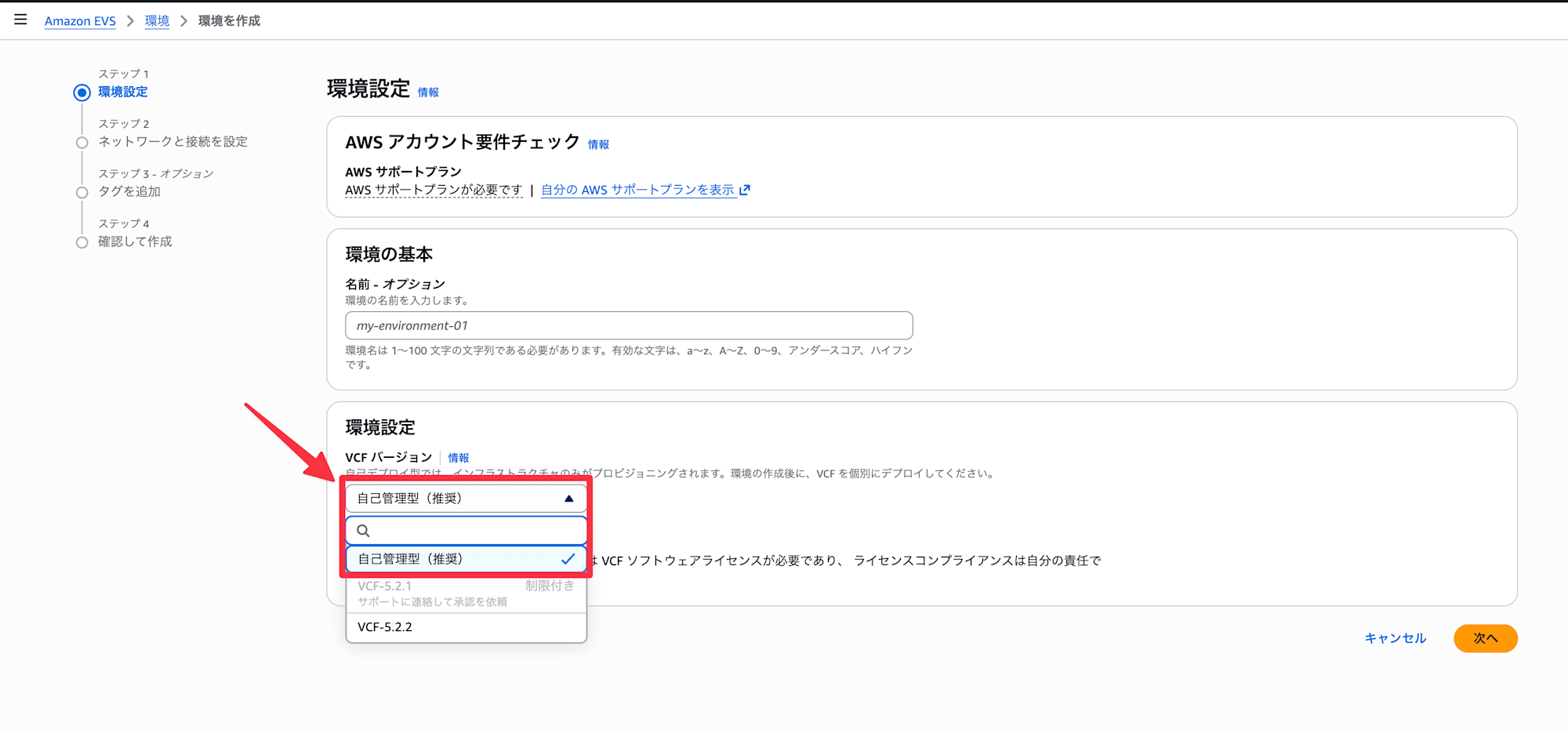
In the Amazon EVS console as well, self-managed (VCF 9.0, 9.1) has become selectable!
Closing Thoughts
This update doesn't feel like a simple "the supported version went up" story, but rather an update that involves a change in the operational model, where part of the responsibility for deploying VCF software has shifted from the AWS side to the user side.
While it may appear that more effort is required, I think it's a positive aspect that mechanisms for reducing that effort—such as evaluation mode and the GitHub automation solution—have been prepared at the same time.
For those currently operating VCF 5.2.x EVS environments, there will likely be announcements regarding upgrade procedures to version 9.x and support end dates, so it's worth keeping an eye out for further news.
I hope this entry is helpful to someone.
That's all from Arahira of the Consulting Division, Cloud Business Division!
References