![[Session Report] Capturing All Directions, "Implementing and Reproducing" the Entire Space: The Cutting Edge of High-Definition, Omnidirectional IR Recording Using a 64-Channel Ambisonics Microphone, and Next-Generation Spatial Representation #CEDEC2026](https://images.ctfassets.net/ct0aopd36mqt/5L0LdMnL6vvm3iyLUBor5I/23a209b62a40af938e8edddf48d73233/cedec2026.png?w=3840&fm=webp)
[Session Report] Capturing All Directions, "Implementing and Reproducing" the Entire Space: The Cutting Edge of High-Definition, Omnidirectional IR Recording Using a 64-Channel Ambisonics Microphone, and Next-Generation Spatial Representation #CEDEC2026

This page has been translated by machine translation. View original
Introduction
This is a report on a session I attended at CEDEC2026. The session focused on Ambisonics, a spatial sound representation technique, introducing its technical trends and an omnidirectional IR recording using a 64-channel microphone developed through industry-academia collaboration.
The session overview is as follows.
- Title: Recording All Directions, "Implementing and Reproducing" the Entire Space: The Cutting Edge of High-Definition Omnidirectional IR Recording Using 64ch Ambisonics Microphones and Next-Generation Spatial Representation
- Speakers: Kenji Hirose (Yamaha Corporation), Shun Saito (Senzoku Gakuen College of Music), Hiroyuki Kato (Moonbow Music Inc.)
- Date and Time: July 22, 2026, 18:00–19:00
- Venue: Hall 6
Ambisonics and Its Tailwind
Ambisonics is an acoustic technology that captures and reproduces a three-dimensional sound field in a consistent format across all directions. Its theoretical foundations were established in the 1970s, and it is characterized by its ability to describe the sound field itself without depending on a specific speaker layout. It was explained that, because it can handle sound from all directions, it is well-suited for spatial representation elements such as environmental sounds.
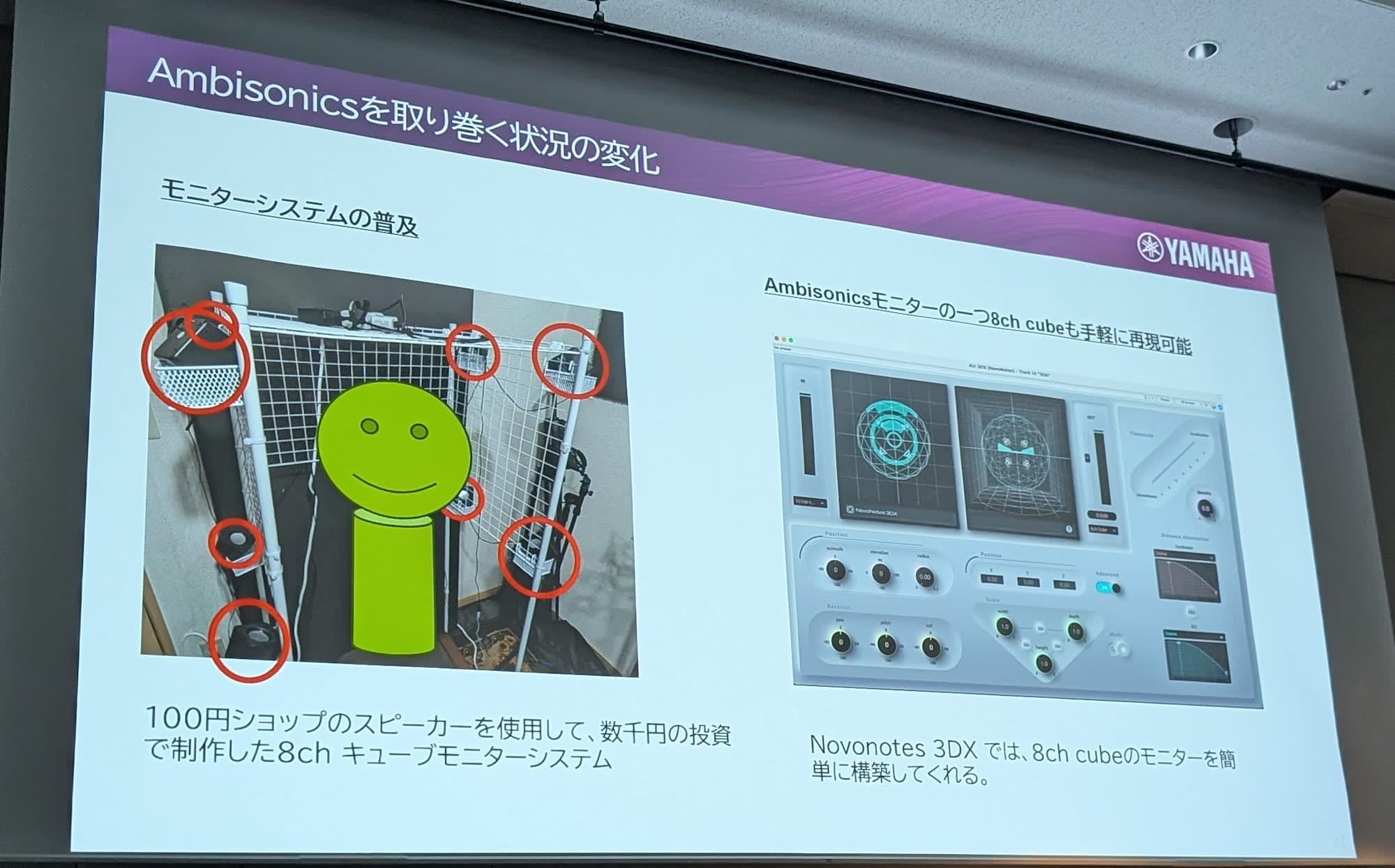
On the other hand, adoption had previously been limited due to constraints in recording equipment, computational load, and an immature production environment. However, the situation has changed in recent years, and the barrier to entry for Ambisonics has reportedly lowered. The emergence of microphones that allow easy single-device recording, the widespread availability of editing tools capable of handling multiple channels, and the growing adoption of frameworks premised on 6DoF—such as Apple's spatial audio format ASAF—were cited as tailwinds driving this change.
IR Recording with the 64ch Microphone ViReal Mic
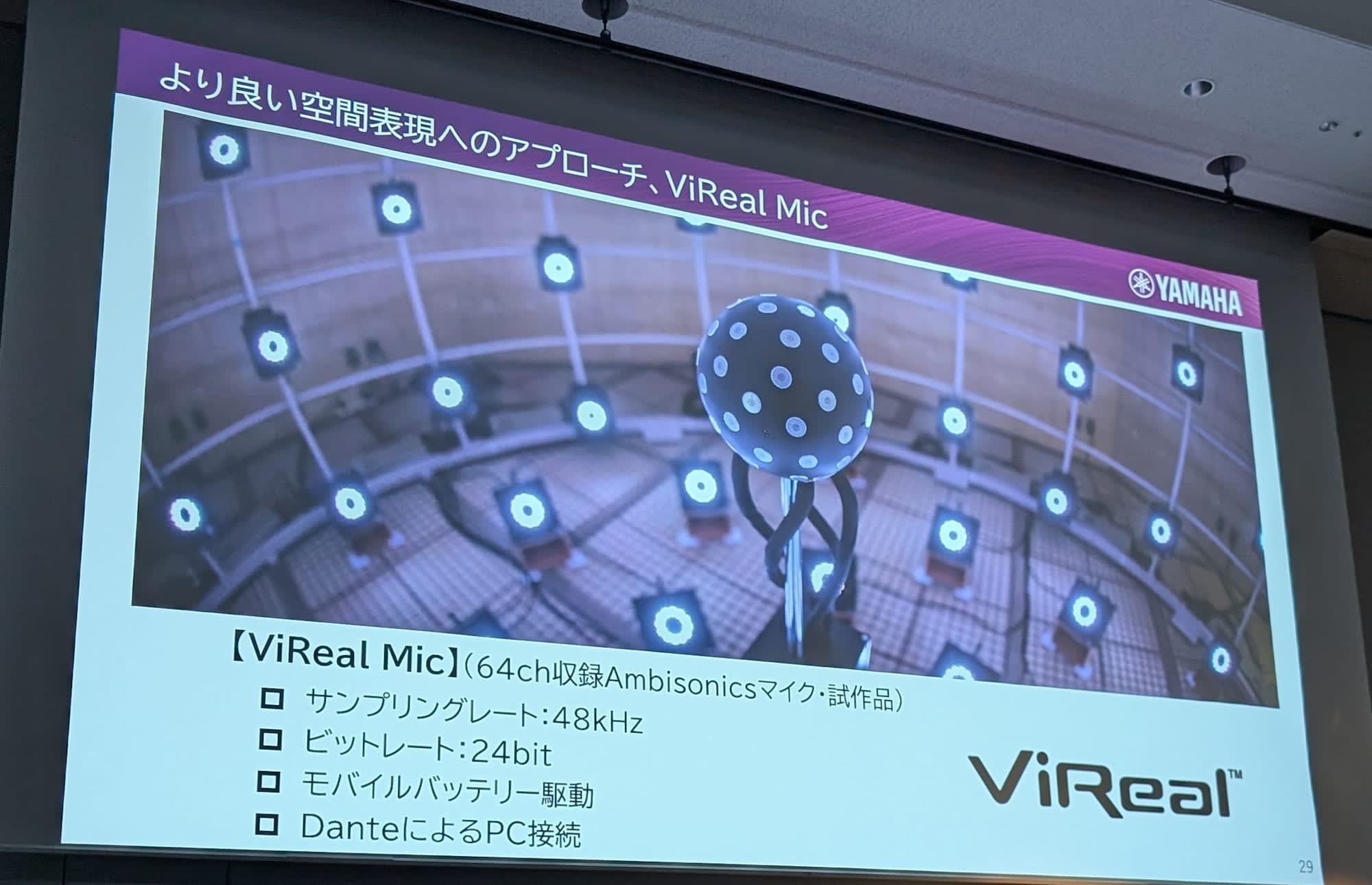
Introduced in the context of these developments was the ViReal Mic, a 64-channel Ambisonics microphone prototyped by Yamaha. It is theoretically capable of recording a sound field in Ambisonics up to 7th order, aiming for higher-definition spatial recording.
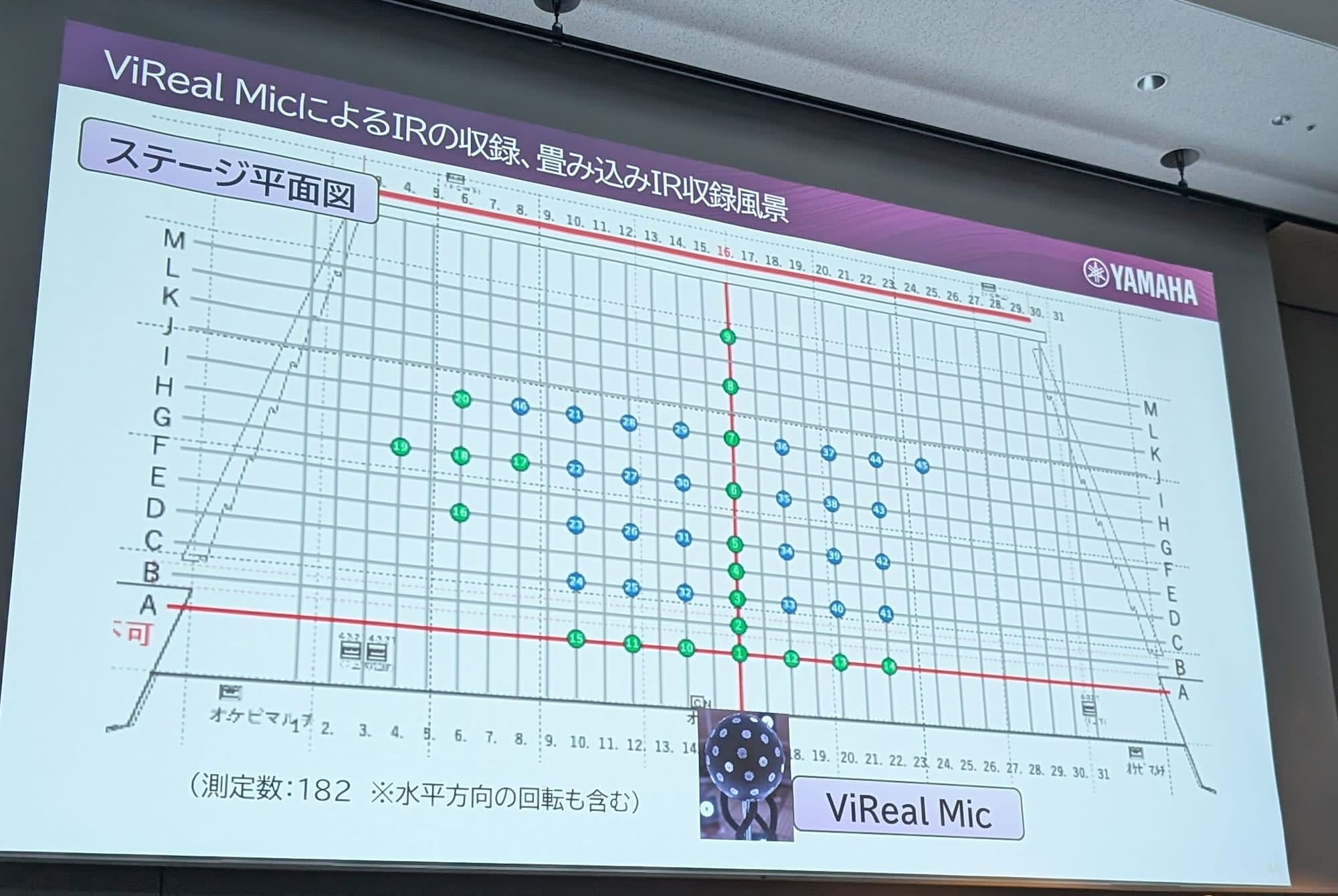
The focus of this session was on IR (impulse response) recording using this ViReal Mic. An IR is a recording of how a given space responds to an instantaneous sound; by convolving this with another sound, the reverberation of that space can be applied to it. While first-order Ambisonics IRs have commonly been used in the past, the session presented an attempt to convolve IRs measured with 64 channels onto a monaural sound source. As a result, it was reported that sound position, distance, orientation, spatial depth, and even spaces different from the one where the recording was made could all be expressed through IR convolution alone. However, it was noted that rigorous subjective evaluation and acoustic-theoretical verification remain to be carried out.
Impressions
I felt that the approach of reproducing the reverberation and depth of a space through IR convolution alone—without having to construct a full 3D environment—has the potential to change how spatial audio is created. I also look forward to future developments in 6DoF expression, where the microphone is moved during recording to support player movement from the audio side.