![[Session Report] Automation Alone Is Not Enough to Protect —— The Frontlines of Quality Assurance and Anti-Cheat in Global Game Operations #CEDEC2026](https://images.ctfassets.net/ct0aopd36mqt/5L0LdMnL6vvm3iyLUBor5I/23a209b62a40af938e8edddf48d73233/cedec2026.png?w=3840&fm=webp)
[Session Report] Automation Alone Is Not Enough to Protect —— The Frontlines of Quality Assurance and Anti-Cheat in Global Game Operations #CEDEC2026

This page has been translated by machine translation. View original
Introduction
This is a report on a session I attended at CEDEC2026. It introduced how Tencent Cloud's game solutions are used for quality assurance and anti-cheat measures in globally deployed games.
The session overview is as follows.
- Title: What Automation Alone Can't Protect —— The Frontlines of Quality Assurance and Anti-Cheat in Global Game Operations
- Speaker: Zilong Liang (Tencent Japan GK Solutions Architect)
- Date and Time: July 23, 2026, 10:00–10:25
- Venue: Hall 12

Two Risks in Game Operations
The session opened by identifying two risks in game development and operations. The first is the risk of quality. Each version update requires new testing, and since human capacity has its limits, test workload becomes a bottleneck. The dilemma between quality and speed is ever-present. The second is the risk of fairness — in other words, cheating. Data tampering leads to fraud, damages community trust, and threatens the very lifespan of a game.
To address these two risks, two pillars were introduced: WeTest Acorn for test automation, and ACE (Anti-Cheat-Expert) for anti-cheat measures.
AI Agent-Driven Test Automation
The first half covered AI agent-driven test automation using WeTest Acorn.
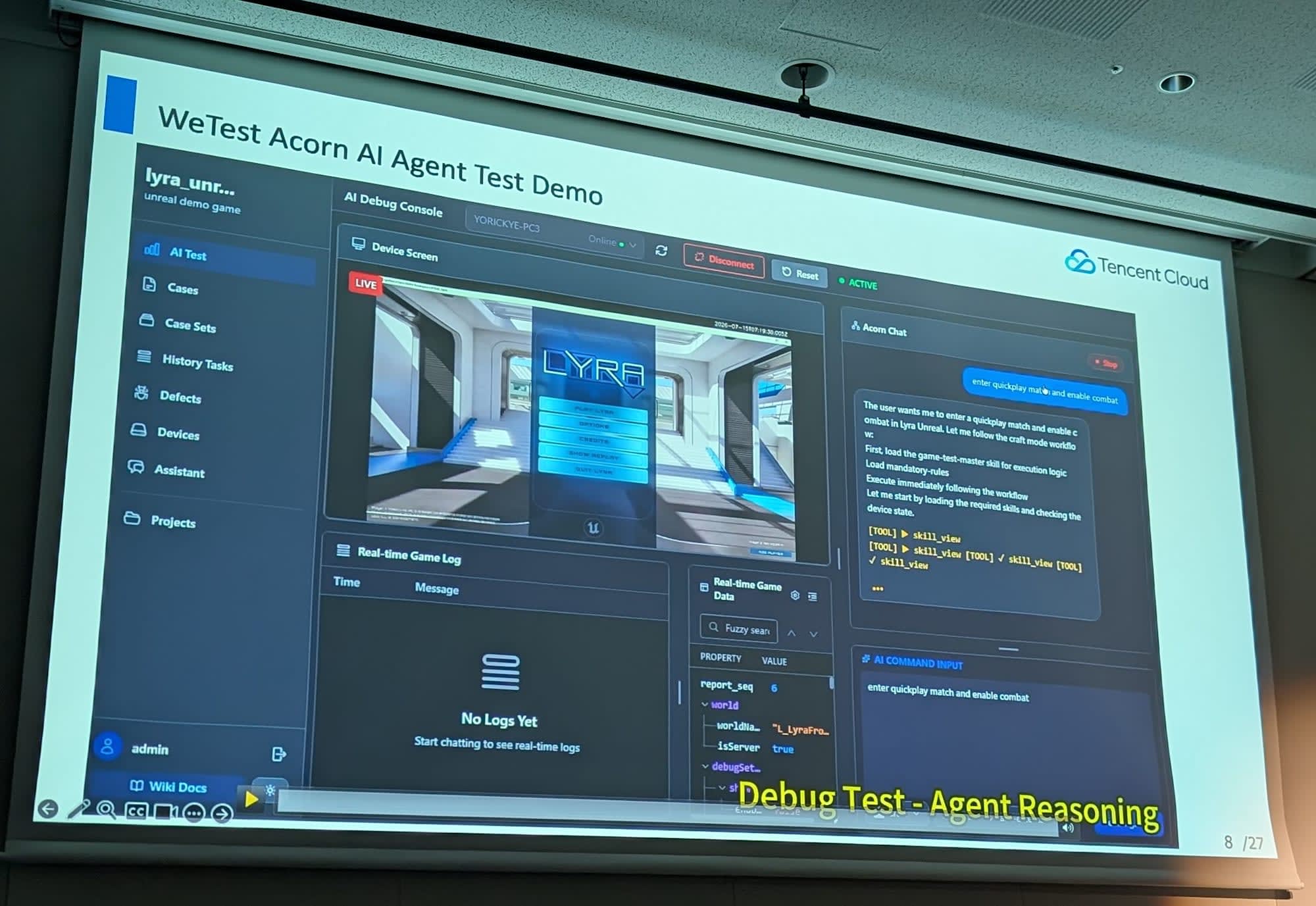
Conventional test automation has come in two forms: script-based and visual model-based. Script-based approaches offer high accuracy but have the drawbacks of a high barrier to creation and poor scalability. Visual model-based approaches require no source code and are versatile, but challenges remain in recognition accuracy. Acorn aims to overcome these limitations through the collaboration of multiple specialized agents.
Agents assigned to roles such as planning, exploration, execution, and judgment work together, running a loop of recognizing execution results and deciding the next action. The design compensates for the weaknesses of any single agent through division of roles. Test cases can be auto-generated from natural language descriptions or documents, reducing the effort required for test design. The demo showed real-time bug detection targeting Lyra, a sample project for Unreal Engine.
Anti-Cheat Solution ACE
The second half covered ACE, the anti-cheat solution.
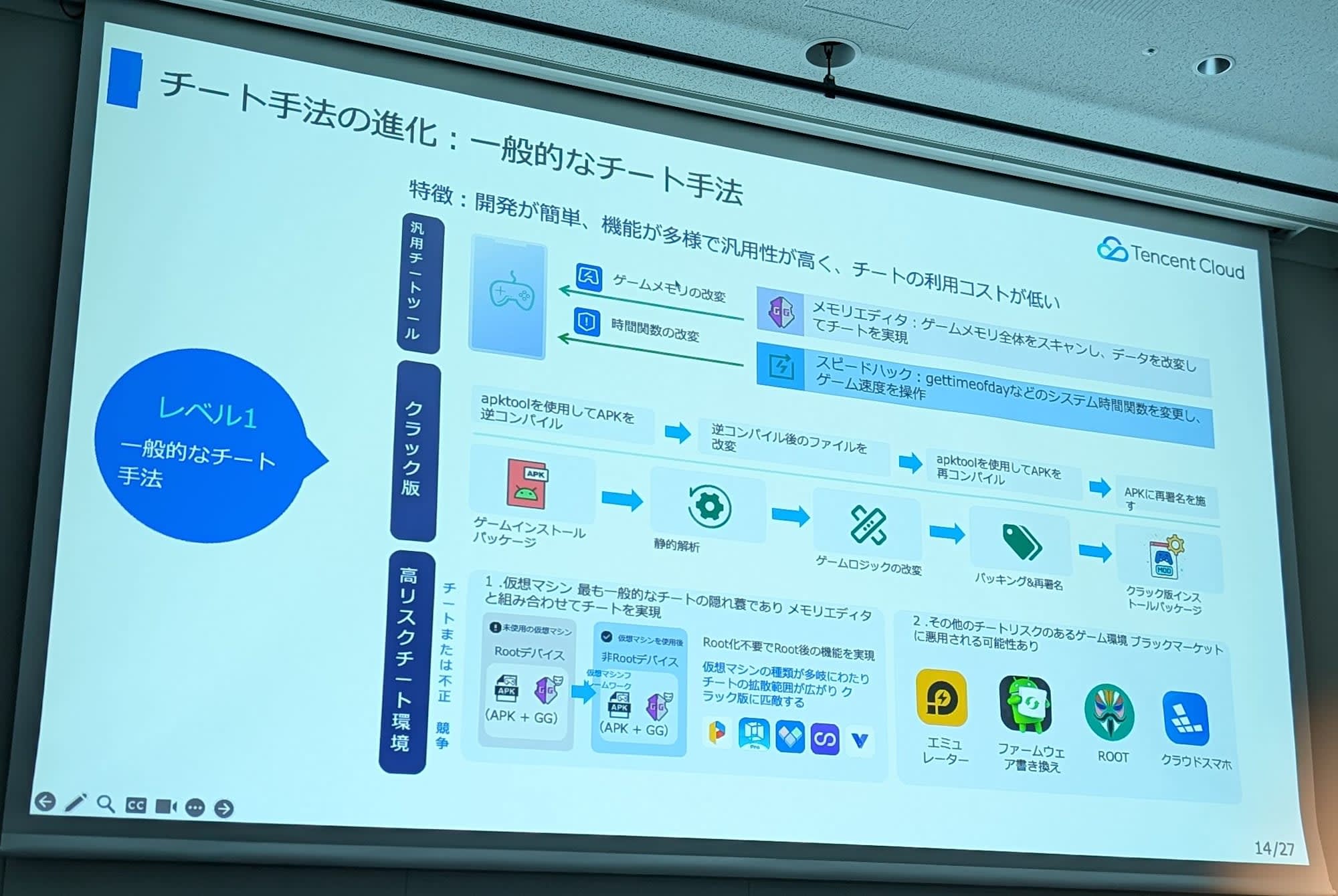
First, cheat methods were organized into three levels. Level 1 consists of common methods such as memory tampering and speed hacks — easy to develop and highly versatile. Level 2 involves advanced methods that attempt to circumvent security measures themselves. Level 3 consists of custom methods built specifically for a particular game; the high development cost makes them equally difficult to detect. These are used in genres where cheating has a large impact, such as FPS games, with examples including auto-aim and world hacks.
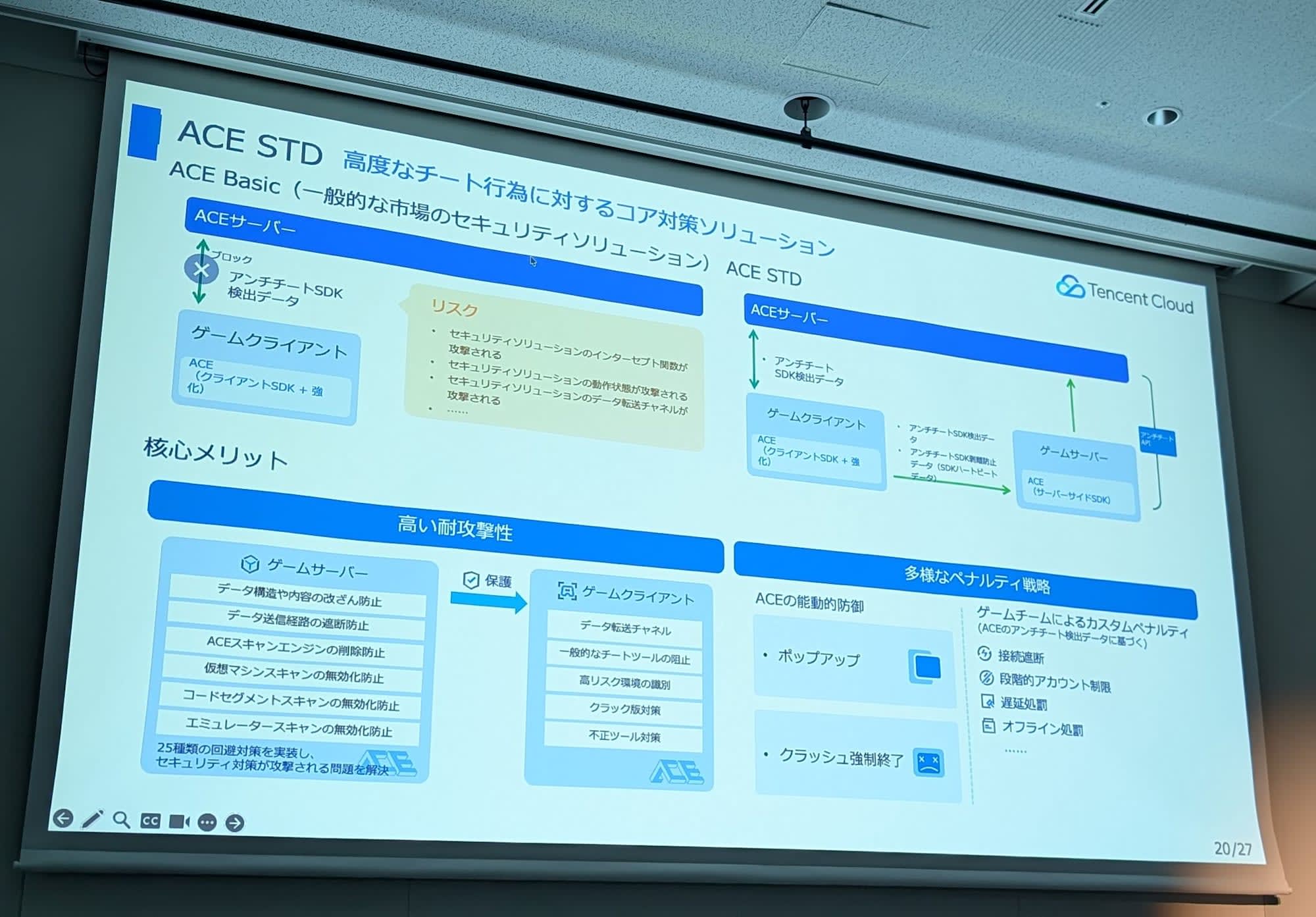
In response to these threats, ACE provides multiple solutions tailored to different use cases. These include hardening to increase resistance against app decompilation and debugging, encryption and tampering detection for communication data, and individual countermeasures against custom cheats. Also introduced were mechanisms for delivering detection logic immediately after a game update, and mechanisms for detecting and handling fraudulent accounts. The session touched on adoption across numerous titles, including Honor of Kings and PUBG Mobile.
Impressions
I was impressed by the direction of using AI and the cloud to support both testing and anti-cheat — two areas where human effort alone simply cannot keep up. In particular, the idea of building test automation not through a single AI but through the collaboration of multiple agents felt like it could become one of the defining approaches to game QA going forward.