![[Session Report] Modernizing Development Pipelines with Cloud-Native Version Control "Diversion" #CEDEC2026](https://images.ctfassets.net/ct0aopd36mqt/5L0LdMnL6vvm3iyLUBor5I/23a209b62a40af938e8edddf48d73233/cedec2026.png?w=3840&fm=webp)
[Session Report] Modernizing Development Pipelines with Cloud-Native Version Control "Diversion" #CEDEC2026

This page has been translated by machine translation. View original
Introduction
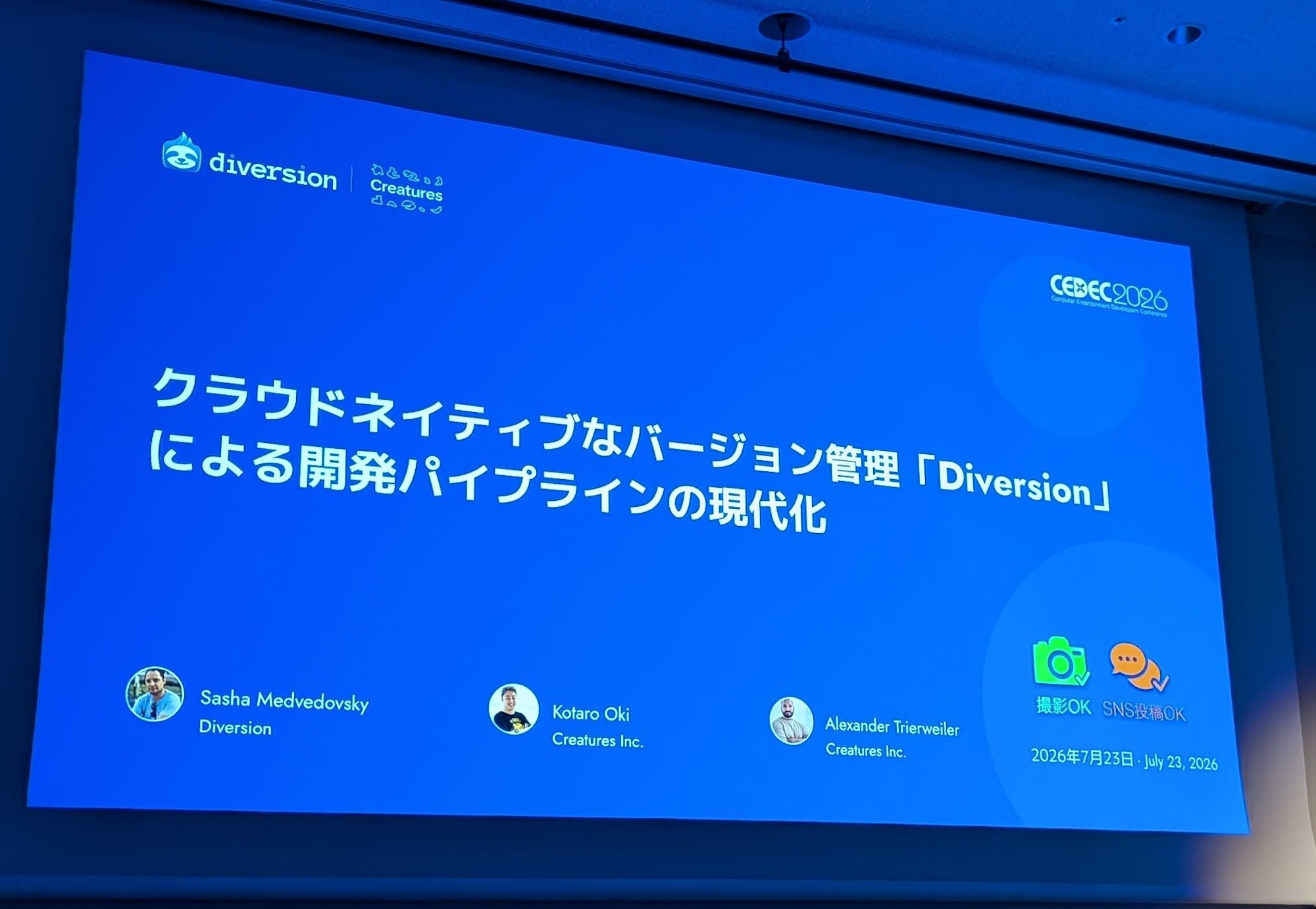
This is a report from a session I attended at CEDEC2026. The session introduced the features of Diversion, a cloud-native version control system, along with a case study of its adoption at Creatures Inc.
The session overview is as follows.
- Title: Modernizing the Development Pipeline with Cloud-Native Version Control "Diversion"
- Speakers: Sasha Medvedovsky (Diversion Co-Founder & CEO), Kotaro Oki (Creatures Inc.)
- Date and Time: July 23, 2026, 09:30–09:55
- Venue: Hall 12
Features of Diversion
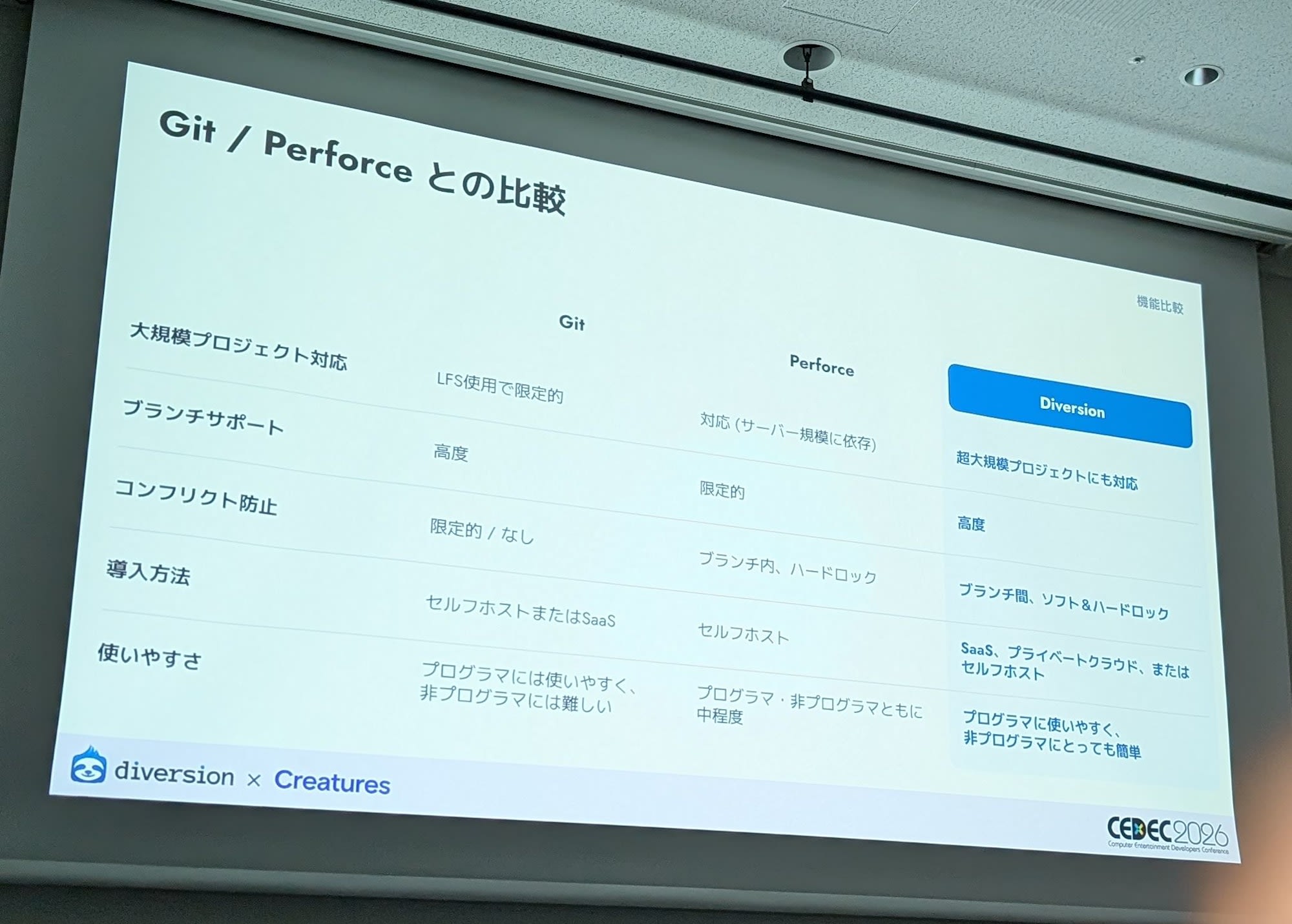
Diversion is a version control system designed to be cloud-native. In game development, asset sizes are growing larger and teams are becoming more distributed, making it easy for traditional on-premises or centralized version control systems to become bottlenecks due to slower synchronization speeds and increasingly complex infrastructure management. Diversion is said to handle even petabyte-scale large repositories at high speed, thanks to its virtual file system and cloud architecture.
There are three deployment options to choose from: SaaS, private cloud, and on-premises. It was also noted that users can migrate gradually on a per-user basis while synchronizing in real time with Git or Perforce. Other highlighted features include ease of use for non-programmers, as well as integration with external tools via RESTful API and Webhooks. Plans for expanding AI capabilities, such as integration with Claude Code, are also in the works.
Creatures Inc. Case Study
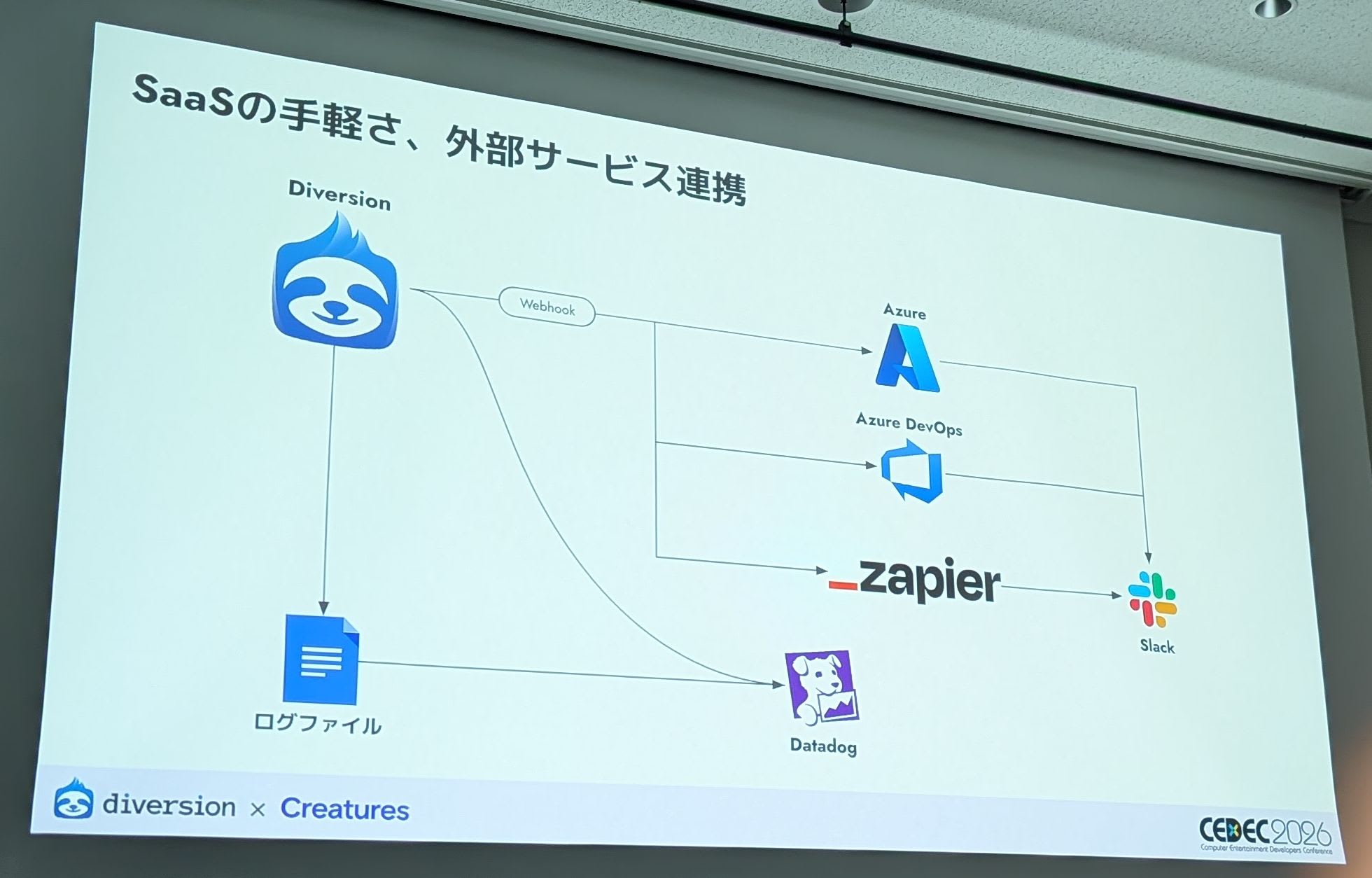
In the second half, a case study from Creatures Inc., which has adopted Diversion, was shared. To enable parallel development without halting work, they have adopted a branching strategy in which a shared branch is created from the main branch, and each team member works in a dev branch before merging. For CI/CD, they combine Azure Pipelines and integrate with external services such as Azure DevOps, Slack, and Datadog via Webhooks.
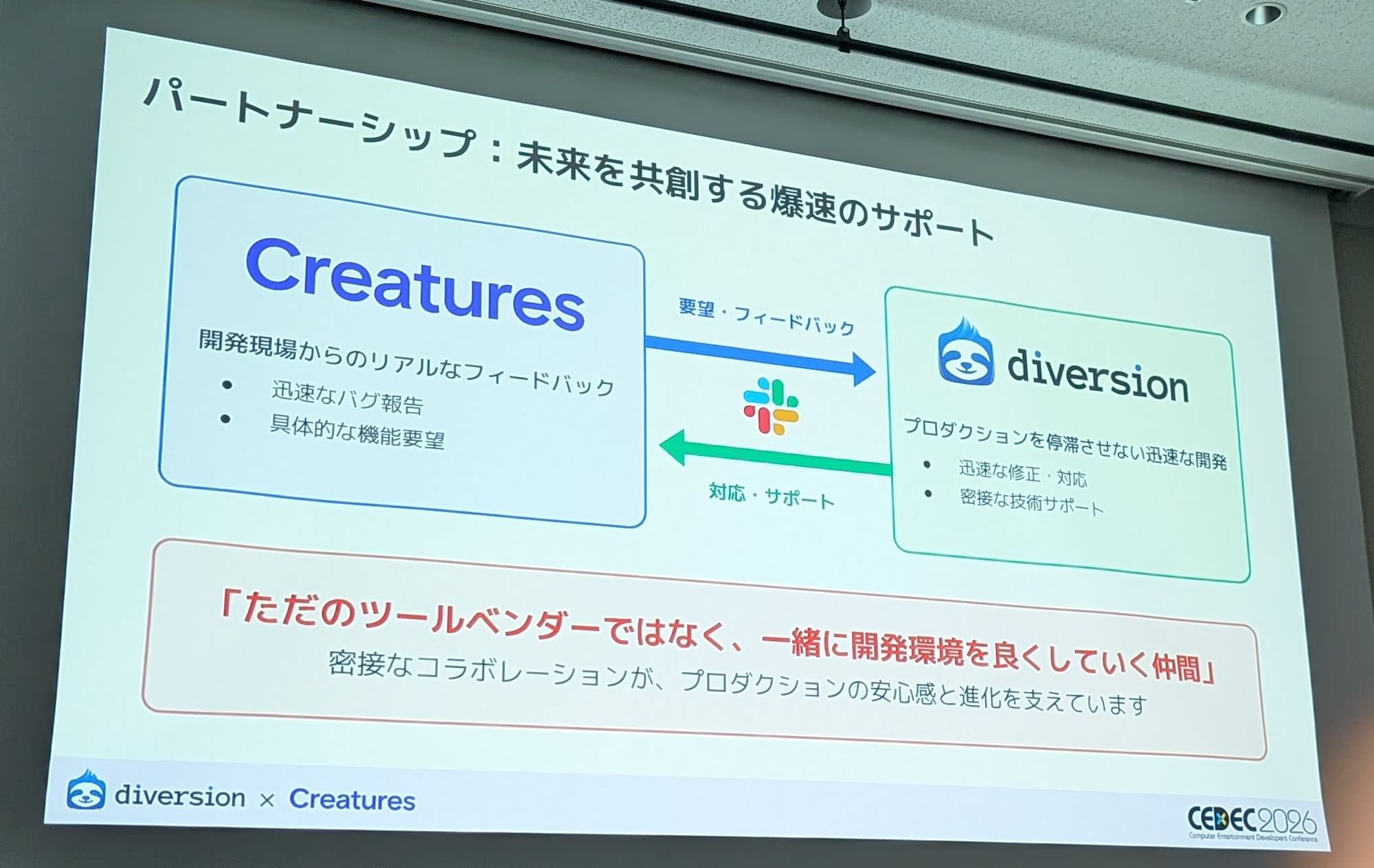
During the presentation, Diversion was positioned not merely as a tool vendor, but as a partner working together to improve the development environment. The speakers described a close collaborative relationship built on feedback from early development stages and prompt support.
Impressions
I felt that replacing version control with a cloud-native solution is significant for game development, where distributed workflows are increasingly common, as it reduces the burden of syncing large assets and managing infrastructure. I also felt that the ability to migrate gradually from Git or Perforce makes it easy to adopt in real-world production environments.