![[Session Report] Establishing Means of Production for Computer and Network Technologies That Can Be Disseminated Worldwide #CEDEC2026](https://images.ctfassets.net/ct0aopd36mqt/5L0LdMnL6vvm3iyLUBor5I/23a209b62a40af938e8edddf48d73233/cedec2026.png?w=3840&fm=webp)
[Session Report] Establishing Means of Production for Computer and Network Technologies That Can Be Disseminated Worldwide #CEDEC2026

This page has been translated by machine translation. View original
Introduction
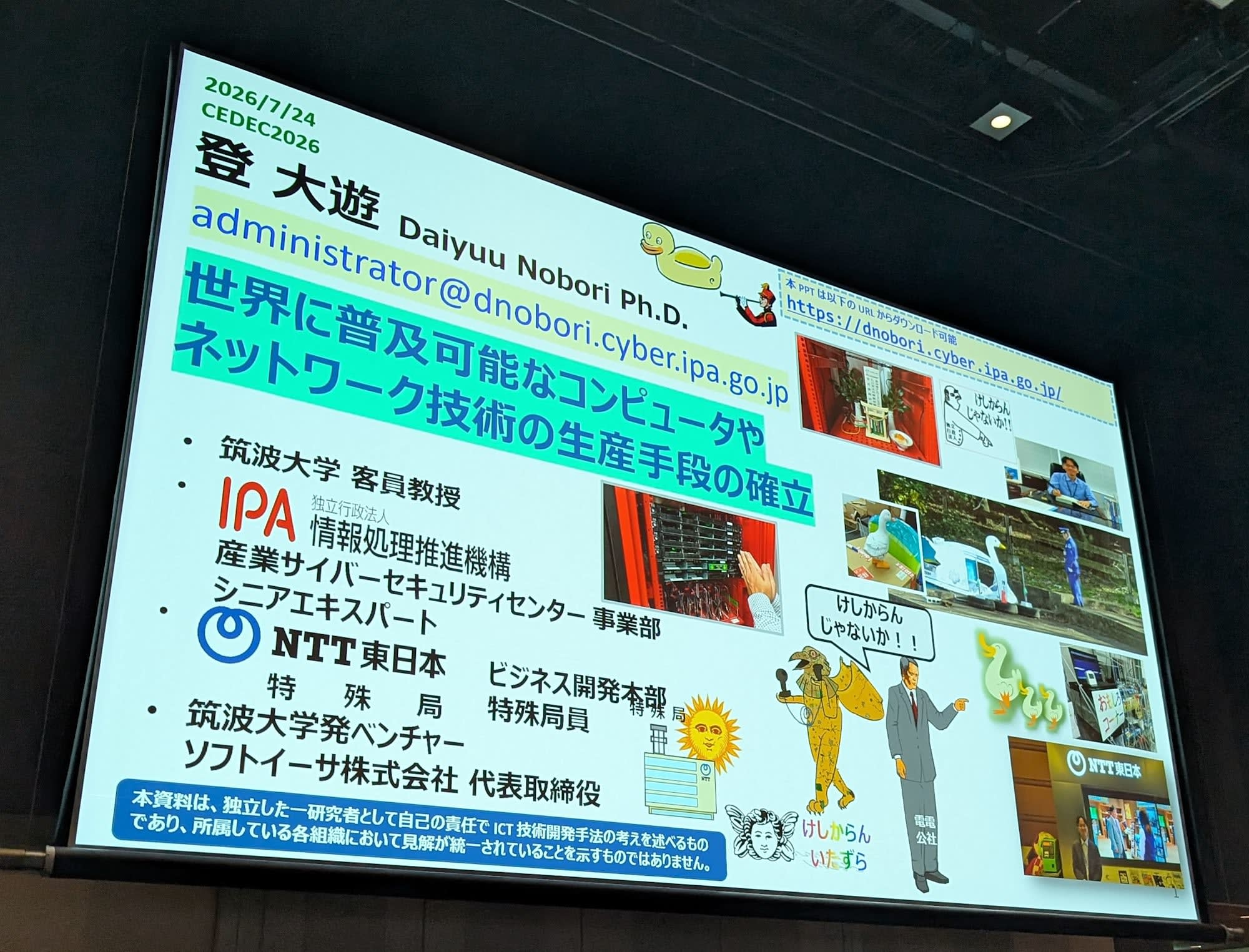
This is a report on the keynote address at CEDEC2026. Daisuke Nobori, known for developing SoftEther VPN and Thin Telework System, discussed how Japan should establish the means of production for digital infrastructure technology. Rather than being a talk about game development technology, this was an industrial policy lecture about how Japan should generate the software technology that forms its foundation.
The session overview is as follows.
- Title: Establishing the Means of Production for Computer and Network Technology That Can Spread Worldwide
- Speaker: Daisuke Nobori (Senior Expert, Industrial Cyber Security Center, Information-technology Promotion Agency (IPA). Concurrently serving as Visiting Professor at University of Tsukuba, NTT East, and Representative Director of SoftEther Corporation)
- Date and Time: July 24, 2026, 09:30 to 10:50
- Venue: Hall 1
It was noted at the outset that the lecture represents the speaker's own views as an individual researcher and does not necessarily reflect the positions of his affiliated organizations.
Social Value Created by Software
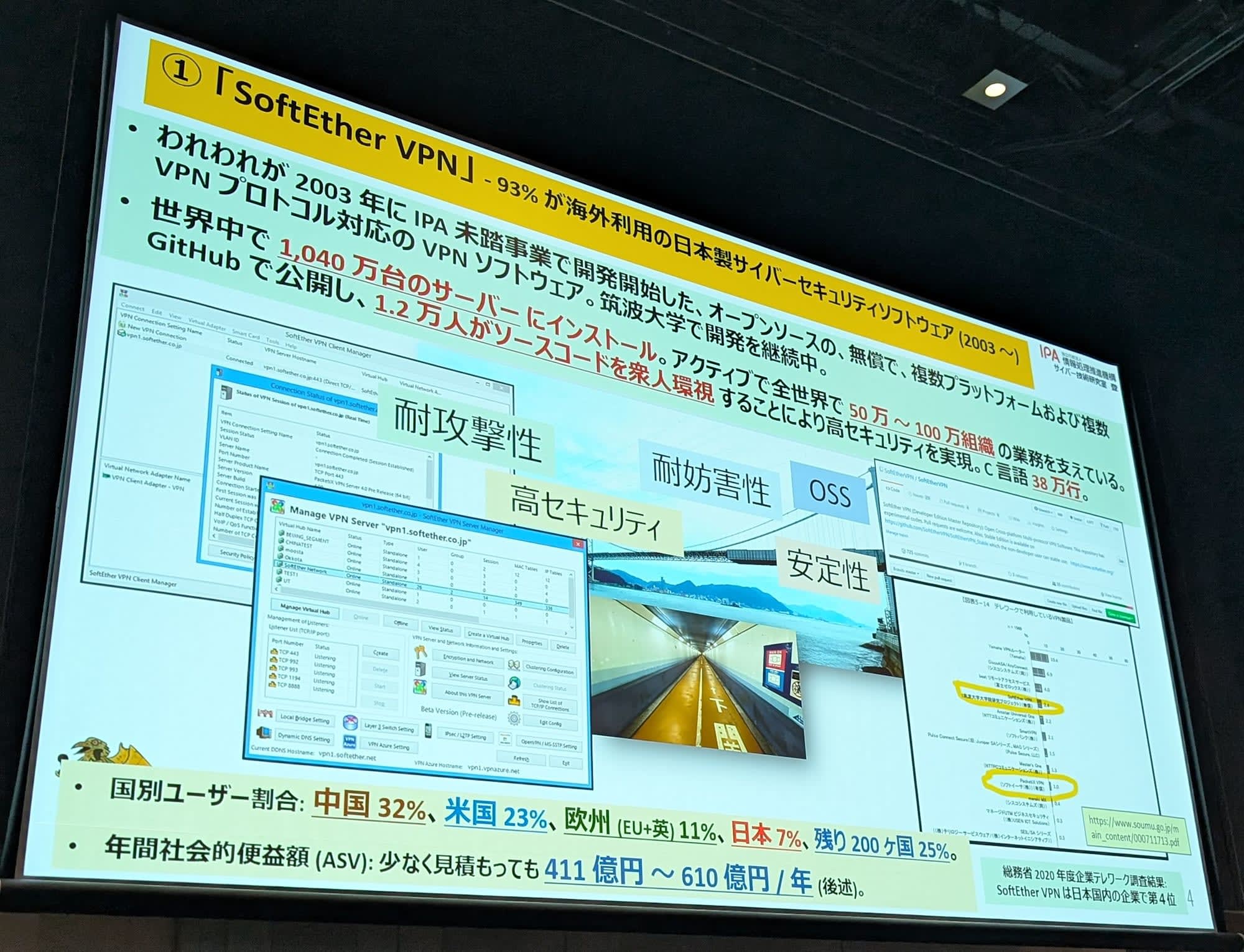
In the first half, the track record of software that Nobori himself had developed was introduced. SoftEther VPN, whose development began in 2003 as an IPA project, has been released as open source and deployed on over 10 million servers worldwide. He noted that more than 90% of users are overseas, with China and the United States topping the list by country, while Japan's share is minimal.
Furthermore, the Thin Telework System released by NTT East and IPA as a COVID-19 countermeasure reached a scale where a cumulative 640,000 people have used it, with 80,000 using it on a daily basis.
Nobori presented these achievements converted into monetary terms using a metric called Annual Social Value (ASV). He showed that the software he has been involved with alone generates value on the order of 100 billion yen per year, and compared this with the value of software originating from Japan such as Ruby and TRON, as well as software from overseas such as Python and Linux.
The development approach that produced these results was also introduced. He spoke of starting from a development environment built from servers placed at home and equipment collected from university disposal, and of creating a space for himself where he could work freely without being constrained by existing rules.
Challenges Facing Japan's Digital Infrastructure
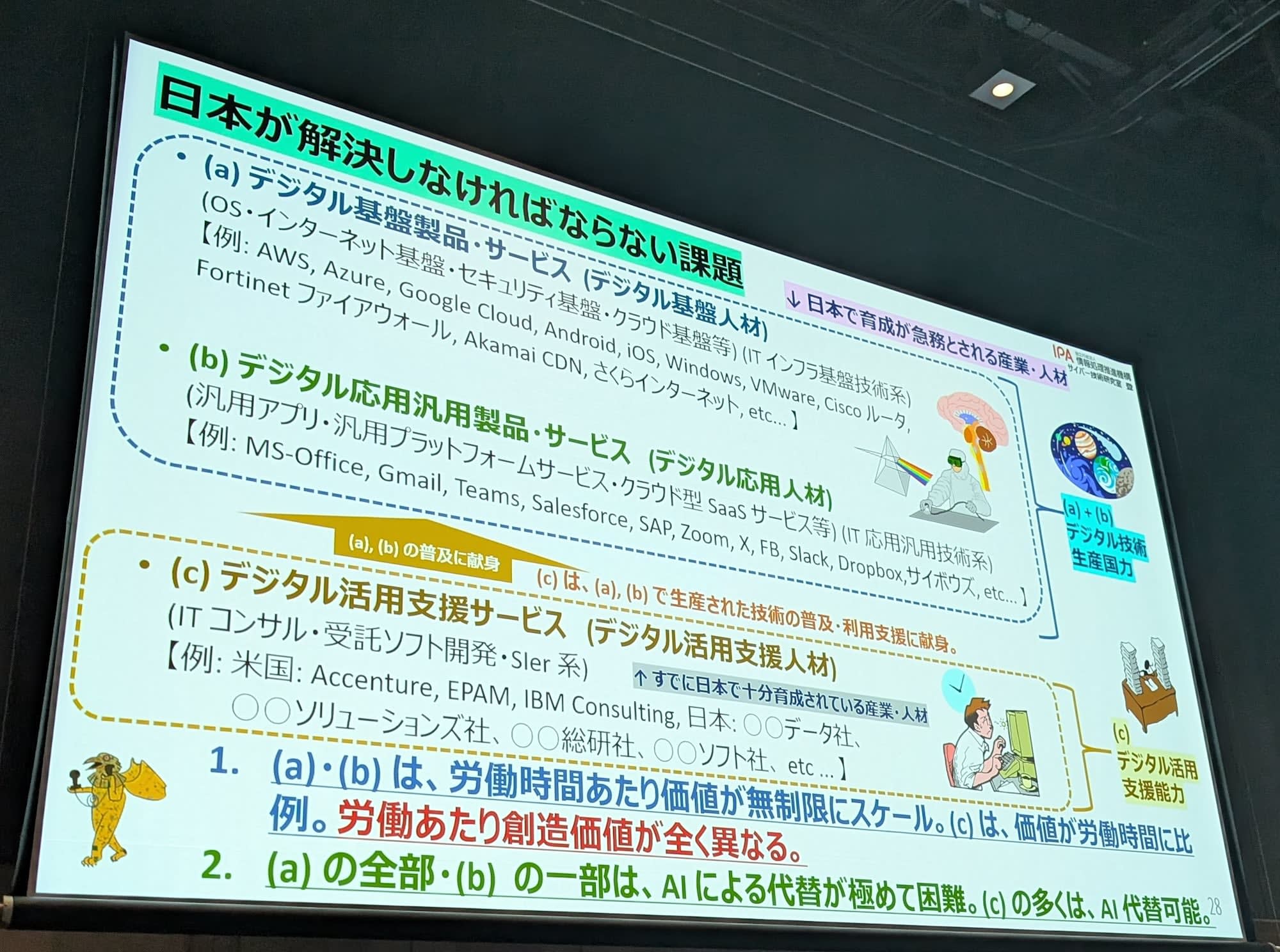
In the second half, the challenges of Japan's industrial structure were discussed. Nobori organized the digital industry into three categories: products and services forming digital infrastructure such as operating systems, internet infrastructure, and security infrastructure; applied products and services such as general-purpose applications; and utilization support services such as IT consulting and contract development.
He stated that while the infrastructure and application domains generate significantly greater value per hour of work and are difficult for AI to replace, many utilization support services could be replaced by AI. Looking at the global market, his analysis showed that the United States stands out in the digital infrastructure domain, China has been growing rapidly in recent years, while Japan has been stagnating.
As background context, he presented news reports and public materials showing that shortages of digital infrastructure personnel have become serious even in the United States, and that China has been focusing on developing talent in this field as a national strategy since 2016. Nobori pointed out that at this rate, China will likely take the top position around 2040, and that Japan also needs to have a strategy for developing infrastructure talent.
Creating Environments Where Young People Can Experiment Freely
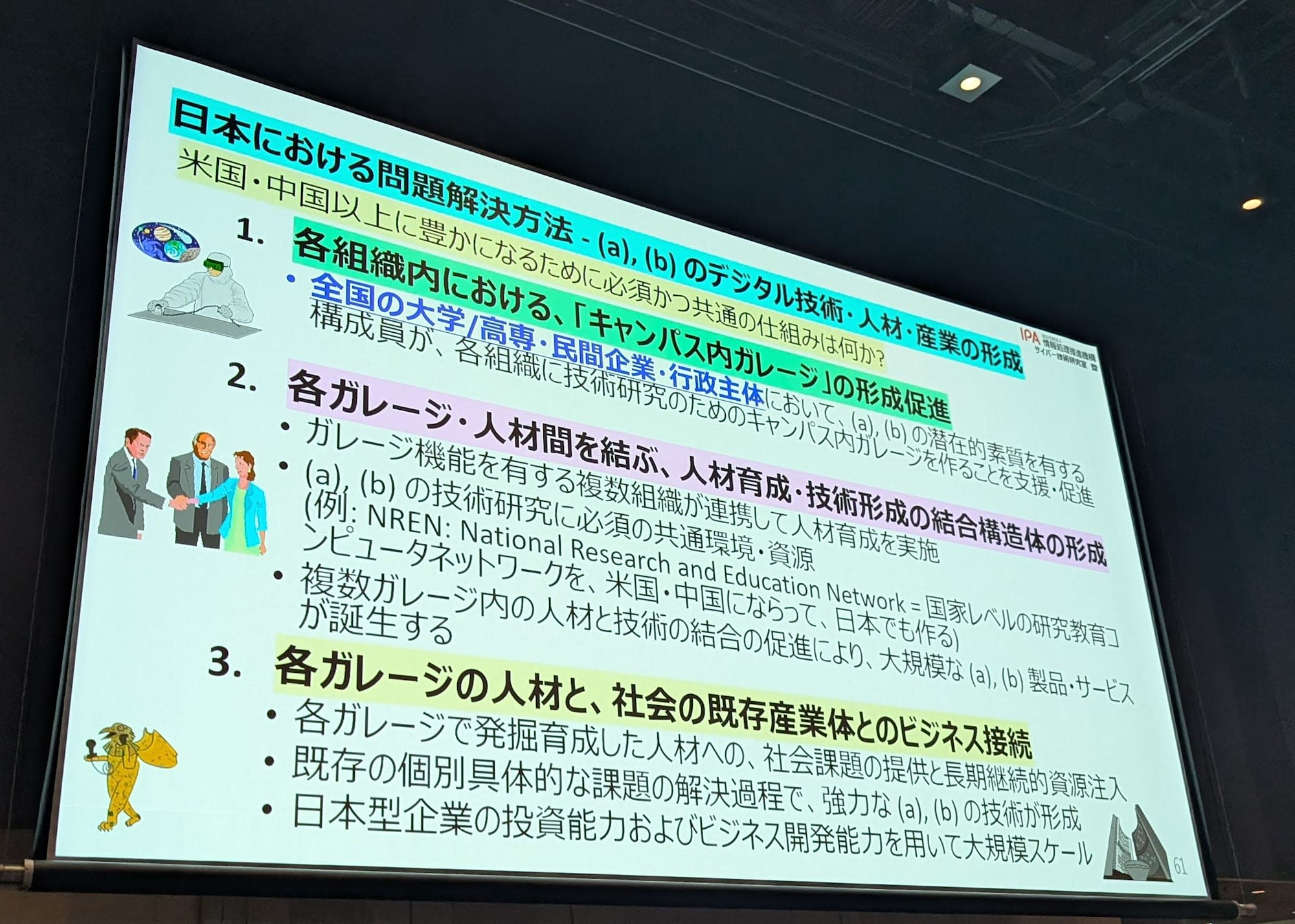
The solution Nobori proposed was to provide environments where talented young people can freely experiment with technology. He presented the idea that if excellent talent gathers in attractive places, world-class technology will naturally emerge.
Specifically, he spoke of a vision to establish garage-like spaces within various organizations where technology research can be conducted freely, connect these through networks of talent development and technology formation, and further link them with existing industries through business. As the foundation for this, four conditions were identified: freedom in computer environments that can be used autonomously, distributed investment in diverse trials by small teams, the ability to obtain common resources cheaply and immediately, and mechanisms through which intrinsic motivation naturally arises from within the individuals themselves rather than from external demands.
Finally, citing the American example of talent and industries emerging from regional universities, he spoke of the importance of spreading this kind of culture to regional areas in Japan as well. A vision that could be called the Silicon Valley-ification of the Kanto region—advancing talent development and industry formation by connecting bases throughout Kanto—was presented as the aim to be explored in this experiment.
Impressions
Although not directly related to game development technology, this was a lecture that made one think about who creates the foundations and how. The argument that providing a space where people can work freely, rather than producing results in a highly constrained environment, is what nurtures talent and technology felt relevant to the game development workplace as well.