![[Session Report] Expand "Relink" - CI Operations That Protect Development Speed and Quality in "GRANBLUE FANTASY: Relink - Endless Ragnarok" #CEDEC2026](https://images.ctfassets.net/ct0aopd36mqt/5L0LdMnL6vvm3iyLUBor5I/23a209b62a40af938e8edddf48d73233/cedec2026.png?w=3840&fm=webp)
[Session Report] Expand "Relink" - CI Operations That Protect Development Speed and Quality in "GRANBLUE FANTASY: Relink - Endless Ragnarok" #CEDEC2026

This page has been translated by machine translation. View original
Introduction
This is a report on a session I attended at CEDEC2026. Three engineers from Cygames, Inc. introduced their CI operations that achieved both development speed and quality in the development of GRANBLUE FANTASY: Relink - Endless Ragnarok.
The session overview is as follows.
- Title: Extend Relink - CI Operations That Protect Development Speed and Quality in GRANBLUE FANTASY: Relink - Endless Ragnarok
- Speakers: Akinobu Fujii, Kodai Tokumatsu, and Hiroki Asashige (all Osaka Consumer Game Engineers at Cygames, Inc.)
- Date and Time: July 24, 2026, 13:40–14:40
- Venue: Hall 8
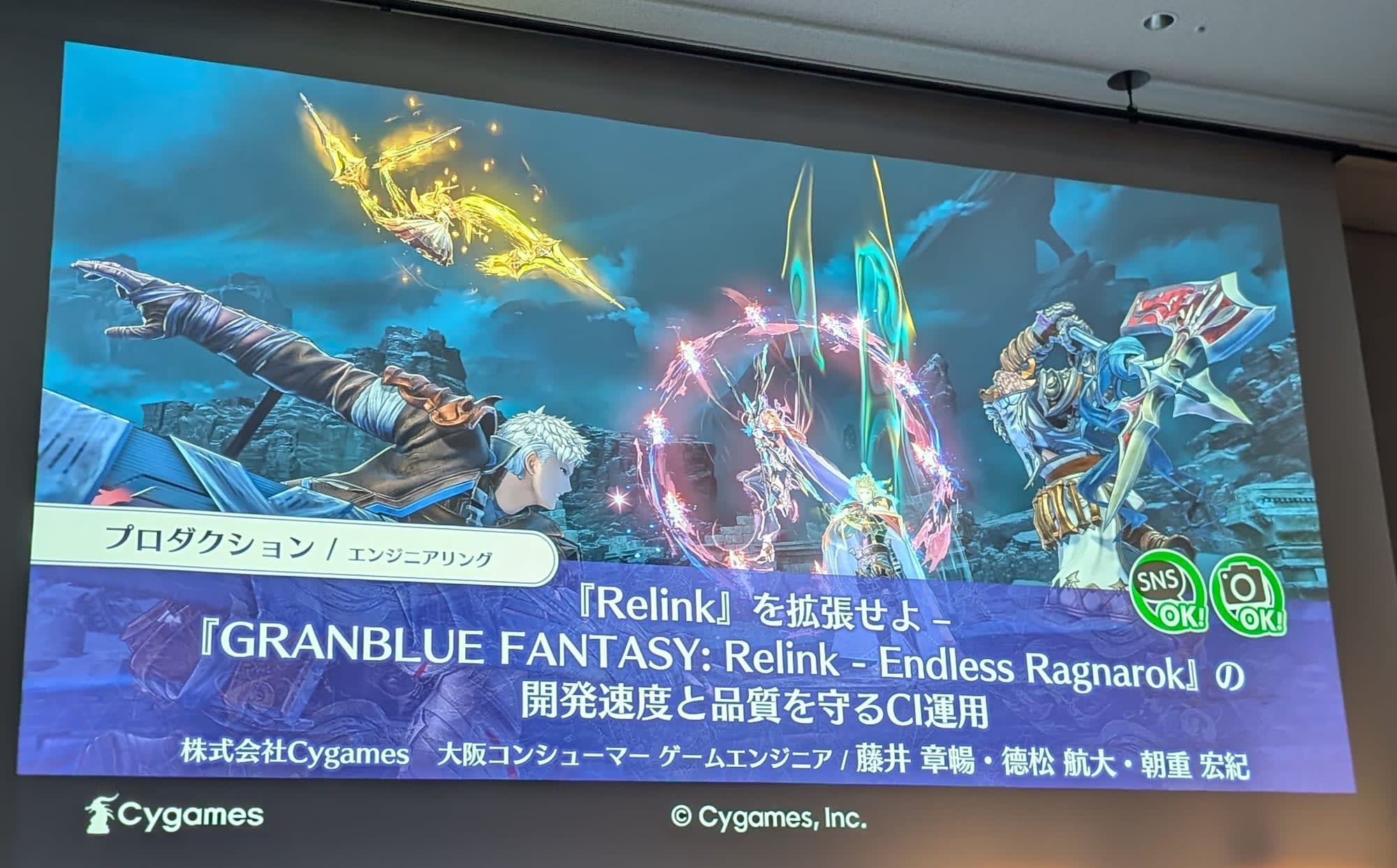
Endless Ragnarok is a major expansion of the previous title Relink. Support for new platforms and the addition of new elements significantly increased the volume of source code, assets, and product data. This brought about three challenges: longer build times, inconsistencies in existing data, and unintended visual changes. Three approaches were taken to address these: visualization of the CI environment using Datadog, static analysis, and automated image comparison testing.
Visualizing the CI Environment with Datadog
First, the challenge of identifying the causes of slow builds. With approximately 50 build machines, around 500 Jenkins jobs related to builds, and a constantly changing configuration, pinpointing bottlenecks was difficult.
Datadog was therefore introduced to record infrastructure metrics for each build machine and Jenkins execution results via CI Visibility. By enabling the correlation of machine status and build results over time, it became possible to identify causes such as unexpected concentrations of pull requests and build cache exhaustion, leading to revisions in machine allocation.
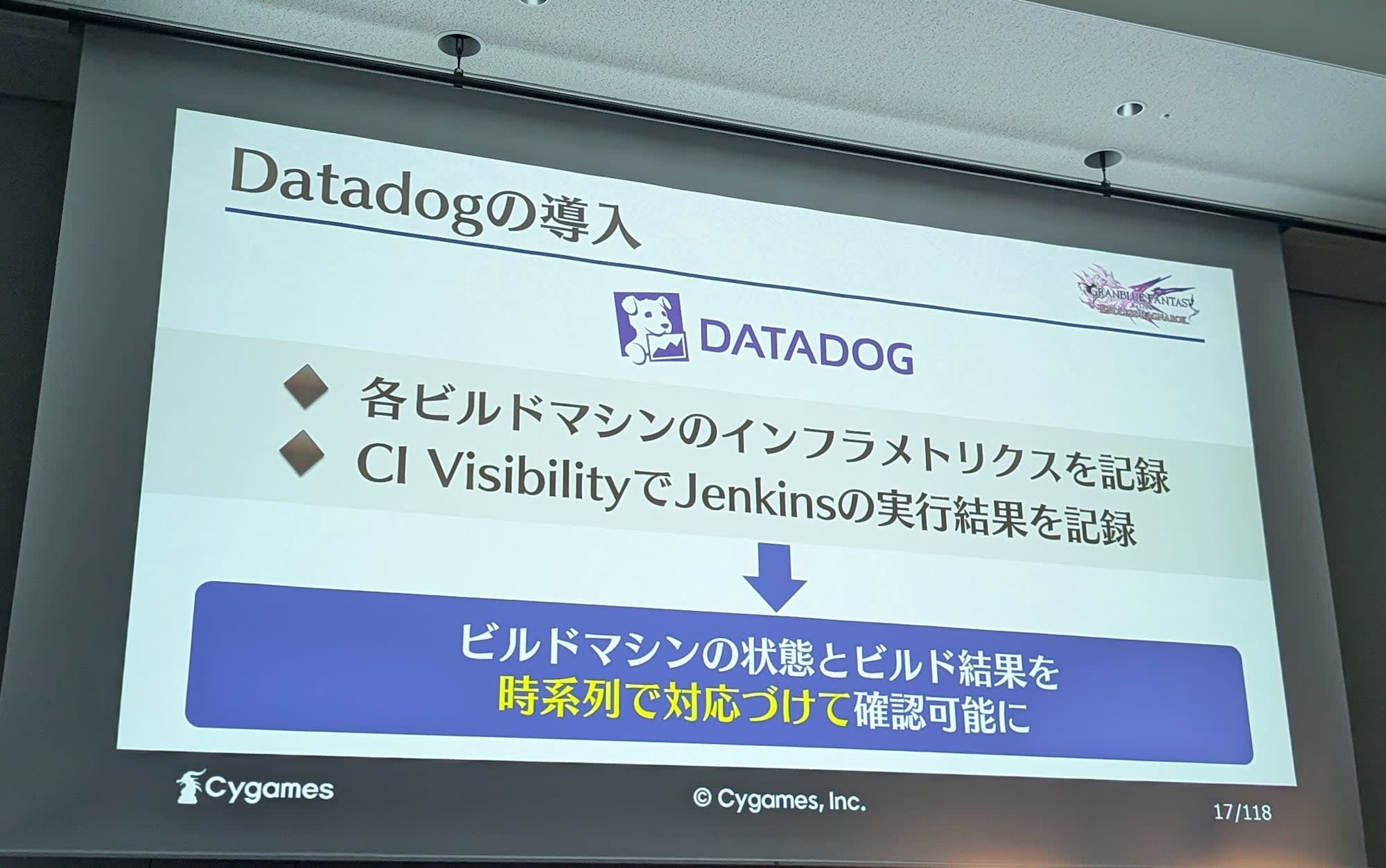
During development, two major failures also occurred on the Jenkins controller. The first was a disk I/O failure, and the second was an unresponsive state caused by the NIC. In both cases, the cause was identified from recorded metrics, and monitoring was added to alert on loss of metric transmission or detection of log warnings, helping to prevent recurrence.
Ensuring Data Quality Through Static Analysis
Next, the challenge of maintaining the quality of ever-increasing assets. The quality of an asset cannot be judged by its size alone; it requires comparison with other assets and examination of configuration inconsistencies.
To address this, analysis files and analysis tools were integrated into the CI pipeline to mechanically detect data deficiencies and trends. Tools were developed to list deficiencies such as mesh naming convention violations and missing LOD settings, as well as tools to aggregate the distribution of texture resolutions and settings to identify data that is heavier than average. In total, 35 analysis tools were developed and put into operation.
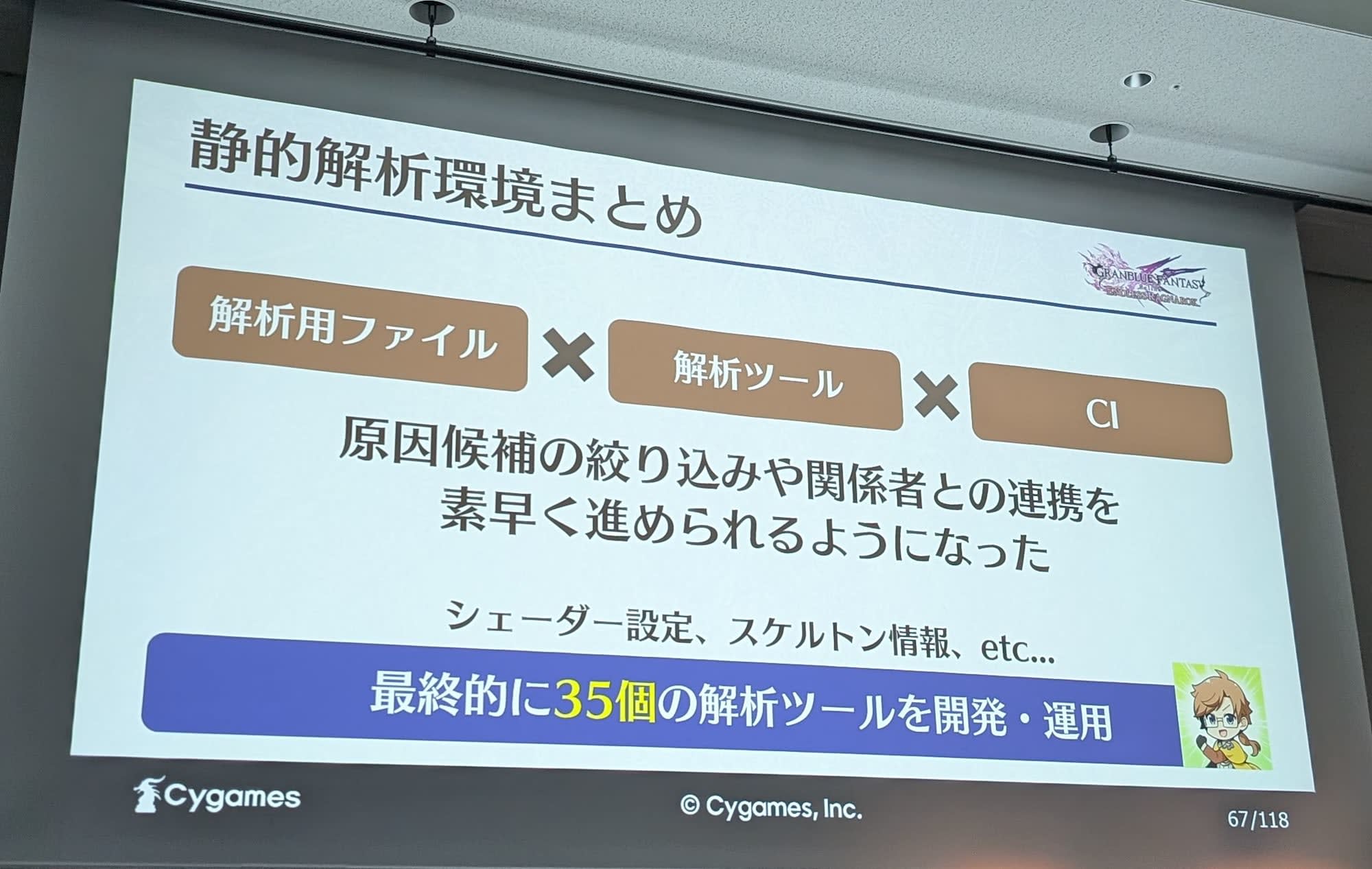
Specific examples cited included issues where an unintended shader was applied to a character causing visual corruption, and issues where mesh sizes across LOD levels were unnaturally misaligned. Such problems were also addressed by batch-detecting and fixing assets of the same type, then adding them to the detection conditions to enable earlier discovery in the future.
Automated Image Comparison Testing
Finally, the challenge of verifying that visuals have not changed unintentionally. Manual visual verification cannot keep pace with the growth in development scale in three respects: verification cost, coverage, and sustainability.
To address this, a system called SnapshotQA was created that captures rendering results on actual hardware as snapshots and compares them against reference images. The workflow of capture, evaluation, storage, and visualization was built using Jenkins, SQLite, Kibana, and other tools, and by using reproducible conditions as input, only meaningful differences can be handled.
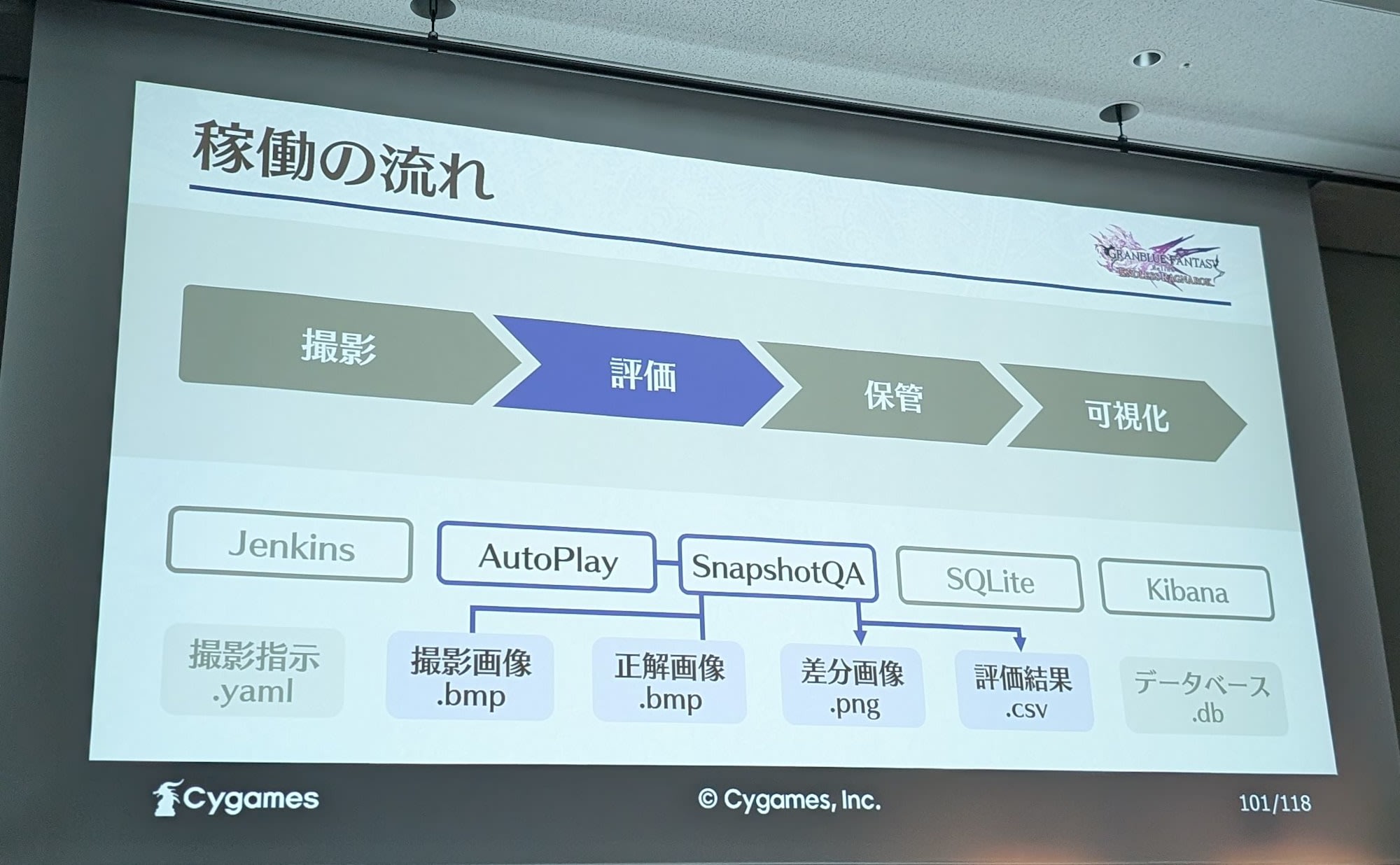
This made it possible to complete the cycle from detecting a difference to identifying the cause and applying a fix. It was also noted that there is value in having a record of what has not changed and when, which can also serve as support for refactoring and final verification. The system is positioned as a black-box test for the image that is delivered as the final product.
Impressions
This was a concrete and informative presentation that conveyed the realities of large-scale development, showing the steady, multi-pronged approach taken to address the unavoidable challenge of increasing volume through visualization, static analysis, and image comparison. In particular, the idea of turning the record of what has not changed into something of value left a strong impression as a way of thinking about quality assurance.