![[Session Report] "Donkey Kong Bananza" Building a World Where Everything Can Be Destroyed: Voxel Technology That Realizes Destruction #CEDEC2026](https://images.ctfassets.net/ct0aopd36mqt/5L0LdMnL6vvm3iyLUBor5I/23a209b62a40af938e8edddf48d73233/cedec2026.png?w=3840&fm=webp)
[Session Report] "Donkey Kong Bananza" Building a World Where Everything Can Be Destroyed: Voxel Technology That Realizes Destruction #CEDEC2026

This page has been translated by machine translation. View original
Introduction
This is a report on a session I attended at CEDEC2026. Nintendo developers explained how the world of Donkey Kong Bananza, where terrain and enemies can be freely destroyed, was created. The voxel technology is what supports this destruction rendering.
The session overview is as follows.
- Title: Donkey Kong Bananza Building a World Where Everything Can Be Destroyed ~Voxel Technology Realizing Destruction~
- Presenters: Yosuke Mori (Graphics Lead Programmer) and Satoshi Miyama (Sound Lead Programmer), both from Nintendo Co., Ltd.
- Date and time: July 23, 2026, 13:20 to 14:20
- Venue: Main Hall
Voxel Technology Supporting Destruction
A voxel is a method of representing space using a fine grid of cubes. In this game, meshes visible in the game world are generated from these voxels. Each voxel holds information such as density representing how solid the interior is, as well as damage, material, and wetness data.
The shape of a mesh is determined by assigning density values from 0 to 255 and moving vertex positions based on those values. However, using density alone results in overly rounded shapes, so a technique called Dual Contouring was adopted, adding information to control vertex positions and enabling the expression of sharp-edged shapes as well.
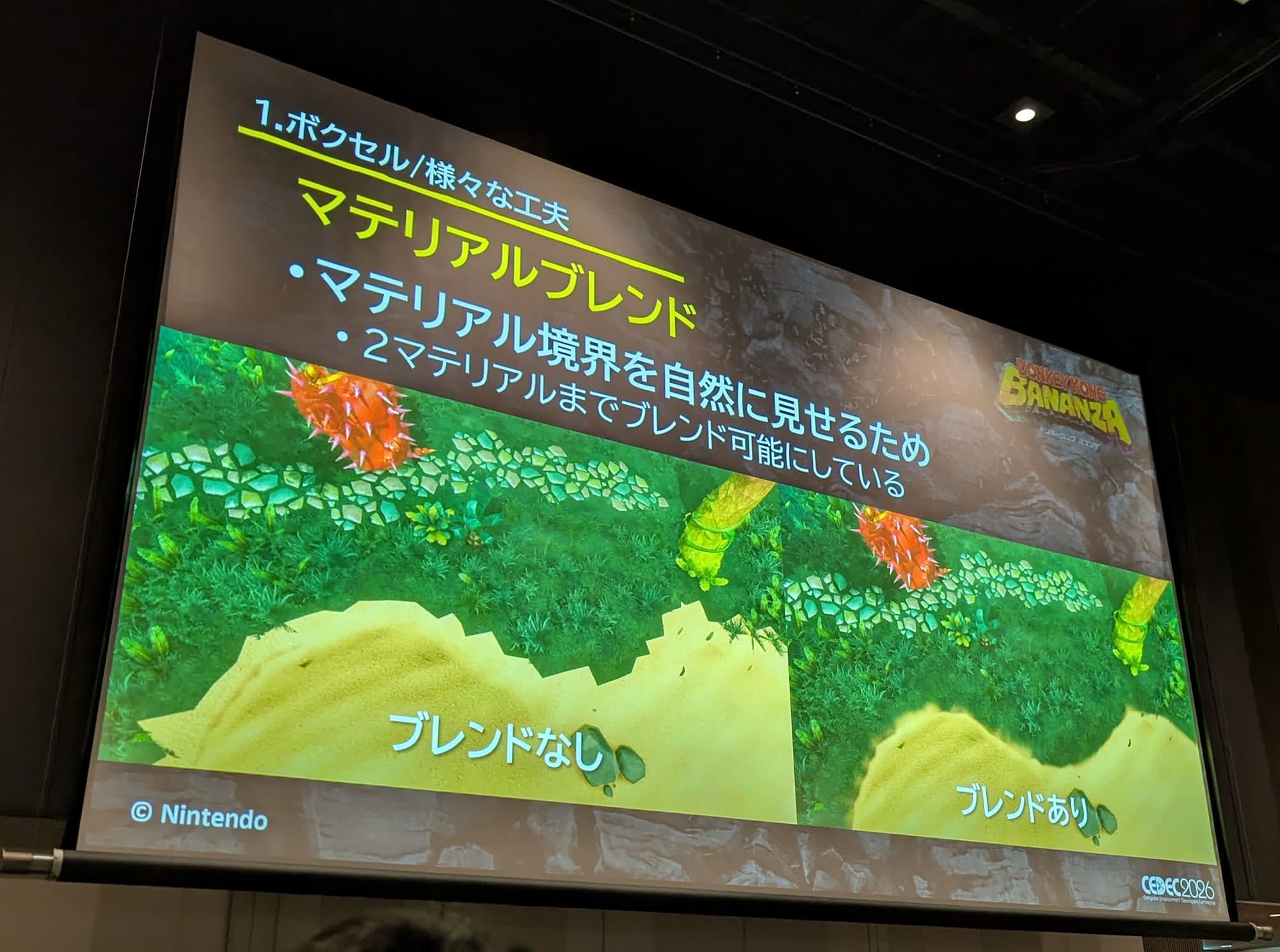
For visual naturalness, techniques such as triplanar projection, which allows textures to blend naturally on surfaces facing any direction, and material blending, which smooths transitions between different materials, were also introduced.
The scale is enormous, with the terrain exceeding 100 million voxels, of which only about 7% have content. To handle this, voxels are managed in chunks of 8×8×8, with no memory allocated to empty chunks. Furthermore, when saving to ROM, empty sections are stored with 1 bit, and only sections with content are compressed, reducing 915MB of data down to 8MB (37MB including textures).
Effects and Sound Creating the Feel of Destruction
Next, the discussion turned to how the feel of destruction is created. That tactile sensation comes from the dynamic control of effects and sound linked to the destruction.
When a voxel is destroyed, information such as where it was destroyed, how much was destroyed, and what material was destroyed is extracted and used to vary the presentation. The feel of a breakthrough and Donkey Kong's voice timed to the final blow are also controlled using this information.
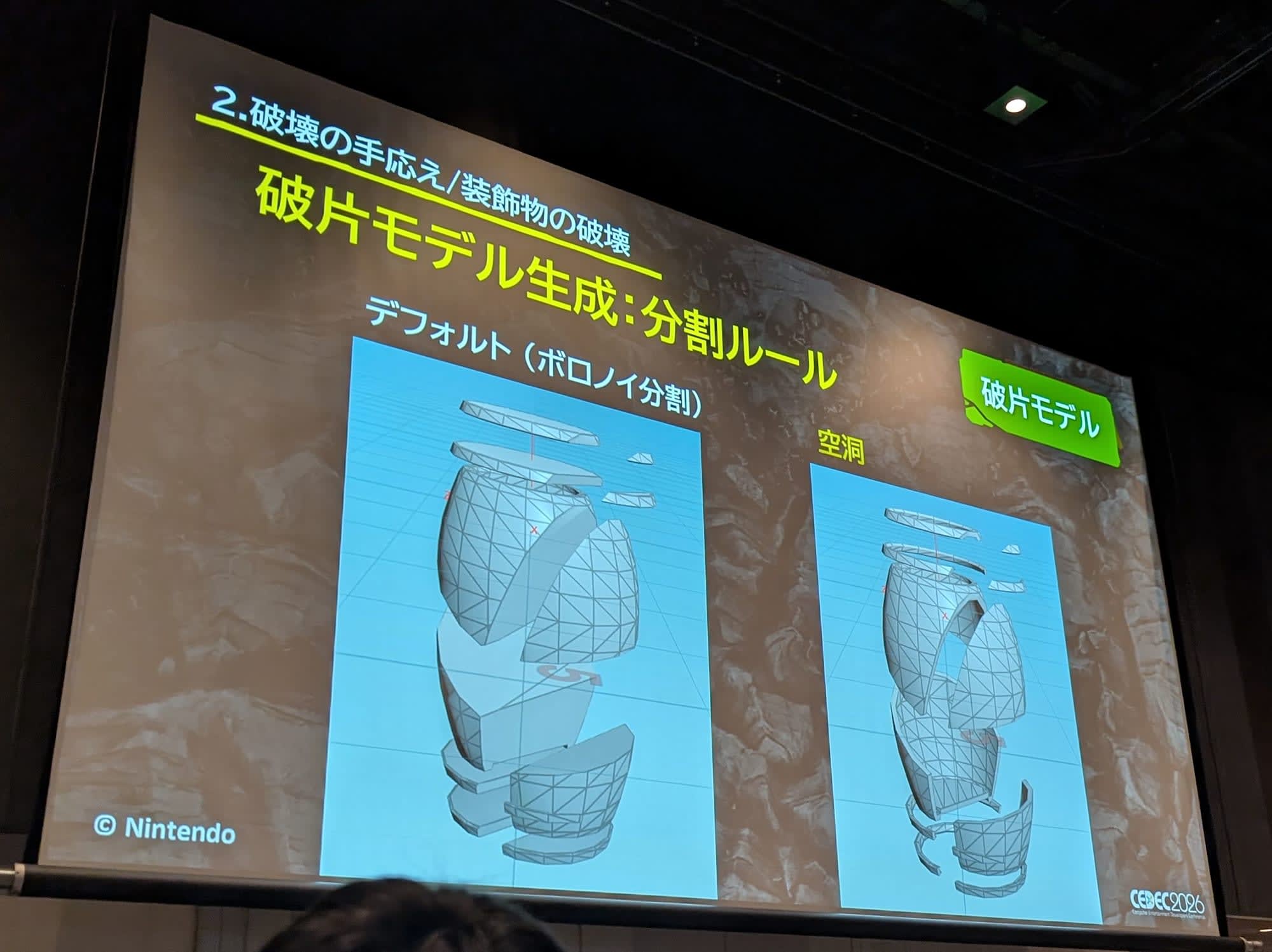
There are an enormous variety of effects, and destruction effects must be prepared for all 800-plus material types. A system was therefore created to automatically generate destruction effects from combinations of material texture and texture image. For the more than 2,000 types of decorative objects as well, breakage animations are created through combinations of fragment models and behaviors, with fragments auto-generated using Voronoi fracturing in Houdini — automating 98% of the work, according to the presenters.
The surrounding environment also changes dynamically through destruction. A cube map is used to calculate the occlusion rate, which represents how much terrain surrounds an area. This was a reuse of something originally used for lighting, which allowed it to be implemented at low cost.
Application to Characters and Terrain Creation
The destruction system is applied not only to terrain but also to characters. Expressions of destroying enemy bodies part by part, generation of footholds created by bosses, and unique uses such as making NPCs dance via morphing were all introduced as voxel-based implementations.
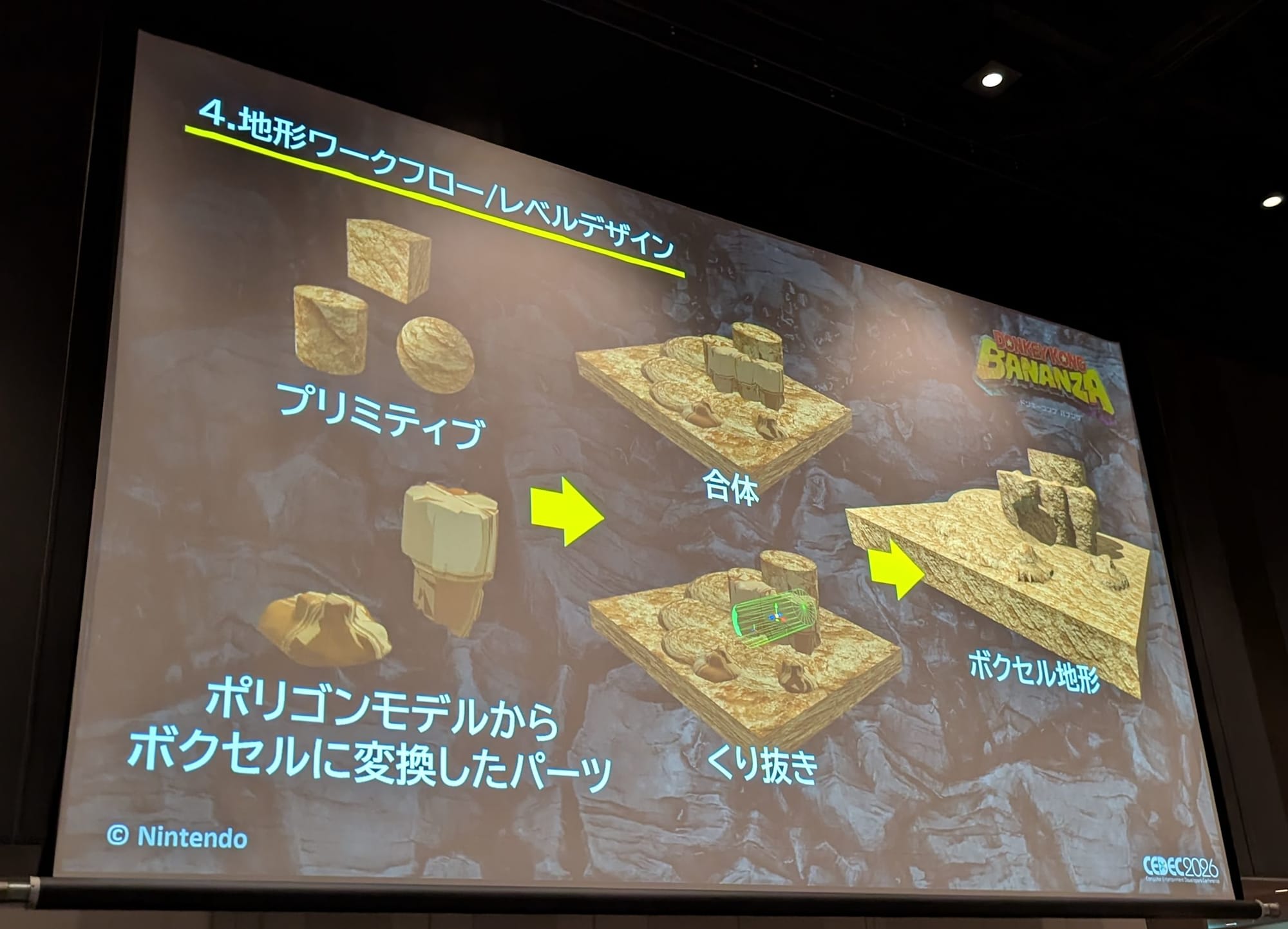
Finally, the workflow for building this world was presented. Level designers assemble terrain by converting polygon models into voxel-based primitives and combining or carving them out.
Impressions
It was a very interesting session that conveyed how destruction — a seemingly extravagant system — is built upon the steady accumulation of efforts such as clever data structures, automated effect generation, and the reuse of existing assets. Learning that the core gameplay of being able to destroy everything is supported by such intricate technology made the sense of satisfaction I felt when actually playing the game feel fully justified.