
I tried out Claude Fable 5, which has become available on Amazon Bedrock

This page has been translated by machine translation. View original
Introduction
On June 9, 2026, Anthropic announced Claude Fable 5. This model is the general release version of the Mythos Preview (Project Glasswing) that had been in limited release since April.
Fable 5 and Mythos 5 share the same underlying model, distinguished only by the presence or absence of safeguards. The names are said to derive from the fact that the Latin "fabula" and the Greek "mythos" both relate to the word "story." Fable 5 is the version with safeguards, while Mythos 5 is the version without.
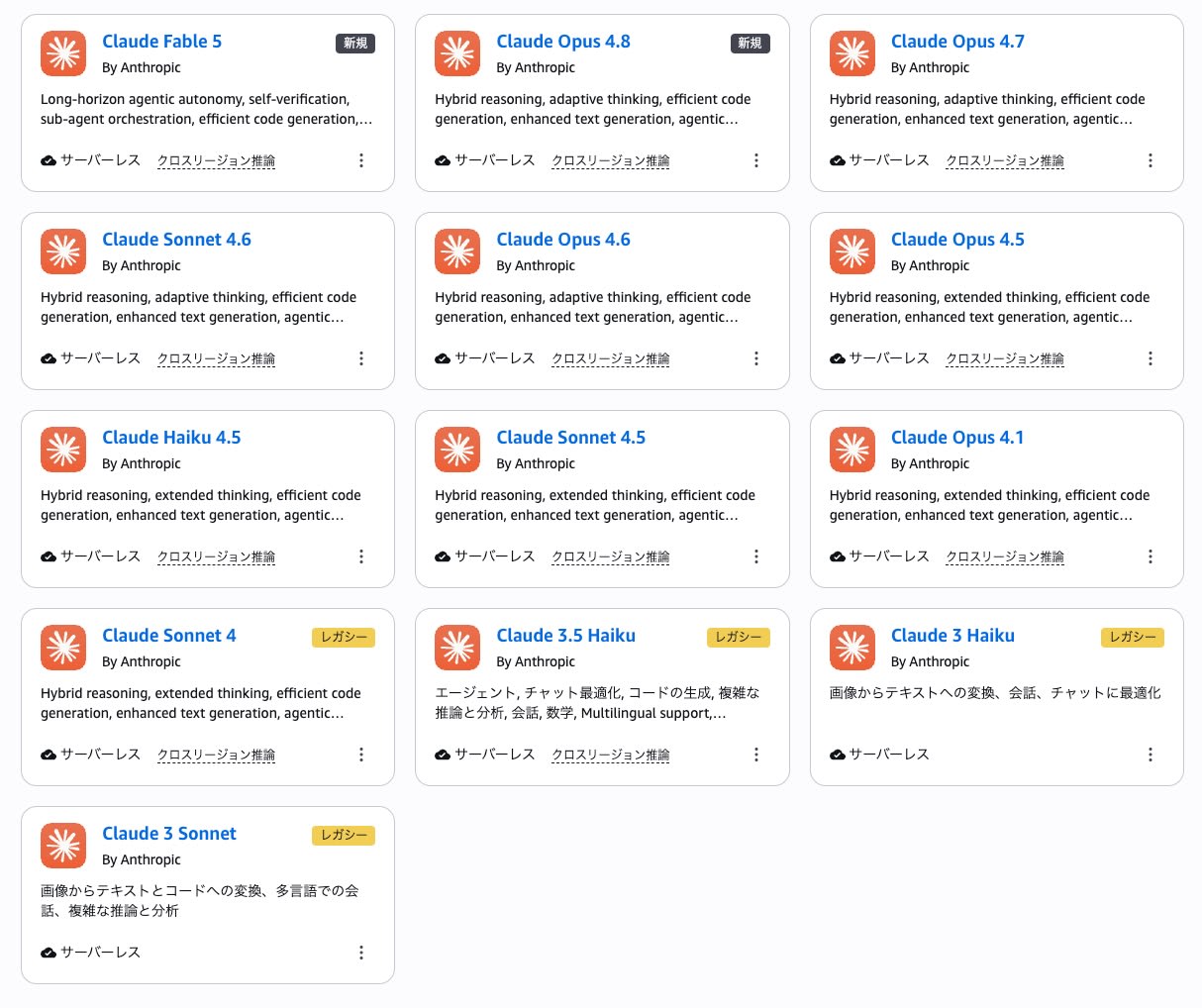
It became available on Amazon Bedrock on the same day, and this article documents the steps we verified.
Cost Comparison
| Item | Claude Fable 5 | Opus 4.8 (reference) | Mythos Preview (reference) |
|---|---|---|---|
| Model class | Mythos | Opus | Mythos |
| API model ID | claude-fable-5 |
claude-opus-4-8 |
(limited release) |
| Context | 1M tokens | 200K tokens | 1M tokens |
| Max output | 128K tokens | 32K tokens | 128K tokens |
| Input pricing | $10 / 1M tokens | $5 / 1M tokens | $25 / 1M tokens |
| Output pricing | $50 / 1M tokens | $25 / 1M tokens | $125 / 1M tokens |
| Safeguards | Yes | No | No |
| Knowledge cutoff | January 2026 | — | — |
Both input and output are priced at 40% of Mythos Preview, making Mythos-class capabilities available at a more affordable price point. However, compared to Opus 4.8, the cost is 2x for input and 2x for output.
Key Features
According to the Anthropic blog, Fable 5 / Mythos 5 has the following capabilities.
- The gap compared to existing models grows larger with longer and more complex tasks
- SWE: Stripe executed two months' worth of migration on a 50-million-line Ruby codebase in a single day
- Vision: According to Anthropic, vision performance is best-in-class. Completed Pokémon FireRed using vision only
- Long-context: Maintains focus across millions of tokens, with performance improvements through self-notes
Safeguard Structure
Fable 5 has the following safeguards built in.
- Target domains: Cybersecurity / Biology & Chemistry / Model distillation
- Behavior when triggered: According to Anthropic, falls back to Opus 4.8 for a response. However, via Bedrock,
content_filteredis returned with empty content (described later) - Trigger rate: According to official information, less than 5% of sessions
- Data retention: Retained for 30 days for safeguard purposes (details explained in the notes section)
Verification: Trying It on Bedrock
The verification environment is as follows.
- Region: us-east-1
- Model ID:
global.anthropic.claude-fable-5(Global cross-region inference profile) - Verification date/time: 2026-06-10 08:45–08:47 JST
- AWS CLI: 2.27.x / Python 3.12
Creating an Agreement
To use Fable 5, you must first agree to the data retention policy (Agreement).
# Check available offers
aws bedrock list-foundation-model-agreement-offers \
  --model-id anthropic.claude-fable-5 \
  --region us-east-1

# Create an Agreement by specifying the obtained offer-token
aws bedrock create-foundation-model-agreement \
  --model-id anthropic.claude-fable-5 \
  --offer-token <offer-token> \
  --region us-east-1
Enabling the Data Retention API
As a condition for using this model, enabling provider data share is required. This setting causes inference data to be shared with Anthropic (see the notes section for details).
At the time of writing, this could not be configured from the management console UI, and no corresponding method was confirmed in boto3, so we called the API directly using manual SigV4 signing.
import boto3, json
from botocore.auth import SigV4Auth
from botocore.awsrequest import AWSRequest
import requests as req

session = boto3.Session(region_name='us-east-1')
credentials = session.get_credentials().get_frozen_credentials()

url = 'https://bedrock.us-east-1.amazonaws.com/data-retention'
body = json.dumps({
    'mode': 'provider_data_share',
    'modelId': 'anthropic.claude-fable-5'
})

request = AWSRequest(method='PUT', url=url, data=body,
                     headers={'Content-Type': 'application/json'})
SigV4Auth(credentials, 'bedrock', 'us-east-1').add_auth(request)

r = req.put(url, headers=dict(request.headers), data=body)
print(r.status_code, r.json())
This assumes that credentials via an IAM role or profile are configured in the execution environment.
On success, a response like the following is returned.
{
  "mode": "provider_data_share",
  "updatedAt": "2026-06-09T23:46:41.595Z"
}
Running Inference with the Converse API
aws bedrock-runtime converse \
  --model-id "global.anthropic.claude-fable-5" \
  --messages '[{"content":[{"text":"こんにちは!あなたのモデル名を教えてください。一言で。"}],"role":"user"}]' \
  --inference-config '{"maxTokens":100}' \
  --region us-east-1
Full response
{
    "output": {
        "message": {
            "role": "assistant",
            "content": [
                {
                    "reasoningContent": {
                        "reasoningText": {
                            "text": "",
                            "signature": "CAISpwIKYAgOEAEYAipABCVa..."
                        }
                    }
                },
                {
                    "text": "こんにちは!**Claude**です。"
                }
            ]
        }
    },
    "stopReason": "end_turn",
    "usage": {
        "inputTokens": 30,
        "outputTokens": 57,
        "totalTokens": 87
    },
    "metrics": {
        "latencyMs": 5431
    }
}
This result indicates that the Converse API call succeeded using the specified inference profile ID. The model's response content ("Claude") is not treated as evidence for verifying the model ID.
The response included a reasoningContent field. Since reasoning is always ON in Fable 5, this field would normally be expected in the response. In this case, reasoningText.text was an empty string, but a signature was returned, suggesting that reasoning was not disabled. The fact that outputTokens: 57 is high relative to the short visible text is likely because the reasoning portion is counted toward output tokens.
Latency was 5,431ms. This is a reference value from a single execution with 30 input tokens.
Notes
Here is a summary of key points to be aware of when using Fable 5 on Bedrock. The following model specifications and constraints are based on the official blog and model card. The content verified in this execution is limited to the successful Converse API call from us-east-1, the response format, usage, and latency.
Provider data share (data sharing)
Enabling provider data share is required as a condition for using this model. Once enabled, inference data is shared with Anthropic for 30 days. It is stated that this retention is for safety purposes and will not be used for model training (please check the official documentation for details). In this article, we enabled it for anthropic.claude-fable-5 in us-east-1.
Reasoning always ON
While the effort level can be adjusted, reasoning itself cannot be disabled. Even if reasoningContent is returned with an empty reasoningText.text, it will still affect output token counts and costs.
temperature fixed at 1.0
The temperature is fixed at 1.0 and cannot be changed by users. Output cannot be stabilized through sampling parameters.
top_p / top_k
According to the model card, if top_p is specified, it must be 0.99 or greater and less than 1.0 (1.0 cannot be specified). If not needed, leave it unspecified. top_k is not supported.
Handling safeguard activation
In Anthropic's announcement, it is stated that when a safeguard is triggered, the model falls back to Opus 4.8 to provide a response. However, when verified via the Bedrock Converse API, stopReason: "content_filtered" was returned and the content was an empty array. No fallback response was included. Note that the stop reason is "content_filtered", not "refusal". Also, when blocked, inputTokens: 0 was returned, meaning there was no charge at all. The application must be designed to handle stopReason: "content_filtered" as part of normal processing.
Example response when a safeguard is triggered
{
    "output": {
        "message": {
            "role": "assistant",
            "content": []
        }
    },
    "stopReason": "content_filtered",
    "usage": {
        "inputTokens": 0,
        "outputTokens": 0,
        "totalTokens": 0
    },
    "metrics": {
        "latencyMs": 5970
    }
}
Regional constraints (as of writing: 2026-06-10)
In-Region is limited to us-east-1 and eu-north-1 only. The Tokyo region (ap-northeast-1) can be accessed via the Global cross-region inference profile. Since regional availability is subject to change, please check the official documentation for the latest information.
Service Tier
Only Standard is supported. Priority / Flex / Reserved are not supported at the time of writing.
Two endpoint types
bedrock-runtime supports AWS features such as Guardrails, Knowledge Bases, and Agents. bedrock-mantle is an Anthropic SDK-compatible endpoint, but does not support these AWS features. The verification in this article was conducted using bedrock-runtime / Converse API. Operation with bedrock-mantle is outside the scope of this verification.
Prompt caching
Fable 5 supports prompt caching, but it is not applied automatically — explicit cache checkpoint specification is required. Minimum 1,024 tokens, maximum 4 checkpoints, TTL of 5 minutes / 1 hour.
Summary
Claude Fable 5 is a generally available model that provides Mythos-class capabilities at 40% of the cost of Mythos Preview. On Amazon Bedrock, you can get started in three steps: creating an Agreement, enabling the Data Retention API, and running inference. However, it is important to understand before adoption that data sharing via provider data share is a condition of use, and that this cannot be configured from the console UI. There are also constraints that differ from conventional Claude models, such as reasoning always being ON and a fixed temperature. Please review the specifications before considering applying this to existing workloads.