
ClassMethod Data Analytics Communication (AWS Data Analysis Edition) - March-April 2026 Combined Issue

This page has been translated by machine translation. View original
I am from the Cloud Business Division, Consulting Department. I apologize that due to being very busy over the past two months, I'm combining March and April into a joint issue. (Sorry m(_ _)m)
This month, Amazon Quick (formerly Quick Suite) became available in the Tokyo Region, Amazon Redshift improved new query performance for dashboard and ETL workloads by up to 7x, and Amazon OpenSearch Service version 3.5 added agentic AI-powered log analysis capabilities. AI-driven analytics experiences are expanding across various services, extending the paradigm of data analysis using natural language. There are more updates to share!
Amazon Redshift / Redshift Serverless
New Features & Updates
2026/02/04 - Amazon Redshift now supports autonomics for multi-cluster environments
Amazon Redshift now supports autonomous optimization (autonomics) for multi-cluster environments. Optimizations such as automatic materialized view refresh, automatic statistics updates, and automatic sort key application are now executed automatically in multi-cluster configurations.
In multi-cluster environments (multiple warehouses using data sharing), the system automatically considers query patterns from all consumer clusters and implements table layouts and maintenance operations accordingly. This enables comprehensive optimization that reflects all workload patterns accessing shared data.
2026/02/09 - Amazon Redshift now supports allocating extra compute for automatic optimizations
Amazon Redshift now allows allocation of additional compute resources for automatic optimizations (autonomics). Users can secure additional resources to run optimization tasks in the background without impacting user workloads.
Previously, automatic optimizations consumed computational resources, potentially competing with user queries. This feature now allows allocation of dedicated additional compute resources for optimization, enabling maintenance to be completed in the background without affecting operational workloads.
2026/03/06 - Amazon Redshift introduces reusable templates for COPY operations
Amazon Redshift has added template functionality for COPY commands. Frequently used COPY parameters can be saved and reused, improving the efficiency and consistency of data loading operations.
2026/03/18 - Amazon Redshift increases performance for new queries in dashboards and ETL workloads by up to 7x
Amazon Redshift has improved the execution performance of new queries in BI dashboards and ETL workloads by up to 7x. This delivers significant acceleration for first-time queries that don't exist in the result cache.
When a new SQL query is issued, during the "compilation" process before execution, the system now improves performance by reusing existing optimized logic and compiling query-specific code, while simultaneously beginning query execution with code created through "Composition."
2026/03/19 - Amazon Redshift supports federated permissions with IAM Identity Center in multiple AWS Regions
Amazon Redshift now supports federated permissions using AWS IAM Identity Center (IdC) across multiple AWS Regions. This integrates Redshift access management in multi-region environments.
API Changes
Amazon Redshift Serverless
New Features & Updates
2026/02/23 - Amazon Redshift Serverless introduces 3-year Serverless Reservations
Amazon Redshift Serverless has introduced 3-year Serverless Reservations. This new discount pricing option enables cost savings of up to 45% compared to on-demand pricing. It provides predictable cost management for long-term Serverless workloads.
2026/03/05 - Amazon Redshift Serverless now maintains datashare permissions during restore
Amazon Redshift Serverless now automatically maintains datashare permissions when restoring a snapshot to the same namespace. This eliminates the need to manually reconfigure permissions after restoration, streamlining recovery in data sharing environments.
Amazon Athena
New Features & Updates
2026/02/10 - Amazon Athena now supports 1-minute reservations and 4 DPU minimum capacity
Amazon Athena Capacity Reservations now support a minimum reservation time of 1 minute and a minimum capacity of 4 DPUs. This update enables cost reductions of up to 95% for short-duration query workloads.
AWS Glue
New Features & Updates
2026/02/05 - AWS Glue launches native REST API connector for universal data integration
AWS Glue has added a native REST API connector. This enables easier data reading from any data source with REST-based APIs, facilitating universal data integration.
2026/03/12 - AWS Glue zero-ETL integrations with Amazon DynamoDB as the source support new configurations
AWS Glue zero-ETL integrations with Amazon DynamoDB now support configurable CDC (Change Data Capture) update intervals (15 minutes to 6 days) and on-demand data ingestion. This allows optimization of change capture frequency according to business requirements. This update aligns DynamoDB integration with existing features of SaaS sources.
API Changes
2026/03/13 - AWS Glue - 1 updated methods
QuerySessionContext has been added to BatchGetPartitionRequest.
2026/03/17 - AWS Glue - 2 updated methods
Authorization capability has been added to overwrite existing Lake Formation permissions on child resources with default permissions specified in CreateTableDefaultPermissions and CreateDatabaseDefaultPermissions during catalog updates.
Amazon Quick
New Features & Updates
2026/02/03 - Amazon Quick Suite Enables Easy Resolution of Ambiguous Map Locations
Dashboard creators in Quick Sight can now resolve ambiguous geographical locations in map visuals. This addresses cases where the same place name exists in multiple regions (e.g., Springfield in multiple states).
Three methods are provided: creating hierarchies by adding geographical fields, searching the geographic database, and directly entering latitude and longitude coordinates. The feature also includes status tracking with "Unmatched," "Matched," and "Unused" categories, and is available in all regions where Quick Sight is available.
2026/03/09 - Amazon Quick Suite launches User Preferences for chat personalization
Amazon Quick Suite has added User Preferences functionality. Users can now customize Quick's appearance, feel, and behavior to their personal preferences, providing a more personalized chat experience.
2026/03/25 - Amazon Quick Now Available in the AWS Tokyo Region
Amazon Quick is now available in the Tokyo Region (ap-northeast-1). Features such as AI-powered chat, research, spaces, flows, and QuickSight dashboards can be utilized while processing and storing data within the Tokyo Region. Japanese customers can now leverage all Amazon Quick features while meeting regional data requirements.
API Changes
2026/02/23 - Amazon QuickSight - 3 updated methods
Support for SEMISTRUCT has been added to InputColumn Type.
2026/03/04 - Amazon QuickSight - 4 updated methods
New Capabilities values have been added, increasing the limit of visuals per sheet to 75. The name change from Quick Suite to Quick has been reflected in multiple places.
2026/03/13 - Amazon QuickSight - 4 updated methods
ManageSharedFolders capability has been added to Custom Permissions.
2026/03/31 - Amazon QuickSight - 2 new 19 updated methods
StartAutomationJob and DescribeAutomationJob APIs have been added for automation jobs. Three custom permission capabilities to control management of spaces and chat agents have been added, along with the ability to provide OAuth 2.0 client credentials inline to data sources.
Amazon SageMaker Unified Studio
New Features & Updates
2026/02/04 - Apache Spark lineage now available in Amazon SageMaker Unified Studio for IDC based domains
Data lineage functionality for Apache Spark jobs is now generally available in SageMaker Unified Studio. It captures and visualizes schema and transformation lineages for Spark jobs on EMR-EC2, EMR-Serverless, EMR-EKS, and AWS Glue as graphs.
It also supports querying via API and comparing transformations between job histories, useful for identifying root causes of complex issues and analyzing the impact of changes. Available in all existing SageMaker Unified Studio regions.
2026/03/03 - Amazon SageMaker Unified Studio now supports AWS Glue 5.1 for data processing jobs
SageMaker Unified Studio now supports data processing jobs using AWS Glue 5.1. It supports Apache Spark 3.5.6, Python 3.11, Scala 2.12.18, and the latest open table format libraries: Apache Iceberg 1.10.0, Apache Hudi 1.0.2, and Delta Lake 3.3.2.
Glue 5.1 can be selected from the version dropdown when creating Visual ETL, notebook, or code-based jobs. Available in all regions where SageMaker Unified Studio is available.
2026/03/03 - Amazon SageMaker Unified Studio launches support for remote connection from Kiro IDE
Remote connections from local Kiro IDE to SageMaker Unified Studio are now supported. Secure connections via IAM authentication using the AWS Toolkit extension allow accessing SageMaker's scalable cloud infrastructure while leveraging Kiro's spec-driven development and conversational coding capabilities.
2026/03/25 - Amazon SageMaker Unified Studio launches support for remote connection from Cursor IDE
Remote connections from Cursor IDE to SageMaker Unified Studio are now supported. Users can leverage Cursor's AI-assisted capabilities (code completion, multi-file editing) while accessing SageMaker's scalable cloud computing resources through IAM authentication. Available in all supported regions.
2026/03/31 - Amazon SageMaker Unified Studio adds Observability for AWS Glue jobs via CloudWatch metrics
SageMaker Unified Studio now displays Amazon CloudWatch metrics for AWS Glue jobs directly alongside job logs in a unified interface. This improves the efficiency of monitoring and debugging Glue jobs.
Amazon SageMaker Data Agent
New Features & Updates
2026/03/30 - Amazon SageMaker Data Agent is now available in the Amazon SageMaker Unified Studio Query Editor
SageMaker Data Agent is now available in the Unified Studio Query Editor. Data Agent functionality, previously available only in notebook experiences, has now been extended to the Query Editor.
Amazon DataZone
New Features & Updates
API Changes
2026/02/23 - Amazon DataZone - 4 updated methods
Support for workflow properties has been added to the Connections API.
2026/03/03 - Amazon DataZone - 1 new methods
QueryGraph operations have been added to the DataZone SDK.
2026/03/31 - Amazon DataZone - 4 updated methods
environmentConfigurationName field has been added to CreateEnvironmentInput and UpdateEnvironmentInput. Domain owners can now automatically recover orphaned environments by recreating configurations with the same name as deleted configurations.
AWS Clean Rooms
New Features & Updates
2026/02/18 - AWS Clean Rooms announces support for remote Apache Iceberg REST catalogs
AWS Clean Rooms now supports catalog federation for remote Apache Iceberg REST catalogs. This enables direct and secure access to Iceberg tables stored in Amazon S3 and registered in remote catalogs, simplifying clean room setup without replicating table metadata.
API Changes
2026/02/18 - AWS Clean Rooms Service - 3 updated methods
Support for federated catalogs has been added to Athena source configured tables.
AWS Lake Formation
New Features & Updates
2026/02/11 - AWS Lake Formation enhances cross-account sharing
AWS Lake Formation's cross-account sharing capability has been enhanced. Unlimited tables can now be shared with other accounts using a single AWS Resource Access Manager resource share, enabling cross-account sharing of hundreds of thousands of tables. Previous per-resource type association limits have been removed.
Amazon EMR
New Features & Updates
API Changes
2026/03/17 - Amazon EMR - 2 updated methods
S3LoggingConfiguration has been added to control log uploads.
2026/03/26 - Amazon EMR - 1 updated methods
StepExecutionRoleArn has been added to the RunJobFlow API.
Amazon Kinesis
New Features & Updates
API Changes
2026/03/31 - Amazon Kinesis Analytics - 8 updated methods
Support for Apache Flink 2.2 has been added to Managed Service for Apache Flink.
Amazon MSK
New Features & Updates
2026/02/11 - MSK simplifies Kafka topic management with new APIs and console integration
Amazon MSK has added three new APIs: CreateTopic, UpdateTopic, and DeleteTopic. Kafka topic management for provisioned clusters can now be performed directly from AWS CLI, SDK, and CloudFormation, eliminating the need to maintain separate management clients. Available at no additional cost for clusters running Kafka 3.6 or later. The MSK console also integrates comprehensive visualization of topic settings, partition information, and metrics.
2026/02/11 - Amazon MSK now supports broker logs on Express Brokers
Broker logs are now supported on Amazon MSK Express Brokers. Integration with CloudWatch Logs and Amazon S3 enables troubleshooting of client connection and availability issues and provides insights into broker behavior. Available at no additional cost for new and existing Express Brokers.
2026/02/17 - Amazon MSK now supports dual-stack (IPv4 and IPv6) connectivity for existing clusters
Amazon MSK now supports dual-stack (IPv4 and IPv6) connectivity for both provisioned and Serverless clusters. While maintaining backward compatibility, this can be enabled by changing the Network Type parameter from the console, CLI, SDK, or CloudFormation. Available at no additional cost in all AWS regions.
API Changes
2026/02/16 - Managed Streaming for Kafka - 11 updated methods
Support for dual-stack connectivity (IPv4/IPv6) has been added to Amazon MSK. Dual-stack can be enabled on existing clusters by specifying the NetworkType parameter in the updateConnectivity API.
Amazon OpenSearch Service
New Features & Updates
2026/02/27 - Amazon OpenSearch Service adds new insights for improved cluster stability
Two new insights, "Suboptimal Sharding Strategy" and "Cluster Overload," have been added to the Cluster Insights tool in Amazon OpenSearch Service. These detect reduced query performance due to uneven shard distribution and potential request throttling due to increased resource consumption, providing specific improvement recommendations. Available at no additional cost with OpenSearch 2.17 and later.
2026/03/04 - Amazon OpenSearch Ingestion now supports Amazon Managed Service for Prometheus as a sink
Amazon OpenSearch Ingestion now supports Amazon Managed Service for Prometheus as a sink. This enables building fully managed end-to-end metric ingestion pipelines that route logs and traces to OpenSearch Service and metrics to Prometheus, without custom forwarding infrastructure. Available in all regions where OpenSearch Ingestion is available.
2026/03/05 - Amazon OpenSearch Service introduces capacity optimized blue/green deployments
Amazon OpenSearch Service has added a capacity-optimized blue/green deployment option. It attempts traditional "full swap" updates but can switch to incremental batch domain updates when sufficient instance capacity is unavailable. It automatically falls back to batch deployment when full capacity deployment is impossible. This can be selected from the console or API. The update makes it easier to complete updates at planned times with less dependency on AWS inventory availability.
2026/03/10 - Amazon OpenSearch Service now supports in-place volume increases for all volume sizes
Amazon OpenSearch Service's in-place volume scaling capability has been extended to clusters larger than 3 TiB. Previously limited to 3 TiB, in-place scaling can now be performed without blue/green deployment for large-scale storage needs. Available in all AWS commercial and GovCloud regions.
2026/03/18 - Amazon OpenSearch Service now supports OpenSearch version 3.5
OpenSearch version 3.5 is now available on Amazon OpenSearch Service. Agentic AI capabilities have been significantly enhanced with agentic conversation memory for multi-turn interactions, context management to optimize LLM token usage, and a no-code agent interface supporting Model Context Protocol integration. The search relevance workbench also adds LLM evaluation and scheduled experiments, enabling tracking of search quality trends.
2026/03/30 - Access Cluster Insights through the Amazon OpenSearch Service Console and Amazon EventBridge events
Cluster Insights can now be accessed from the AWS Management Console. In addition to existing OpenSearch UI dashboards, users can view performance and resilience recommendations and make necessary configuration changes in a single interface. Amazon EventBridge events for monitoring insights are also supported. Available at no additional cost with OpenSearch 2.17 and later.
2026/03/31 - Amazon OpenSearch Service introduces agentic AI for log analytics
Amazon OpenSearch Service has added agentic AI-powered log analysis capabilities. Engineering and support teams can analyze log data through a conversational natural language interface. This simplifies log queries and accelerates incident investigation, making log analysis possible without specialized query language knowledge.
API Changes
2026/03/04 - Amazon OpenSearch Service - 7 updated methods
Support for DeploymentStrategyOptions has been added.
2026/03/09 - Amazon OpenSearch Service - 6 updated methods
Cross-account and cross-region access for DataSources has been enabled. Access policies can be defined on data sources to allow access and querying of data from other AWS accounts.
2026/03/20 - Amazon OpenSearch Service - 4 updated methods
Amazon Managed Service for Prometheus (AMP) is now supported as a connected data source in OpenSearch UI. Prometheus metrics can be analyzed in OpenSearch UI without copying data.
2026/03/30 - Amazon OpenSearch Service - 2 new methods
Cluster Insights APIs have been added to the OpenSearch Service SDK.
2026/03/31 - Amazon OpenSearch Service - 3 new methods
RegisterCapability, GetCapability, and DeregisterCapability APIs have been added for managing AI assistant features in OpenSearch UI applications.
Amazon OpenSearch Serverless
New Features & Updates
2026/02/10 - Amazon OpenSearch Serverless now supports Collection Groups
Amazon OpenSearch Serverless now supports Collection Groups. Previously, collections with different encryption keys (AWS KMS) could not share compute resources (OCUs), resulting in separate costs. With this feature, OCUs can now be shared across multiple collections with different KMS keys, reducing costs in multi-tenant environments. Additionally, minimum OCU capacity can be pre-allocated to prevent startup delays (cold starts) and ensure stable performance.
Amazon S3 Tables
New Features & Updates
2026/02/12 - Amazon S3 Tables add partition and sort order definition in the CreateTable API
Amazon S3 Tables' CreateTable API now supports partition specification and sort order definition. This makes it easier to programmatically define how data is organized using transformation functions and specify sort direction and NULL ordering.
2026/03/17 - Simplified permissions for Amazon S3 Tables and Iceberg materialized views
AWS Glue Data Catalog now supports IAM-based authorization for Amazon S3 Tables and Apache Iceberg materialized views. All permissions spanning storage, catalog, and query engines can be defined in a single IAM policy, significantly simplifying permission management.
API Changes
2026/02/11 - Amazon S3 Tables - 1 updated methods
Support for setting partition specifications and sort orders on tables has been added. This enables defining how data is organized using transformation functions and specifying sort direction and NULL ordering.
2026/03/31 - Amazon S3 Tables - 1 updated methods
Support for nested types (struct, list, map) has been added when creating tables. These types can be combined to model complex hierarchical data structures within the table schema.
In Conclusion
From February to March 2026, AI feature region expansion and service integration were notable topics. Amazon Quick (formerly Amazon Quick Suite) became available in the Tokyo region, expanding the AI agent-powered BI experience globally. Amazon OpenSearch Service version 3.5 added log analysis capabilities using Agentic AI, and natural language data analysis is becoming established as a new paradigm.
In terms of performance and cost optimization, Amazon Redshift achieved up to 7x performance improvement for new queries, and Redshift Serverless now offers up to 45% cost reduction with 3-year reservations. Amazon S3 has strengthened data lake foundations with features like account regional namespace and S3 Tables partition specification and sort order definition support. If any updates interest you, please try them out. I hope this article is helpful to you.
On a personal note, last month on 3/11, I co-authored a blog titled Amazon Redshift DC2 migration approach with a customer case study on the AWS Big Data Blog with AWS's Mr. Osono (@jostandard). It introduces a case study of migration from DC2 instances to RA3 instances.
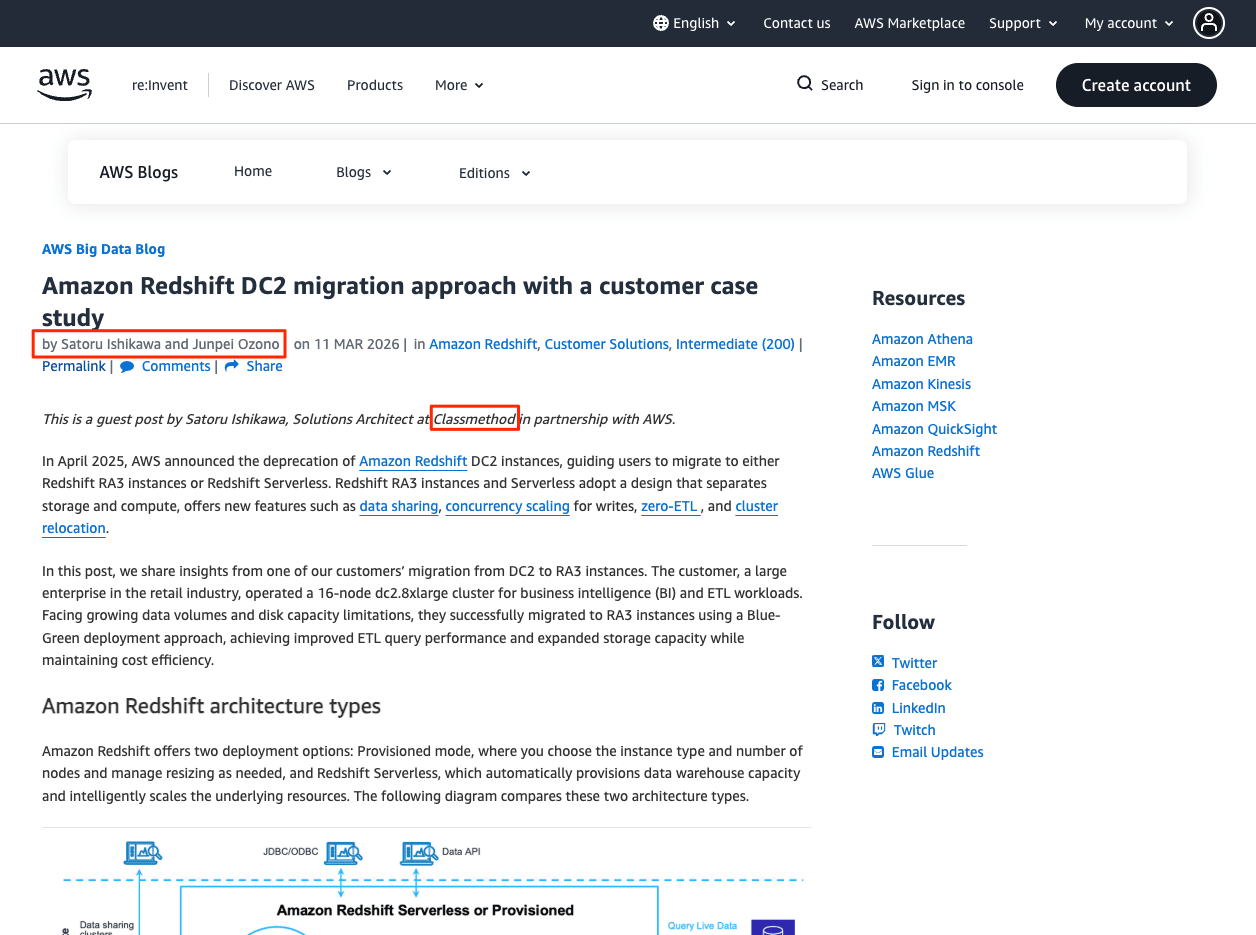
We've also published the load testing tool used for replaying Tableau queries during migration on GitHub.
For more detailed information about migration from DC2 instances to RA3 instances, please refer to this blog.