
Does vLLM's /v1/decisions Return the Same Probabilities for the Same Question? Testing on NVIDIA DGX Spark

This page has been translated by machine translation. View original
Introduction
Hi, I'm Mori from the Manufacturing Business Technology Department at Classmethod.
vLLM 0.33.0, released on November 2, 2026, added an OpenAI-compatible POST /v1/decisions. Instead of generating text, you pass an input, questions and choices, and get back a probability for each choice. If you start a supported generative model, the endpoint is enabled by default.
Over the past two months I have followed non-generative judgment in several articles. One rebuilt the judge role of NeMo Switchyard as a 1-token judgment (as of 2026-09-23). Another called a judgment-only diffusion model through /v1/systemone (as of 2026-10-15). Now the same way of reading has become an OpenAI-compatible API in vLLM itself, so I checked its shape on my DGX Spark.
What I find interesting is that this landed in vLLM itself, a serving platform for generation. The non-generative judgments I tried before were external APIs like Jev, judgment-only models, and my own code reading label logprobs. vLLM 0.32.0 added /v1/systemone, shaped like the API of TypeSafe, Jev's developer. 0.33.0 then added /v1/decisions, shaped like OpenAI's Decisions API. According to the docs, both work by default with supported generative models. So you can use a generative model started for chat for judgments just by changing how it is read, without preparing a judgment-only model. I organize the timeline with dates in the next section, and after the measurements I give my own thoughts on why a generation platform gained a judgment-style reading.
The official docs say probabilities can vary even for the same request. I wanted to know how much, and whether it is enough to flip judgments, so I sent the same question 30 times per condition.
Here are the conclusions first.
I did three things: checked the response shape and limits with the official example, sent the same question 30 times under different conditions to watch the probabilities, and finally measured speed.
What I found:
- The API shape is straightforward and ready to use. The official arm64 image ran as is, and the OpenAI Python SDK works by just swapping
base_url. Asking 64 questions about a roughly 1,900-token text takes under 0.5 seconds. - With default settings, the returned probabilities were not always identical. 30 requests sent one at a time under the same condition gave the same value, but values move depending on whether the prefix cache (reuse of computed results) was hit and whether other requests are running concurrently.
- For questions with a clear answer, the judgment did not change even when values moved. In this article, the higher-probability choice is the "judgment", and a different choice winning for the same question is a "flip".
- For a question where two choices are almost 50/50, under concurrent traffic the 30 judgments split into 15 positive and 15 negative. This was the same on 0.33.0 and on 0.34.0, which I measured later.
- Even values from one-at-a-time requests changed between vLLM versions. The near-50/50 question was positive 30 times on 0.33.0 and negative 30 times on 0.34.0.
- With
VLLM_BATCH_INVARIANT=1, the probability of the near-50/50 question was identical across all 120 requests under varied conditions. The value was also the same between 0.33.0 and 0.34.0.
So what is the verdict? I split it into two uses. Both are assessments from one model, Qwen3-0.6B. I did not measure classification accuracy, so read this as an assessment of API shape and probability stability.
First, using it like a router's judge, cutting probabilities at a threshold to route. As an API it is practical, but cutting probabilities at 0.5 with default settings as a judge is risky for near-50/50 questions, in my assessment. With assumptions such as adding VLLM_BATCH_INVARIANT=1 when the same input needs the same judgment and handling near-50/50 cases separately, I think it is usable.
Second, using it broadly for classification and scoring inside an app. You can send multiple questions about one text in a single request, and the OpenAI SDK works as is, so it is usable in form. However, treating the returned probability as an absolute confidence requires your own validation. The reasons:
- As above, the probabilities themselves move with conditions and versions. The docs say
confidenceis not calibrated to match OpenAI's models, and I did not check its relation to accuracy. - Merely swapping the order of choices changed the probability of the same choice from around 0.6 to around 0.95.
- Both yes/no questions (predicate) and graded questions (score) are internally read as choice questions with letter labels. A predicate's probability is that of the true label, and a score is a weighted average of per-level probabilities, so when label probabilities move, the returned value moves.
- The response lacks
label_mass, an indicator of whether the model is trying to answer with a label, and for predicates it cannot be back-calculated. - The limits are 64 questions and 26 choices, smaller than the original's 400 questions and 255 choices.
This article presents the /v1/decisions response shape, limits, differences from /v1/systemone, probability stability and speed, measured on DGX Spark. Stability results are shown for both 0.33.0 and 0.34.0. I hope it resonates with people building classification or routing on probabilities and thresholds.
Seven weeks from Jev to /v1/decisions
Before the measurements, here is where this API came from, by date. This section contains only facts I could verify in announcements, changelogs and vLLM Pull Requests.
| Date | Event | Source checked |
|---|---|---|
| 2026-09-15 | TypeSafe AI announces System One Model and its first model Jev in early access | TypeSafe AI blog |
| 2026-09-29 | Pull Request (#59299) adding /v1/systemone to vLLM opened |
vLLM Pull Request |
| 2026-10-06 | OpenAI releases the Decisions API in beta with gpt-6-luna | OpenAI changelog |
| 2026-10-07 | Pull Request (#60465) adding /v1/decisions to vLLM opened |
vLLM Pull Request |
| 2026-10-08 | #59299 merged | vLLM Pull Request |
| 2026-10-13 | #60465 merged | vLLM Pull Request |
| 2026-10-18 | vLLM 0.32.0 released, including /v1/systemone |
vLLM release notes |
| 2026-10-22 | OpenAI makes the Decisions API generally available; question limit raised from 200 to 400 | OpenAI changelog, guide |
| 2026-11-02 | vLLM 0.33.0 released, including /v1/decisions |
vLLM release notes |
It began with TypeSafe AI's Jev. The announcement describes the System One Model as a fast model returning typed judgments that software can use directly. It generates no text and returns an answer in a predefined type together with probabilities. It is offered via TypeSafe's API, and when I researched in September the weights were not public.
vLLM's /v1/systemone appeared as a Pull Request two weeks later. Its description says judgment servers had been provided as samples and that running them inside vLLM is more effective. The first implementation had only the choice type and targeted autoregressive generative models. The commit message says the request and answer shapes were matched to Jev's judgment API. The 0.32.0 release notes introduce it as an endpoint answering three types: choice, noul and score. The docs call the section "TypeSafe System One Endpoint".
OpenAI's Decisions API went into beta on October 6. Only gpt-6-luna is supported, with three question types: predicate, choice and score. These three (yes/no probability, selection from choices, graded scoring) correspond to noul, choice and score in Jev and vLLM's /v1/systemone. But OpenAI's guide and changelog do not mention Jev or TypeSafe. I could not confirm from the sources whether OpenAI released this API in response to Jev.
vLLM's /v1/decisions Pull Request came the day after OpenAI's beta. Its description says it is a text-only endpoint following OpenAI's API shape, built on top of the /v1/systemone Pull Request. According to the docs, the request shape matches the OpenAI schema fetched on 2026-10-07. It was merged on October 13, but the 0.32.0 release notes five days later do not mention /v1/decisions; it reached users in 0.33.0 on November 2.
Counting from Jev's announcement, it took seven weeks for two judgment APIs to be in vLLM itself.
/v1/decisions reads one question with one token
You pass /v1/decisions the text to judge (input) and an array of questions (questions). There are three question types.
| Type | How it asks | What is returned |
|---|---|---|
predicate |
A yes/no question | Probability of true, probability |
choice |
Pick one from choices | Selected value, per-choice probabilities, confidence |
score |
Answer on ordered levels | Expected level, per-level probabilities, confidence |
The mechanism is described in the official docs. Here is how it works for Qwen3-0.6B, which I used. For each question, one prompt is built, choices get labels like A, B, C, and the model is told to "answer with one label". The model produces only the first token of the answer, and the per-label log probabilities (logprobs) at that point are read. The softmax across labels is the returned probability. No text is generated, so output is one token per question.
vLLM has had the judgment endpoint /v1/systemone since 0.32.0, and /v1/decisions uses the same reading code. In 0.33.0 it is a first text-only implementation, and the docs state these limits:
- 1–64 questions, 2–26 choices for choice, 2–10 levels for score
- Image input, roles other than user, tools and streaming are unsupported
confidenceis not calibrated to match OpenAI's models
The vLLM docs say the original OpenAI API accepts up to 200 questions and 255 choices. This is based on the schema fetched on 2026-10-07; per the original guide, the question limit was raised to 400 at general availability. vLLM returns HTTP 400 for anything over its limits.
The official arm64 image ran as is on DGX Spark
0.33.0 is distributed for CUDA 13 only. Docker Hub has an arm64 image vllm/vllm-openai:v0.33.0-aarch64, which started as is on DGX Spark. The model is Qwen/Qwen3-0.6B, same as the official example.
docker run -d --name vllm-decisions --gpus all --ipc=host \
  -p 127.0.0.1:18033:8000 \
  -v ~/.cache/huggingface:/root/.cache/huggingface \
  vllm/vllm-openai:v0.33.0-aarch64 Qwen/Qwen3-0.6B \
  --logprobs-mode processed_logprobs \
  --gpu-memory-utilization 0.06 --max-model-len 16384
I set --logprobs-mode explicitly because the docs require raw_logprobs or processed_logprobs. --gpu-memory-utilization 0.06 is a small value to coexist with other uses of the same machine. Since it is a 0.6B model, it still secured 3.45GiB of KV cache (area holding computed context), or 32,304 tokens.
Measured startup time and memory are below. Startup time is from docker run until /health returns 200.
| Item | Value |
|---|---|
| Startup time (first, including weight download) | 147.4 s |
| Startup time (second) | 125.5 s |
Memory usage increase (free used) |
about 10.0GiB |
GPU resident (nvidia-smi) |
5,557MiB |
| Model itself | 1.12GiB |
Of the second run's 125.5 s, 89.0 s was engine initialization, of which 69 s was CUDA graph capture per the log. Even for a small model, more than half of startup goes to this step.
Response shape seen with the official example
I sent the example from the official docs as is. The input is a complaint, "The package arrived with a broken screen", with three questions: whether it is damaged, which department, and how severe the damage is.
curl -s http://127.0.0.1:18033/v1/decisions \
  -H "Content-Type: application/json" \
  -d '{
    "model": "Qwen/Qwen3-0.6B",
    "input": "The package arrived with a broken screen.",
    "questions": [
      {"type": "predicate", "name": "damaged",
       "instructions": "Does the customer report a damaged item?"},
      {"type": "choice", "name": "department",
       "instructions": "Which department should handle this complaint?",
       "choices": [{"value": "returns"}, {"value": "billing"}]},
      {"type": "score", "name": "severity",
       "instructions": "How severe is the damage?",
       "levels": [{"label": "cosmetic"}, {"label": "broken"}]}
    ]
  }'
The response to the first request right after startup:
{
  "model": "Qwen/Qwen3-0.6B",
  "answers": [
    { "type": "predicate", "name": "damaged", "probability": 0.5312093733737563 },
    {
      "type": "choice",
      "name": "department",
      "choice": "returns",
      "probabilities": [
        { "value": "returns", "probability": 0.5926665999540697 },
        { "value": "billing", "probability": 0.4073334000459302 }
      ],
      "confidence": 0.5195948622794421
    },
    {
      "type": "score",
      "name": "severity",
      "score": 0.0040701367947516215,
      "probabilities": [
        { "value": 0, "label": "cosmetic", "probability": 0.9959298632052485 },
        { "value": 1, "label": "broken", "probability": 0.0040701367947516215 }
      ],
      "confidence": 0.9538638734924344
    }
  ],
  "usage": {
    "input_tokens": 140,
    "input_tokens_details": { "cached_tokens": 0, "cache_write_tokens": 112 },
    "output_tokens": 3,
    "output_tokens_details": { "reasoning_tokens": 0 },
    "total_tokens": 143
  }
}
The top-level keys are just model, answers and usage. answers is an array in question order, and a question without name returns "name": null. Predicates carry no confidence. usage is the total for the three reads, with one output token per question, three in total. This first request after startup took 283 ms; the next two took 15–16 ms for three questions.
confidence for choice and score is the winning label's probability viewed across the whole vocabulary. It is the inter-label probability multiplied by the share at which the model tried to output one of the labels, so it is lower when the model wants to output a non-label token.
Looking at the content, for a complaint about a broken screen, the probability of damage is 0.53 and the severity is 0.996 cosmetic. That misses the mark. This comes from asking a small 0.6B model this way, so read it here as a check of API shape. I touch on why in the section comparing with /v1/systemone.
It can also be called from the OpenAI Python SDK. Just swapping base_url runs the official example code as is.
from openai import OpenAI

client = OpenAI(base_url="http://127.0.0.1:18033/v1", api_key="EMPTY")
decision = client.decisions.create(
    model="Qwen/Qwen3-0.6B",
    input="The package arrived with a broken screen.",
    questions=[
        {"type": "predicate", "name": "damaged",
         "instructions": "Does the customer report a damaged item?"},
        {"type": "choice", "name": "department",
         "instructions": "Which department should handle this complaint?",
         "choices": [{"value": "returns"}, {"value": "billing"}]},
    ],
)
print(decision.answers)
It worked with both openai 3.26.0, the docs' minimum, and 3.57.0, installed at measurement time. A request over the limits surfaces the server's 400 as the SDK's BadRequestError.
Limits of 26 choices, 64 questions and 10 levels
I checked the documented limits on both sides of each boundary.
| Sent | Result | Returned message |
|---|---|---|
| choice 26 choices | 200 | |
| choice 27 choices | 400 | This model supports at most 26 choices per question |
| 64 questions | 200 | |
| 65 questions | 400 | questions: at most 64 for this model |
| score 10 levels | 200 | |
| score 11 levels | 400 | List should have at most 10 items |
The lower side is the same: 1 choice, 0 questions and 1 score level all gave 400. The 26-choice limit exists because labels are single letters A to Z.
I also sent items listed as unsupported. stream, tools, chat_template_kwargs and unknown fields all give 400 with Extra inputs are not permitted. Image input is refused with Decisions supports text input only. Nothing I tried was silently ignored. As a vLLM-specific extension, cache_salt is accepted. It is a value to separate the prefix cache (reuse of computed results for the start of a prompt), and I use it in the stability measurements below.
How label assignment makes probabilities differ from /v1/systemone
The official explanation is that /v1/decisions and /v1/systemone use the same reading code. So I sent the same three questions to /v1/systemone too. Its question types are noul (yes/no), choice and score.
| Question | /v1/decisions |
/v1/systemone |
|---|---|---|
| damaged | 0.5312 | 0.9987 |
| department | returns 0.5927, billing 0.4073 | returns 0.5, billing 0.5 |
| severity | 0.0041 (leaning cosmetic) | 0.7549 (leaning broken) |
Despite the same code, the probabilities differ greatly. Damage is 0.53 versus 0.9987, and severity points the opposite way.
Reading the implementation inside the container revealed why. /v1/decisions converts all three types into choice questions with letter labels before passing them to the reading code.
/v1/decisions question |
Choices after conversion | Labels |
|---|---|---|
| predicate | false, true |
A, B |
| choice | values as JSON strings | A, B, … |
| score | each level's label |
A, B, … |
/v1/systemone, on the other hand, uses yes and no for noul and digits 0 to 9 as labels for score. So a predicate question in /v1/decisions becomes the prompt "answer with a letter from A: false, B: true", while in /v1/systemone it is "answer yes or no". In this example, Qwen3-0.6B gave a more sensible answer for the latter phrasing.
To verify, I sent /v1/systemone a choice I hand-wrote with the same conversion as /v1/decisions. In runs where values did not move, the probabilities matched to 10 digits.
| Question | /v1/decisions |
/v1/systemone (conversion reproduced) |
|---|---|---|
| damaged | 0.5312093734 | 0.5312093734 |
| department | 0.6791787122 | 0.6791787122 |
| severity | 0.0021827164 | 0.0021827164 |
So the "same reading code" claim was confirmed in the form that values match when prompts are aligned. In this comparison I attached the same cache_salt to both requests, and department differs from the earlier table. Of five requests, /v1/decisions moved to a neighboring value twice for department and once for severity. This fluctuation is the theme of the next section.
What /v1/systemone has and /v1/decisions lacks is diagnostics. The label_mass inside is the total probability the model placed on labels across the whole vocabulary, an indicator of whether the model is trying to answer with a label. It does not show whether the question is understood or the answer is correct. The /v1/decisions response has no such field. For choice and score, though, it can be back-calculated as confidence ÷ winning label's probability. Computed for department in the run where values matched, it was 0.8752, matching label_mass from /v1/systemone in the same run. Predicates return no confidence, so they cannot be back-calculated.
Probabilities that move on the same question, and judgments that flip at the boundary
Now the main topic. I measured how much the probability moves when the same request is sent repeatedly.
The subject is 2-choice choice questions. I scanned 20 candidates and picked three:
- Clear case: classify "Absolutely loved it. Best purchase I have made this year." as positive or negative
- The official example's department: returns or billing
- Near-boundary case: classify "The food was great but we waited an hour for a table." as negative or positive. The closest to 0.5 among 20 candidates
One question per request, the same request sent 30 times. There are four ways of sending:
| Condition | How sent | prefix cache |
|---|---|---|
| Single | One at a time in sequence | Used from the 2nd request |
Single, with cache_salt |
One at a time, with a different cache_salt each time |
Not used |
| Mixed | Sent while 8 threads keep sending other requests | Used |
Mixed, with cache_salt |
Same, with a different cache_salt each time |
Not used |
In the mixed conditions, I kept sending ordinary chat completions and /v1/decisions with other inputs in a 50/50 mix. With 0.33.0's default settings, 112–123 requests flowed per condition during the 30 measurements.
Results with 0.33.0 default settings. Table values are the probability of the first choice: positive for the clear case, returns for department, negative for the near-boundary case.
| Subject | Condition | Mean | Std dev | Min | Max | Judgment |
|---|---|---|---|---|---|---|
| Clear | Single | 0.9995 | 0.0000 | 0.9995 | 0.9995 | positive 30 |
| Clear | Mixed, cache_salt |
0.9994 | 0.0001 | 0.9993 | 0.9996 | positive 30 |
| department | Single | 0.5927 | 0.0000 | 0.5927 | 0.5927 | returns 30 |
| department | Single, cache_salt |
0.6225 | 0.0000 | 0.6225 | 0.6225 | returns 30 |
| department | Mixed | 0.6204 | 0.0151 | 0.5927 | 0.6514 | returns 30 |
| department | Mixed, cache_salt |
0.6054 | 0.0224 | 0.5927 | 0.6514 | returns 30 |
| Near-boundary | Single | 0.4378 | 0.0000 | 0.4378 | 0.4378 | positive 30 |
| Near-boundary | Single, cache_salt |
0.4378 | 0.0000 | 0.4378 | 0.4378 | positive 30 |
| Near-boundary | Mixed | 0.4298 | 0.0205 | 0.3775 | 0.4378 | positive 30 |
| Near-boundary | Mixed, cache_salt |
0.4669 | 0.0348 | 0.3775 | 0.5000 | negative 15, positive 15 |
When sent one at a time in sequence, all 30 values are identical. In department, though, the value differed by cache use alone: 0.5927 when the prefix cache was used and 0.6225 when not.
In mixed conditions values move. Department moved among three values, 0.5927, 0.6225 and 0.6514, to four decimal places. And for the near-boundary case, in the mixed condition with cache_salt, negative's probability was exactly 0.5 in 15 of 30 runs: 0.3775 once, 0.4378 14 times, and 0.5000 15 times. On ties the choice listed first wins, so in those 15 runs the judgment became negative. The same question to the same server returned positive half the time and negative half the time.
The clear case's value moves at the fourth decimal but is far from 0.5, so the judgment did not change. Only questions near the threshold are a problem.
VLLM_BATCH_INVARIANT=1 fixes a value different from the default
The official docs recommend VLLM_BATCH_INVARIANT=1 for reads that need reproducibility. I restarted with this variable and repeated the same measurements. Still 0.33.0 results.
| Subject | Value in all 4 conditions | Judgment (30 × 4 conditions) |
|---|---|---|
| Clear | 0.9994 | positive 120 |
| department | 0.6792 | returns 120 |
| Near-boundary | 0.5000 | negative 120 |
For every subject, all 30 values within a condition were identical, with zero standard deviation. Probabilities for department and the near-boundary case were also the same across the four conditions. Only the clear case kept a 10th-decimal difference (about 0.0000000002) between single and mixed. confidence also differed at the 7th decimal between single and mixed for the clear and near-boundary cases. Values are not bit-identical, but judgments were identical in all 120 runs, and at the digits in the table they are unaffected by prefix cache use or other requests.
However, the fixed values differ from the default settings' values. Department is 0.6792, different from the 0.5927 and 0.6225 seen with default single requests. The near-boundary case is fixed at an exact 0.5 tie, with the judgment negative in all 120 runs, whereas default single requests gave positive 30 times. It seems best to read VLLM_BATCH_INVARIANT=1 not as "fixing the default values" but as "producing the same value every time through a different computation path".
Probabilities sitting on a logit grid of 0.125 steps
Lining up the table values, you notice there are oddly few distinct probabilities: 0.3775, 0.4378, 0.5, 0.5927, 0.6225. Checking, every one was the probability when the difference between the two labels' logits (values before softmax) is a multiple of 0.125.
| Observed probability | Corresponding logit difference |
|---|---|
| 0.3775 | −0.5 |
| 0.4378 | −0.25 |
| 0.5000 | 0 |
| 0.5312 | 0.125 |
| 0.5927 | 0.375 |
| 0.6225 | 0.5 |
| 0.6514 | 0.625 |
| 0.6792 | 0.75 |
From here it is conjecture. According to the startup log, the model runs in bfloat16. bfloat16 has only 8 significant binary digits, so for values in the 16–32 range the step is 0.125. If logits are rounded this coarsely, tiny computation differences from batch composition or cache use show up as a jump of one or two grid steps. Near 0.5, that is a jump of 0.03–0.06 in probability.
To test this, I restarted with --dtype float32. Float32 doubles the memory needed for the KV cache, so I raised --gpu-memory-utilization to 0.10.
| Subject | Condition | Mean | Std dev | Min | Max | Judgment |
|---|---|---|---|---|---|---|
| department | Mixed | 0.6422 | 0.0004 | 0.6412 | 0.6424 | returns 30 |
| department | Mixed, cache_salt |
0.6419 | 0.0003 | 0.6417 | 0.6433 | returns 30 |
| Near-boundary | Single | 0.4998 | 0.0001 | 0.4998 | 0.5003 | positive 29, negative 1 |
| Near-boundary | Mixed | 0.4997 | 0.0003 | 0.4989 | 0.5003 | positive 28, negative 2 |
| Near-boundary | Mixed, cache_salt |
0.4987 | 0.0022 | 0.4952 | 0.5003 | negative 19, positive 11 |
The grid disappeared. Standard deviations in mixed conditions are 0.0003–0.0022, over an order of magnitude smaller than bfloat16's 0.0151–0.0348.
I learned one more thing: the near-boundary case computed at higher precision. In float32 it is 0.4952–0.5003, practically exactly 0.5. The 0.4378 that bfloat16 singles stably produced is two grid steps away from that. I have not verified float32 as ground truth, but it shows that getting the same value 30 times is a different matter from that value being close to a high-precision computation. The same holds for VLLM_BATCH_INVARIANT=1. Its 0.5 for the near-boundary case is close to float32, but department's 0.6792 is more than one grid step away from float32's 0.6419.
And with float32, judgments still flip. Even when value scatter shrinks to 0.002, if the question itself sits on 0.5, the judgment splits. Raising precision narrows the fluctuation but does not stabilize judgments near the threshold.
Mixed-batch flips reproduced on 0.34.0, and single-request values that changed
So far these are 0.33.0 results. 0.34.0 came out a week before my measurements, so I measured stability on 0.34.0 as well with the same script, subjects and startup options. Here are the near-boundary case's results for both versions. Values are negative's probability.
| Configuration | 0.33.0 | 0.34.0 |
|---|---|---|
| Default, single (2 conditions) | 0.4378, positive 60 | 0.5000, negative 60 |
| Default, mixed | 0.3775–0.4378, positive 30 | 0.4378–0.5000, negative 10, positive 20 |
Default, mixed, cache_salt |
0.3775–0.5000, negative 15, positive 15 | 0.4378–0.5000, negative 15, positive 15 |
VLLM_BATCH_INVARIANT=1 (4 conditions) |
0.5000, negative 120 | 0.5000, negative 120 |
| float32, mixed | 0.4989–0.5003, positive 28, negative 2 | 0.4966–0.5014, positive 28, negative 2 |
float32, mixed, cache_salt |
0.4952–0.5003, negative 19, positive 11 | 0.4966–0.4997, positive 30 |
Flips in mixed batches happened on 0.34.0 too. Mixed with cache_salt split into 15 each, as on 0.33.0, and even mixed without cache_salt gave negative 10 times out of 30. Only two values appeared, 0.4378 and 0.5000, and the 0.125 grid remained. Department also moved among 0.5927, 0.6225 and 0.6514 in mixed conditions.
The values for VLLM_BATCH_INVARIANT=1 did not change across versions. Comparing the same conditions, all three subjects match 0.33.0 to 10 digits (department is 0.6791786862).
What changed is the default single-request value. The near-boundary case was 0.4378 with positive 30 times on 0.33.0, and an exact 0.5000 tie with negative 30 times on 0.34.0. With the same model, question and startup options, merely upgrading vLLM flipped the judgment. The earlier statement that the VLLM_BATCH_INVARIANT=1 judgment is the opposite of the default single one holds for 0.33.0; on 0.34.0 the default single is also 0.5000.
One caution. On 0.34.0, even without cache_salt, the response's cached_tokens was 0 in all 30 runs. On 0.33.0, the same condition read 32–48 tokens from cache. The "no cache_salt" condition on 0.34.0 may not have been a prefix-cache-hit condition, so read cache-related differences from the 0.33.0 results only. Department's singles on 0.34.0 were 0.6225 under both conditions. The version comparison also holds between cache_salt conditions: for the near-boundary single case that is 0.4378 versus 0.5000.
In float32, standard deviations in mixed conditions were 0.0003–0.0016, again over an order of magnitude smaller than bfloat16 on 0.34.0. The near-boundary single was 0.4966, slightly different from 0.33.0's 0.4998–0.5003.
Here are the near-boundary case's 30 runs for two versions and four configurations in a figure.
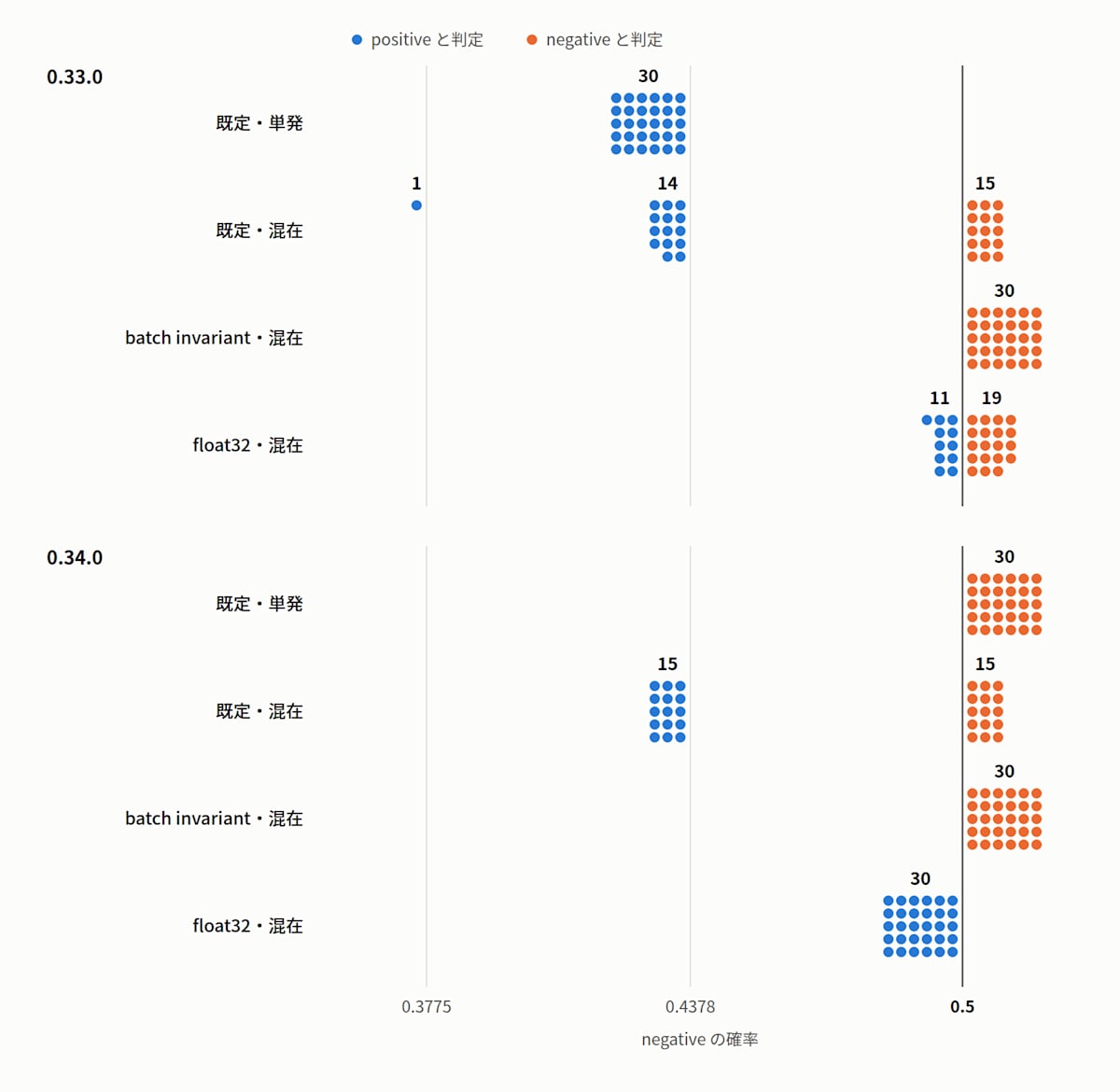
Each dot is one read, and every row uses a different cache_salt each time. In default mixed, judgments split 15/15 in both versions, and default single moved from 0.4378 on 0.33.0 to 0.5 on 0.34.0. Batch invariant is 0.5 in all 30 in both versions. The float32 row's values cluster at 0.495–0.501, so they are grouped by judgment on either side of the 0.5 line.
64 questions in one request in under 0.5 seconds
Speed was measured on 0.33.0. This is the median latency per request from a single client sending in sequence, 10 runs each. "First" uses a different cache_salt each time so other requests' cache cannot be used; "Second onward" repeats the same request.
| Input | Questions | First | Second onward | Total input tokens |
|---|---|---|---|---|
| Short (the example's one sentence) | 1 | 13.8 ms | 14.1 ms | 51 |
| Short | 8 | 31.4 ms | 28.6 ms | 411 |
| Short | 32 | 67.7 ms | 75.6 ms | 1,667 |
| Short | 64 | 165.8 ms | 117.0 ms | 3,343 |
| Long (about 1,900 tokens) | 1 | 57.6 ms | 21.4 ms | 1,947 |
| Long | 8 | 106.0 ms | 70.0 ms | 15,579 |
| Long | 32 | 271.7 ms | 219.7 ms | 62,339 |
| Long | 64 | 460.8 ms | 416.4 ms | 124,687 |
Going from 1 to 64 questions on the long input multiplies total input tokens by 64, but latency grew only 8.0 times, from 57.6 ms to 460.8 ms. In usage, with 64 questions even the first request read 119,952 of 124,687 tokens from cache. As the docs explain, within one request the prefill (computation to read the prompt) of the input text is done once, and the other questions only need to read their own question text. That suits asking many questions about one text.
Cross-request cache also works. The long input's single question went from 57.6 ms on the first request to 21.4 ms from the second onward.
With VLLM_BATCH_INVARIANT=1, I saw no tendency to slow down with this method. The example's 3 questions took 19.1 ms versus 18.3 ms by default, and the long input's 64 questions took 370.7 ms versus 460.8 ms. The docs say throughput drops in exchange. How much and under what conditions I could not confirm with this sequential measurement.
Decide up front how to handle values near the threshold
Based on the measurements, here is how I would use /v1/decisions for judgments. This covers only the single model Qwen3-0.6B.
If you stop at cutting returned probabilities at 0.5, the judgment can split for the same input, as with this article's near-boundary case. Jumps under default settings were 0.03–0.06 in probability, so leaving a margin of that size on both sides of the threshold and handling items inside the margin differently seems realistic: passing them to a human, or re-asking a larger model. Jump width depends on model and precision, so it is best to send the same question a few dozen times to your model and check.
For uses needing the same judgment for the same input, such as routing that must be reproducible later for audit, VLLM_BATCH_INVARIANT=1 is available. In this range, values did not change between 0.33.0 and 0.34.0 either. But the fixed values differ from the defaults', so threshold tuning must be redone with this variable set. There are also subjects where an exact 0.5 tie appears stably, as in these results.
If you use default settings, it seems wise to recheck when upgrading vLLM. Judgments that were uniform over 30 single requests flipped between 0.33.0 and 0.34.0.
One more thing I noticed during measurement: choice order changed probabilities a lot. Asking department in the order returns, billing gives returns 0.59–0.62, while in the order billing, returns gives returns around 0.95. I did not measure this systematically, but with a 0.6B model, the order of choices seems to be part of the result.
Contrast with Jev, a dedicated API
I compare the order effect and boundary weakness with how Jev, a judgment-only API, behaved in my earlier article (as of 2026-09-18). The models, subjects and methods differ, so this is not a same-condition comparison.
First, choice order. In the earlier article I sent 36 Japanese questions choosing one of four candidates to Jev 1.13 via OpenRouter, in the original and reversed orders. Zero of 36 questions changed selection when reversed. When I sent the same material to Qwen3.5-4B, which reads label scores directly, 2 of 36 changed selection. With this article's Qwen3-0.6B, in the single 2-choice department question, swapping order moved returns' probability from around 0.6 to around 0.95. I looked at only one question this time and did not measure how many questions would change selection. Still, a difference is visible: methods reading a generative model's labels are easily pulled by order, and Jev was not pulled on those 36 questions.
Second, probabilities moving under concurrent requests. This showed up when putting judgments on a general-purpose generation engine. With vLLM I run the server myself, so I could compare conditions with and without background requests. With Jev, users cannot see how batches are formed on the API side, so the same comparison is impossible. I also did not measure whether Jev's values move on repeated identical questions. I cannot say Jev does not have this problem.
Third, weakness at the boundary. Jev had this too. The two questions Jev got wrong in the earlier article had probabilities of 0.66 and 0.47. For one, reversing the order kept the selection but moved the probability from 0.66 to 0.76. TypeSafe's official constraints page also states, among other things, that a threshold tuned for one type cannot be carried over to another. The two questions where Qwen3.5-4B changed selection had probabilities of 0.472 and 0.587.
In summary, weakness at low or near-50/50 probabilities is shared by dedicated APIs and by label-reading generative models. I think the difference is in kind and degree. With vLLM this time, besides order, values also moved with co-located requests and versions, and at the boundary the judgment itself flipped. With Jev, within what I saw, probabilities moved with order but selections did not. However, I did not measure Jev's repeat stability, so this article's numbers cannot say which is more stable.
Why a generation serving platform gained a judgment-style reading: a reflection
From here it is my own reflection, not measurement. I found no document where vLLM developers explain the reasons. There are only two clues. One is the /v1/systemone Pull Request's statement that running it in vLLM is more effective than keeping it as a sample. The other is the docs' sentence that this kind of model is often used for classification and routing. The four points below are what I thought from these, the dates in the background section, and this measurement.
First, demand for judgment is no longer special. Jev's announcement lists classification, routing, scoring and checking prompts and outputs as uses. When I built a router's judge, I also had a generative model write JSON and read it to route. I suspect many people running generative models build the same judgments with their own code. If so, judgment is not a niche use but one a serving platform may reasonably support.
Second, the operational benefit of putting generation and judgment in the same deployment. /v1/decisions only reads the logprobs of the label for the first token of the answer, so no model needs to be added. In this measurement too, one vLLM handled chat completions and judgments simultaneously and returned 64 questions in under 0.5 seconds. You avoid adding GPU memory and monitoring targets for judgments. But the probability movement seen this time is the flip side of this co-location. Values move because they are computed in the same batches as other requests, and VLLM_BATCH_INVARIANT=1, which stops it, is off by default.
Third, the strength of the OpenAI-compatible standard. vLLM is used as an OpenAI-compatible server, and users point the OpenAI SDK at it as is. That the /v1/decisions Pull Request appeared the day after OpenAI's beta suggests a force to follow when the original adds an API. That the SDK could call it with just a base_url swap this time is the result. The closeness of dates is fact, but I did not confirm developers' motives, so this is my conjecture.
Fourth, demand from agent architectures. Agents and routers make small judgments many times within one task: which model to route to, which tool to use, whether an output may pass. Generating text for each one is slow and costly. I rebuilt my judge as a 1-token judgment to cut the time spent writing JSON. If a model started for generation also offers judgment-style reading as a standard API, you need not prepare a separate judgment component when building such architectures.
To sum up the four, demand has broadened, the cost of adding it is small, and a standard shape was decided from outside. On the other hand, becoming usable by default is separate from being able to trust the returned probabilities as they are. Choosing the model and handling the probabilities remain with the user.
Summary
I tried vLLM 0.33.0's /v1/decisions on DGX Spark with Qwen/Qwen3-0.6B, looking at response shape and limits, differences from /v1/systemone, probability stability and speed. I measured stability on 0.34.0 too.
The API shape is straightforward and easy to handle. The official arm64 image started as is, and the OpenAI Python SDK works by swapping base_url. Limits are 26 choices, 64 questions and 10 levels, and anything beyond them or unsupported fields return 400. Asking 64 questions about a roughly 1,900-token input took 460.8 ms. The probability difference from /v1/systemone comes from /v1/decisions converting all questions into letter-labelled choices; given the same conversion, values matched to 10 digits in runs where they did not move.
On the other hand, returned probabilities were not stable under default settings. 30 requests one at a time under the same condition gave the same value, but values move with whether the prefix cache was hit and whether other requests run concurrently. For questions with a clear answer, judgments did not change even when values moved. For a question with two near-50/50 choices, the 30 judgments split 15 each, the same on 0.33.0 and 0.34.0. Single-request values also changed with version: this question went from positive at 0.4378 to negative at 0.5000.
There is a way to fix values. With VLLM_BATCH_INVARIANT=1, the near-boundary probability was identical in all 120 runs, and between the two versions it matched to 10 digits under the same conditions. But the fixed value differs from the default's, so thresholds must be re-decided under this setting. When values move, probabilities jump on a grid of 0.125 logit-difference steps, which I presume is due to bfloat16 rounding. On 0.33.0's float32, standard deviation in mixed conditions dropped from 0.0151–0.0348 to 0.0003–0.0022, yet judgments for a question sitting on 0.5 still split.
Apart from the measured numbers, here is the positioning. In this measurement, one vLLM handled chat completions and /v1/decisions at the same time. The model is Qwen3-0.6B, an ordinary generative model not trained for judgment. A vLLM started for generation can handle judgments as is, without a separate server or model. What was added is not a model but an API for reading label logprobs. Jev was announced on 2026-09-15, OpenAI's Decisions API went to beta on 10-06, and vLLM added TypeSafe-shaped /v1/systemone in 0.32.0 and OpenAI-shaped /v1/decisions in 0.33.0 in succession. Seven weeks after Jev's announcement, two non-generative judgment APIs were in the core of a generation serving platform. I think the background is broader demand for judgment, the operational benefit of one deployment, the OpenAI-compatible standard and demand from agent architectures. But supported architectures are limited to those in the docs' table. Even with the same way of reading, the quality of returned probabilities depends on model and settings, which is what this article measured.
Here is the overall assessment, split into two uses. I did not measure classification accuracy, so this is about API shape and probability stability.
For cutting probabilities at a threshold to route, like a router's judge, my assessment is that it is practical as an API, and usable as a judge with assumptions in place. Cutting at 0.5 with default settings can return different judgments for the same input on near-50/50 questions. If the same input needs the same judgment, add VLLM_BATCH_INVARIANT=1, and decide beforehand to send near-50/50 cases to a human or a larger model, and I think it works.
For broad use in classification and scoring inside an app, it is usable in form. Multiple questions about one text go in one request, and the OpenAI SDK worked as is. Limits are 64 questions, 26 choices and 10 score levels, with questions and choices smaller than the original's 400 and 255. However, treating returned probabilities as absolute confidence requires your own validation. Probabilities move with conditions and versions, the docs say confidence is not calibrated to match OpenAI's models, and I did not check its relation to accuracy. Swapping the order of choices changed the same choice's probability from 0.59–0.62 to around 0.95. Predicate and score are both read internally as letter-labelled choices. A score value is a weighted average of per-level probabilities, so when label probabilities move so does the value, and in repeated runs some moved to the neighboring value. The response has no label_mass, the indicator of whether the model is trying to answer with a label; it can be back-calculated for choice and score but not for predicate. It seems best to check, with your model and questions, how values move and how order matters.
I measured only one 0.6B model. On 0.34.0 I measured only stability; response shape, limits and speed are 0.33.0 results. I have not checked how grid coarseness and order effects change with larger models, or how much throughput VLLM_BATCH_INVARIANT=1 loses under parallel load. I also have not confirmed that unsupported models return 501.
References
- Structured Decisions Models - vLLM — official docs for
/v1/decisionsand/v1/systemone - vLLM v0.33.0 release notes (2026-11-02. The note body is on the
v0.33.0rc3tag page) - vLLM v0.34.0 release notes (2026-11-16)
- [Feat] Add text-only OpenAI Decisions API #60465
- [Feat] Structured decisions endpoint (
/v1/systemone) #59299 (merged 2026-10-08) - [Frontend] Add cache salt and tracing to openai decisions #61550
- vLLM v0.32.0 release notes (2026-10-18)
- Decisions - OpenAI API — the original guide referenced by the vLLM docs
- Changelog - OpenAI API — Decisions API beta (2026-10-06) and general availability (2026-10-22)
- Introducing System One Models & Jev (TypeSafe AI Blog) (2026-09-15)
- Qwen/Qwen3-0.6B - Hugging Face
- I read OpenJev and thought about alternatives to non-generative AI (2026-09-18) — measurements used for the Jev comparison
- I turned Nemotron 3.5 Lightning's judge into a non-generative 1-token judgment like Jev (2026-09-23)
- Trying the non-generative diffusion model Nemotron Deciffusion 8B on DGX Spark (2026-10-15)