![[Session Report] New Developments in Spherical Harmonics: Latest Techniques for Rotation, Integration, and Gradient Computation #CEDEC2026](https://images.ctfassets.net/ct0aopd36mqt/5L0LdMnL6vvm3iyLUBor5I/23a209b62a40af938e8edddf48d73233/cedec2026.png?w=3840&fm=webp)
[Session Report] New Developments in Spherical Harmonics: Latest Techniques for Rotation, Integration, and Gradient Computation #CEDEC2026

This page has been translated by machine translation. View original
Introduction
This is a report on a session I attended at CEDEC2026. Professor Kei Iwasaki of Saitama University gave a systematic explanation, from the basics to the latest research results, on spherical harmonics — an important mathematical tool in CG rendering.
The session overview is as follows.
- Title: New Developments in Spherical Harmonics: Latest Techniques for Rotation, Integration, and Gradient Computation
- Speaker: Kei Iwasaki (Professor, Department of Information and Computer Sciences, Faculty of Engineering, Saitama University)
- Date and Time: July 24, 2026, 18:00–19:00
- Venue: Hall 10
Spherical Harmonics and Their Role in Rendering
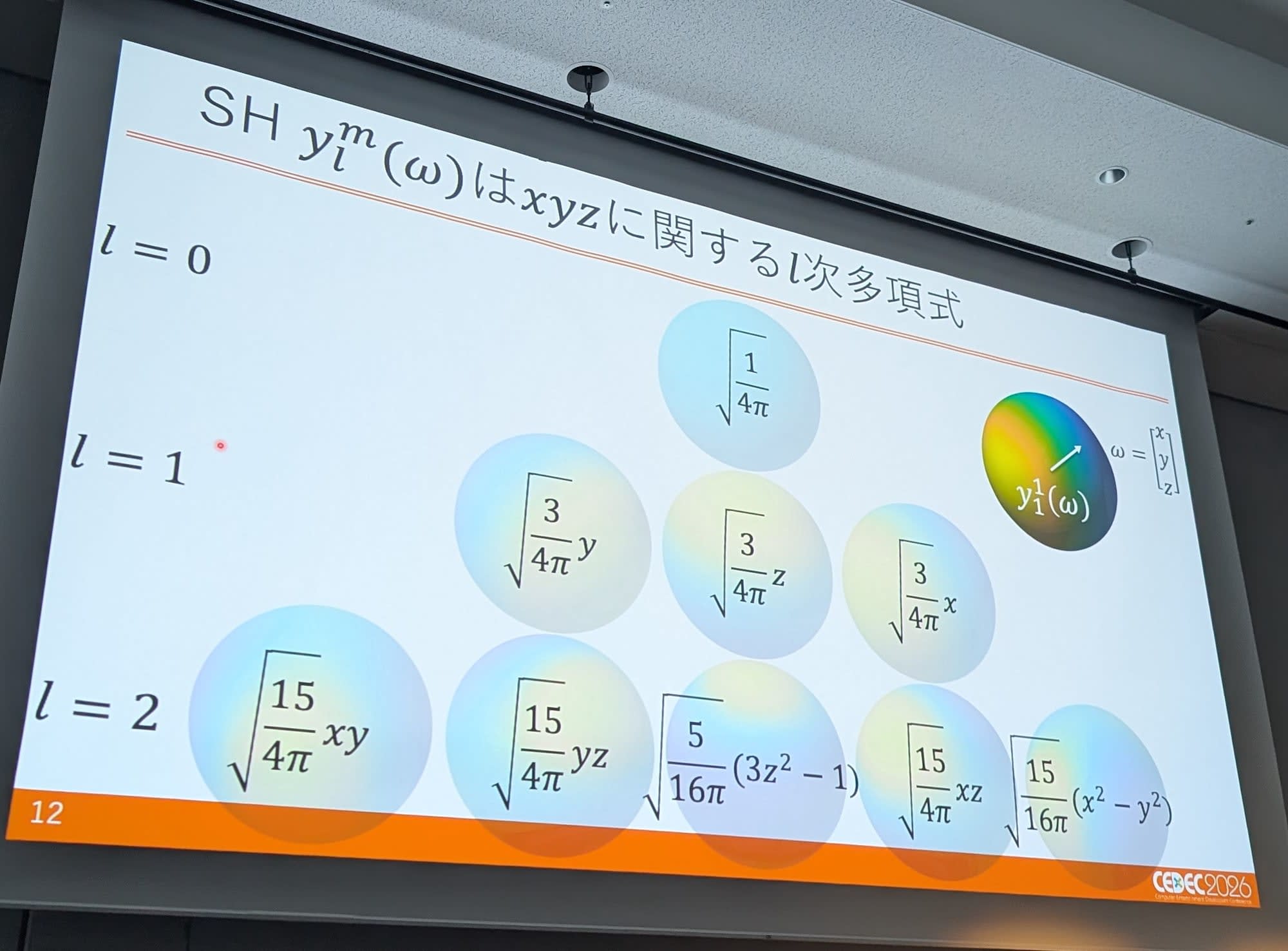
Spherical Harmonics (SH) are basis functions used to represent functions on a sphere. Because functions that vary by direction can be approximated with a set of coefficients, they allow compact handling of distributions such as light arriving from all directions.
In rendering, they are widely used in situations involving direction-dependent quantities, such as Light Probes representing light reaching each point in space, and shading for polygonal light sources and sphere lights. They are also used in representations where color changes depending on the viewing direction, as seen in recently prominent techniques like NeRF and Gaussian Splatting. This session introduced the latest techniques surrounding rotation, integration, and gradient computation for spherical harmonics, along with research papers from SIGGRAPH and other venues.
Zonal Harmonics for Easier Rotation
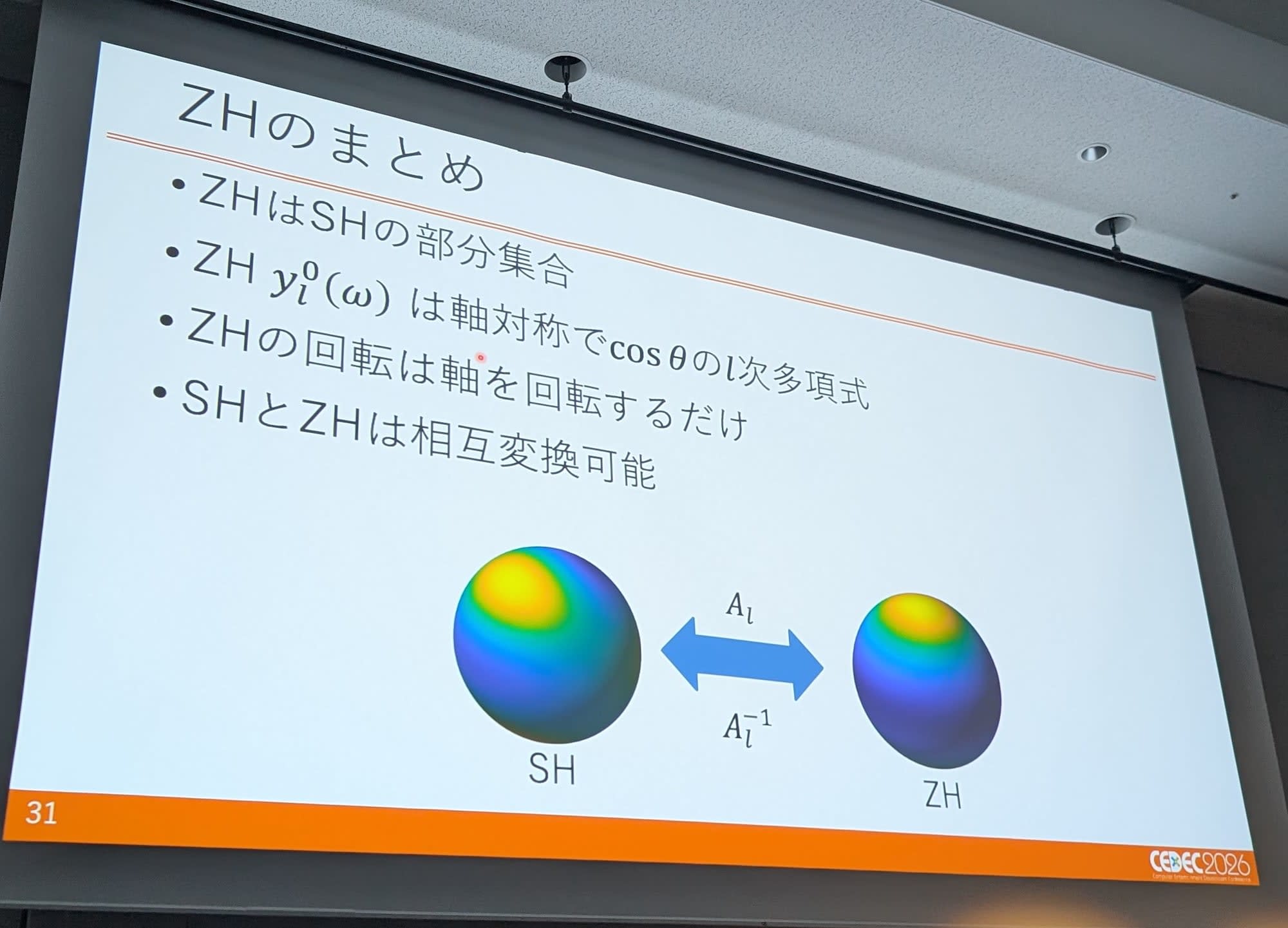
Rotating spherical harmonics directly is generally a computationally expensive operation. The key here is Zonal Harmonics (ZH). These are a subset of spherical harmonics that are symmetric around a given axis, so rotation simply requires rotating the axis itself.
Spherical harmonics and zonal harmonics have a mutually convertible relationship. Using this property, the rotation of spherical harmonics can be computed efficiently by passing through zonal harmonics along multiple pre-defined axis directions. This was introduced as a technique that uses pre-computed matrices.
Acceleration via Integration and Gradients in Light Source Shading
Calculating shading for polygonal light sources and sphere lights requires integrating reflectance properties over the visible range of the light source. A technique was introduced for analytically computing such integrals, which were previously obtained numerically. For polygonal light sources, area integrals are computed using a concept called Axial Moments, and for sphere lights, it was shown that the integral of the projected area can be expressed using spherical harmonics values.
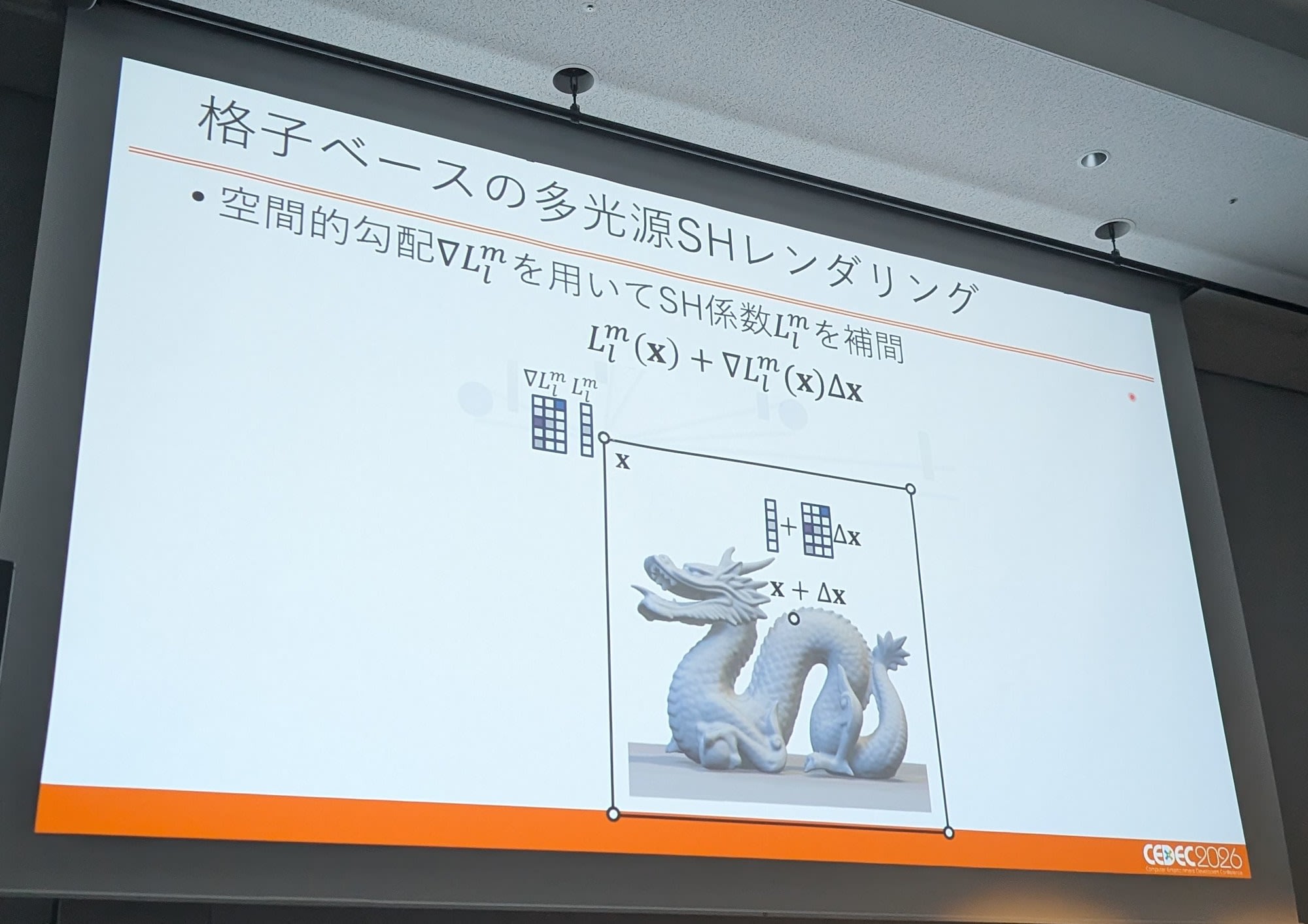
Furthermore, when there are a large number of light sources, computing coefficients at each point is costly. To address this, a coarse grid is placed in space, and the coefficients computed at the grid points along with their spatial gradients are used to interpolate values at intermediate points, enabling acceleration. To make this gradient computation more tractable, Solid Spherical Harmonics — which incorporate a radial component into spherical harmonics — are used. Because they can be expressed as polynomials in coordinates, gradients and even second-order derivatives used in error evaluation can be computed with good clarity. A code generator that automatically generates such computations has also been made publicly available on GitHub.
Impressions
Although this was a theory-focused session centered on mathematical formulas, it conveyed how a single tool — spherical harmonics — consistently underpins everything from light representation to light source shading and performance optimization. I felt that staying current with the latest developments in the mathematics underlying real-time rendering is valuable for gaining a clear perspective on future technology choices.