
At the Google Cloud Next 2026 Recap, Google Cloud Made the Case That It Is Now Serious About Multicloud

This page has been translated by machine translation. View original
I'm Oguri, a devoted lover of whisky, cigars, and pipes.
I spoke at a study session reviewing Google Cloud Next 2026, where I talked about Google Cloud's multi-cloud support.
It's finally here! Google Cloud in the era of true multi-cloud
Agentic Enterprise
For AI agents to act autonomously based on enterprise data, they need to be able to use data wherever it resides.
Google Cloud announced multi-cloud support across 3 layers.
- Network : Interconnection at the network layer
- Partner Cross-Cloud Interconnect
- AWS Interconnect - multicloud
- Analytics : Integration at the analytics layer
- Cross-cloud Lakehouse (formerly BigLake)
- Transaction : Multi-cloud at the transaction layer
- Spanner Omni
Network
Partner Cross-Cloud Interconnect for AWS was announced in November 2025 as a feature to easily connect Google Cloud and AWS directly, and general availability began just before Google Cloud Next 2026.
- 4-fold redundancy with 4 routers across 2 locations
- Connects immediately with just creation and approval
- Setup goes from days to minutes
- On-demand scaling from 1 to 100 Gbps
- Stable performance and latency
Japan isn't supported yet, so I hope it comes soon!!!
Network Connectivity Center (NCC) also now supports this in Preview, evolving from Peer to Peer into a multi-cloud WAN!
Analytics
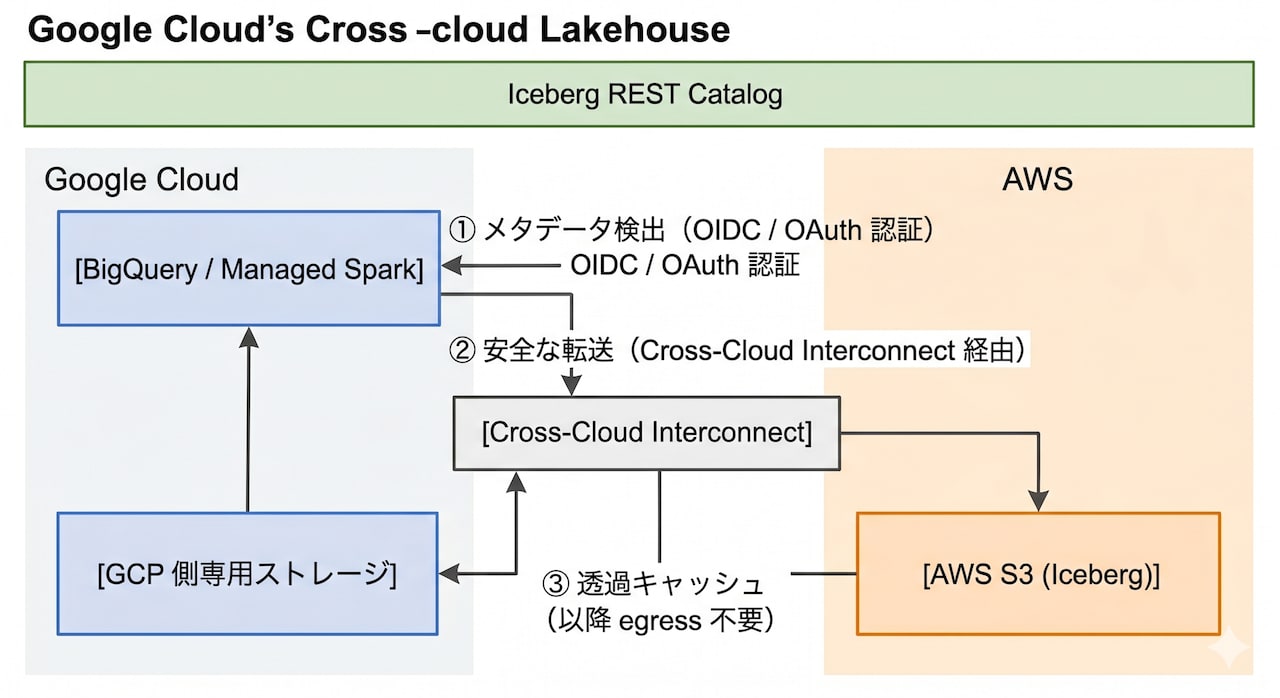
On April 20, 2026, BigLake was renamed to Google Cloud Lakehouse, and during Google Cloud Next 2026, Cross-cloud Lakehouse became available in Preview. It detects Iceberg REST Catalog metadata and enables fast, low-latency access to data in AWS S3.
By leveraging Cross-Cloud Interconnect, stable analytics becomes possible.
Transaction
Cloud Spanner is a leading NewSQL service that pioneered distributed SQL.
Features of Cloud Spanner
- NoSQL's horizontal scaling + RDBMS's ACID + external consistency
- Various data models: Relational / Key-Value / Vector / Graph
- Full-text search and a columnar engine
- 99.999% availability
For the following reasons, a Spanner that runs anywhere became necessary.
- Business continuity
- Data residency
- Multi / hybrid cloud strategy
- Non-GCP customers interested in Spanner
Among the technologies underpinning Cloud Spanner, the following depend on Google, so reimplementation was required.
- Colossus → Abstraction layer
- TrueTime → Rebuilt
Colossus
Colossus is the file system that underpins almost all of Google's products. To eliminate the dependency, an abstraction layer providing Colossus-equivalent functionality was introduced.
For Spanner Omni storage, SSD + ext4 is recommended. That's a somewhat old file system, isn't it...
TrueTime
TrueTime, the most famous technology in Spanner, is well known for its atomic clocks + GPS. However, since the time interval representation and Commit Wait are the most important aspects, it can be reimplemented in software.
Because the uncertainty range overlaps with other DB operations, performance is not degraded.
Deployment patterns
The following deployment patterns exist.
- Single server
- Single zone
- Single location, multiple zones (replicated deployment)
- Multiple locations, multiple zones
If you just want to try it out, you can even try it on macOS.
Summary
I think we can say this was the year Google Cloud got serious about multi-cloud.
- From lock-in to technical superiority
- Their seriousness is shown by covering all 3 layers: Network, Analytics, and Transaction
- The Agentic Era made it inevitable
Finally
Since Partner Cross-Cloud Interconnect for AWS was released last year, allowing Google Cloud and AWS networks to be easily connected directly, I had been watching announcements such as those at AWS re:Invent. I thought it would become generally available at Google Cloud Next 2026, but it went GA just before Next 2026, so I was waiting for features that assume networks are connected to appear.
With Spanner Omni and various other multi-cloud features emerging, I plan to keep checking them out going forward.