I Attended the 1st Study Session of JAWS-UG AI-DLC Branch - Raja SP Japan Visit Commemorative Special

This page has been translated by machine translation. View original
Introduction
On July 1, 2026, the first study session of the JAWS-UG AI-DLC chapter was held. The venue was the 36th floor of Azabudai Hills Mori JP Tower, AWS's new office.

Sign-ups on connpass filled up quickly, and the event was a great success with approximately 100 attendees on the day, including those seated in supplementary chairs.
The highlight of this event was that Raja SP, the proponent of AI-DLC, traveled from Singapore to Japan to personally answer questions in a Q&A session.
Please note that all statements attributed to speakers in this article are summaries based on the author's understanding and are not exact quotes.
One-on-One Q&A with Raja SP
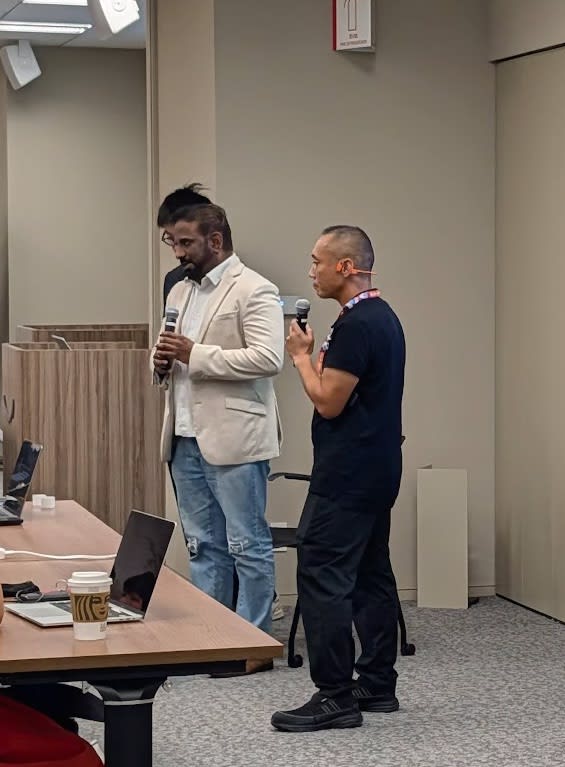
With Kats serving as moderator, the Q&A session proceeded based on over 120 questions submitted in advance.
What was difficult about creating AI-DLC
He said it was "getting other people to practice it and receiving feedback." More than creating the framework itself, the most challenging part was getting people to actually use it and running the improvement cycle.
Changes from V1 to V2
V1 was designed with the assumption that humans would judge and intervene at each step, but V2 evolved into a design where human judgment patterns are distilled so that AI can autonomously run the loop. He mentioned that while human involvement decreases, humans are able to do more.
Reasons why adoption isn't progressing
Raja cited the difficulty of mob elaboration (the process of gathering stakeholders to align context), overreliance on AI, and inadequate context management. He pointed out that it's not a tool problem, but rather organizational and process issues that hinder adoption.
The secret to successful adoption
There are two, he said. First, gaining experience, and second, building a harness (safety mechanism). The idea is to first prepare a system that allows you to try things on a small scale and safely receive feedback.
Corporate Case Study Sessions & Lightning Talks
The second half featured corporate case study presentations and lightning talks.
LINE Yahoo: Building an information infrastructure in a large-scale environment (Shinji Kobayashi)
This presentation came from the team in charge of Yahoo Shopping. They built an information infrastructure platform to deliver information at the granularity needed by AI in a large-scale environment with over 3,000 repositories. What was particularly impressive was the story of how they took one year to implement it while being sensitive to the "scary" feeling among non-engineers.
LINE Yahoo: Generating UI Mocks from AI-DLC deliverables (Fu Shindo)
This was a use case in the design domain. They built a flow to generate UI Mocks from AI-DLC deliverables, and described a process where AI generates personas and customer journeys, which designers then review.
Askul: Facing the gap between ideal and reality (Moeka Sato)
She candidly shared realistic challenges such as the difficulty of estimation and decision-makers not participating in the process. Rather than aiming for 100% adoption, an approach of partial adoption by process unit proved effective in producing results.
Tokio Marine & Nichido Systems: Review and retrospective agent (Ryota Konabe)
This was a case study of building a review and retrospective agent using Kiro. Quantitative results were reported, including the time spent on retrospectives being reduced from one hour to 20 minutes.
KDDI: Discussing AI-DLC Workflow v2 (Genki Kato)
This was a sharing of discussions about AI-DLC Workflow v2 held at an OST session. The importance of keeping intent and decisions in the repository was emphasized.
Summary
What I felt throughout each session was that AI-DLC is not simply about tool utilization, but goes as far as systematically preserving intent and decisions and organizing the organization's context. There were moments where pursuing the use of generative AI made organizational challenges more visible, which is precisely why systematization is key.
This was a study session where I felt great value in seeing the AI-DLC community in Japan steadily getting off the ground, and in having a venue where we could simultaneously hear firsthand accounts from companies that have been working on it from the early stages alongside a Q&A with Raja himself. I'm looking forward to the next session.
Group photo here:
Reference Links