Tried training full-layer LoRA including Mamba-2 on Nemotron 9B × Megatron-Bridge using NVIDIA Brev H100

This page has been translated by machine translation. View original
Introduction
Hello, I'm Morishige from Classmethod's Manufacturing Business Technology Department.
In my previous article, I fine-tuned Nemotron 9B-v2-Japanese with RAFT on the NTA FAQ to improve RAG answer accuracy. However, I was always bothered by the fact that LoRA couldn't pass through the Mamba-2 layers, meaning only 53% of all parameters were being trained. The results themselves weren't bad—F1 improved by +8.9 points and answer refusals dropped dramatically from 47 to 3—but still...
In Nemotron 9B-v2-Japanese, 27 out of 56 layers are Mamba-2 (SSM). At the time of writing, the HuggingFace PEFT implementation provides no means to apply LoRA to their in_proj and out_proj. Results were achieved with just the remaining Attention and FFN layers, but the question "would results change if we trained the remaining 47% too?" never left my mind.
In this article, I used Megatron-Bridge v0.2.0 included in the NGC NeMo container to achieve 100% LoRA coverage including Mamba-2, and ran training on NVIDIA Brev's cloud H100. I then brought the trained adapter back to DGX Spark, converted it to GGUF, and ran inference with Ollama—all in one end-to-end pipeline. To cut to the chase: the results didn't turn out as expected.
What is Megatron-Bridge?
At the time of writing, HuggingFace PEFT had a limitation where there was no way to apply LoRA to Mamba-2's in_proj and out_proj. This is an issue stemming from the HuggingFace implementation—Megatron's training pipeline natively supports these layers. In other words, you convert the model to Megatron format, train it, and then convert it back to HuggingFace format. Megatron-Bridge is what bridges this gap.
Megatron-Bridge is included in NeMo 25.11 series containers, and with the 3 steps of import_ckpt → finetune → export_ckpt, you can train HuggingFace ecosystem models through Megatron's native pipeline and bring the results back in HuggingFace format.
The NeMo container comes with a dedicated recipe (nemotron_nano_9b_v2_finetune_config) with pre-tuned LoRA target modules and hyperparameters. The 6 LoRA targets included in the recipe are as follows.
| Target | Layer Type | HF PEFT | Megatron-Bridge |
|---|---|---|---|
| linear_qkv / q_proj,k_proj,v_proj | Self-Attention | Yes | Yes |
| linear_proj / o_proj | Self-Attention | Yes | Yes |
| linear_fc1 / gate_proj,up_proj | FFN | Yes | Yes |
| linear_fc2 / down_proj | FFN | Yes | Yes |
| in_proj | Mamba-2 | No | Yes |
| out_proj | Mamba-2 | No | Yes |
HF PEFT covers only the top 4 at 53%. Megatron-Bridge covers all 6 at 100%.
The DGX Spark Wall and Brev
The SM 12.1 Wall
Last time I broke through the SM 12.1 issue on DGX Spark using the NGC NeMo container, but with Megatron-Bridge's import_ckpt, I hit another wall where multiprocessing.Manager().Queue() throws an EOFError inside a Docker container. So this time I decided it would be faster to rent a cloud H100 rather than persist locally.
NVIDIA Brev
NVIDIA Brev is a cloud GPU instance service provided by NVIDIA. You can use H100s and A100s on an hourly basis.
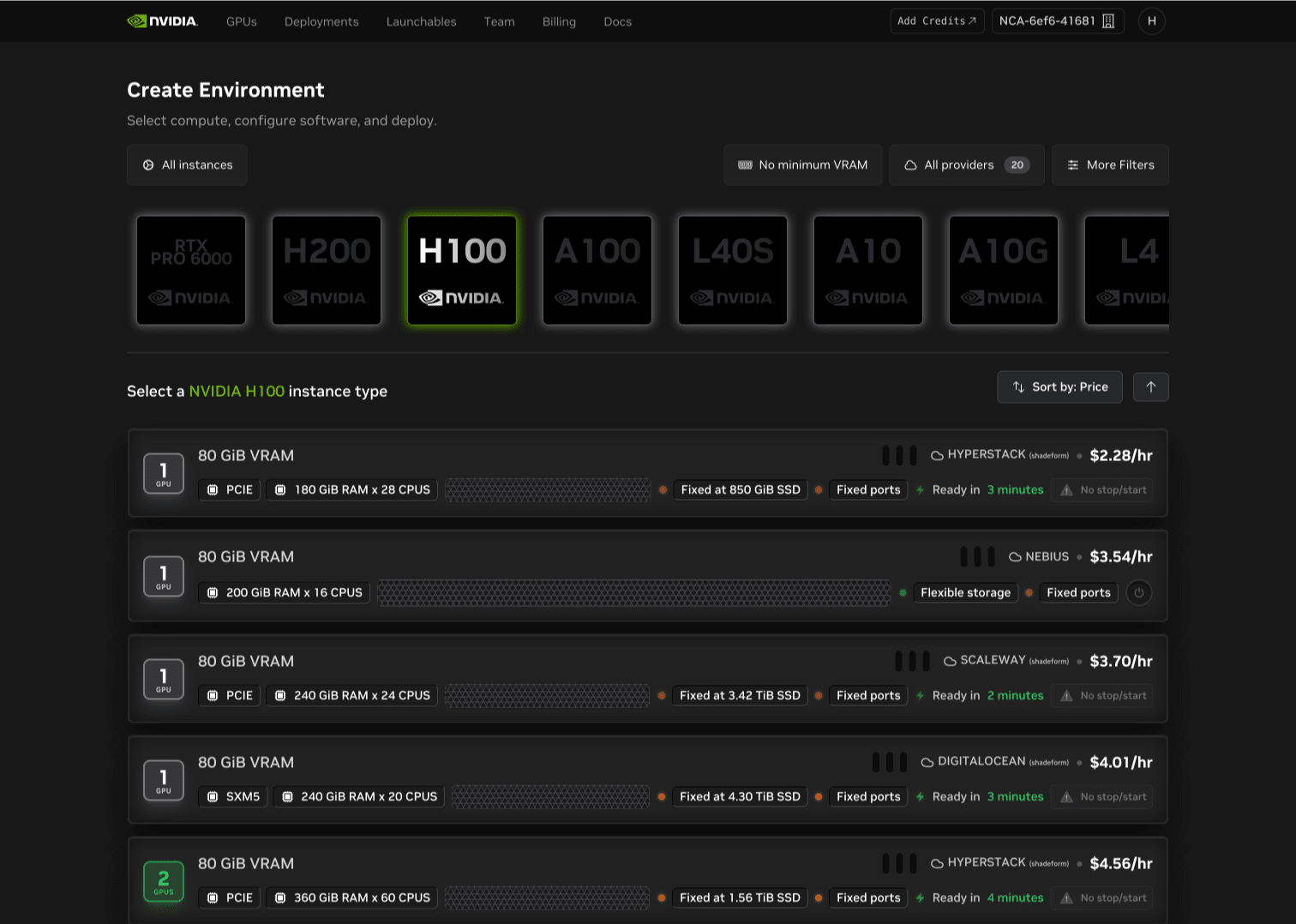
With a single H100 80GB PCIe configuration, at the time of writing it costs around $2.26/hr (Hyperstack provider), which is within reach for personal verification purposes. Since I was doing LoRA training with TP=1 (no tensor parallelism), one instance was sufficient.
Choosing VM Mode
Brev offers several ways to configure the GPU environment.
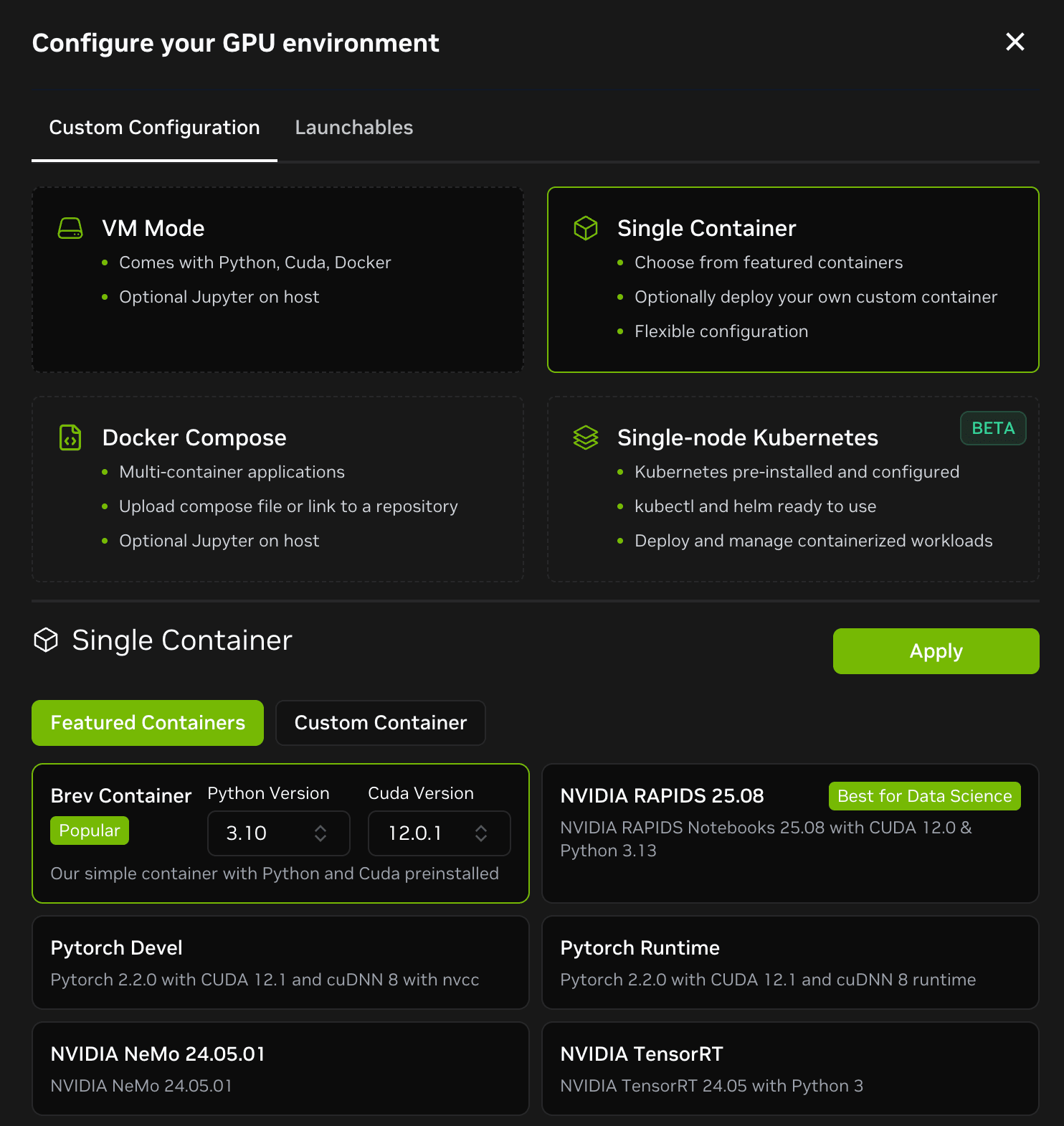
I initially tried to specify the NeMo container directly in Custom Container mode, but pip install didn't work because the Python environment inside the container was treated as externally managed. Switching to VM Mode and running docker run myself turned out to be more flexible and felt the same as working locally.
Brev Environment Setup
The entire pipeline was consolidated into a shell script (n6-brev-run.sh).
SSH into the VM Mode instance and start the NeMo container.
# Pull and launch the NeMo container
docker pull nvcr.io/nvidia/nemo:25.11.01
docker run --gpus all --ipc=host --ulimit memlock=-1 \
  --ulimit stack=67108864 -v /ephemeral:/workspace \
  nvcr.io/nvidia/nemo:25.11.01 bash /workspace/n6-brev-run.sh
/ephemeral is temporary storage on the Brev instance, where training data and scripts are pre-transferred via scp. --ipc=host and --ulimit memlock=-1 are flags required for Megatron's distributed training.
The H100's nvidia-smi output is as follows.
+-----------------------------------------------------------------------------------------+
| NVIDIA-SMI 570.195.03             Driver Version: 570.195.03     CUDA Version: 13.0     |
|-----------------------------------------+------------------------+----------------------+
| GPU  Name                 Persistence-M | Bus-Id          Disp.A | Volatile Uncorr. ECC |
|   0  NVIDIA H100 PCIe               On  |   00000000:00:07.0 Off |                    0 |
| N/A   28C    P0             67W /  350W |       0MiB /  81559MiB |      0%      Default |
+-----------------------------------------+------------------------+----------------------+
Converting from HF to Megatron Format
Use AutoBridge.import_ckpt() to convert a HuggingFace format model to Megatron format.
from megatron.bridge import AutoBridge

AutoBridge.import_ckpt(
    "nvidia/NVIDIA-Nemotron-Nano-9B-v2-Japanese",
    "/workspace/megatron-ckpt",
    trust_remote_code=True,
    dtype=torch.bfloat16,
    device_map="cpu",
)
trust_remote_code=True is required. Nemotron 9B-v2-Japanese is a custom model, and without this it gets rejected at can_handle(). This was a subtle gotcha I noticed during a dry run.
mp.Queue() Patch
I encountered a problem where multiprocessing.Manager().Queue() throws an EOFError during the conversion save step. It seems related to the /dev/shm size limit inside the Docker container, but I prioritized a workaround over investigating the root cause.
import multiprocessing as mp
import megatron.core.dist_checkpointing.strategies.filesystem_async as fs_async

# Use plain mp.Queue() instead of Manager().Queue()
fs_async._get_write_results_queue = lambda: mp.Queue()
For single-node configurations, mp.Queue() is functionally equivalent. With this patch applied on H100, conversion completed in 71 seconds. The checkpoint size is 16.6GB.
100% LoRA Training
Recipe Configuration
Megatron-Bridge provides training recipes for each model. For Nemotron 9B-v2-Japanese, nemotron_nano_9b_v2_finetune_config can be used.
from megatron.bridge.recipes.nemotronh import nemotron_nano_9b_v2_finetune_config
from megatron.bridge.peft.lora import LoRA

lora_config = LoRA(
    target_modules=[
        "linear_qkv", "linear_proj",    # Attention
        "linear_fc1", "linear_fc2",     # FFN
        "in_proj", "out_proj",          # Mamba-2 ← Not available with HF PEFT
    ],
    dim=32,
    alpha=32,
)

config = nemotron_nano_9b_v2_finetune_config(
    peft=lora_config,
    pretrained_checkpoint="/workspace/megatron-ckpt",
    train_iters=500,
    micro_batch_size=1,
    global_batch_size=8,
    seq_length=2048,
    finetune_lr=1e-4,
)
Here is a summary of configuration differences from the previous run (HF PEFT).
| Item | Previous (HF PEFT) | This Time (Megatron-Bridge) |
|---|---|---|
| Training Framework | trl SFTTrainer | Megatron finetune() |
| LoRA Coverage | 53% | 100% |
| LoRA rank | 16 | 32 (recipe default) |
| LoRA alpha | 32 | 32 |
| Learning Rate | 2e-4 | 1e-4 (recipe default) |
| Iterations | 138 steps (1 epoch) | 500 iter |
| Batch Size | 8 (bs=1 × grad_accum=8) | 8 (mbs=1 × gbs=8) |
| Precision | BF16 | BF16 |
| Training Env | DGX Spark (GB10) | Brev H100 80GB |
Eval Batch Size Issue
Megatron-Bridge's eval crashes on batch splitting when the number of data points is less than global_batch_size. With 100 eval samples and global_batch_size=8, this shouldn't normally be a problem, but I got caught by a bug in remainder handling. Since the final evaluation is done on Ollama, I worked around this by making eval a no-op.
import megatron.bridge.training.train as _train_module
_train_module.evaluate_and_print_results = lambda *a, **kw: None
Loss Progression
Here is the lm loss progression over 500 iterations.
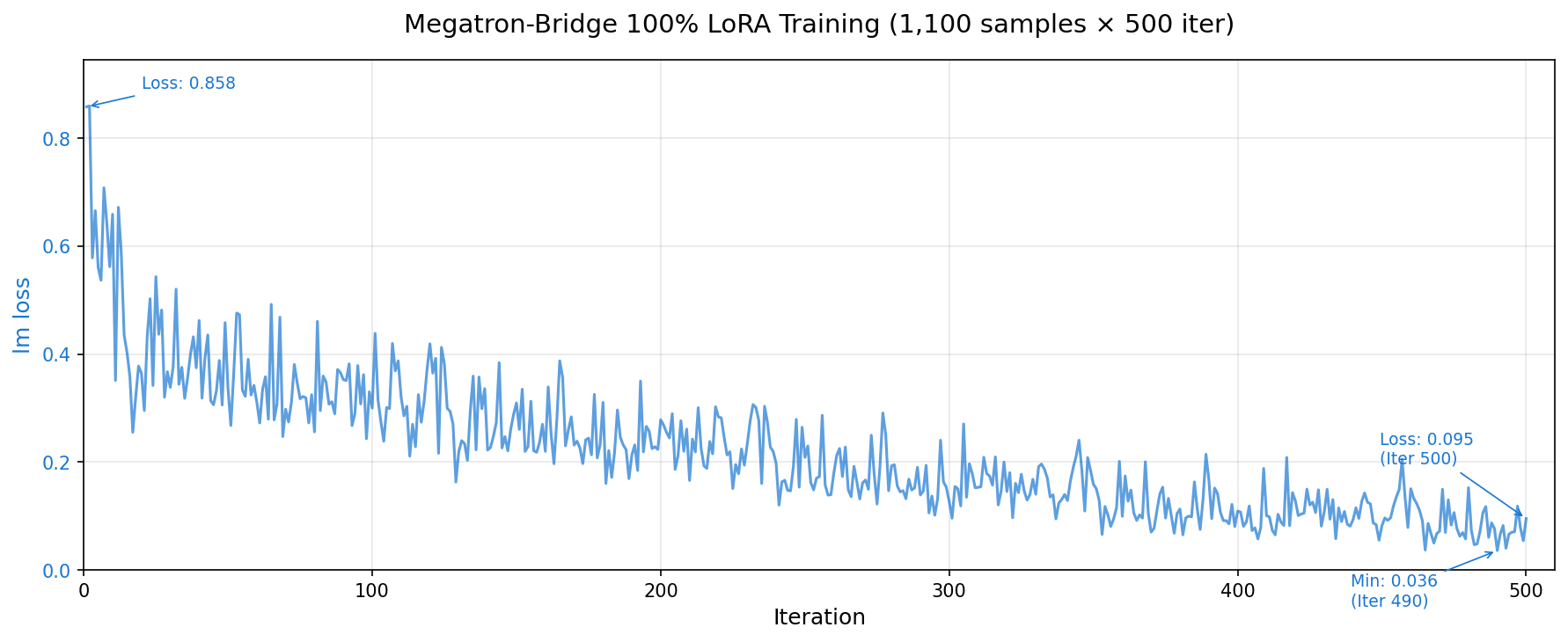
Loss dropped from an initial 0.858 to 0.095. Compared to the final loss of 6.64 in the previous run (HF PEFT), the magnitude is completely different. Since the loss calculation methods differ between training frameworks, a direct comparison isn't possible, but it's clear that training converged smoothly.
Training took approximately 17 minutes. You really feel the speed of H100. The same dataset that took 55 minutes (138 steps) on DGX Spark ran in this time even with 500 iter. GPU memory usage was 23.3GB / 80GB, with plenty of headroom even at TP=1.
Bringing the Adapter Back
export_ckpt source_path
Once training is complete, export to HuggingFace format. The training checkpoint (iter_0000500/) only contains LoRA delta weights (.distcp), so pass this to export_ckpt's source_path while merging with the base checkpoint.
bridge = AutoBridge.from_hf_pretrained(
    "nvidia/NVIDIA-Nemotron-Nano-9B-v2-Japanese",
    trust_remote_code=True,
)

bridge.export_ckpt(
    "/workspace/megatron-ckpt",      # Base Megatron checkpoint
    "/workspace/hf-export",           # Export destination (HF format)
    source_path="/workspace/output/n6-megatron-lora/checkpoints/iter_0000500",
)
Note that the bridge instance should be initialized with from_hf_pretrained. Using from_hf_config results in an error because save_artifacts is not implemented. I was able to catch this during a dry run, which was a relief.
Export completed in 50 seconds. Total work time on Brev up to this point was about 20 minutes, with a cost of approximately $2.26/hr × 1 hour ≈ $2.26.
GGUF Conversion and Ollama Registration
Transfer the exported HF model to DGX Spark via scp and convert to GGUF.
Previously, I converted only the LoRA adapter to GGUF and combined it using Ollama's ADAPTER directive. That approach can't be used this time. llama.cpp's LoRA adapter GGUF doesn't support Mamba-2's in_proj and out_proj, and these tensors get ignored during conversion.
So this time I'm directly converting the fully merged HF model to GGUF.
# Convert fully merged HF model to GGUF Q4_K_M
python3 llama.cpp/convert_hf_to_gguf.py ./hf-export/ \
    --outtype q4_k_m \
    --outfile nemotron-9b-n6-Q4_K_M.gguf
| Method | Previous (HF PEFT) | This Time (Megatron-Bridge) |
|---|---|---|
| GGUF Format | LoRA adapter GGUF (36MB) | Full model GGUF (6.1GB) |
| Ollama Reg. | ADAPTER directive |
FROM directive |
| Reason | llama.cpp supports Attention + FFN LoRA | Mamba-2 LoRA adapter unsupported |
The Ollama Modelfile is as follows.
FROM ./nemotron-9b-n6-Q4_K_M.gguf

TEMPLATE """{{- range $i, $_ := .Messages }}
{{- if eq .Role "system" }}<extra_id_0>System
{{ .Content }}
{{ end }}
{{- if eq .Role "user" }}<extra_id_1>User
{{ .Content }}
{{ end }}
{{- if eq .Role "assistant" }}<extra_id_1>Assistant
{{ .Content }}
{{ end }}
{{- end }}<extra_id_1>Assistant
"""

PARAMETER stop "<extra_id_1>"
PARAMETER num_ctx 8192
PARAMETER temperature 0.6
PARAMETER top_p 0.95
ollama create nemotron-9b-n6 -f Modelfile
This makes it possible to run inference with ollama run nemotron-9b-n6.
Evaluation Results
The exact same evaluation script and test data from the previous article were used to ensure comparable conditions.
JCQ Regression Check
General capability regression was verified with JCommonsenseQA (1,119 questions).
| Model | JCQ Accuracy | Diff |
|---|---|---|
| Baseline (no FT) | 91.96% (1029/1119) | - |
| RAFT FT (HF PEFT / 53% LoRA) | 91.51% (1024/1119) | -0.45pp |
| RAFT FT (Megatron-Bridge / 100% LoRA) | 92.14% (1031/1119) | +0.18pp |
RAFT Domain F1 Evaluation
Token-level F1 was measured on the NTA FAQ test set of 200 samples.
| Model | F1 | Refusal FP | Refusal TN |
|---|---|---|---|
| Baseline (no FT) | 0.5646 | 47 | 153 |
| RAFT FT (HF PEFT / 53% LoRA) | 0.6536 | 3 | 197 |
| RAFT FT (Megatron-Bridge / 100% LoRA) | 0.4884 | 69 | 131 |
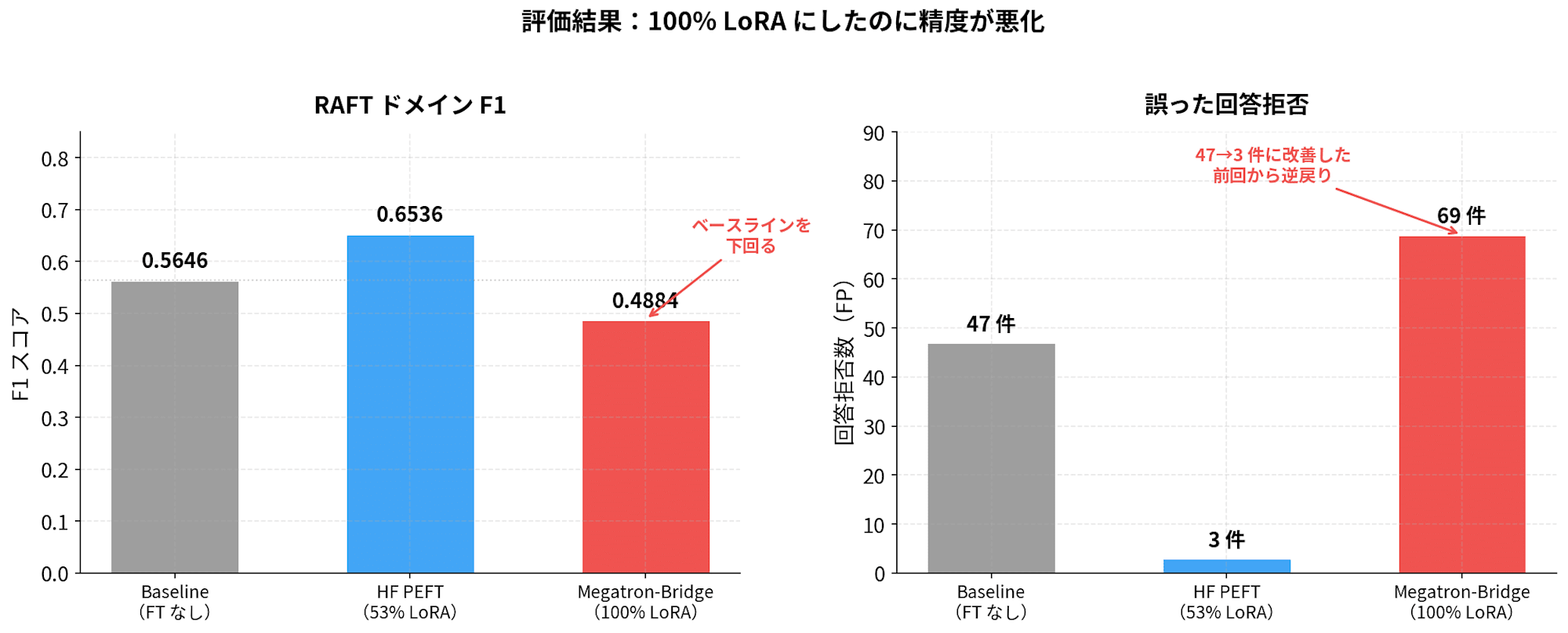
Honestly, this result was unexpected. F1 fell below the baseline despite achieving 100% LoRA. Answer refusals (FP) also increased to 69—the exact opposite of the previous run, which dramatically reduced them from 47 to 3.
Qualitative Samples
I dug into some samples. One thing I wanted to look at was "F1 limited to samples where this model actually answered."
| Model | Answers | Average F1 for Answered Samples |
|---|---|---|
| RAFT FT (HF PEFT / 53% LoRA) | 197 | 0.6636 |
| RAFT FT (Megatron-Bridge / 100% LoRA) | 131 | 0.7457 |
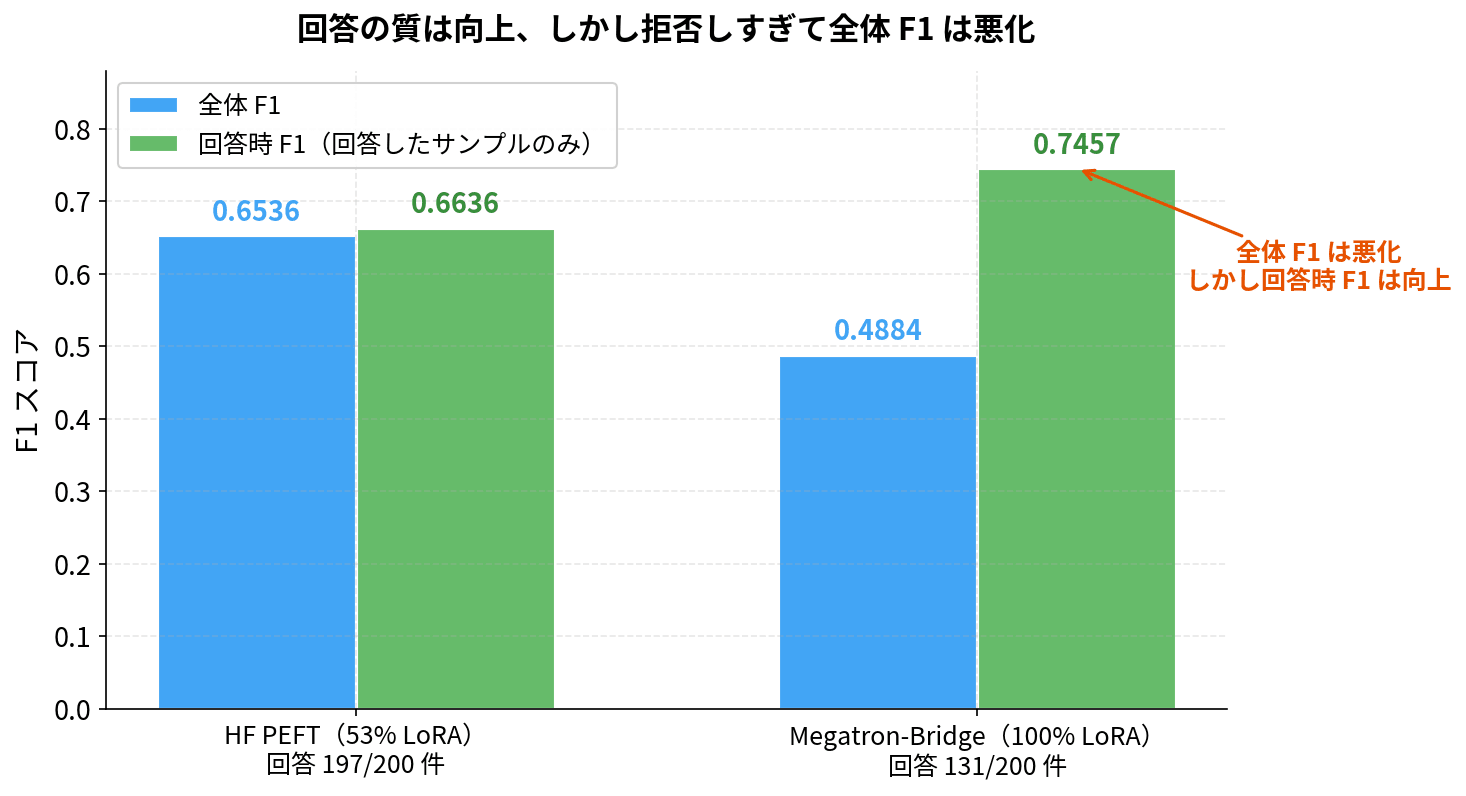
The accuracy when this model does answer is actually higher with Megatron-Bridge. The problem is the "whether to answer" judgment—this model is being overly conservative.
Examples where this model refused but the previous model answered (3 cases)
Of the 69 incorrect refusals, only 3 were also refused by the previous model. The remaining 66 were cases where the previous model was able to answer correctly. Here are 3 typical patterns.
First, a question about converting an endowment insurance policy. Reference document 5 explicitly states "it may be included in necessary expenses for the tax year in which the conversion date falls," yet this model returned "I cannot answer from the information provided." The previous model quoted the relevant passage and answered (F1: 0.418).
Next, regarding how to handle the expiration of the My Number grace period. Again, reference document 5 contains a detailed answer, and the previous model answered with F1=0.808. This model refused the same way. The length of the reference document or density of technical terms might be a factor, but the information needed to answer was clearly provided.
The third case involves the application of a tax treaty to interest paid to an Indian corporation via an SPC. Reference document 1 explicitly states the tax exemption, and the previous model answered with F1=0.744. This model refused again.
What these have in common is that all reference documents contained a clear answer. The impression is that this model understands the document content, but is being overly cautious in judging "whether it can answer."
Discussion
Why Accuracy Dropped Despite 100% LoRA
As seen in the qualitative samples, when the model does answer, its F1 is higher (0.7457 vs 0.6636). That means the quality of answers itself improved. The reason overall F1 degraded is the 69 cases of refusing to answer when it could have. The RAFT training data includes samples that say "if the answer is not in the reference documents, say you cannot answer," and it seems the model over-learned this refusal pattern.
So why didn't this happen with the same data in the previous run? I think the biggest factor is the difference in the number of epochs. Previously I stopped training at 138 steps (1 epoch), but this time I ran 500 iterations using the Megatron-Bridge recipe defaults. This corresponds to approximately 3.6 epochs for the 1,100-sample dataset. It's natural that repeatedly training on the refusal pattern 3.6 times would lower the threshold excessively.
Other factors are also conceivable. The GGUF conversion method differs (previous: stacking LoRA adapter GGUF on base, this time: Q4_K_M quantization after full merge), and the subtle weight changes from training may have been rounded away by quantization. Alternatively, by passing LoRA through the Mamba-2 SSM layers, pattern memorization of training data may have taken precedence over the RAG behavior of "finding answers in reference documents." Verifying the latter would require a comparative experiment with only the Mamba-2 layers frozen, but I wasn't able to go that far this time.
For a fair comparison with the previous run, an experiment aligning rank=16, 1 epoch, and the same GGUF conversion method would be needed.
Cost-Effectiveness of Brev
Here is a breakdown of Brev costs for this run.
| Item | Time | Cost |
|---|---|---|
| Dry run | ~1h | ~$2.26 |
| Production run | ~1h | ~$2.26 |
| CoT generation (Claude Haiku, done previously) | - | ~$2.00 |
| Total | ~$6.52 |
There's a possibility the DGX Spark issues could have been resolved with more time, but I think renting an H100 for $2.26/hr to break through the problem at once was a reasonable call. Training itself finished in 17 minutes, and most of the time was trial and error for environment setup.
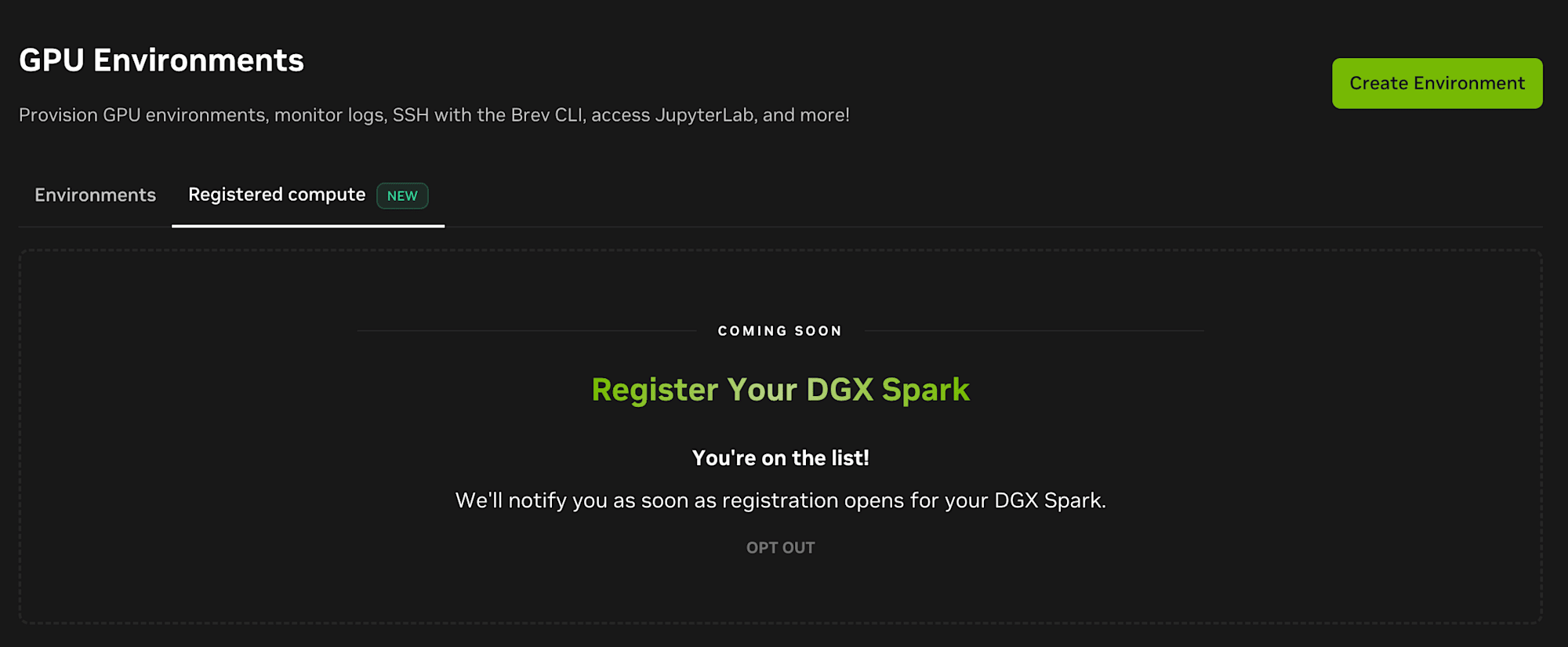
The "train in the cloud, infer at the edge" pattern feels like a good fit with DGX Spark. Training is where H100 speed shines, and inference is where DGX Spark's 128GB unified memory shines. A workflow of renting an H100 on Brev for spot training and bringing the results back locally is something I'll keep using, and I'm also looking forward to the coming soon integration between DGX Spark and NVIDIA Brev, which seems to be targeting exactly this workflow.
Impressions of Megatron-Bridge
Honestly, Megatron-Bridge has sparse documentation. Most of the time I had to read the source code and figure things out by trial and error. The 3-step flow of import_ckpt → finetune → export_ckpt is simple in itself, which is a positive.
However, each step had its own pitfall. import_ckpt had the Manager().Queue() EOFError, finetune had the eval data batch size mismatch, and export_ckpt would corrupt the model if source_path wasn't passed. All the workarounds fit in a single line, so I hope this article helps anyone who gets stuck in the same places. This was my experience as of NeMo 25.11.01, so future versions may have improvements. (I also suspect there may be issues with my own usage...)
Summary
Using Megatron-Bridge v0.2.0, I performed 100% LoRA training including the Mamba-2 layers of Nemotron 9B-v2-Japanese on Brev H100.
| Item | Previous (HF PEFT) | This Time (Megatron-Bridge) |
|---|---|---|
| Training Framework | HF PEFT + trl | Megatron-Bridge v0.2.0 |
| LoRA Coverage | 53% | 100% |
| Training Env | DGX Spark (GB10) | Brev H100 80GB |
| Training Time | 55 min | 17 min |
| GGUF Method | LoRA adapter (36MB) | Full model (6.1GB) |
| Additional Cost | ~$2 (CoT gen only) | ~$6.52 (Brev + CoT) |
| JCQ Regression | -0.45pp | +0.18pp (no regression) |
| RAFT F1 | 0.6536 | 0.4884 (degraded) |
Technically, I was able to achieve 100% LoRA training including Mamba-2 using Brev's cloud H100 with Megatron-Bridge. The "train in the cloud and bring back to the edge" workflow also worked without issues.
However, the RAFT accuracy that matters actually degraded compared to the previous run (53% LoRA). The lesson here is that increasing LoRA coverage doesn't necessarily improve accuracy. Since the F1 when the model did answer actually improved, re-running with matched epoch counts to suppress over-learning of the refusal pattern might yield different results.
Megatron-Bridge itself has many pitfalls, but I found its positioning as a bridge connecting the HuggingFace ecosystem and Megatron's training pipeline to be interesting. I look forward to better documentation, and I hope this serves as a reference for anyone trying to do the same thing.
The full scripts are published in the repository below.