OpenAI AgentKit Has Fragmented — From the End of Agent Builder to Workspace Agents and Claude Cowork, Taking Stock of Where No-Code AI Agents Stand Today

This page has been translated by machine translation. View original
Introduction
"Whatever happened to OpenAI's AgentKit? Is it safe to start a new project with Agent Builder?"——Many people are likely asking this question in mid-2026.
After looking into it, it turns out that AgentKit is not a monolithic platform—each component has taken a different path. Furthermore, comparing "Workspace Agents," which emerged as the migration destination, with Anthropic's "Claude Cowork" reveals the broader trend of no-code AI agents.
In this article, we'll follow each question that came up during our research and organize the overall picture as of June 2026.
AgentKit Has "Split" — A Component-by-Component Survival Map
First, the biggest question: is all of AgentKit ending, or just part of it?
The bottom line: AgentKit is not monolithic—each component has taken a different fate.
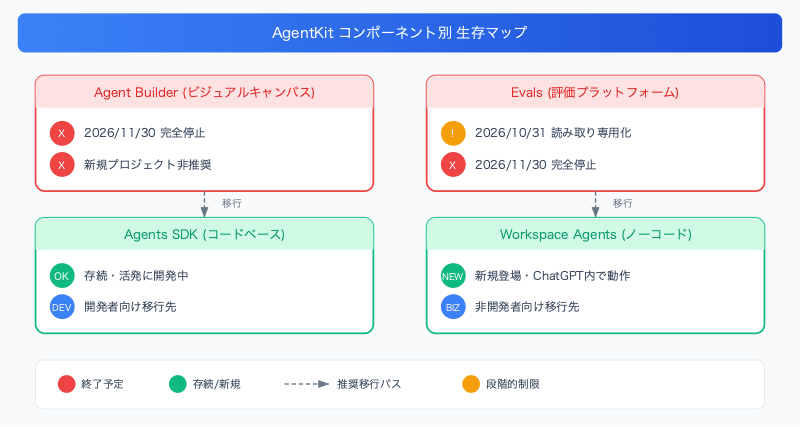
| Component | Status | Details |
|---|---|---|
| Agent Builder (visual canvas) | Scheduled for termination | Full shutdown on November 30, 2026 |
| Evals (evaluation platform) | Scheduled for termination | Read-only on October 31, 2026; full shutdown on November 30, 2026 |
| Agents SDK (code-based) | Surviving & actively developed | Recommended migration destination (for developers) |
| Workspace Agents (no-code) | Newly launched | Team-oriented agents running inside ChatGPT |
Key Timeline
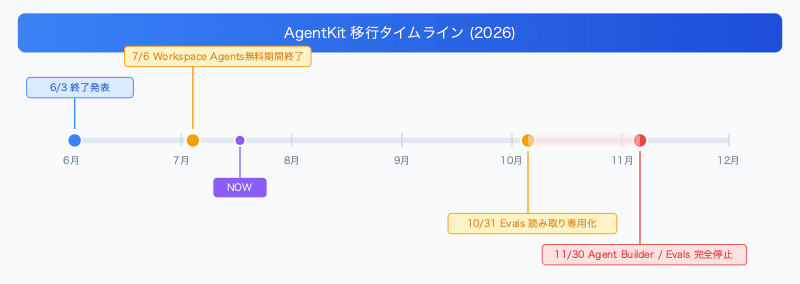
- June 3, 2026: OpenAI announces wind down of Agent Builder and Evals
- October 31, 2026: Evals becomes read-only
- November 30, 2026: Both Agent Builder and Evals become completely unavailable
In other words, starting a new project with Agent Builder now is risky. It will be unusable in about 5 months.
Choosing Your Migration Path
OpenAI offers two migration destinations, depending on the type of user:
- People who write code → Agents SDK (Python SDK, MCP integration, sandboxed agents, guardrails, etc.)
- People who don't write code → Workspace Agents in ChatGPT (configured in natural language, shared with teams)
What Are Workspace Agents — The Evolution of Custom GPTs
Next question: what exactly can Workspace Agents do?
Workspace Agents are team-shared, persistently running AI agents that operate inside ChatGPT. They are positioned as an evolution of Custom GPTs, which first appeared in late 2023.
Key Features
- Persistent cloud execution: Keeps running even when users are offline
- External app connections: Connects to Slack, Salesforce, and more via connectors
- Team sharing: Once built, available across the entire organization
- Powered by Codex model: Driven by OpenAI's Codex model
- No-code: Configured and built using natural language
- Supported plans: Business / Enterprise / Edu / Teachers
Differences from Custom GPTs
While Custom GPTs were "personalized custom chatbots for individuals," Workspace Agents are designed to be shared across an entire team and run autonomously in the background. Use cases like deploying to Slack for the whole team to use are the intended scenario.
Pricing
The free period has been extended through July 6, 2026, after which credit-based billing is scheduled to begin.
Comparison with Claude Cowork — Cloud vs. Local, Team vs. Individual
"Aren't Workspace Agents basically the same as Claude Cowork?"——This is a natural question too.
Both aim to solve the same problem of providing agent capabilities to non-developers, but their approaches differ significantly.
| Perspective | Workspace Agents (OpenAI) | Claude Cowork (Anthropic) |
|---|---|---|
| Execution environment | Cloud (OpenAI side) | Local desktop (macOS / Windows) |
| Sharing | Whole team, Slack deployment available | Per individual, siloed per user |
| Target | Enterprise teams | Individual knowledge workers |
| Background execution | Yes (cloud) | Yes (local scheduled tasks) |
| File access | Via external apps (connectors) | Direct local file access |
| Supported plans | Business / Enterprise / Edu | Pro ($20) / Max ($100-200) / Team ($20/seat) / Enterprise |
Which Should You Choose?
- Want to share with a team, integrate with Slack → Workspace Agents
- Want to work with your own files on your personal PC → Claude Cowork
Honestly, the two are less competitors and more a case of differentiated niches. If you prioritize team and cloud, go with OpenAI; if you prioritize individual and local, go with Anthropic—that's the basis for judgment at this point.
Promptfoo — The LLM Evaluation Tool Designated as the Successor to OpenAI Evals
If Evals is ending, how should we evaluate LLMs?
The migration destination OpenAI recommends is Promptfoo. And interestingly, OpenAI acquired Promptfoo in March 2026.
What Is Promptfoo?
- An open-source CLI tool for testing, evaluating, and red-teaming LLM applications
- Built on the philosophy of treating prompts as "testable code"
- Define test cases in YAML and run them against any LLM provider
- Includes built-in red-teaming capabilities covering 50+ vulnerability types
- Easy to integrate into CI/CD pipelines
A Basic Usage Example
# Example promptfoo configuration (conceptual illustration)
prompts:
  - "You are customer support. Please answer the following question: {{question}}"

providers:
  - openai:gpt-4o

tests:
  - vars:
      question: "What is your return policy?"
    assert:
      - type: contains
        value: "within 30 days"
      - type: llm-rubric
        value: "The response should be polite and accurate"
Why Did OpenAI Acquire Promptfoo?
By shutting down its own Evals platform while absorbing Promptfoo—which had already become the de facto standard—OpenAI appears to have decided to delegate the evaluation layer of its ecosystem to an external tool.
Why Every Company Is Focusing on No-Code AI Agents
Looking at the overall flow so far, it's clear that both OpenAI and Anthropic are making a major pivot toward building and operating agents without code.
Expanding Beyond Developers
Code-based tools like the Agents SDK are powerful, but only developers can use them. Meanwhile, many business tasks within companies—lead evaluation, report creation, feedback aggregation, and more—are handled by non-engineers.
No-code agents are an interface for extending the benefits of AI to people beyond developers.
Each Company's Approach
| Vendor | Product | Position |
|---|---|---|
| OpenAI | Workspace Agents | Cloud, team sharing, Slack deployment |
| Anthropic | Claude Cowork | Local desktop, individual optimization |
| OpenAI | Agents SDK | Code-based (for developers) |
| Anthropic | Claude Code | Code-based (for developers) |
Offering an SDK for developers and a product for non-code users alike——both companies are pursuing a dual-track strategy, and that's the state of things in mid-2026.
Summary
| What We Learned | Practical Decision Criteria |
|---|---|
| Agent Builder / Evals end on November 30, 2026 | Don't use for new projects. Migrate to Agents SDK or Workspace Agents |
| Workspace Agents is cloud-based and team-shared | First choice for cross-team usage |
| Claude Cowork is local and individual-focused | Strong for personal productivity improvement and local file operations |
| Promptfoo is the de facto standard for LLM evaluation | Consider as the migration destination from Evals. Already acquired by OpenAI, so ongoing support is expected |
| No-code AI agents are a focus area across all major vendors | Select tools based on non-engineer workflow automation needs |
The biggest takeaway from this research is that a single question—"whatever happened to AgentKit?"—revealed the industry-wide trend of no-code AI agents. When making technology decisions, I was reminded once again of the importance of understanding not just individual products, but the dynamics of the layer those products belong to.