I Tried Enabling Multipath Resilience with Cross-Region TGW Peering and VPC Peering

This page has been translated by machine translation. View original
Introduction
On November 17, 2026, Multipath Resilience was announced, which adds a 99.999% availability SLA to cross-Region communication.
When Multipath Resilience is enabled, a copy of each packet is sent over multiple physically separated paths. In the destination Region, the first packet to arrive is passed on, and duplicates that arrive later are discarded.
In this article, I tried enabling Multipath Resilience on a Transit Gateway (TGW) peering attachment and a VPC peering connection between N. Virginia (us-east-1) and Oregon (us-west-2).
Test environment
- AWS CLI: 2.41.0
- Regions: us-east-1 (requester side), us-west-2 (accepter side)
- Account: the same on the requester side and the accepter side
TGW peering attachment
We start from a state where one TGW has been created in each of us-east-1 and us-west-2. The attachment requester is us-east-1, and the accepter is us-west-2.
State before enabling
When you describe an attachment that was created and accepted without specifying options, the Options include Multipath Resilience items.
aws ec2 describe-transit-gateway-peering-attachments --region us-east-1 --transit-gateway-attachment-ids tgw-attach-0123456789abcdef0
"Options": {
    "RequesterAllowMultipathResilience": false,
    "AccepterAllowMultipathResilience": false,
    "MultipathResilienceStatus": "disabled"
}
The responses of create and accept executed without options did not include Multipath Resilience items. The Options in the accept response contained only DynamicRouting.
Enabling on an existing attachment
Run modify-transit-gateway-peering-attachment on the requester side (us-east-1) and then on the accepter side (us-west-2). First, the requester side.
aws ec2 modify-transit-gateway-peering-attachment --region us-east-1 --transit-gateway-attachment-id tgw-attach-0123456789abcdef0 --options AllowMultipathResilience=true
The Options in the response are as follows. I specified only AllowMultipathResilience=true, but RequesterMultipathResilienceMode was set to always-on.
"Options": {
    "RequesterAllowMultipathResilience": true,
    "RequesterMultipathResilienceMode": "always-on",
    "AccepterAllowMultipathResilience": false,
    "MultipathResilienceStatus": "pending"
}
At this point, MultipathResilienceStatus was pending when described from either Region. Next, the accepter side.
aws ec2 modify-transit-gateway-peering-attachment --region us-west-2 --transit-gateway-attachment-id tgw-attach-0123456789abcdef0 --options AllowMultipathResilience=true
In the response of this modify as well, MultipathResilienceStatus was pending. When I described it about 14 seconds later, it was enabled.
aws ec2 describe-transit-gateway-peering-attachments --region us-east-1 --transit-gateway-attachment-ids tgw-attach-0123456789abcdef0 --query TransitGatewayPeeringAttachments\[0\].\[State\,Options\]
[
    "available",
    {
        "RequesterAllowMultipathResilience": true,
        "RequesterMultipathResilienceMode": "always-on",
        "AccepterAllowMultipathResilience": true,
        "AccepterMultipathResilienceMode": "always-on",
        "MultipathResilienceStatus": "enabled"
    }
]
While enabling an existing attachment with modify, State remains available. Only MultipathResilienceStatus shows the transition.
Enabling at creation
Specify AllowMultipathResilience=true in the options of create-transit-gateway-peering-attachment.
aws ec2 create-transit-gateway-peering-attachment --region us-east-1 --transit-gateway-id tgw-0123456789abcdef0 --peer-transit-gateway-id tgw-0fedcba9876543210 --peer-account-id 111122223333 --peer-region us-west-2 --options AllowMultipathResilience=true
"Options": {
    "RequesterAllowMultipathResilience": true,
    "RequesterMultipathResilienceMode": "always-on",
    "AccepterAllowMultipathResilience": false,
    "MultipathResilienceStatus": "pending"
}
For a connection within the same account, simply accepting without running modify on the accepter side resulted in AccepterAllowMultipathResilience being true and MultipathResilienceStatus being enabled.
It took about 3 minutes 23 seconds from accept until I confirmed available and enabled on the requester side. An attachment without options took about 3 minutes 15 seconds, and with checks at 10–15 second intervals, no difference could be discerned.
Display in the Console
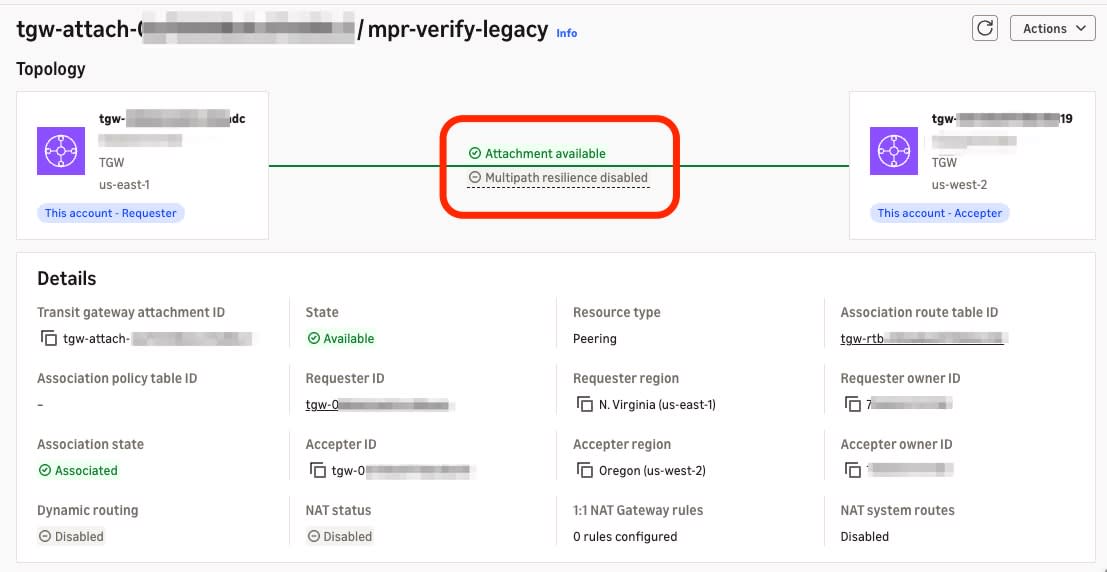
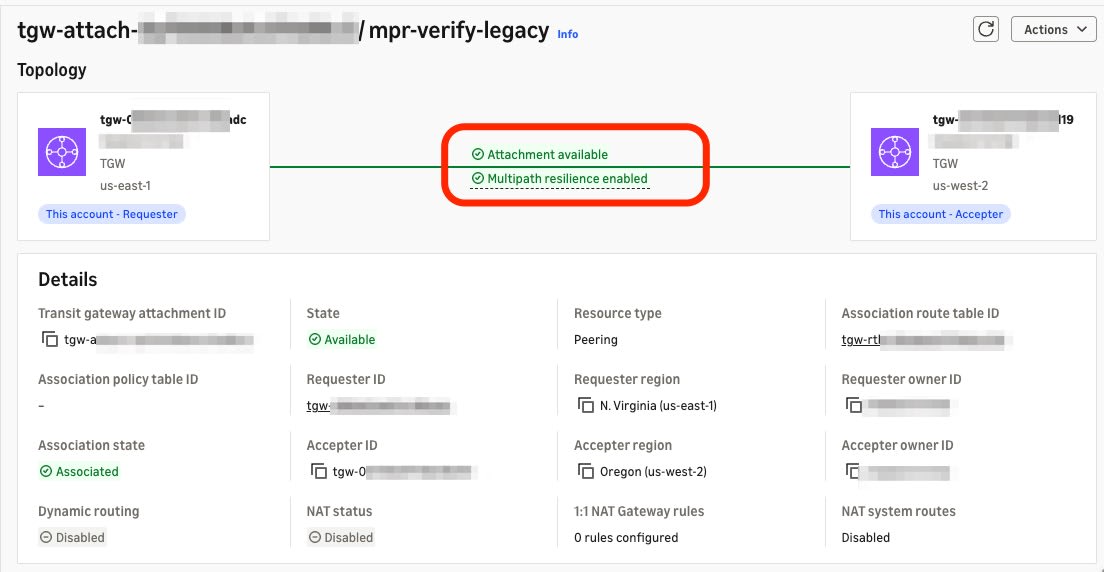
In the topology diagram on the attachment details page, the indication below Attachment available changes from Multipath resilience disabled to enabled. The images are of the requester side (us-east-1) screen. Items in the details section, such as State and Dynamic routing, are the same before and after enabling.
VPC peering
I newly created one VPC in each of us-east-1 and us-west-2 and created a peering connection between them. The requester is us-east-1, and the accepter is us-west-2.
Enabling on an existing connection
We enable it on a connection (Status is active) that was created and accepted without specifying options. Comparing the describe results before enabling and after both sides allowed it, the following items changed.
| Item | Before enabling | After both sides allowed |
|---|---|---|
| MultipathResilienceStatus | disabled | enabled |
| AllowMultipathResilience on the requester side | false | true |
| AllowMultipathResilience on the accepter side | false | true |
| MultipathResilienceMode | no item | always-on |
The requester side is specified with --requester-peering-connection-options. The accepter side is specified with --accepter-peering-connection-options.
aws ec2 modify-vpc-peering-connection-options --region us-east-1 --vpc-peering-connection-id pcx-0123456789abcdef0 --requester-peering-connection-options AllowMultipathResilience=true
aws ec2 modify-vpc-peering-connection-options --region us-west-2 --vpc-peering-connection-id pcx-0123456789abcdef0 --accepter-peering-connection-options AllowMultipathResilience=true
While only the requester side had allowed it, MultipathResilienceStatus was pending when described from either Region. The result of describe about 11 seconds after the accepter-side modify is as follows.
aws ec2 describe-vpc-peering-connections --region us-east-1 --vpc-peering-connection-ids pcx-0123456789abcdef0 --query VpcPeeringConnections\[0\].\[Status.Code\,MultipathResilienceStatus\,RequesterVpcInfo.PeeringOptions\,AccepterVpcInfo.PeeringOptions\]
[
    "active",
    "enabled",
    {
        "AllowDnsResolutionFromRemoteVpc": false,
        "AllowEgressFromLocalClassicLinkToRemoteVpc": false,
        "AllowEgressFromLocalVpcToRemoteClassicLink": false,
        "AllowMultipathResilience": true,
        "MultipathResilienceMode": "always-on"
    },
    {
        "AllowDnsResolutionFromRemoteVpc": false,
        "AllowEgressFromLocalClassicLinkToRemoteVpc": false,
        "AllowEgressFromLocalVpcToRemoteClassicLink": false,
        "AllowMultipathResilience": true,
        "MultipathResilienceMode": "always-on"
    }
]
Status.Code, which shows the connection state, is active both before and after enabling.
Enabling at creation
Specify AllowMultipathResilience=true in --requester-peering-connection-options of create-vpc-peering-connection.
aws ec2 create-vpc-peering-connection --region us-east-1 --vpc-id vpc-0123456789abcdef0 --peer-vpc-id vpc-0fedcba9876543210 --peer-region us-west-2 --requester-peering-connection-options AllowMultipathResilience=true
MultipathResilienceStatus in the create response is pending. For a connection within the same account, simply accepting without running modify on the accepter side resulted in AllowMultipathResilience on the accepter side being true at the time of that response. MultipathResilienceStatus was also enabled.
aws ec2 accept-vpc-peering-connection --region us-west-2 --vpc-peering-connection-id pcx-0abcdef0123456789 --query VpcPeeringConnection.\[Status.Code\,MultipathResilienceStatus\,AccepterVpcInfo.PeeringOptions\]
[
    "provisioning",
    "enabled",
    {
        "AllowDnsResolutionFromRemoteVpc": false,
        "AllowEgressFromLocalClassicLinkToRemoteVpc": false,
        "AllowEgressFromLocalVpcToRemoteClassicLink": false,
        "AllowMultipathResilience": true,
        "MultipathResilienceMode": "always-on"
    }
]
At the time of this response, Status.Code was provisioning, and it had become active in a describe about 11 seconds after accept.
API differences from TGW peering
TGW peering and VPC peering differ in where the items are located in the response and in the arguments used with modify.
| TGW peering attachment | VPC peering | |
|---|---|---|
| MultipathResilienceStatus | Inside Options | Top level of the connection |
| Allow flag | Inside Options | Inside PeeringOptions on each side |
| Argument of modify | --options |
--requester-peering-connection-options, --accepter-peering-connection-options |
| MultipathResilienceStatus in the modify response | Present (pending) | Absent |
| MultipathResilienceStatus in the accept response | Absent | Present |
Supported scope and SLA
The targets are cross-Region VPC peering, TGW peering attachments, and Cloud WAN communication. The available Regions are N. Virginia, Ohio, N. California, Oregon, and Ireland.
The SLA is measured for the AWS backbone portion, per Network Path (one-way communication), over Qualifying Minutes. A Qualifying Minute is a minute with at least 250,000 packets per minute and that does not include a flow (5-tuple) exceeding 1 Gbps.
Pricing
Data sent from an enabled connection to another Region is charged per GB. This charge is billed in addition to the inter-Region data transfer charge. Received data is not charged for Multipath Resilience. According to the table on the VPC pricing page, there are two unit prices:
- Between N. Virginia and Ohio: $0.015/GB
- Other Region combinations (including between us-east-1 and us-west-2): $0.03/GB
For TGW peering, TGW charges apply in addition to the Multipath Resilience charge.
- Hourly charge for a TGW peering attachment: $0.05/hour. It is billed to each of the owners of the TGWs on both sides of the peering
- TGW data processing charge: $0.02/GB. It is charged for data sent from a VPC to the TGW
Summary
Multipath Resilience is now available in four North American Regions and Ireland.
The AWS Transit Gateway SLA is based on monthly uptime: 99.99% for a TGW deployed across multiple AZs and 99.9% otherwise. A cross-Region TGW peering connection with Multipath Resilience enabled can be used with an SLA of 99.999% daily uptime. This adds an option for when higher availability and reliability are required for network connections such as TGW.
Using Multipath Resilience costs $0.03/GB for sent data ($0.015/GB only between N. Virginia and Ohio). If you need availability that justifies this charge in the target Regions, consider adopting it.
The Tokyo Region was not covered at GA, so I will wait for it to be added to the Regions that support Multipath Resilience.
