Why AI Alone Cannot Inherit "the Seasoned Intuition" — Embodied Knowledge Is Captured with Sensors, Tacit Mental Knowledge Is Drawn Out with Questions
This page has been translated by machine translation. View original
"I want to pass on the veteran's intuition to AI" — this is a request I often receive. But when I step onto the manufacturing floor, the substance of that "intuition" is often temperature, smell, sound, and the feel of one's hands. I want to be honest about something here. AI alone cannot replicate sensory experience. An LLM is a device that receives language — it has neither a nose nor fingers.
So does that mean we give up? Not at all. Embodied knowledge is captured through sensors and logs, while cognitive knowledge is elicited by firing it up with real cases. Skilled judgment is in most cases a cross between both, so tools that address only one side will miss the mark. In this article, I map out five pathways for tackling tacit knowledge and clarify what to capture with AI and what to capture with sensors.
Note that the premise — that tacit knowledge divides into "cognitive knowledge" and "embodied knowledge" — was covered in a previous article. This article goes further: how do we actually capture the sensory side?
Skilled Judgment Contains Sensory Elements
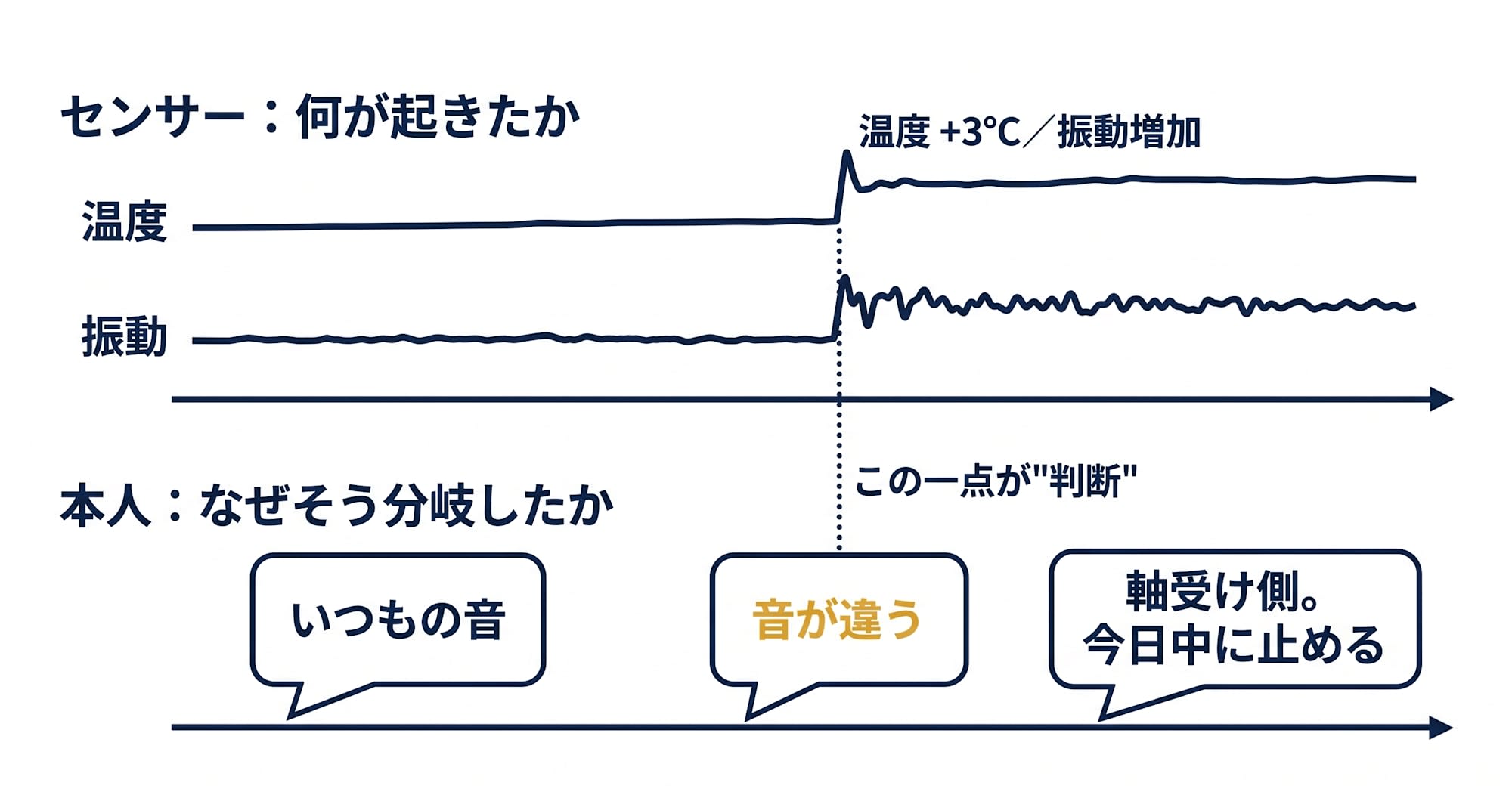
When you ask a veteran on the floor "why did you stop it?", the answer comes back: "the sound was different from usual." Abnormal noise, vibration, smell, temperature, tactile feedback. These are clear signals to the person themselves, but they're invisible from the outside, and even the person finds them hard to put into words.
What makes this even trickier is that it's not the sensory experience itself but "how that sensation was interpreted and how a decision was branched from it" that holds the value. Even when hearing the same abnormal sound, a newcomer brushes it off as "probably nothing," while the veteran decides "this is coming from the bearing side, so we stop today." In practice, what actually works is the cross of embodied knowledge (sensory input) × cognitive knowledge (interpretation and branching).
How Has Humanity Approached Tacit Knowledge? (5 Pathways)
Attempts to extract tacit knowledge can broadly be organized into 5 pathways. Each has its own inherent limitations.
- ① Self-reporting: interviews, think-aloud protocols, reverse questioning → Limitation: behavior is invisible
- ② Behavioral measurement: video, eye-tracking, sensors → Limitation: judgment is invisible
- ③ Shared experience: apprenticeship, OJT → Limitation: does not scale
- ④ Trace-back inference: estimation from logs or imitation learning → Limitation: requires large amounts of data / individual characteristics don't emerge
- ⑤ Collective emergence: Delphi method, peer review → Limitation: individual depth doesn't emerge
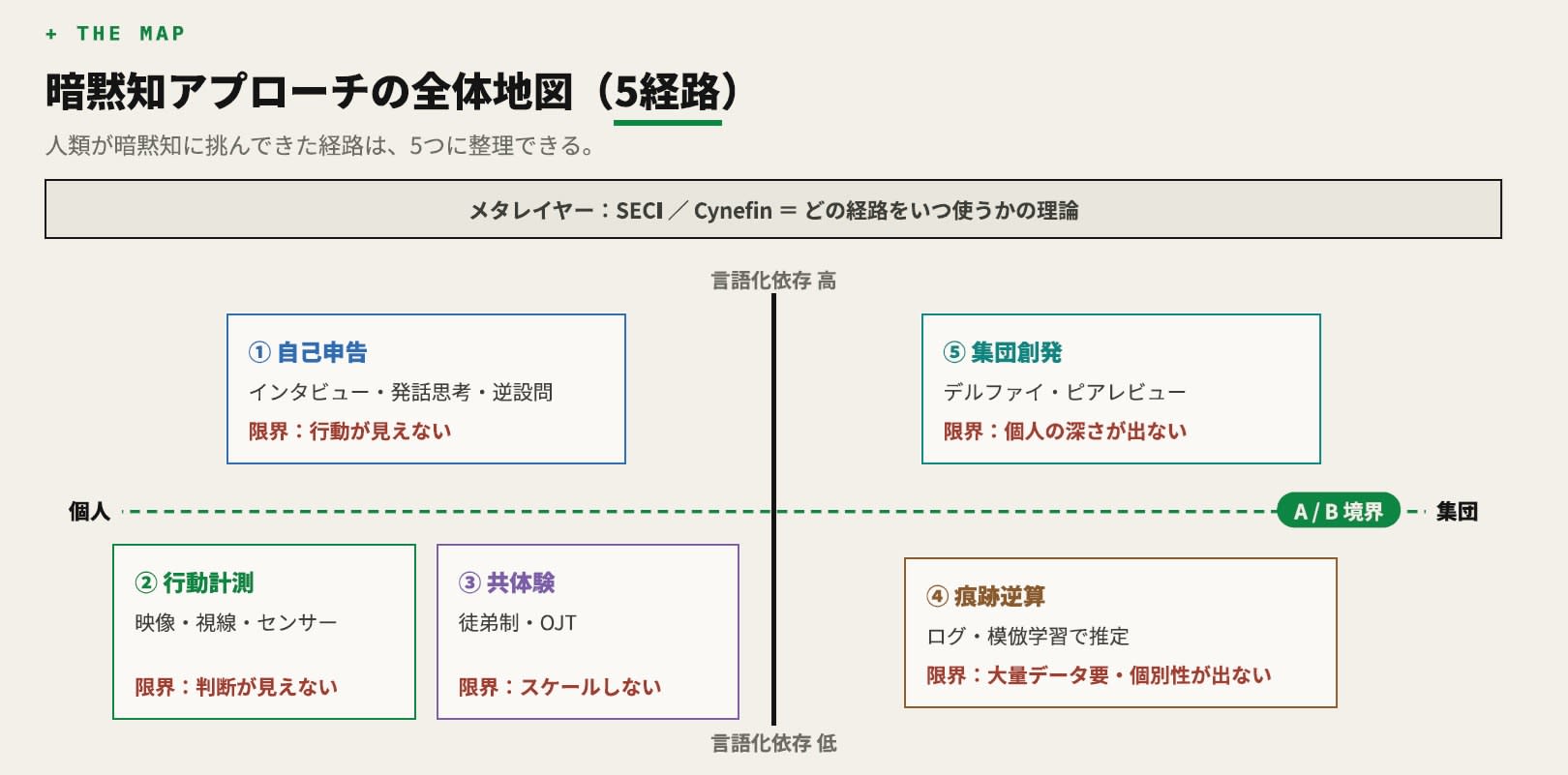
What I want to highlight is that ① and ② have exactly inverse limitations. Asking alone makes behavior invisible; measuring alone makes judgment invisible. Skilled judgment involving sensory experience falls precisely into the overlapping gap between these two blind spots.
Why "Just Asking AI" Cannot Capture Sensory Experience
There are two reasons.
First: AI only receives language. As long as input arrives as text or speech, what the model can handle is "a verbally reported account of a sensation," not the sensation itself. There is an unbridgeable gap between the six characters that spell "a slightly burnt smell" and the actual smell that rises in the air.
Second: The person themselves has not verbalized it. Skilled practitioners are not comparing options and choosing — the first move emerges the instant they perceive a situation (Gary Klein's RPD model from cognitive psychology). Because judgment is automated, it cannot be retrieved through introspection, and what surfaces when asked "why?" tends to be a post-hoc explanation. This tendency is especially strong for judgments rooted in sensory experience.
That is why simply "interviewing veterans and feeding the results into AI" leaves the entire sensory layer missing.
So How Do We Capture It? — Combining Sensors and Questions
The practical solution is to combine pathways.
For embodied knowledge, capture it with machines rather than human senses. Abnormal sounds go to vibration and acoustic sensors; temperature to thermocouples and thermal cameras; operations to equipment logs. Anomaly detection that humans were watching over with a vague sense of "something feels off" is replaced by measurement. This is a job for sensing and data infrastructure, not for AI's language capabilities.
For cognitive knowledge, fire it up with real cases and ask. Rather than "why?", ask questions like "If you were handing this off to a newcomer, what would you tell them to look at first?" — grounding the question in actual projects and actual trouble. The harder cases where judgment diverges are precisely where each person's unique decision branching appears. This approach has about 40 years of validation in military command, firefighting, and emergency medicine, and belongs to the lineage of CDM (Critical Decision Method).
Then bring both together. The sensor shows "at that moment, the temperature rose by 3 degrees," and the person says "that's when I pushed / waited." Data that holds no meaning on its own comes alive as a judgment the moment they are overlaid.
Constraints When Bringing This to the Floor
Even if the design is sound, it means nothing if it doesn't work on the floor. When I discussed this with internal members who are actively observing manufacturing sites, the following constraints came up.
- No devices allowed: bringing PCs or smartphones into work areas is restricted
- Unfamiliarity with input: we cannot assume operators use chat UIs on a daily basis
- High turnover: on floors where departures and rotations are rapid, even keeping manuals up to date falls behind
- Data is delayed: operation reports are on paper or in Excel, with updates reflected the following day — unusable for real-time decisions
Therefore, "just hand out AI chat and call it done" won't work. A design is needed that pushes measurement to the machine side and minimizes what humans are asked to input — for example, limiting it to a few minutes of voice response once a week. Building a system that sustains ongoing input can have more impact than model accuracy.
Where ghoost Excels, and Where It Doesn't
Let me draw an honest line here. ghoost is a service that draws out unverbalized judgments together with the person themselves and preserves them within the organization. It is strong in domains where judgment can be put into words — such as PC-based work and office tasks, like a salesperson's instincts for sizing up a prospect, design policies, or the key points of an assessment.
On the other hand, detecting abnormal machine sounds or temperature changes themselves is outside ghoost's scope. That is work for sensors and data infrastructure, and it should not be forcibly substituted with a language model. If you are tackling tacit knowledge on the manufacturing floor, the natural design is to divide responsibilities between measurement (embodied knowledge) and ghoost (cognitive knowledge).
The term "digital twin" also warrants caution. There are contexts where it refers to a physical reproduction of equipment, and contexts where it refers to reproducing a person's judgment, and discussions often proceed with misaligned expectations. Simply aligning which of the two you are talking about from the start can change the success rate of a project.
Frequently Asked Questions (FAQ)
Q. Can't multimodal AI handle smells and sounds?
A. Sound and images have become increasingly viable as inputs, but that means "sensor-captured data is being passed to AI." In other words, sensors do not become unnecessary. It is appropriate to think of the means of capturing and the means of interpreting as separate things.
Q. What is ghoost?
A. An AI agent service that draws out the unverbalized judgments of veterans and key individuals together with the person themselves, preserves them within the organization, and reproduces their judgment. Rather than storing documents, it elicits judgment from the person directly.
Q. Does this mean it can't be used in manufacturing?
A. Not at all. It is effective in domains where judgment can be put into words — such as troubleshooting policies when defects occur, approaches to prioritization, and interactions with business partners. The practical approach is to leave equipment anomaly detection to the measurement side and combine them with clearly divided roles.
Summary
- Skilled judgment contains sensory elements (temperature, smell, sound, touch), and AI alone cannot replicate the sensory experience itself.
- Among the 5 pathways for tacit knowledge, ① self-reporting makes behavior invisible, and ② behavioral measurement makes judgment invisible. Judgment involving sensory experience falls into the overlap of both blind spots.
- Therefore, embodied knowledge is captured through sensors and logs, and cognitive knowledge is elicited by firing it up with real cases. Only by bringing both together does it survive as preserved judgment.
If you have the challenge of "wanting to preserve that person's judgment within the organization," please take a look at the ghoost service page as well.
References (Background)
- M. Polanyi, The Tacit Dimension (1966)
- Ikujiro Nonaka & Hirotaka Takeuchi, The Knowledge-Creating Company (1996)
- G. Klein, Sources of Power (1998) / Klein, Calderwood & MacGregor (IEEE Trans. SMC, 1989) / Crandall, Klein & Hoffman, Working Minds (2006)