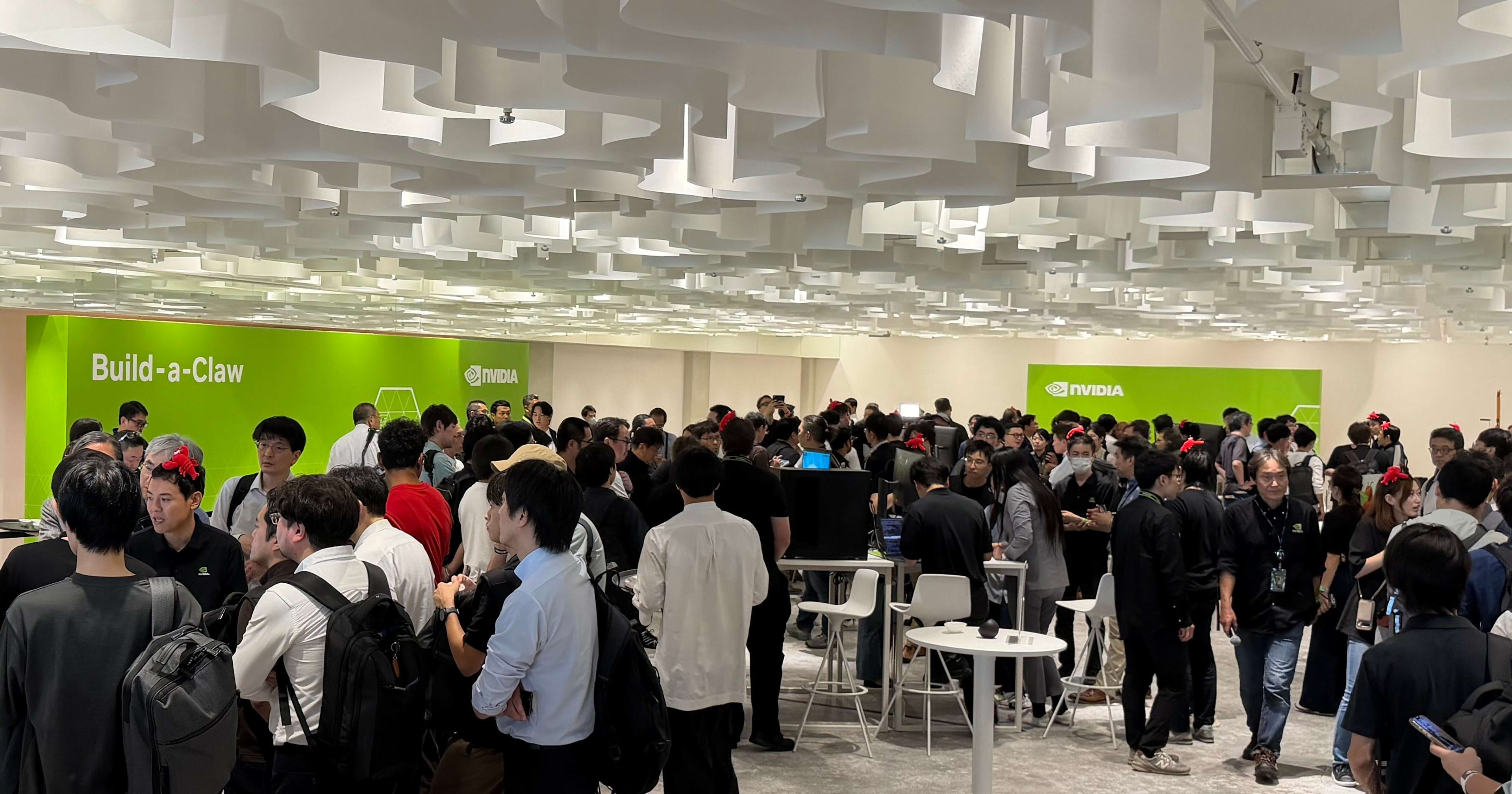
I attended Build a Claw Tokyo, where Jensen Huang, the CEO, also made a surprise appearance.

This page has been translated by machine translation. View original
Introduction
Hello, I'm Morishige from Classmethod's Manufacturing Business Technology Department.
On July 15, 2026, I attended "Build a Claw Tokyo," a community event hosted by NVIDIA. The name "Claw" in the event title comes from OpenClaw, a trending open-source autonomous AI agent, and NemoClaw, NVIDIA's enterprise edition that packages it together with a secure runtime. The event's theme was "meeting people who are actually trying, learning, and building these agents," and it was structured around three tech talks, a live demo, and networking.
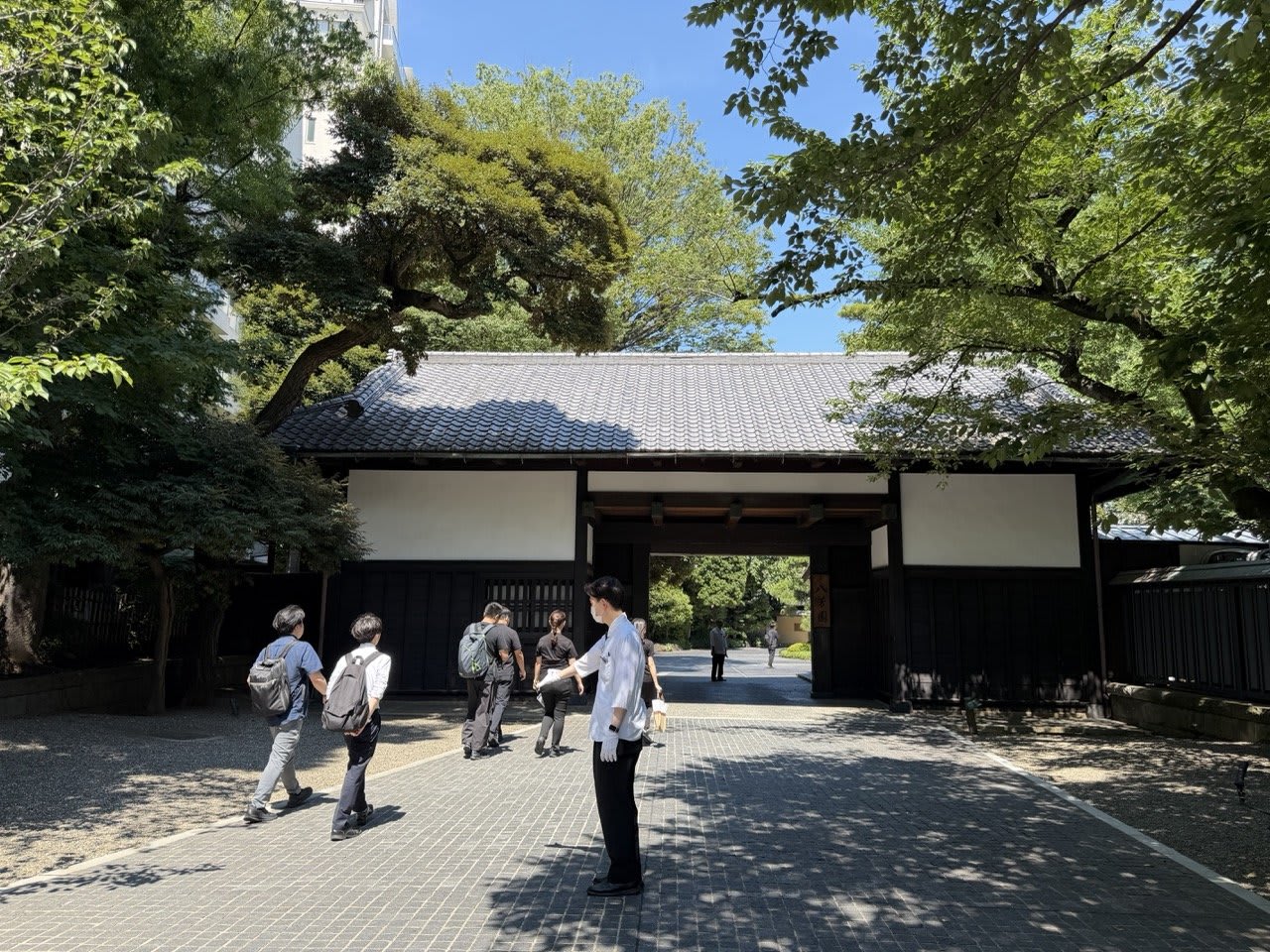
The venue was Happo-en in Shirokanedai. The first thing that surprised me upon arrival was the sheer number of people. There were even reports of a 45-minute wait in the entry line. While each demo originally had a capacity limit of about 5 people, the queue kept growing, and at some point they switched to running the demos without restrictions—that's how much energy there was. Then, in the second half, CEO Jensen Huang made a surprise appearance as a special guest, making this feel like anything but a weekday evening community event.
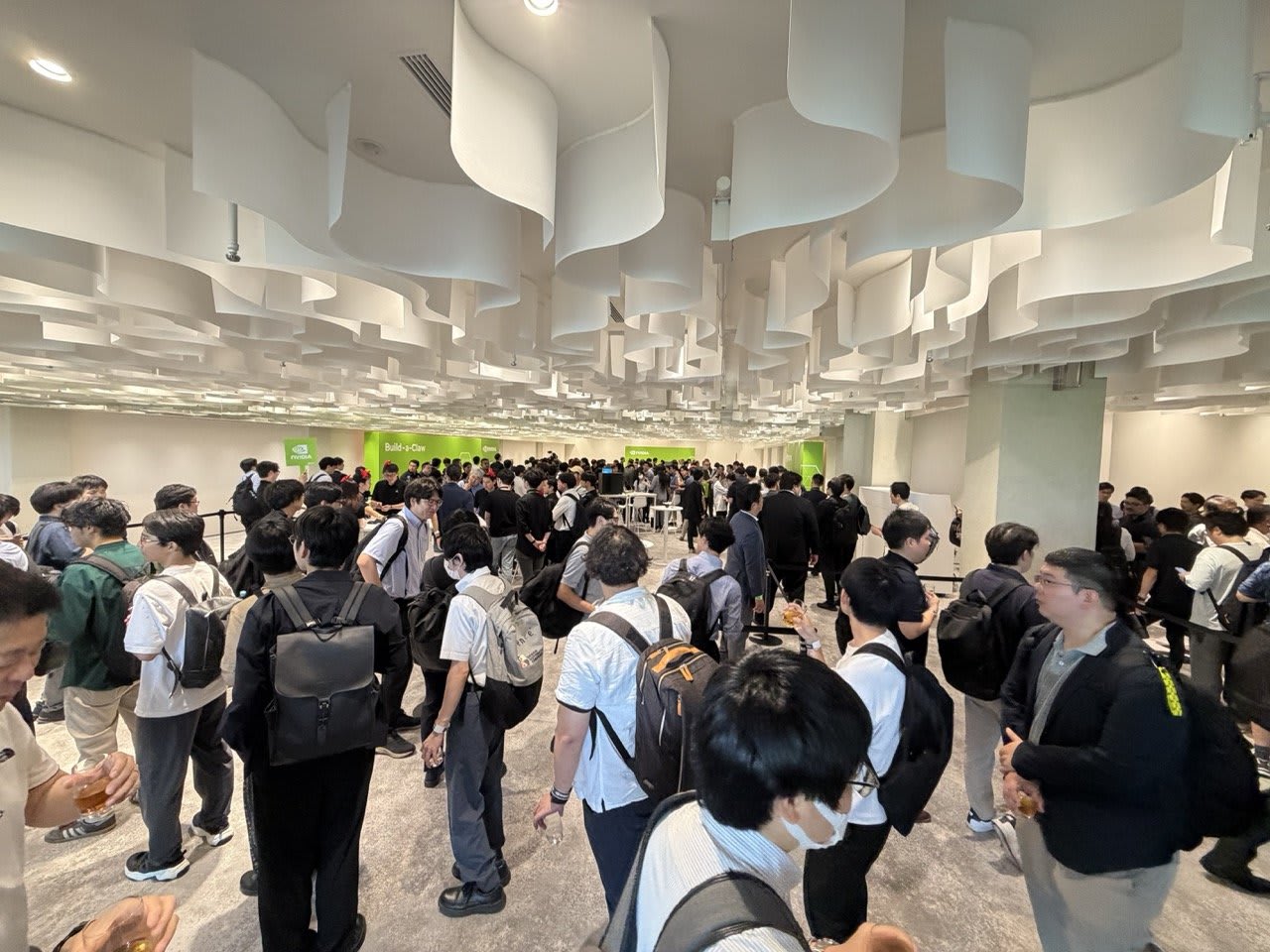
In this article, I'll summarize the key points from the three tech talks, Jensen Huang's appearance, and the SOP Monitoring Blueprint exhibit that caught my attention the most, as my event participation report.
Event Overview
Here are the basic details of the event.
- Date: Afternoon of July 15, 2026
- Venue: Happo-en (Shirokanedai, Tokyo)
- Organizer: NVIDIA
- Structure: 3 tech talks (15:00–16:00) + live demo (14:00–18:00) + networking
The tech talks consisted of three 20-minute sessions.
| Session | Speaker | Main Topics |
|---|---|---|
| The AI Agent Era Begins | NVIDIA's Kenji Tanaka | Nemotron 3, NVIDIA Agent Toolkit, OpenShell, NeMo Switchyard |
| On the Frontlines of Physical AI Development | NVIDIA's Ken Arai | Data Factory, Cosmos 3, OSMO, Isaac, FOX |
| From Demo to Business System | Fixstars' Yoh Sato | Deploying agents in the enterprise, designing autonomy and reliability, leveraging NemoClaw |
After the sessions, there was time for demo exhibits and networking, followed by a surprise guest appearance and a raffle around 5 PM. Let's go through each of them.
"The AI Agent Era Begins": An Overview of Nemotron and Agent Toolkit
The first session was by Kenji Tanaka, Senior Developer Relations Manager for Generative AI at NVIDIA Japan. He started by reviewing the progression from ChatGPT in 2022, to the opening up of reasoning with DeepSeek in 2025, and then the emergence of long-running, self-evolving agents represented by OpenClaw in 2026, framing the current moment as "when LLMs and harnesses have finally started working in tandem." A harness is the layer that repeatedly processes LLM inputs and outputs, inserting tools along the way to observe results, enabling extended trial-and-error toward a goal. The positioning was that we've now entered an era where anyone can build open agents on their own.
Against that backdrop, he introduced the NVIDIA Agent Toolkit for Enterprise, a reference architecture for building business-specific agents. It brings together NemoClaw as the agent execution environment, OpenShell as the secure runtime foundation, a suite of skills including AI-Q and cuOpt, and the open model Nemotron as the brain—all available openly. The demo showed the flow from a one-command installation to an agent launching in a Claude Code-like CLI interface, backed by the open model Nemotron 3 Ultra. Examples given for the demo of supplying a goal via the /goal command and having it run autonomously for extended periods included implementing Andrej Karpathy's nanochat and automated research for model optimization—that left quite an impression.
Nemotron 3, the open model serving as the agent's brain, comes in three sizes—Ultra (550B-A55B), Super (120B-A12B), and Nano (30B-A3B)—plus vision-oriented Omni, speech, and safety variants, with the flagship being Nemotron 3 Ultra announced in June. He was candid about its strengths in agent productivity, instruction-following, and deep-reasoning tasks, while acknowledging some shortcomings in coding. The efficiency gains come from a deep understanding of GPU architecture, and compared to open frontier-class models like Kimi K2.6 (1T), GLM-5.1 (744B), and Qwen3.5 (397B), inference speed is 5x faster and cost per task completion is reduced by up to 30%.
On the security side, OpenShell was introduced as a runtime that sandboxes the agent and controls ingress/egress through a gateway whitelist. The context was that no matter how intelligent a model is, prompt injection and jailbreaks can still be attempted, so enterprises need a governance mechanism if they're going to use agents. It's worth noting that OpenShell isn't exclusive to NVIDIA agents—it can also be used alongside other agents like Codex.
NeMo Switchyard was also mentioned in the context of cost optimization. The idea is to have expensive frontier models handle only the planning, while delegating execution to a local Nemotron instance. It was introduced with the comment, "Claude Code has gotten pretty expensive lately, hasn't it?" I've previously written a first-touch article on Switchyard myself, so feel free to check it out if you're interested (written as of July 3, 2026).
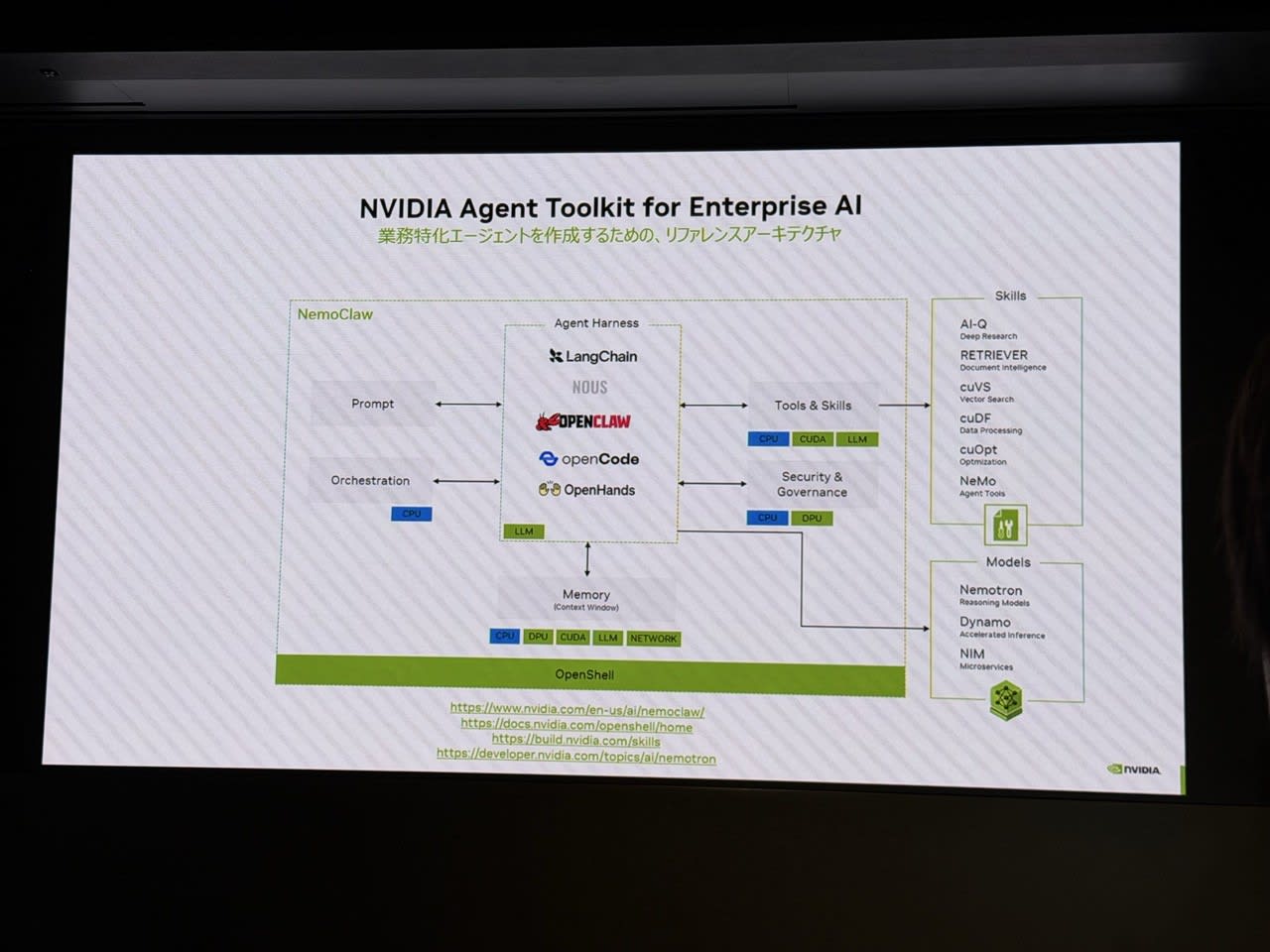
The overall picture of NVIDIA Agent Toolkit. Within the NemoClaw frame, harnesses such as LangChain and OpenClaw are listed as swappable components, with OpenShell as the foundation, and skills and models including Nemotron on the right.
"On the Frontlines of Physical AI Development": Cosmos and Isaac in the Spotlight
The second session was by Ken Arai, Senior Manager of Robotics Developer Relations at NVIDIA Japan, covering physical AI. He started by organizing the concept of VLA (Vision Language Action)—which takes vision and language as inputs and generates actions—and its expansion into autonomous driving, infrastructure, robotics, and healthcare. He then outlined the direction of "aiming to combine the best of Japan's traditionally strong specialist-type automation with the generalist-type flexibility of VLA."
The first challenge raised was data. Real-world data is scarce and costly, and even when simulation is used to supplement it, physical AI doesn't have access to anything comparable to the web-scale data that LLMs benefit from. NVIDIA's answer to this is an approach built around the motto "Compute is Data"—generating and augmenting data through computation—embodied in the Physical AI Data Factory. OSMO, a workflow orchestration tool, and Cosmos, the world foundation model, were introduced as its core components.
OSMO is an open-source framework for building, testing, and validating physical AI that lets you describe and execute workflows spanning different computing environments—simulation, training, and edge—in a single YAML file. There was also mention of using coding agents like Claude Code or Codex to handle construction and operations, which gave a sense that agentic AI and physical AI are part of a continuum. For Cosmos, the session covered Cosmos 3, announced at GTC Taipei in June, describing it as an omni model with a Mixture-of-Transformers architecture combining autoregressive and diffusion models, capable of freely mixing and matching text, images, video, audio, and actions as inputs and outputs. The vision is for a single model family to cover video reasoning, background replacement, future frame prediction, and robot policy learning. The example of generating rare hazardous events like children running into traffic as training data for autonomous driving was a particularly clear illustration of where world models are useful.
For manufacturing, the NVIDIA Factory Operations Blueprint (FOX) was introduced as a reference blueprint described as giving factories an AI brain. In contrast to shop floors that have traditionally built up precise rule-based designs and local optimizations cell by cell, the approach here has agents discovering and integrating systems within the factory and taking on cell management, with skills available for video analysis, defect image generation, and digital twin construction from CAD data (CAD-to-SimReady). Compute resources were framed across three scales—DGX Spark for small factories, DGX Station as the core, and GB300 NVL72 for large-scale multi-plant deployments—but the addition of "it's fine to start with whatever environment you have on hand" felt refreshingly honest.
The robotics development side was covered more quickly. Isaac Sim 6.0 has gone GA, with MCP server integration and a revamped physics engine. What personally caught my attention was Newton, the physics engine available in Isaac Lab 3.0 (still in beta) for robot learning, developed jointly with Google DeepMind and Disney Research, capable of simulating the behavior of particles and soft bodies. Other items mentioned included Isaac SIL for in-software testing before real-world deployment, and Isaac GR00T, a humanoid foundation that uses Cosmos Reason for the rational decision-making component—and once again, Cosmos makes an appearance. There was also a note that agent skills for physical AI are growing on build.nvidia.com's Agent Skills section, so I plan to browse through that later.
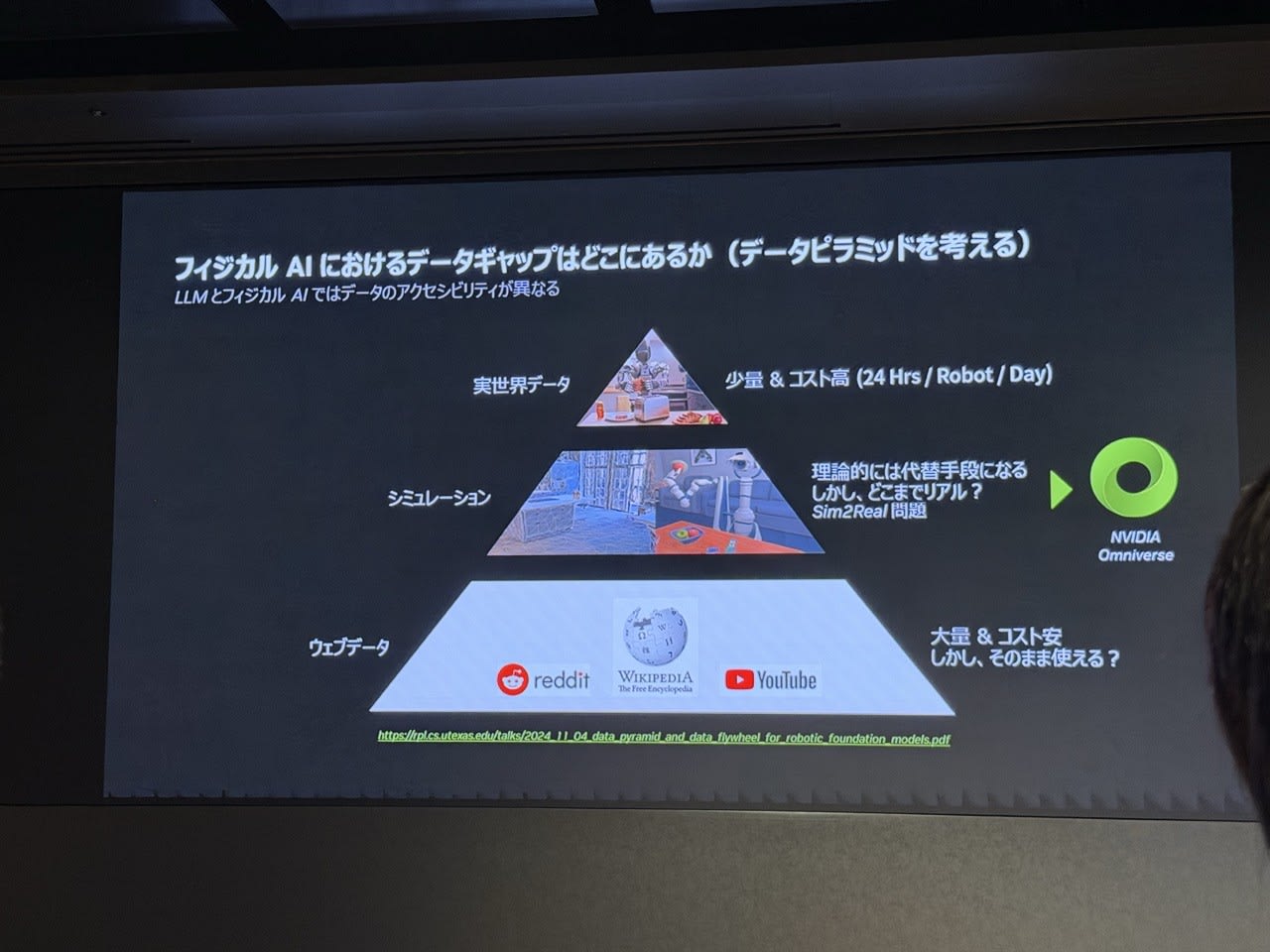
The data pyramid slide. Real-world data at the top is scarce and expensive (24 Hrs / Robot / Day), simulation in the middle still has the Sim2Real problem, and the challenge at the base is whether web data can be used as-is.
Fixstars on "From Demo to Business System"
The third session was by Yoh Sato of Fixstars Corporation, an NVIDIA partner, titled "From Demo to Business System: Enterprise AI Agent Design in the NVIDIA NemoClaw Era." The key message was delivered upfront: the key to evolving AI agents from demos to business systems lies not in the agents themselves, but in the system design that supports their autonomy. The core challenge for agents has shifted from intelligence to reliability—the cleverness of inferring 10 things from 1 translates directly into risk in a business system context. While a demo only needs to work once, a business system needs to keep working, and that requires authority management, policies, failure handling, and auditability.
On the practical side, he used a co-developed ERM (Enterprise Risk Management) platform as a case study, describing a combination of three players: agents for interpreting ambiguous requests, workflows for routine processing, and humans for approving critical operations. He then noted that approvals alone can't prevent incidents like API key leaks, which is why they adopted NemoClaw and are actually using OpenShell's sandboxing and credential shielding. The framing of NemoClaw not as an agent itself, but as a foundation for letting agents safely exercise autonomy, resonated with me. There were also plenty of design insights to take away: guardrails can only protect against anticipated scenarios, and reducing unanticipated scenarios is the designer's job; leakage of information fed into prompts can't be reduced to zero, so the question is whether the risk is one you can accept.
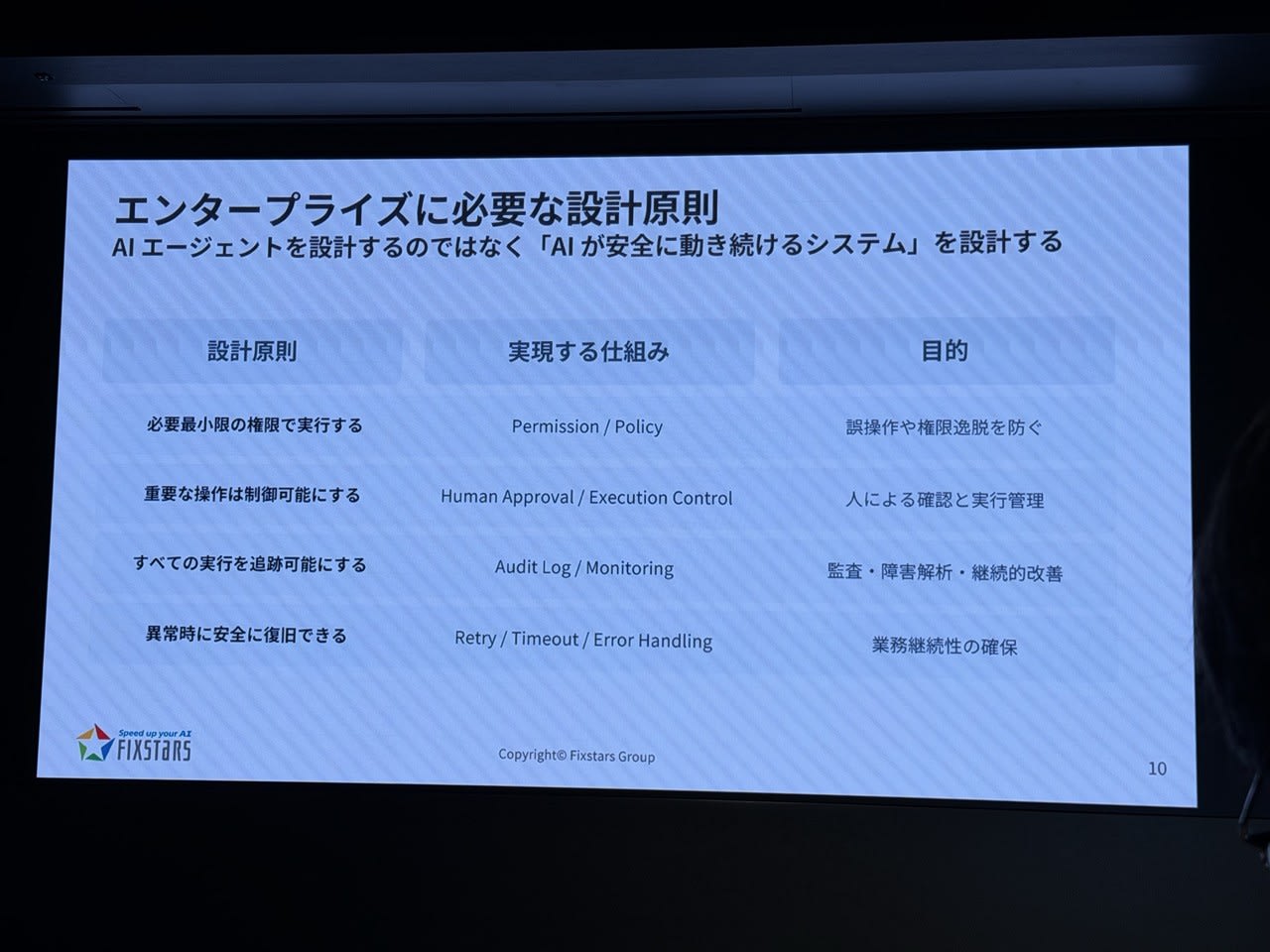
The slide on design principles required for the enterprise. The four principles—least privilege, control over critical operations, execution tracing, and recovery from anomalies—are organized with the mechanisms and objectives that realize each one.
CEO Jensen Huang's Surprise Appearance
Midway through the demo time after the sessions, an announcement came in: "A special guest is on their way from Akihabara." Without ever revealing who it was, the person who appeared around 5 PM was none other than CEO Jensen Huang himself.
Finally useful. After working on AI for 15 years, AI is now useful.
The speech that began with this single line—that after 15 years of working on AI, it has finally become useful—centered on "personal AI." Forty years ago, the personal computer revolution began, and 40 years later, everyone will be able to have their own personal AI in place of a personal computer. That's why he was glad to meet everyone here building their own agents.
He then picked up a DGX Spark. As a personal AI supercomputer in the lineage of the original DGX-1 from 2016, he described it as "a baby version but with nearly equivalent performance—128GB, 1 petaflops, NVFP4." He also shared the origin story of the first DGX-1: when it was built, there was no demand for AI and zero customers. The only "customer" was his friend Elon Musk, who despite being wealthy asked to have the first unit donated. And that donation went to OpenAI, which at the time was a nonprofit. As someone who works daily with a DGX Spark on hand, hearing this backstory directly from the man himself was a genuinely moving experience.
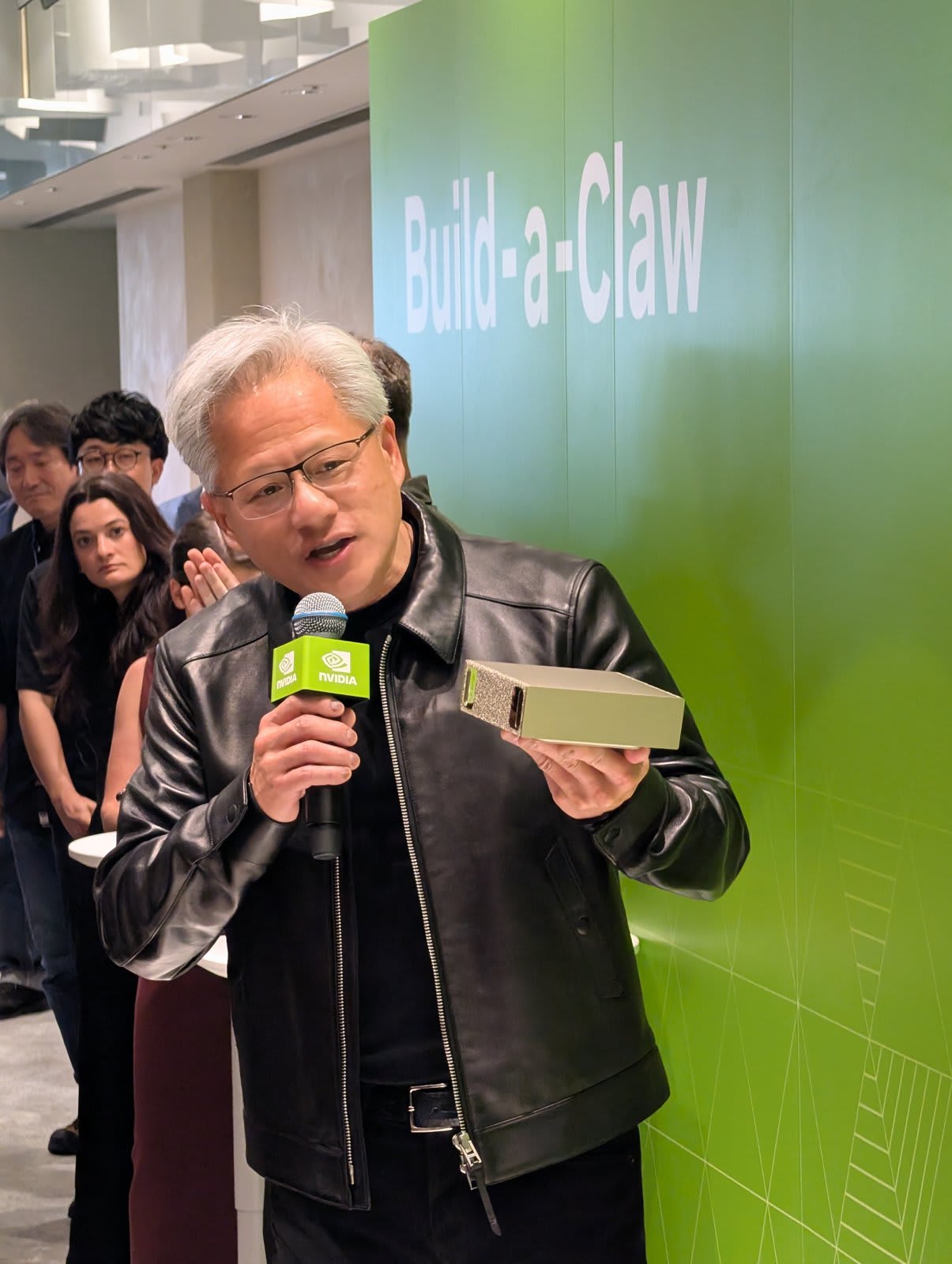
CEO Jensen Huang talking about "personal AI" with the actual DGX Spark in hand. In his trademark leather jacket, being able to see him at this close a distance was something only possible at a community event.
The speech closed with a raffle for a signed DGX Spark. Two winners were announced, and Jensen himself handed over the boxes. As for me—I didn't win, unfortunately. I did manage to record a video right in front of him, so I'll count that as a win.
The SOP Monitoring Blueprint That Caught My Eye Most at the Exhibits
The demo exhibits featured nine setups, ranging from "Getting Started with Claw Agents" for beginners, to browser operation via OpenClaw on DGX Spark, live control of Isaac Sim by a Claw agent, a Unitree G1 humanoid combined with Cosmos 3, and voice-based multimodal model personalization by SB Intuitions—a wide-ranging lineup. Among them, as someone who handles manufacturing projects, the one I spent the most time at was the SOP Monitoring Blueprint exhibit.
SOP (Standard Operating Procedure) refers to standardized work procedures in manufacturing and similar settings. In the demo, a video of work being performed is fed in, analyzed by a VLM, and the work steps appear timestamped along a video timeline in the UI. These are then cross-referenced against the proper procedure defined in advance on the blueprint side (9 steps in the demo), structurally determining missing parts or incorrect order as OK/NG. When I asked at the booth, I was told that even when a video of a different worker performing the task is provided, if the correct procedure is followed, it properly recognizes each step in sequence. This demo used pre-recorded video analysis, and streaming real-time analysis depends on machine power. The fact that everything—including the UI and workflow definitions—is published as open source was genuinely surprising.
Looking at the repository after returning home, it's not a standalone demo app—it's structured to cover the entire pipeline from training to inference. It's built on two pillars: a training microservice that prepares a SOP-specific VLM and temporal segmentation model, and an inference microservice that performs low-latency inference via DeepStream. These are accompanied by a suite of agentic skills handling everything from data augmentation to fine-tuning and evaluation of Cosmos Reason-based VLMs. The overall workflow looks like this:
The flow involves annotating your own work videos with action start/end timestamps, generating QA pairs from them, and fine-tuning a VLM—meaning you can build a model specialized to your actual shop floor procedures rather than relying on prompting a general-purpose VLM. NVIDIA's NGC model and container distribution catalog has a sample dataset based on server fan and power supply installation work, so you can try it out even without your own videos. The code is licensed under Apache 2.0. Inquiries about verifying "whether work is being performed according to the prescribed procedure" using factory camera footage come up frequently in practice, and having this workflow available as open source feels quite practically valuable.
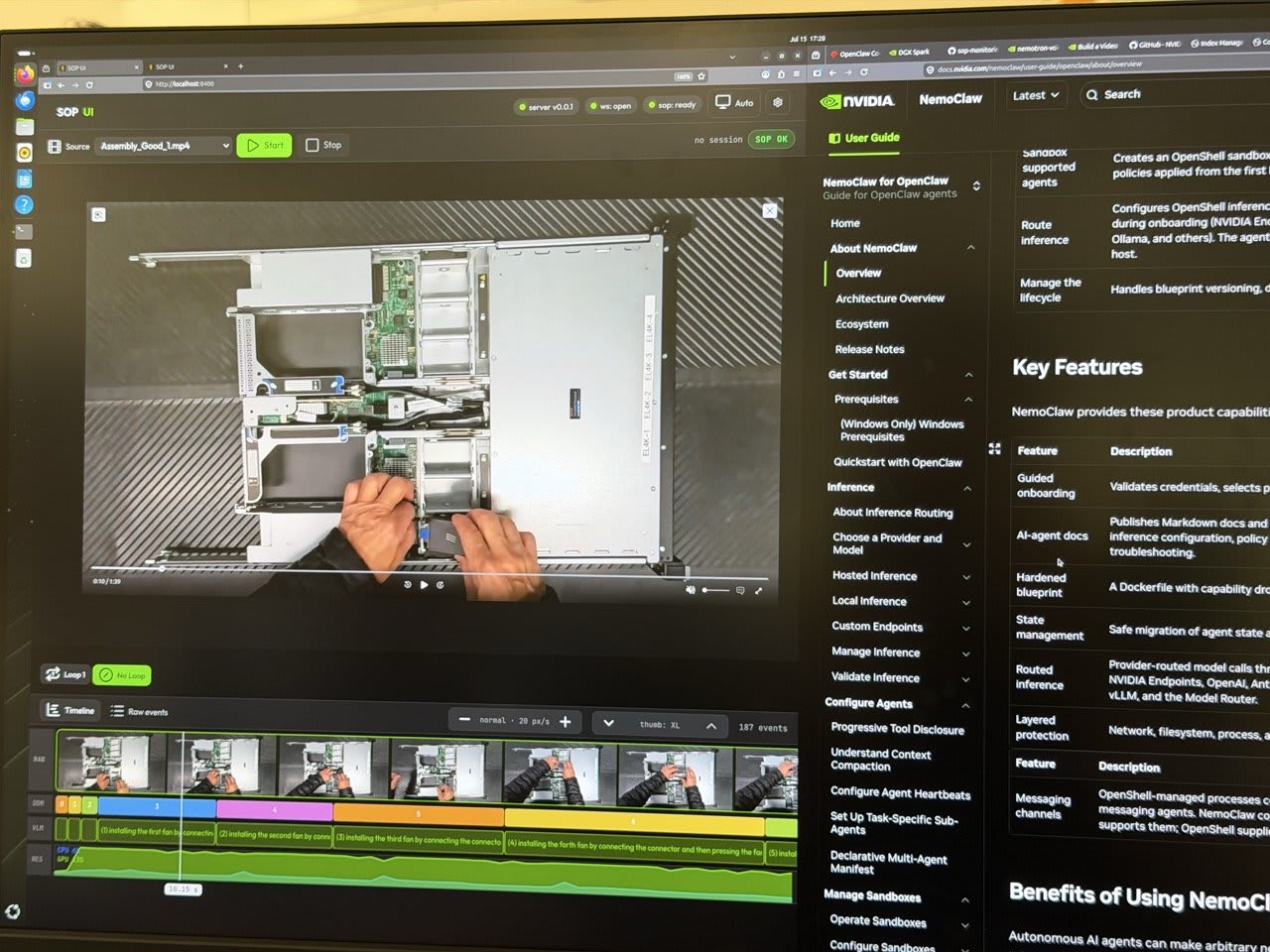
The SOP UI from the demo. A video of fan installation on a server is color-coded and segmented by step along the timeline, with an SOP OK judgment displayed in the upper right.
The DGX Station Unit Was Also on Display
One other thing I personally wanted to see was the actual DGX Station hardware. I have a DGX Spark on hand, but this was my first time seeing a Station in person. It's quite compelling to have the class of machine that was named in Session 2 as the execution environment for FOX sitting right there at the venue. (I forgot to take a photo of it...)
Summary
Across the three tech talks, I was able to get a sweeping overview covering "the current state of agents," "physical AI," and "designing for business system deployment," and it was a dense, rewarding event including the demo exhibits and networking. It was also personally gratifying when, during the closing of the tech talks, Tanaka-san mentioned that a talk session I participated in about OpenShell had been published on NVIDIA Japan's YouTube channel. Above all, being there to witness CEO Jensen Huang himself appear at a community event and speak about personal AI was well worth the trip.