I was selected as a finalist for the Snowflake Community Awards, so I looked back on my content sharing activities so far #Snowflake #SnowflakeCommunity #CommunityAwards

This page has been translated by machine translation. View original
This is Kawabata.
I am honored to announce that I have been selected as a finalist in the "RISING COMMUNITY LEADER OF THE YEAR" category (APJ slot) at the Snowflake Community Awards. This is all thanks to everyone who has been reading my articles. I am truly grateful.
I have also been deeply moved by the many words of encouragement I have received since being selected as a finalist.
I will continue to do my best to share information for all of you who are cheering me on.
In this article, I will look back on my content creation activities so far and introduce the mindset that serves as the foundation for continuing to share information, aimed at those who want to start sharing content.
What are the Snowflake Community Awards?
These are awards that recognize individuals and organizations that contribute to the Snowflake community.
"RISING COMMUNITY LEADER OF THE YEAR" is a category that recognizes emerging contributors who have made a meaningful impact during their first year of involvement in the Snowflake community.
Community voting for finalists is currently underway.
Voting instructions are summarized in the "Request for Votes" section at the end of this article.
Activities I Have Been Involved In
Since joining Classmethod in July 2025, I have continued sharing content focused on Snowflake and the Modern Data Stack space.
- Blog writing: 113 articles on DevelopersIO (as of August 19, 2026). Mainly covering Snowflake new feature verification, data governance, and dbt integration
- Sharing on X and LinkedIn: Announcing article publications and sharing new feature information
- Webinar presentations: Presenting at internal webinars on topics such as basic usage and practical applications of data platform products including Snowflake
- Technical support: Supporting customers in building and utilizing data platforms through presales and implementation assistance
The story of how I reached 100 blog posts in my first year is looked back on in the following article.
Looking Back on My Snowflake Articles
Let me look back on the articles I have published, organized by theme. I hope this serves as a reference for those who are about to start sharing content and are looking for topics.
New Feature Verification
These are articles where I quickly test features that have entered Public Preview or GA, and organize the steps, notes, and limitations.
I am mindful of confirming actual behavior that is difficult to grasp from official documentation alone, and then sharing that information.
Data Governance and Policy Verification
This covers verification related to data governance, including aggregation policies, projection policies, and masking policies.
Recently, I have also been tackling themes that combine AI and governance, such as access control when using AI agents via IS_AGENT_ACTIVATED.
Integration with dbt and Related Services
These are verifications of configurations that combine Snowflake with dbt, Fivetran, Azure Data Factory, and other tools, rather than Snowflake alone.
I am mindful of covering themes that are close to the actual building and operation of data platforms.
Monthly New Feature Summaries and Event Reports
These are monthly summaries of Snowflake new features and changes, as well as event reports from events like Snowflake Summit.
The monthly summaries are a series that also serves as my own way of keeping up with information. Team members take turns writing each month.
I also plan to write an event report for the upcoming Snowflake World Tour Tokyo 2026. Please look forward to it.
Mindset I Value in My Content Creation Activities
Here I will introduce two ways of thinking that serve as the foundation for continuing to share information.
Sanpo-yoshi: Good for Customers, Community, and Myself
"Sanpo-yoshi" is a phrase known for succinctly expressing the spirit of commerce cultivated by Omi merchants.
The concept of "good for the seller, good for the buyer, good for society" is something I reframe in my own case as "good for customers, good for the community, good for myself."
(Source: Higashiomi City Omi Merchant Museum)
In my first-year retrospective article, I touched on my writing approach with a customer-focused perspective. Here I will dig one step deeper.
The starting point is giving my full effort to the work in front of me.
My main responsibilities are presales and technical support, which in abstract terms means "solving what customers want to do and the challenges they face."
When I think about customer challenges every day, my antenna naturally goes up.
"Could this new feature solve that challenge?"
"If we combine it with this product, we might be able to achieve what they want to do."
Insights like these emerge naturally.
Some of those verification results are published as blog posts.
I keep the SQL and execution results from verification as I go, and use them directly as the skeleton of an article.
Customer challenges are often common to other users as well, and I feel that my articles are indirectly helping the community.
Additionally, my own technical skills improve through the process of producing output.
When I try to explain procedures and constraints in an article, I cannot leave anything vague, and the act of writing itself raises the resolution of my verification.
By positioning content sharing not as an activity separate from my main job, but as part of my work — understanding customer challenges, verifying solutions, and improving the quality of my next support — I am able to continue sharing information consistently.
In this way, I believe that starting from solving customer challenges and connecting that to both giving back knowledge to the community and improving my own technical skills is the foundation that allows me to keep sharing.
The Appeal of Snowflake Comes Through Because There Is Something to Compare It To
I believe that if you only work with Snowflake, you have no point of comparison, and it becomes truly difficult to convey what makes it good.
It is precisely because I work with and compare other products like Databricks and dbt that I can specifically communicate "it is good because of ○○."
What I am aiming for is not simply introducing new features, but delivering the criteria for making decisions in practical use through verification.
What users are looking for is a means to achieve what they want to do, and Snowflake is ultimately just one of those options.
Keeping this perspective in mind, I will continue to broaden the range of what I can handle and share information that conveys the appeal of Snowflake.
Request for Votes
Community voting is currently being held from Saturday, August 15, 2026 to Tuesday, September 15, 2026.
If the articles I have published have been even a little helpful to you, I would be grateful if you could support me by voting.
The winners are scheduled to be announced at Expedition 2026, to be held in November 2026.
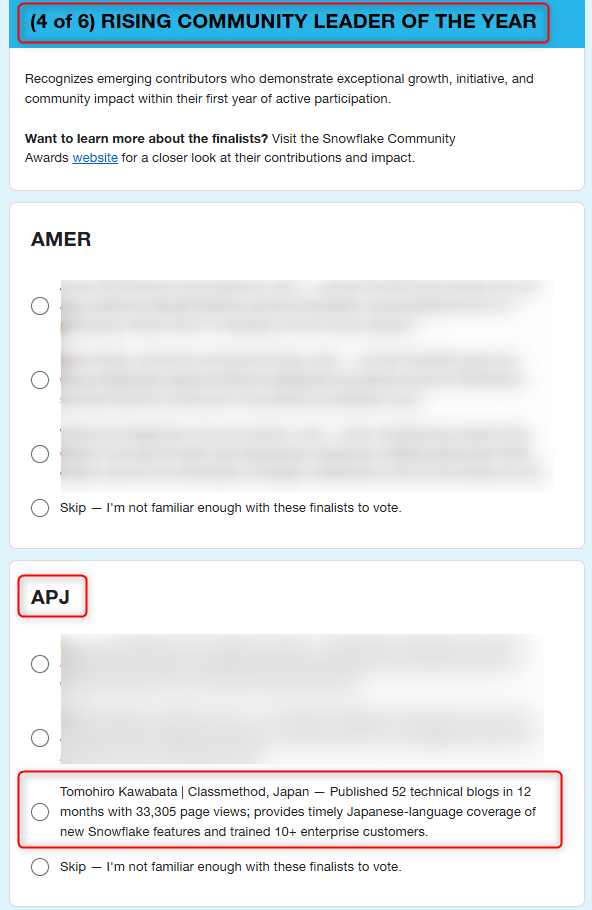
Voting Instructions
Voting is accepted via the Google Form at the URL below.
- Open the voting form and enter your email address
- Proceed to the "(4 of 6) RISING COMMUNITY LEADER OF THE YEAR" section
- Select "Tomohiro Kawabata | Classmethod, Japan" in the APJ slot
- Proceed to the final page and submit the form
[Voting URL]
In Closing
Once again, thank you very much for always reading my articles.
I will continue to share technical information about Snowflake and other technologies in a form that is easy to apply in practice.
I hope this article is helpful in some way!