![[Report] Building a Reliable Semantic Layer from Scratch with Snowflake #SWTTokyo26](https://images.ctfassets.net/ct0aopd36mqt/4kFYCMTvi9ucEtpiAfvm01/b605f81aa314b1fdbc86f8fee275fb43/eyecatch_snowflakeworldtourtokyo2026.webp?w=3840&fm=webp)
[Report] Building a Reliable Semantic Layer from Scratch with Snowflake #SWTTokyo26

This page has been translated by machine translation. View original
This is Kawabata.
"SNOWFLAKE WORLD TOUR 2026 - TOKYO" was held from September 10 to September 11, 2026.
This article is a report blog for the session
[Building a Reliable Semantic Layer from Zero with Snowflake].
※This article contains information about preview features and future roadmap items. Please refer to the latest official documentation for feature availability and usage conditions.
※Statements by the presenters are summarized based on the author's notes.
Presenters
- Shinichi Kawakami
- Snowflake Senior Solution Engineer
The Semantic Layer Is Not a New Concept
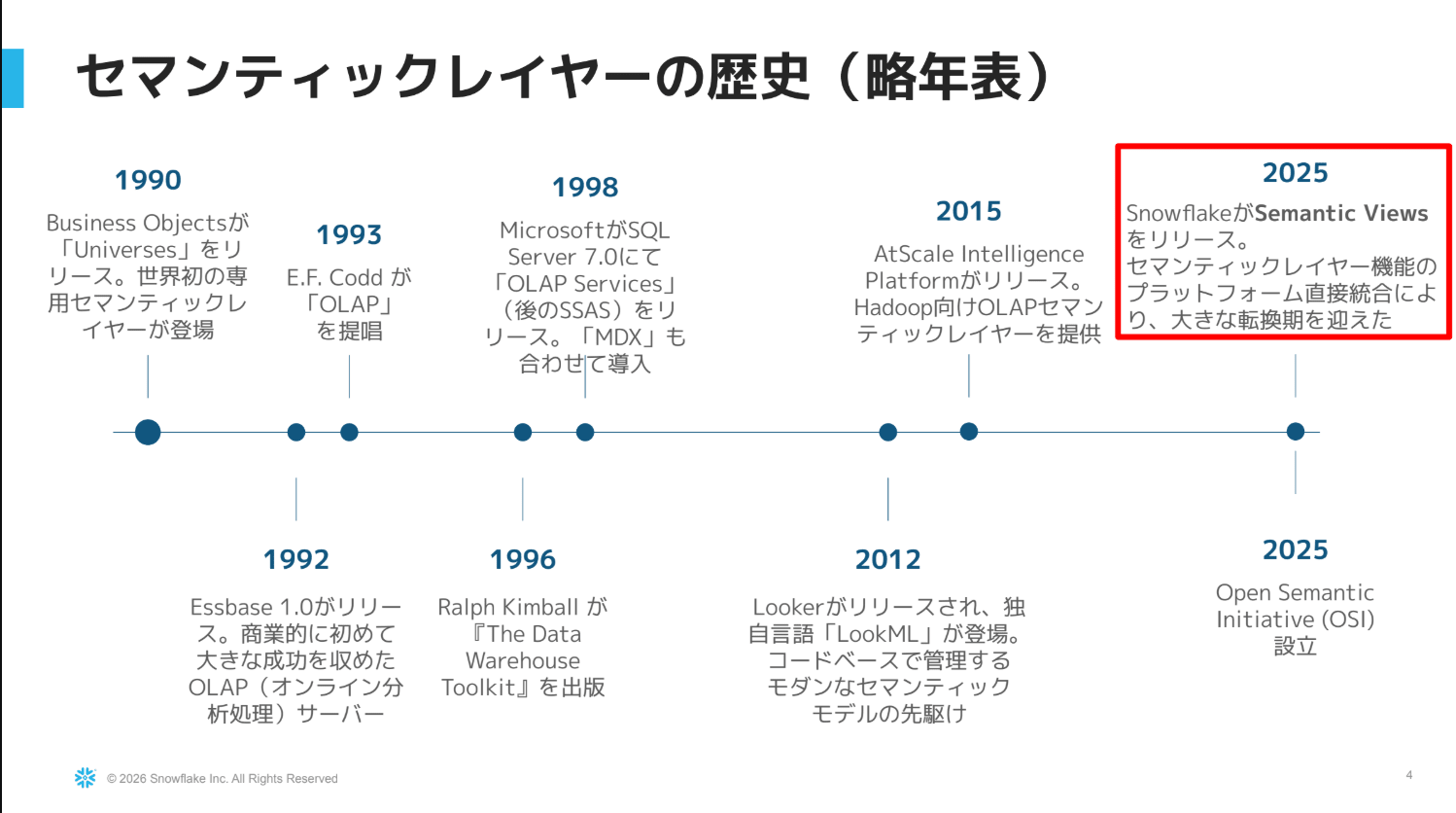
- The semantic layer is a concept that has existed since the 1990s
- It has evolved through BusinessObjects Universe, Essbase, Kimball's data warehouse theory, and Looker's LookML
- LookML made it possible to manage the bridge between physical databases and business users through code
- For over 30 years, the industry has continued to tackle the problem of how to connect complex data structures with business language
- The challenge with traditional semantic layers was that they were features of standalone tools outside the data warehouse
- As a result, definitions were fragmented across tools
- The assessment is that 2025–2026 marks a historic turning point
- Snowflake introduced Semantic Views natively integrated into the platform
- The semantic layer has evolved from a "tool" to "a feature of the data platform itself"
The Context Gap and Centralizing Context
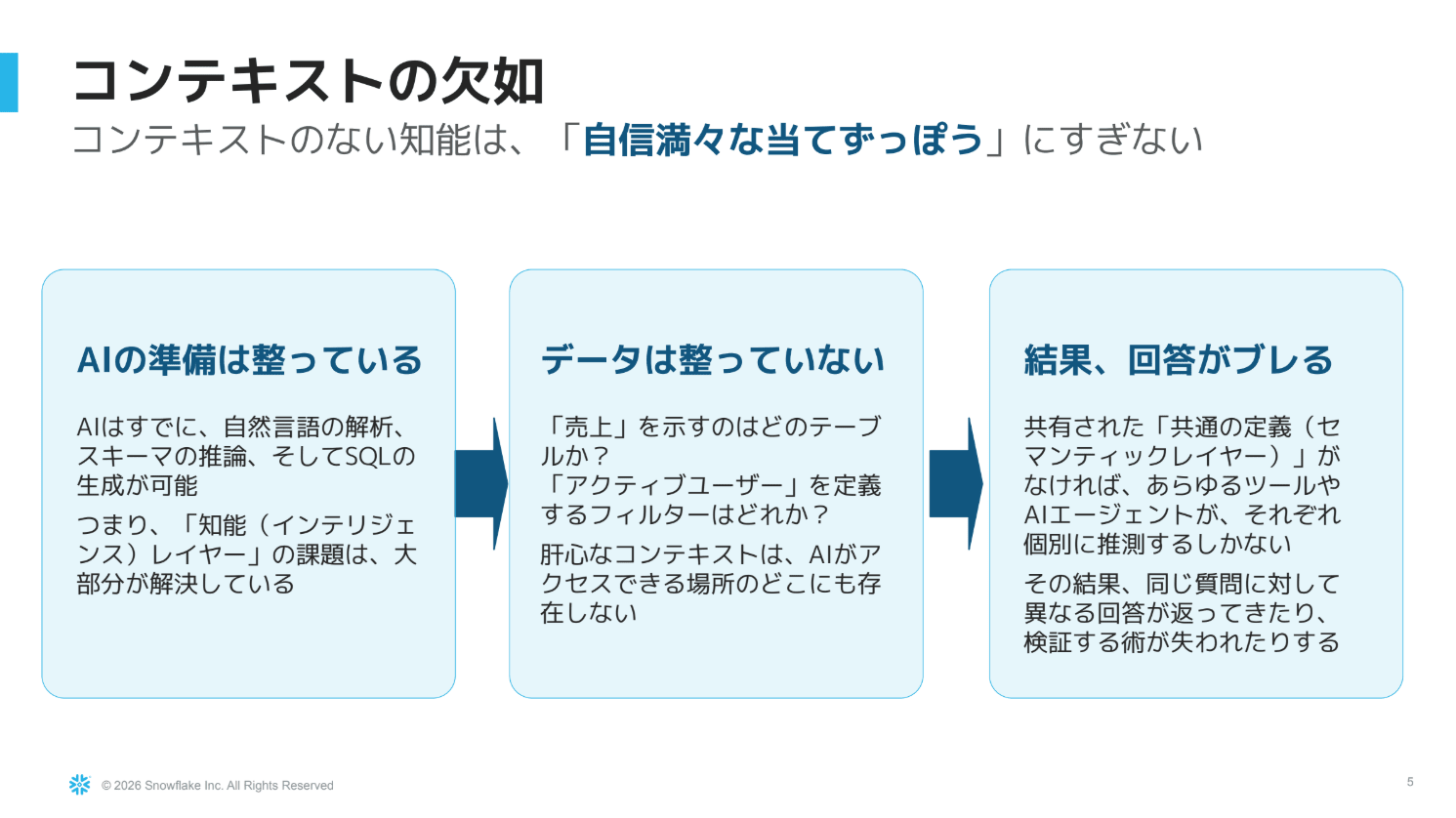
- Why is the semantic layer being talked about so much right now? Because a context gap exists
- Modern AI can generate SQL from natural language. However, the data side lacks business context
- Which table represents true revenue? How should active users be filtered?
- Without shared definitions, AI agents and BI tools each have no choice but to guess on their own
- The same question returns different answers depending on the tool or agent
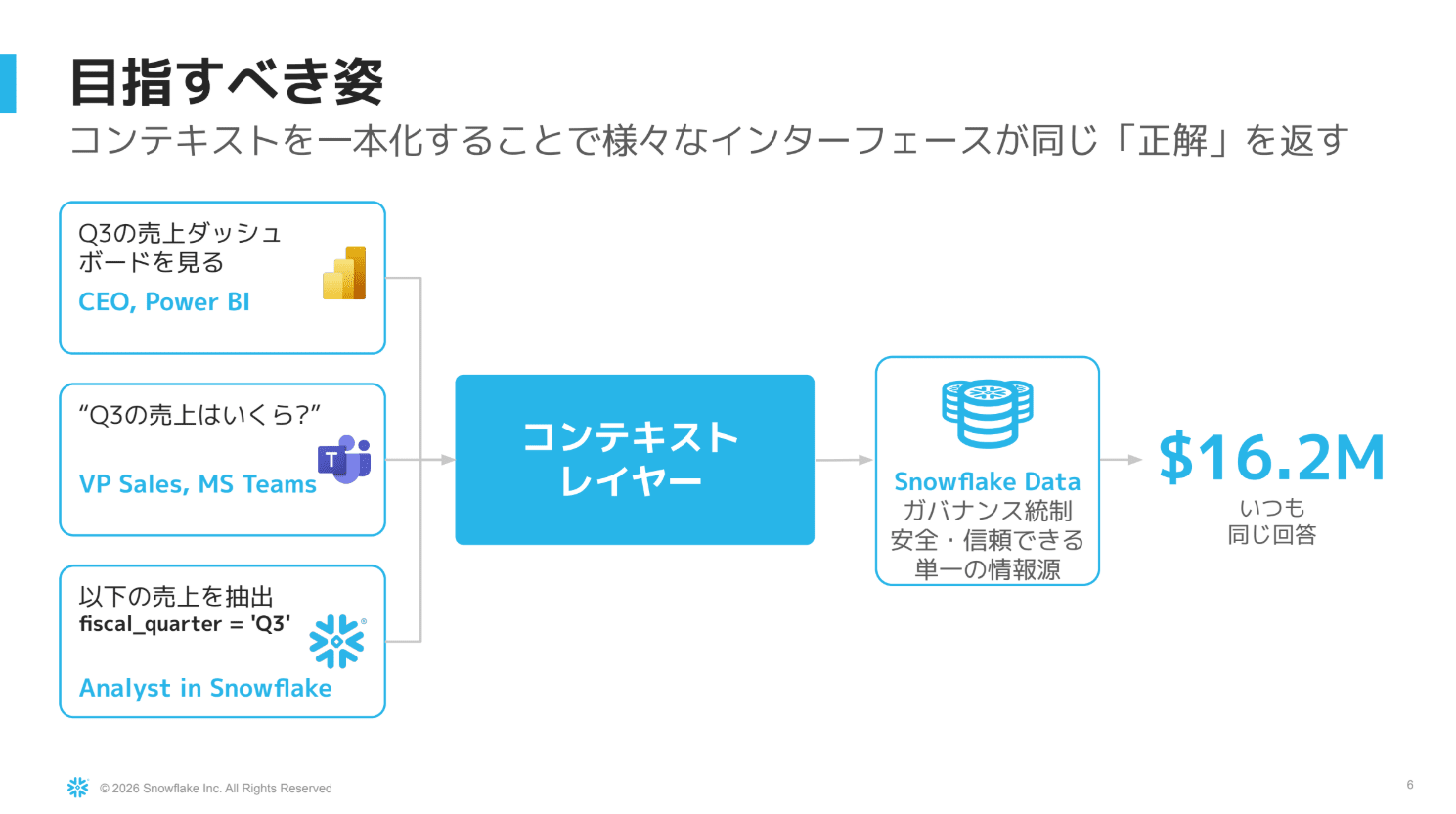
- The goal is centralization of context
- A CEO views Q3 revenue in Power BI, a sales manager views it via chat, and an analyst views it via SQL
- Through a unified context layer, everyone gets the same answer: "16.2 million"
- This is argued to be the single source of truth in the AI era
Snowflake Horizon Context and Semantic Views
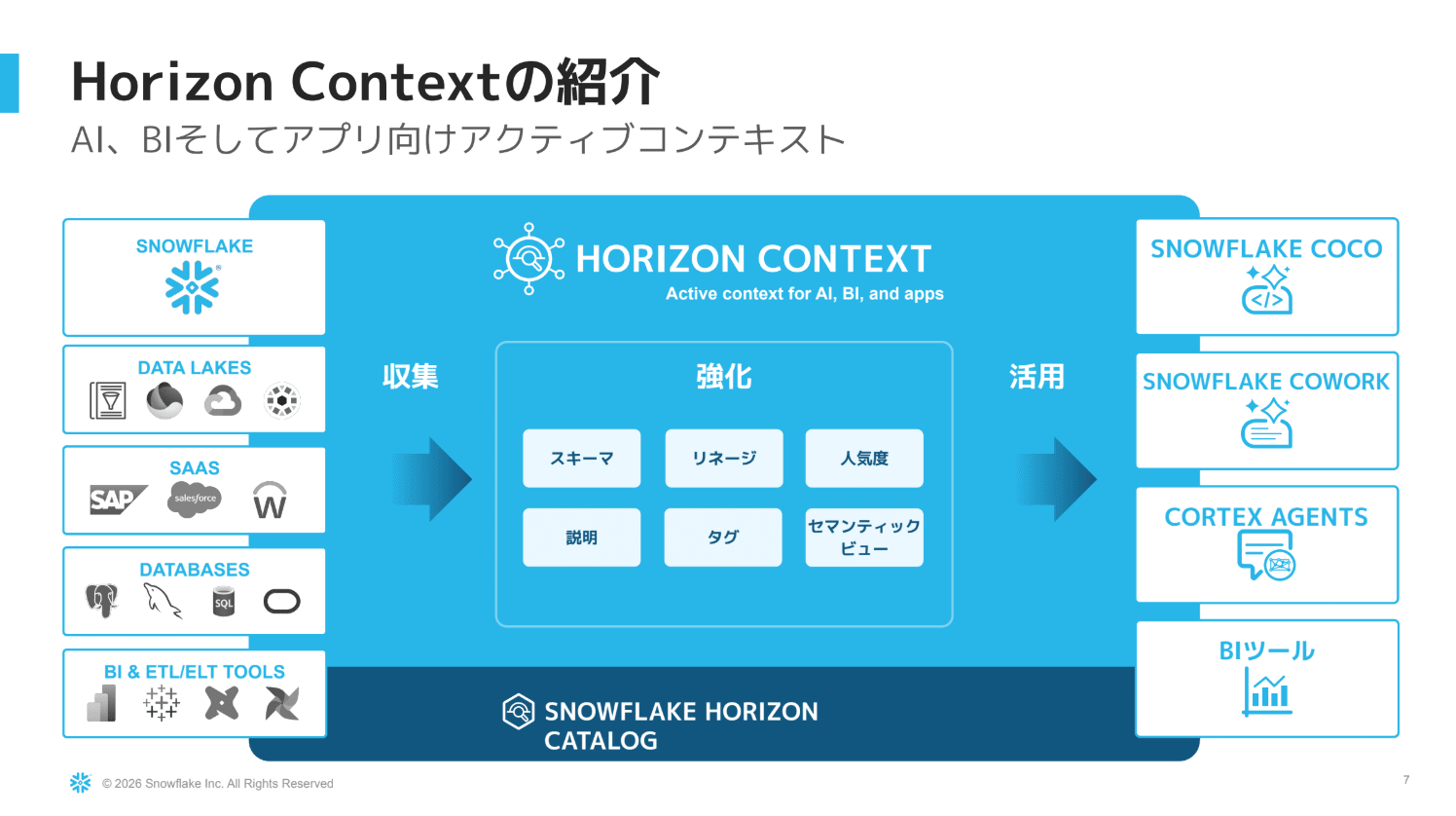
- To realize this ideal, Snowflake is beginning to offer Snowflake Horizon Context
- With Horizon Catalog at its center, it collects context from external databases, SaaS, data lakes, and more
- It enriches context with business glossary, lineage, and semantic views
- It delivers context to Snowflake CoWork, Snowflake CoCo, and various BI tools
- It evolves from a mere data repository to an active context foundation that AI and BI can immediately understand
Value Delivered by Horizon Context
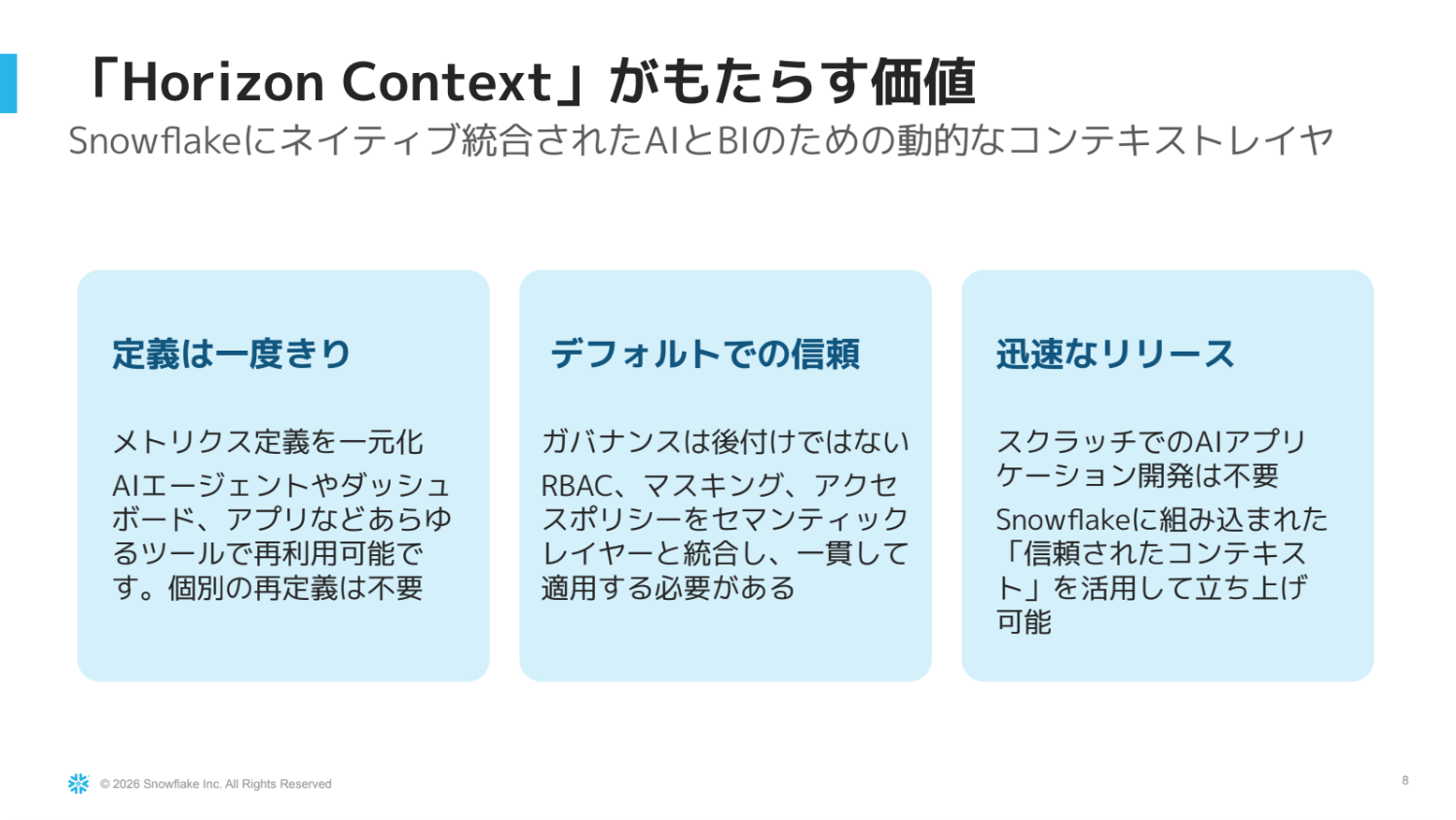
- Define once: Define metrics and calculation logic in one place, and reuse them across AI, BI, and applications
- Trusted by default: Existing governance such as RBAC, row access policies, and masking policies is enforced regardless of the caller—whether BI or AI agents
- This reduces the need to redundantly configure governance for each tool
- Rapid deployment: When building new AI applications, you can immediately use trusted context without building prompts or logic from scratch
The Role of Semantic Views
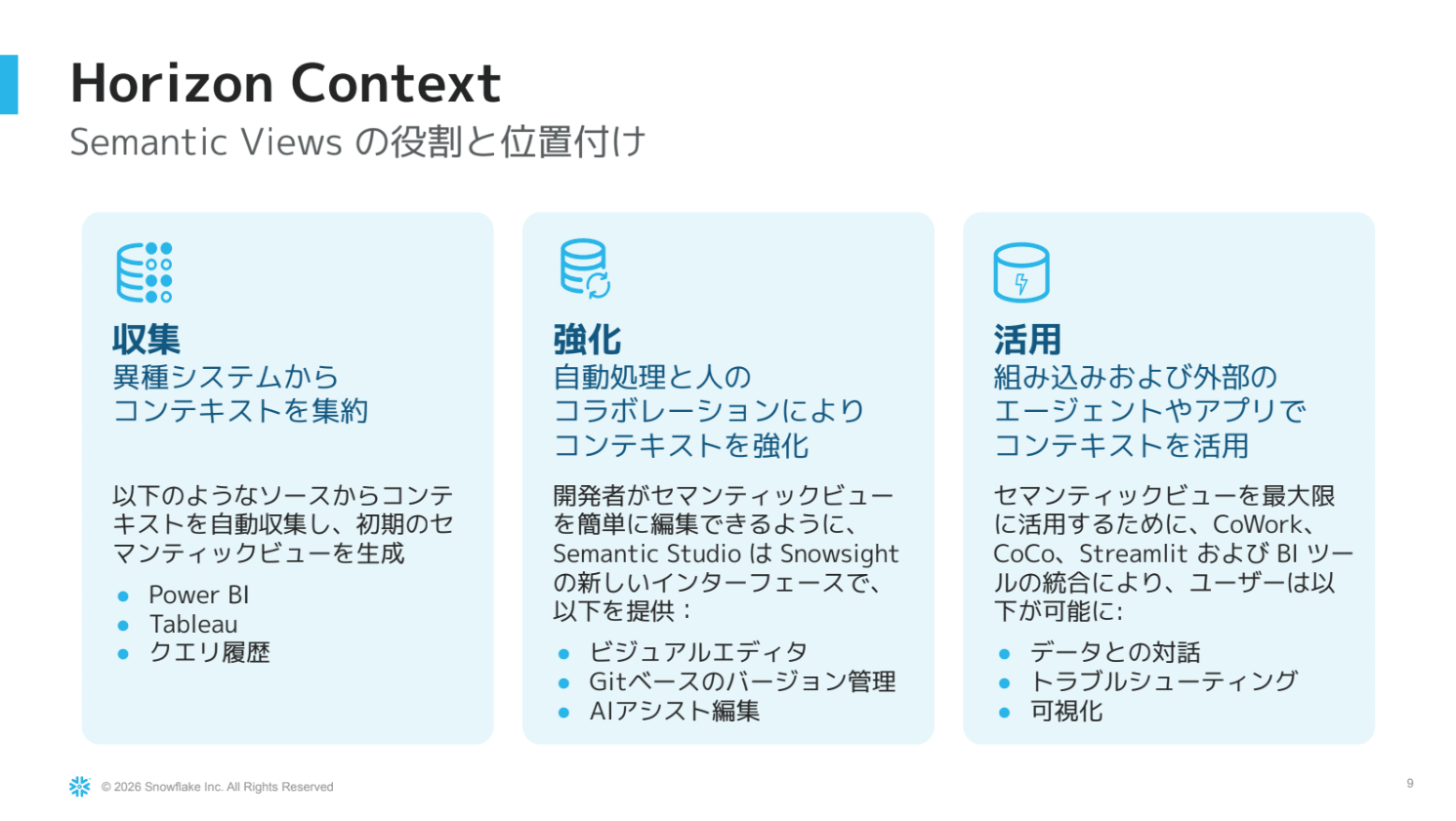
- The most core component within Horizon Context is the Semantic View
- Collect: Aggregate existing definitions from Power BI and past query history
- Enrich: Perform visual editing and lineage tracking in Semantic Studio
- Activate: Inject context in real time into queries from AI agents and BI tools
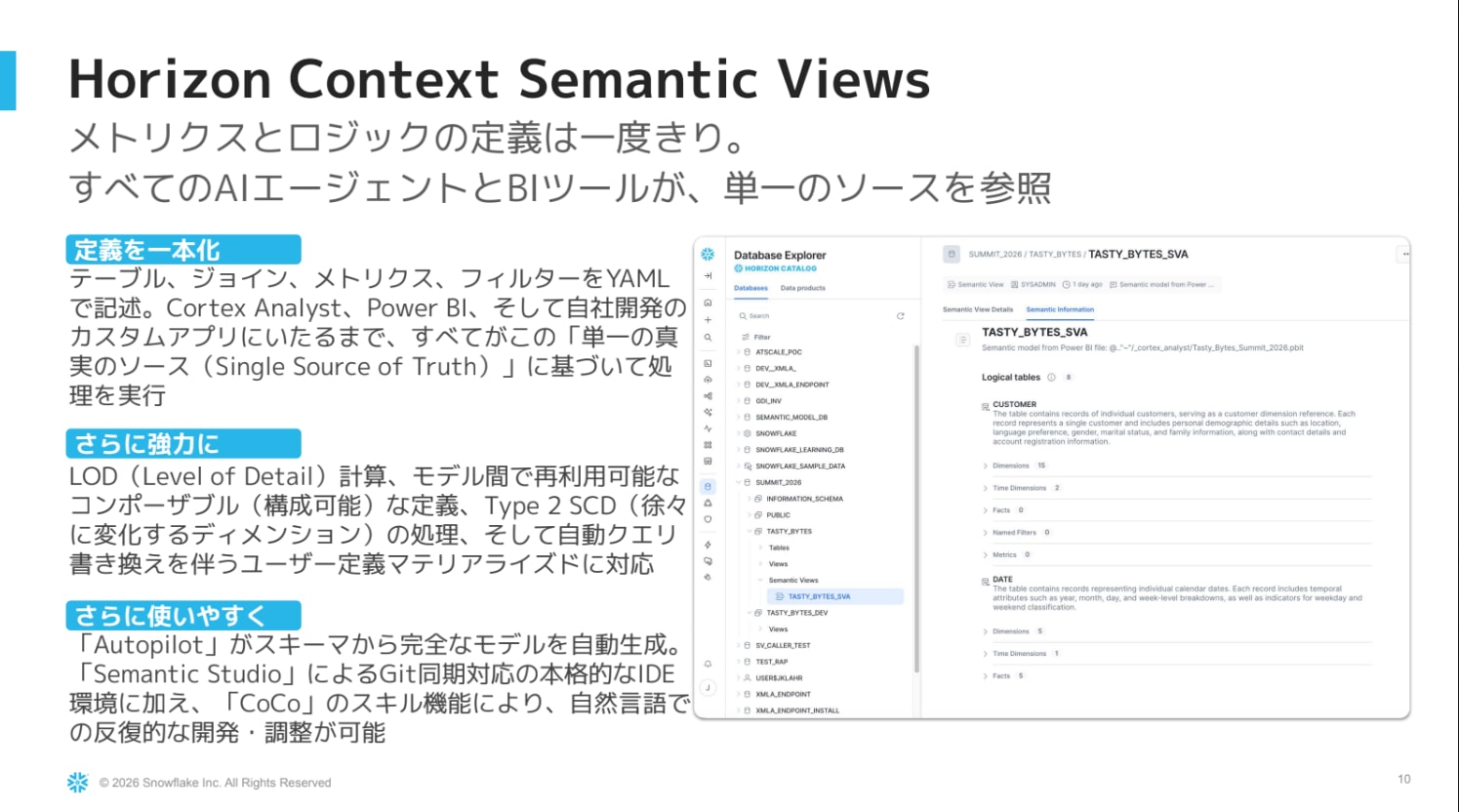
- Definitions are organized once in YAML. It combines the power to handle advanced enterprise-grade calculations with the ease of AI-assisted generation and Git synchronization
- What traditional semantic layers like LookML provided: facts, dimensions, relationships, and pre-calculations
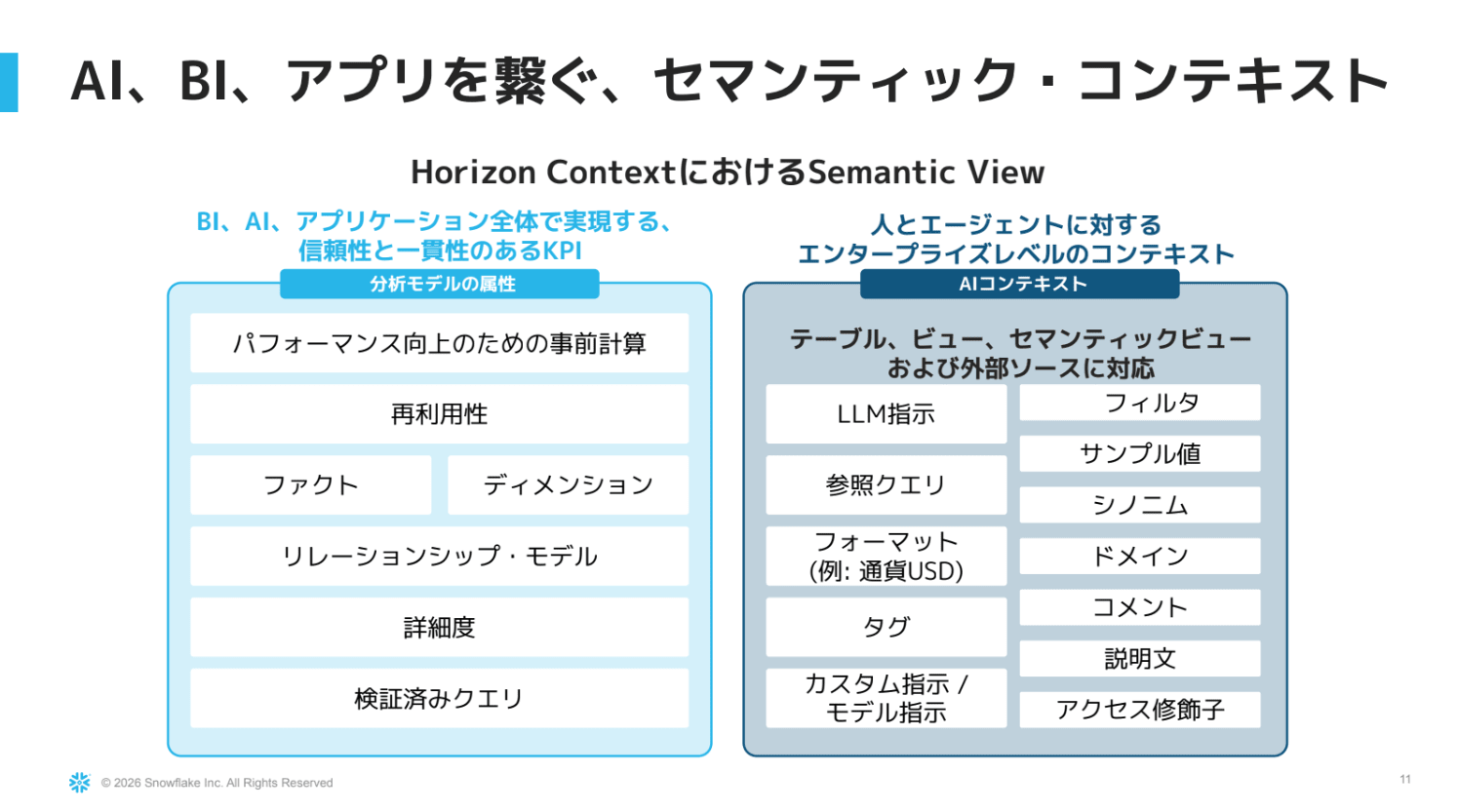
- In the AI era, this is no longer enough. By bundling all necessary elements into one package, it becomes an accurate and trustworthy data source for both humans and AI
Four Walls in the Real World of Building
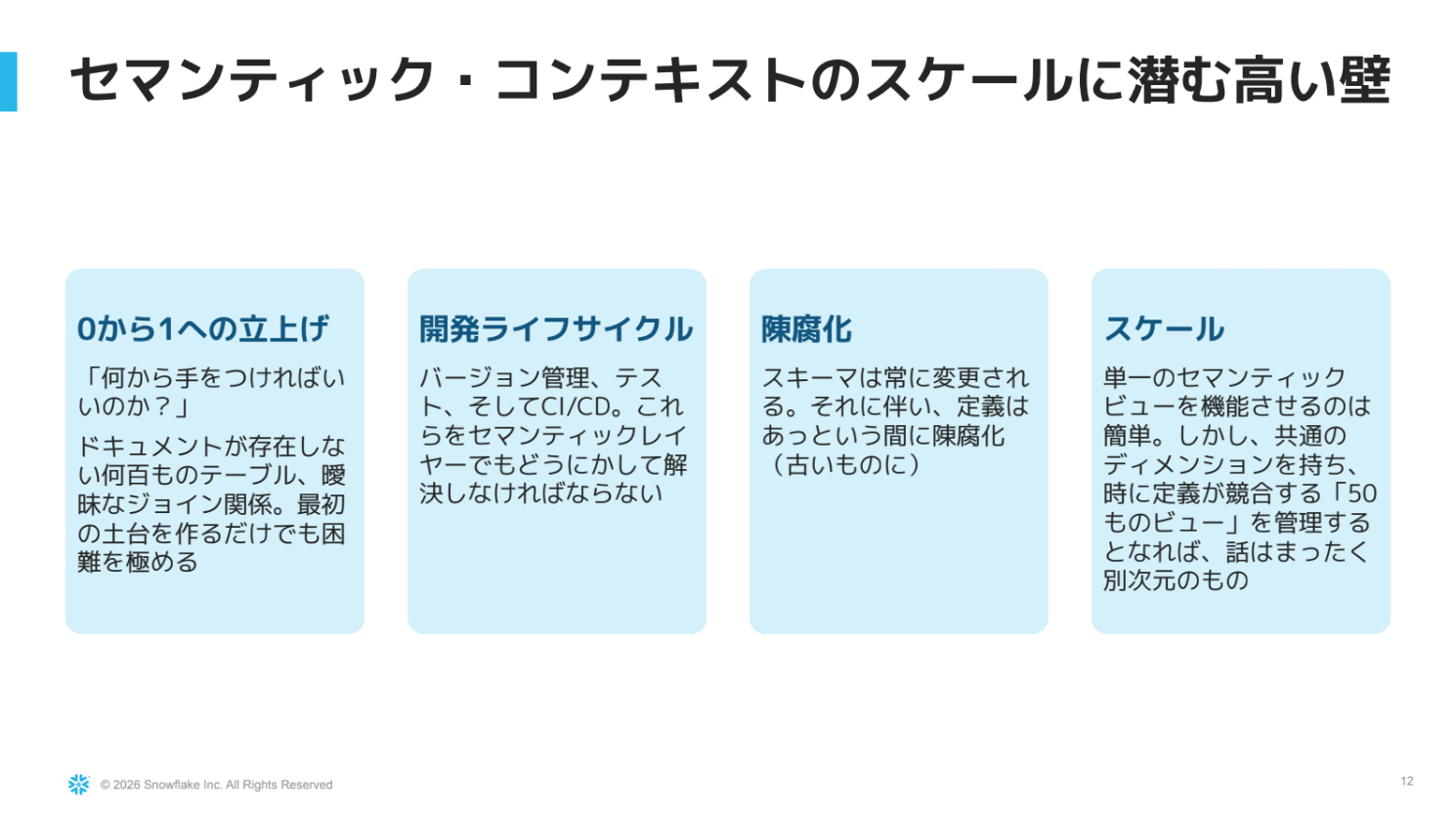
Even if the ideal is clear, in practice there are gritty walls when you actually try to build it—four were identified.
| Wall | Description |
|---|---|
| Starting from zero | No documentation; how do you build a semantic model from hundreds of tables? |
| Development lifecycle | How do you incorporate testing, version control, and CI/CD? |
| Staleness | Schemas keep changing, but the model can't keep up |
| Scale | Definitions differ by department; how do you centrally manage 50 or 100 semantic views? |
Semantic View Autopilot
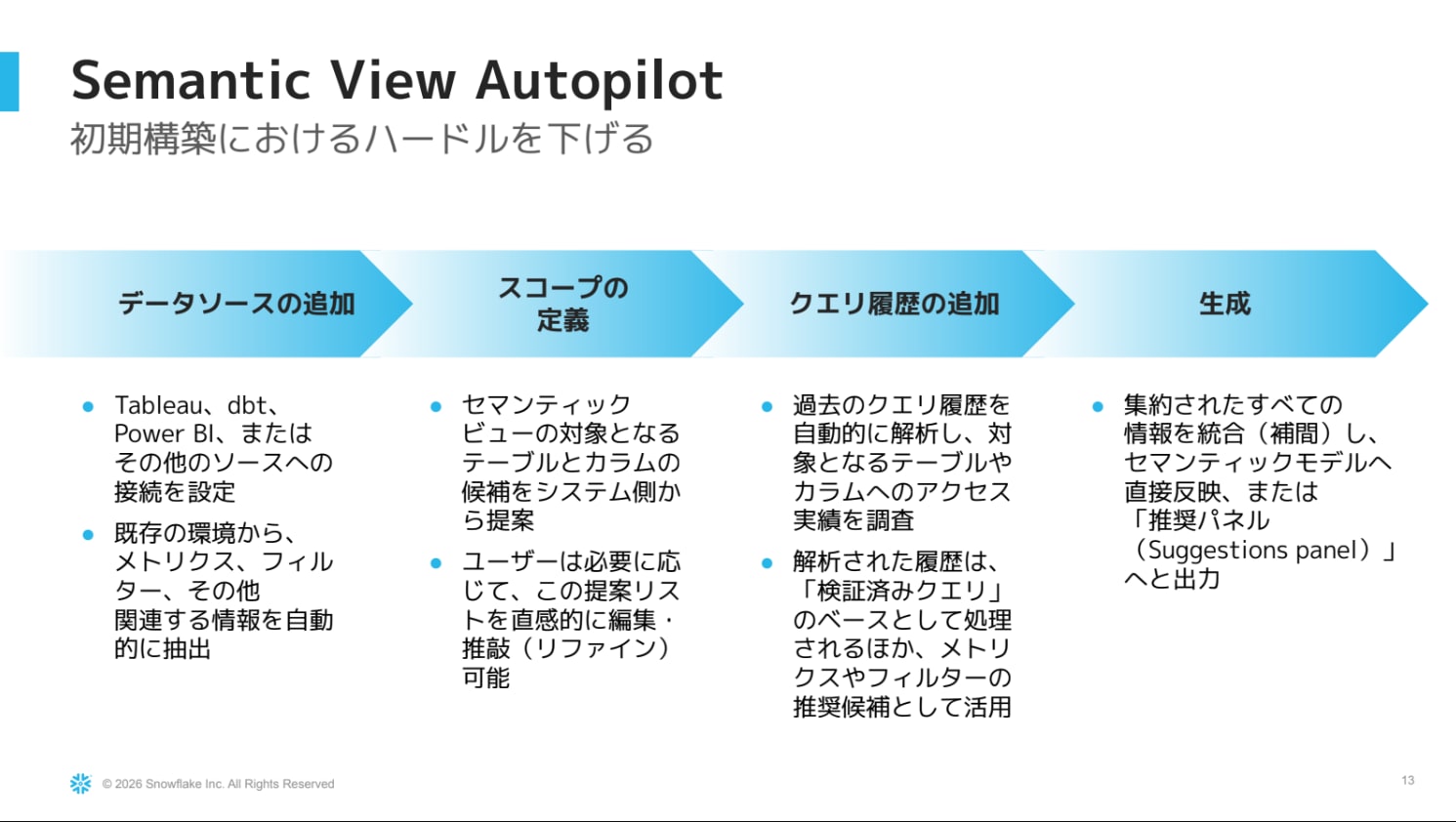
- Semantic View Autopilot is GA (GA announced in a press release in February 2026)
- Power BI file ingestion went GA on August 18, 2026
- The design principle is "start from the user's perspective"
- Rather than starting from databases registered in the system, start from what users want to see
- Many companies already have dashboards built in Tableau or Power BI. Use those assets
- Extract table and relationship information from BI tool definitions
- Additionally, AI analyzes Snowflake's past query history
- It extracts frequently accessed tables, column combinations, and commonly used calculation logic, and proposes them as the base for a recommended model
- Work that might have taken months manually can be reduced to minutes
Generating the First Draft from a Power BI File
- The subject matter is a Power BI dashboard built using Tasty Bytes data, familiar from the quickstart "Zero to Snowflake"
- The Power BI file also has relationships between tables defined
- Import the Power BI file from the screen built into Workspaces, and specify the name and the destination database and schema
- Pressing "Deploy" triggers analysis of the file and collection of query history, generating a foundational semantic view
- The initial work of deciding which columns to bring over and how to define relationships can start from existing assets
- Dimensions and facts were also imported
The Feedback Loop and Semantic Studio
A Feedback Loop That Grows with Use
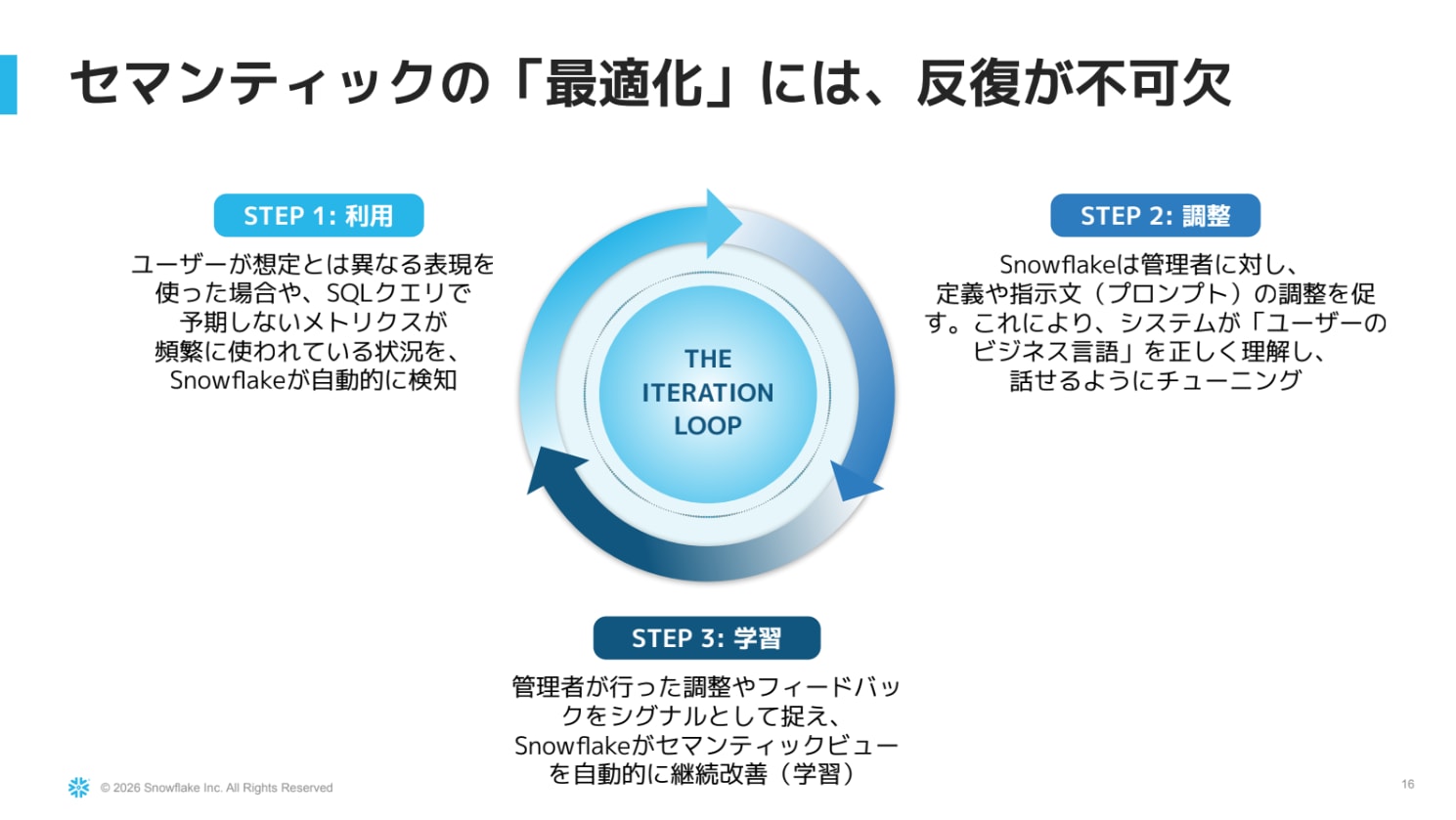
- A model is not something you build once and leave; it needs to be continuously refined based on usage
- In Snowflake, this loop can be run by reviewing and adopting suggested improvements
- As users work with data, the system detects query patterns and variations in natural language expressions
- It suggests: "Would you like to add this query pattern as a verified query?" or "Would you like to add this metric?"
- The system learns from what has been incorporated and updates the model
- The more it is used, the more the semantic view evolves to reflect the organization's business language
Snowflake Semantic Studio
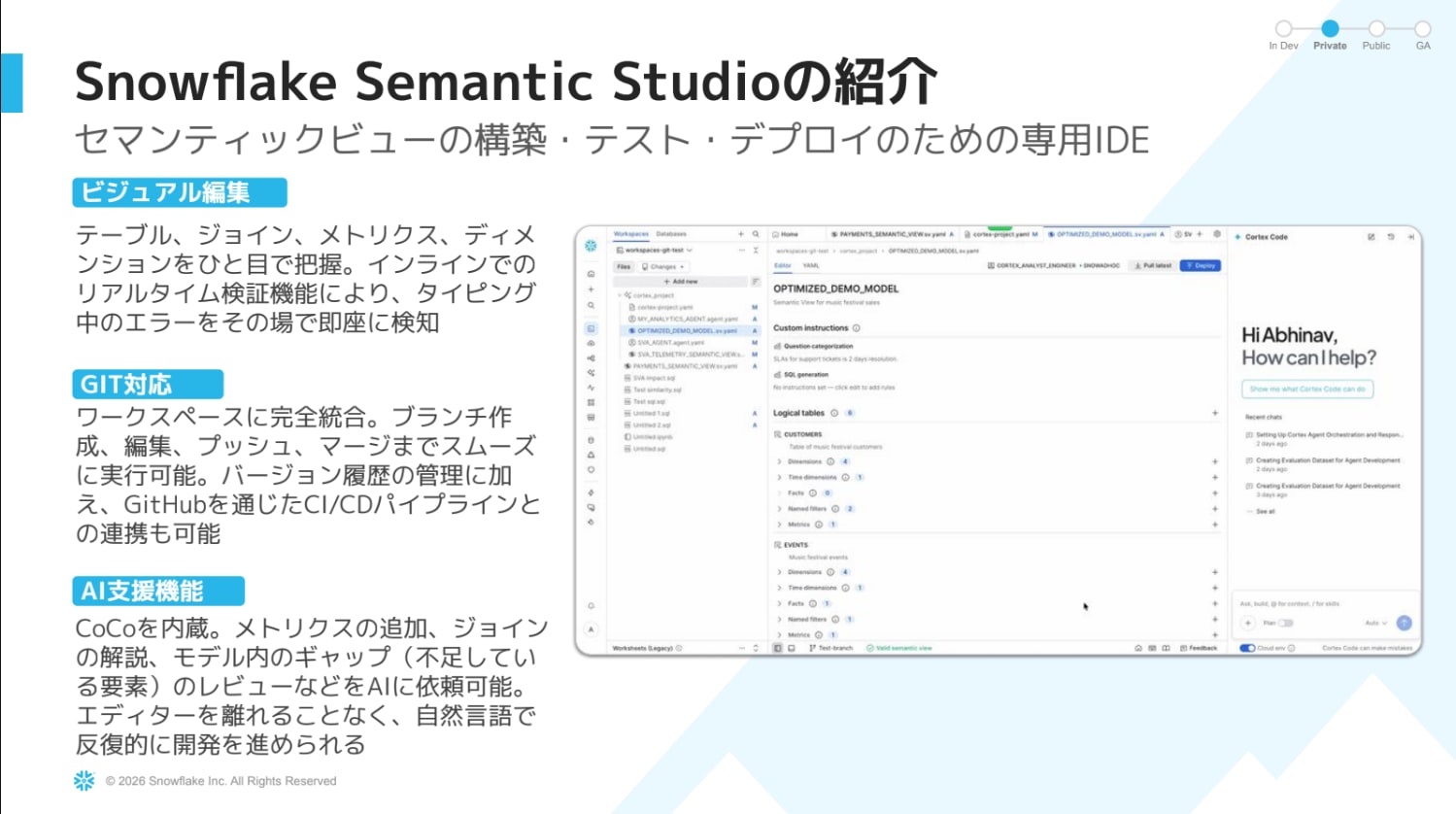
- At the center of this development and operations loop is the newly available Snowflake Semantic Studio (Public Preview on August 26, 2026)
- It features an intuitive editor while also integrating with Git repositories for branch creation and commits
- It can also be incorporated into Git-centric review and CI/CD workflows
- Snowflake CoCo is built in from the start, so you can make requests in natural language such as "Add a new metric"
Enterprise Requirements and Composable Views
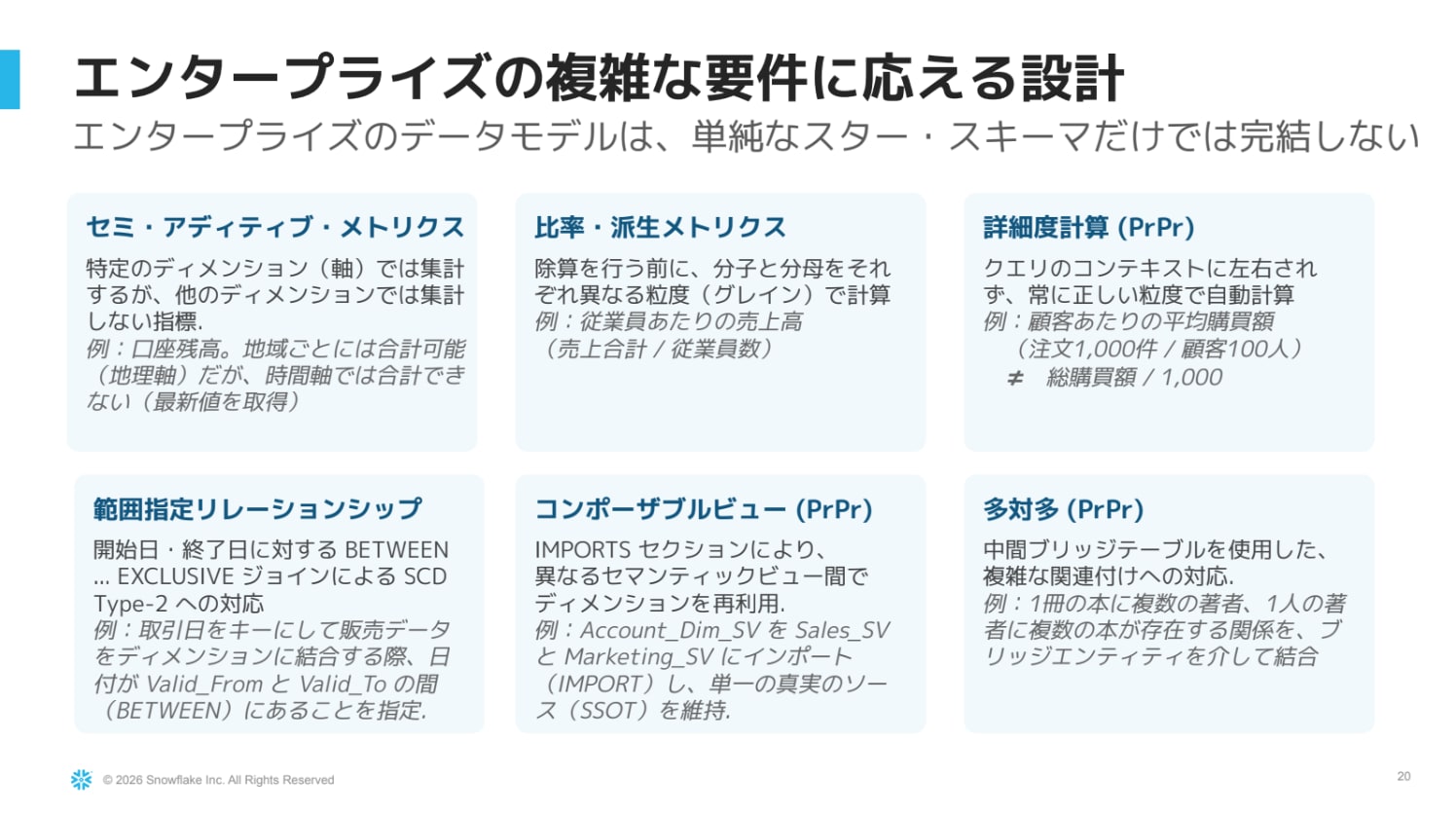
- Real-world data models don't fit neatly into simple star schemas. Semantic views are evolving to handle complex requirements
- Semi-additive metrics, like bank account balances, that can be summed across regions but not across time
- Ratio metrics where the numerator and denominator have different granularities
- Joins using start and end dates that cannot be expressed by keys alone
- Many-to-many relationships using bridge tables, though not a recommended configuration
Composable Views
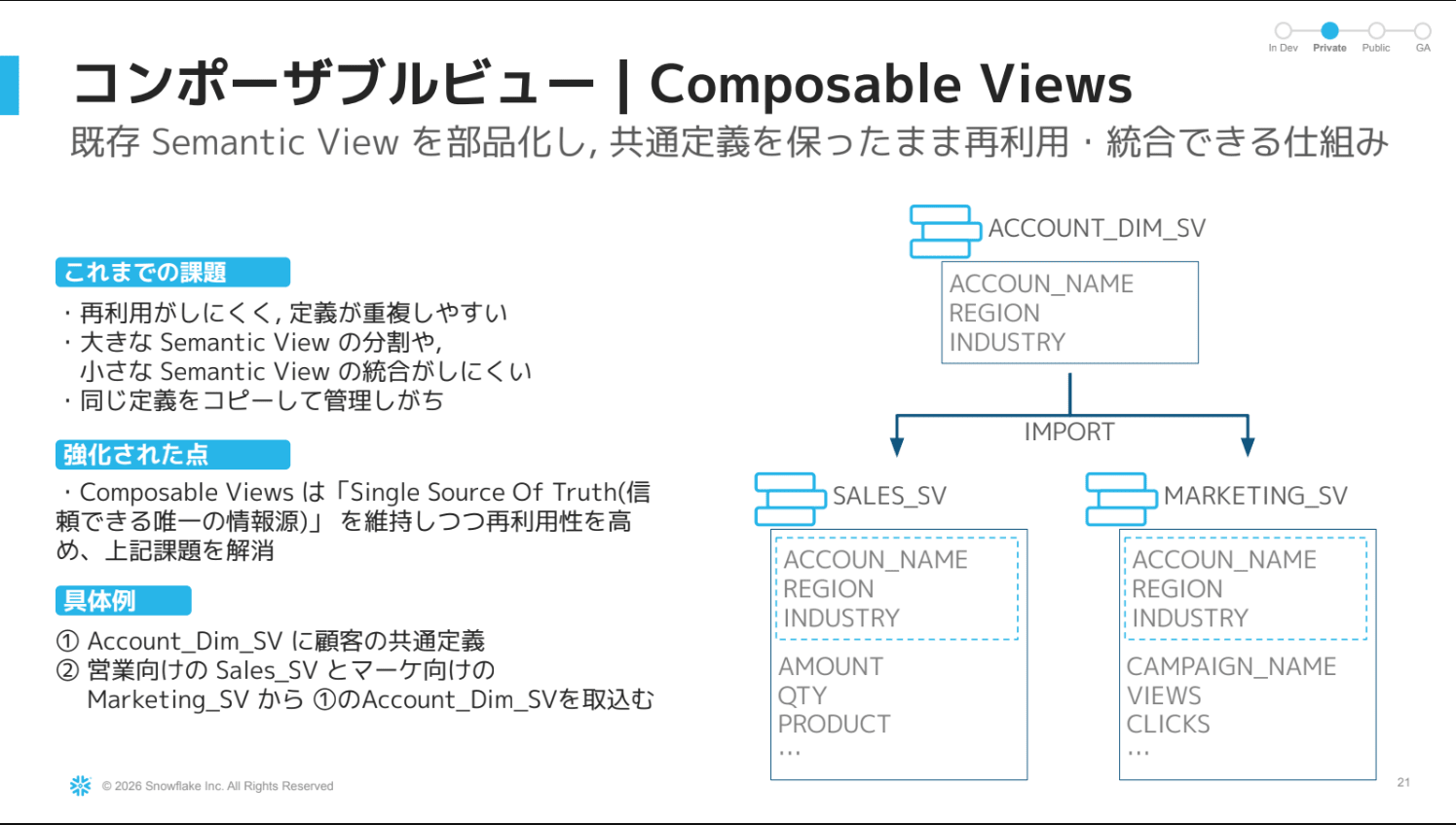
- What the presenter considers particularly powerful is Composable Views
- Previously, common definitions were copied and pasted for reuse, causing definitions to drift and the same definition to be scattered in multiple places
- If you build a customer semantic view once as a common module, it can be imported and reused by semantic views for sales or marketing
- You can keep building simply with unified definitions, without reinventing the wheel
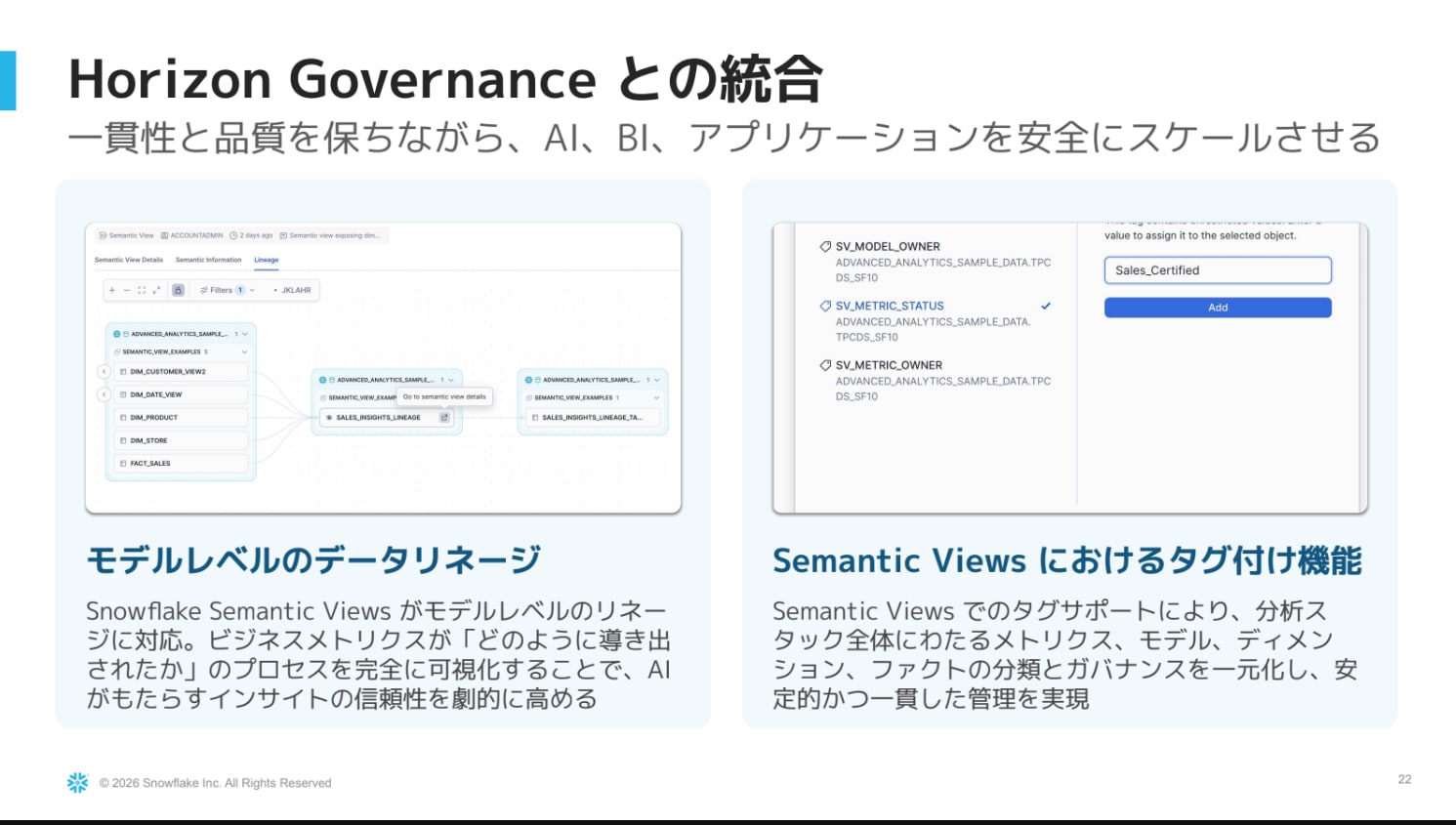
- Governance is also supported. Model-level lineage allows tracking of which data sources were used and how the model was created
- Classification and access control through tagging is also possible
Ecosystem and Open Standards
XMLA Endpoint
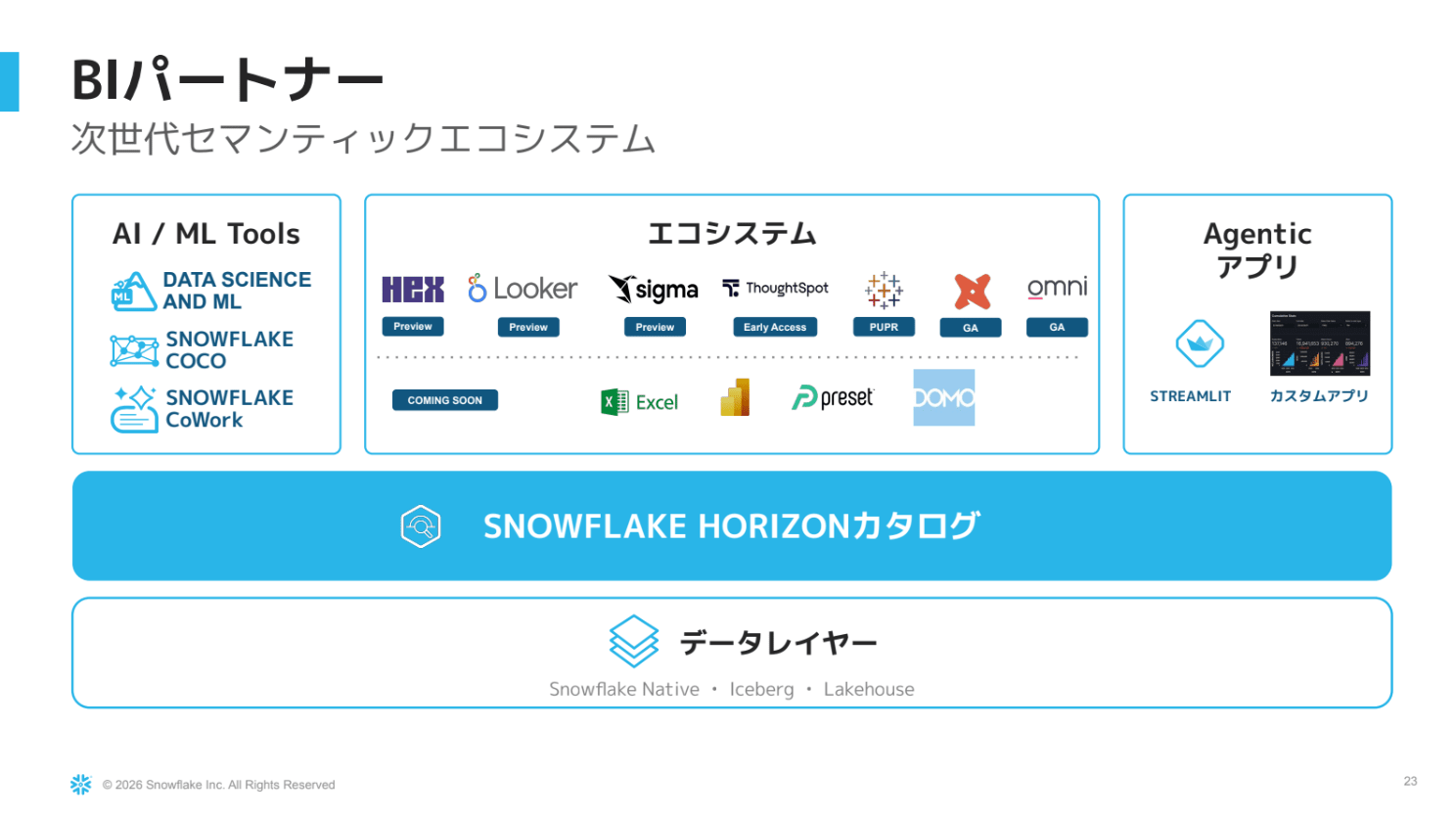
- Semantic views are not locked inside Snowflake
- They can integrate not only with Streamlit and CoWork, but also with other BI tools, AI/ML tools, and custom applications
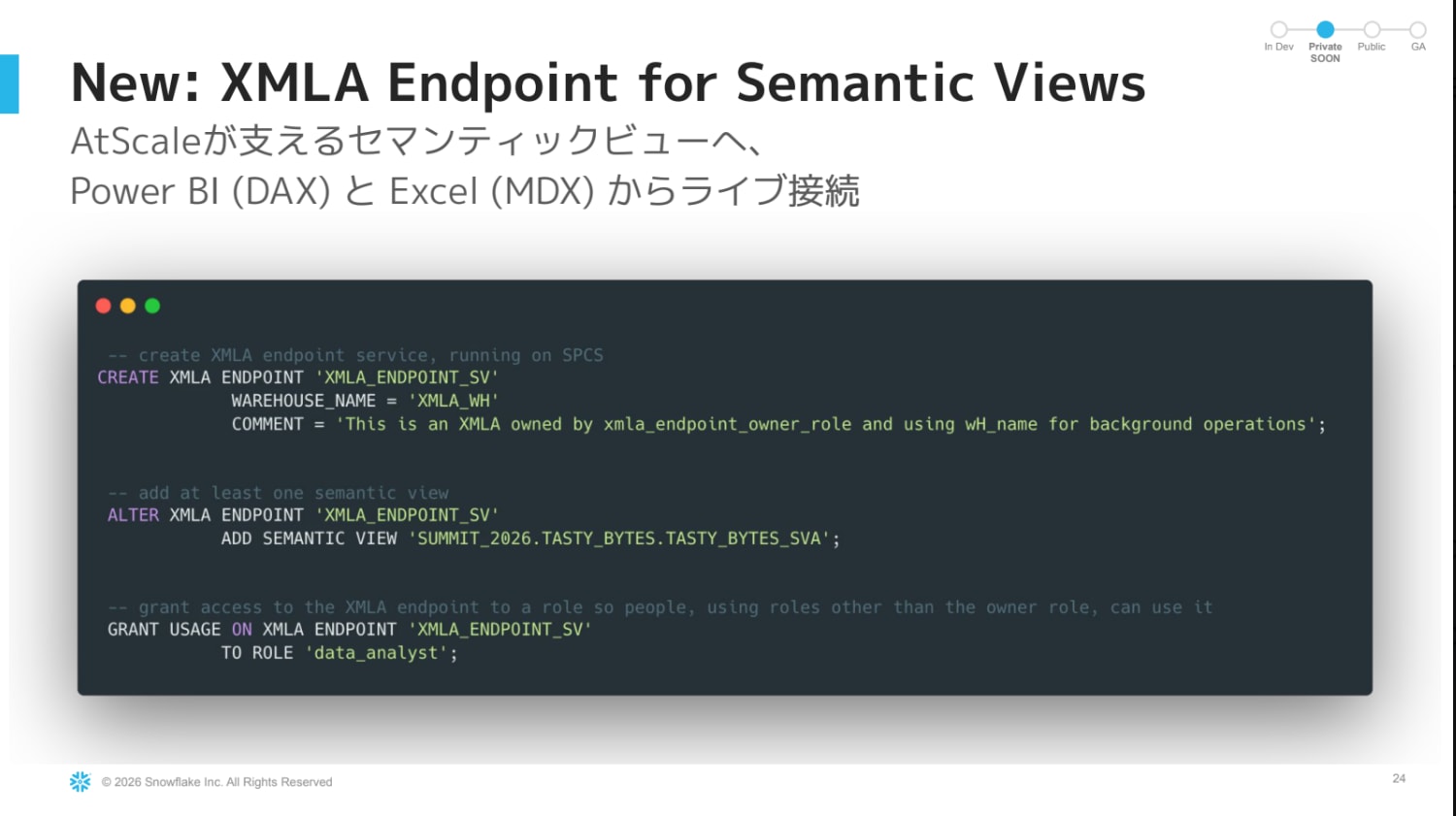
- What was newly introduced is the XMLA endpoint
- The vision is to directly query semantic views with live connections from Power BI using DAX and from Excel using MDX
- End users will be able to reference semantic views from the familiar Excel environment
- This prevents the situation where users guess which table to use, resulting in different numbers depending on the person
※The XMLA endpoint is described in the official blog as a Private Preview feature provided through a partnership with AtScale. As details on usage conditions and scope of support had not been published at the time of writing, please check the latest official information.
Shift Left and Apache Ossie
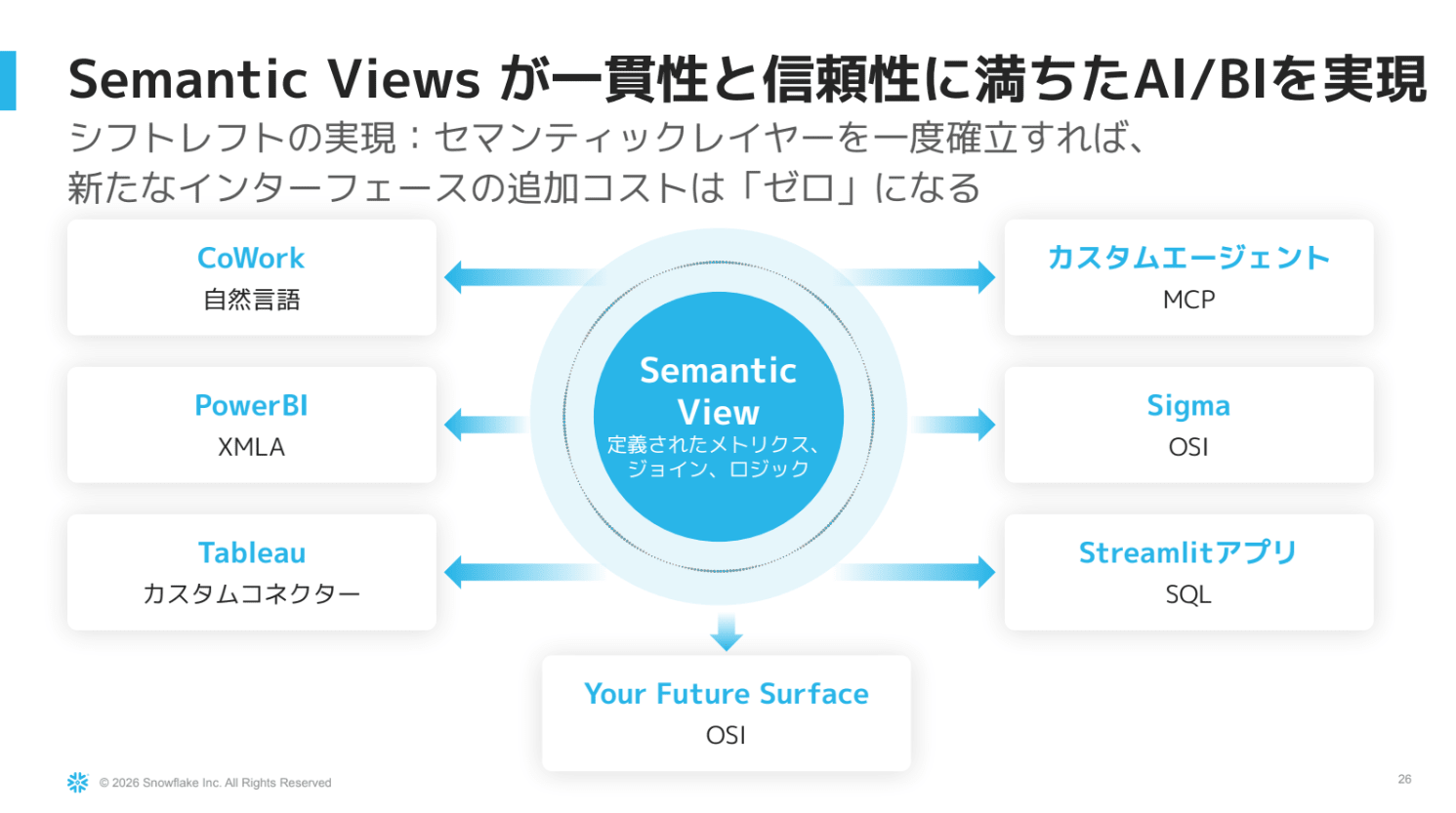
- The goal is shift left
- By consolidating the semantic layer on Snowflake, there is no need to redefine things when new AI agents or BI tools emerge
- Have trusted data ready to use from the very beginning
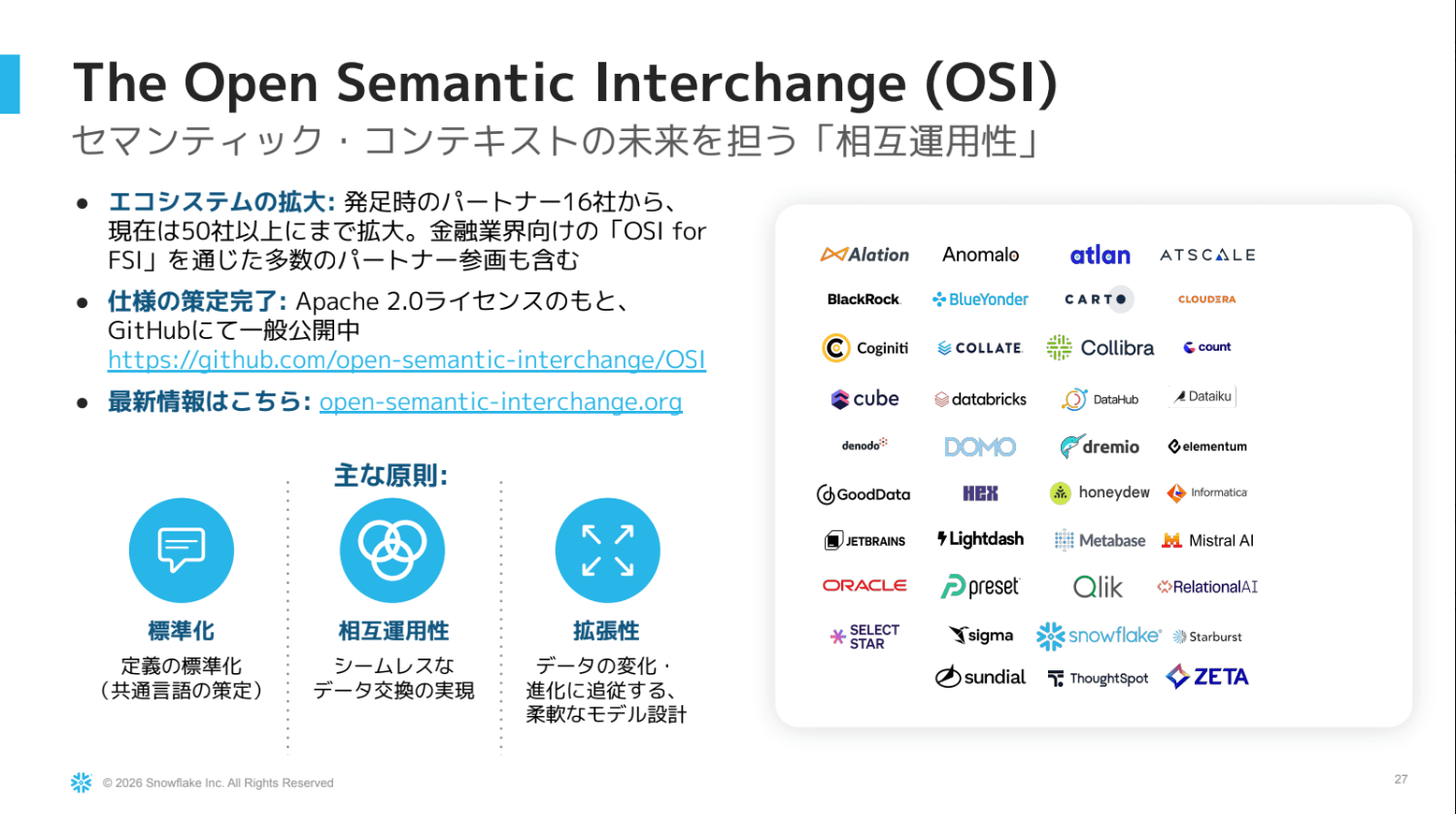
- For this reason, Snowflake is pursuing its work on semantic views in an open manner
- To enable interoperability across the industry, it has been promoting the open standard Open Semantic Interchange (OSI)
- The presentation explained that it started with around 16 partner companies and has now grown to more than 80. The specification is published on GitHub
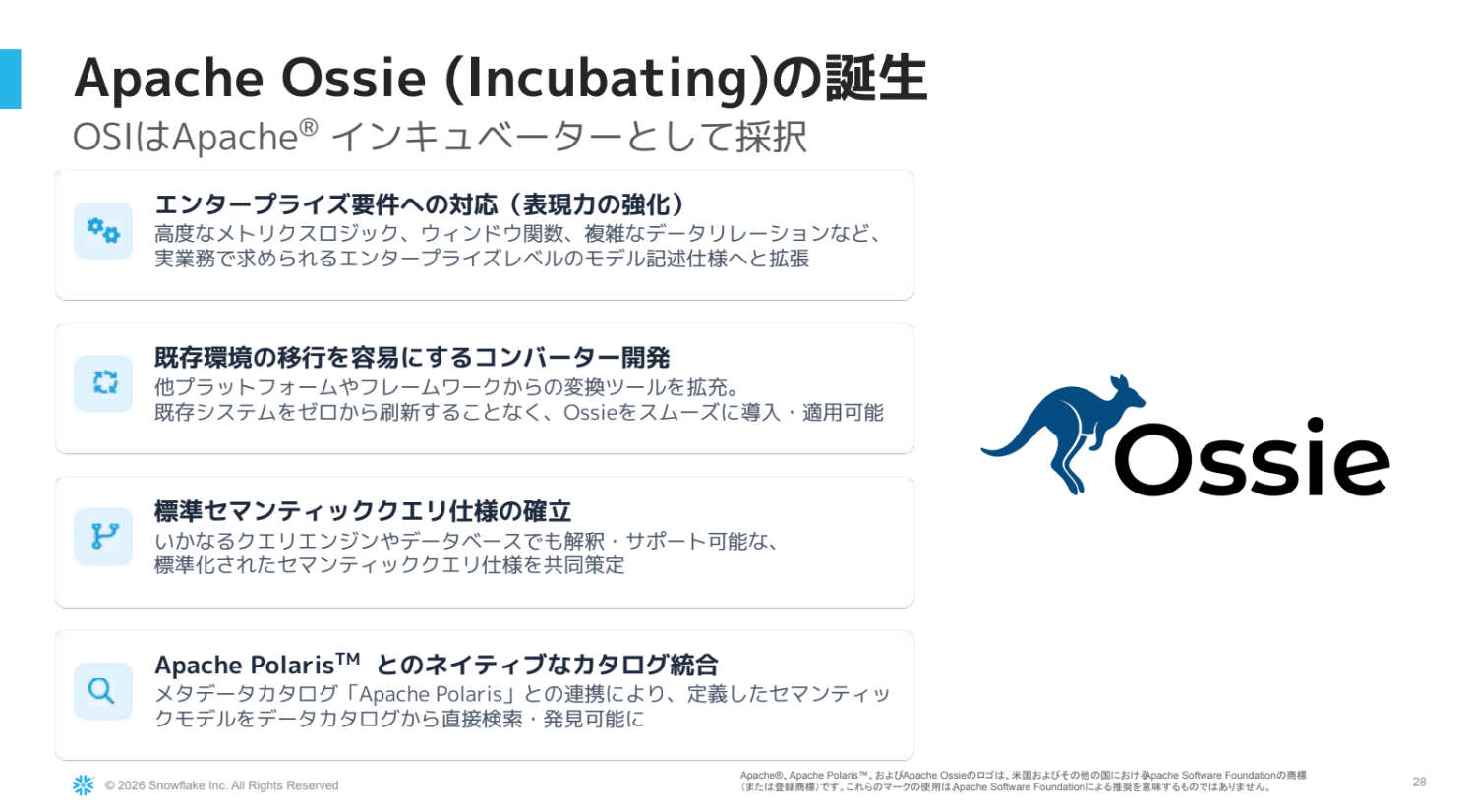
- OSI was accepted into the Apache Incubator and is now being developed as Apache Ossie (incubating)
- The message was that they want to build a future together with partners where vendor lock-in is eliminated and semantic models can be freely exchanged and utilized
Related Articles
Here is the report for the Day 1 KEYNOTE.
Here is the official documentation for the features introduced in the session.
Impressions
I attended the session "Building a Reliable Semantic Layer from Zero with Snowflake" on Day 1 of SNOWFLAKE WORLD TOUR TOKYO 2026. Starting from the 30-year history of the semantic layer, it was a session that showed how Snowflake answers the high walls lurking within scale.
I was able to gain a broad understanding of the overall picture of Snowflake's semantic layer, through to features planned for future release.
Snowflake Cortex Sense hasn't been released yet either, but I'd like to make use of it together as well.
I hope this article is helpful to someone!