![[Update] Amazon Redshift Graviton-based RG instances are now available on the trailing track as well](https://images.ctfassets.net/ct0aopd36mqt/wp-thumbnail-63f1274931b942e9a92e601c1127ad73/cfe87ec6d62fa2fc3c474ed4cb2f6c2e/amazon-redshift?w=3840&fm=webp)
[Update] Amazon Redshift Graviton-based RG instances are now available on the trailing track as well

This page has been translated by machine translation. View original
This is Ishikawa from the Cloud Business Division. Amazon Redshift's Graviton-based RG instances (rg.4xlarge / rg.xlarge) are now available on the trailing track (P201).
With RG instances now supported on both tracks — previously available only on the leading track — you can now enjoy the price-performance benefits of AWS Graviton even in production environments where stability is a priority.
Available sizes are rg.xlarge and rg.4xlarge.
What Are Maintenance Tracks (leading / trailing)?
In Amazon Redshift, you can control the update policy applied to your data warehouse when a new version is released using "tracks."
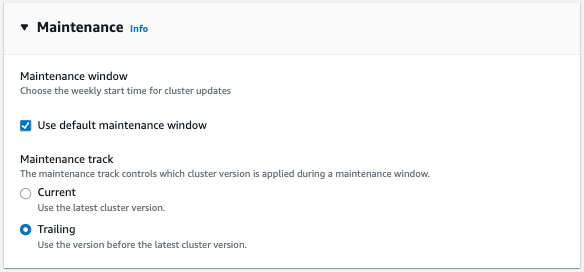
- Current (leading) track: The latest certified release is applied, giving you early access to the latest features, security updates, and performance improvements.
- Trailing track: Operates on the previous certified release. The
P201targeted in this update corresponds to this trailing track version.
The trailing track applies releases that have undergone 1–6 weeks of validation and integration testing on the Current track, making it well-suited for mission-critical production environments that demand maximum stability. By placing development and test environments on the Current track and production environments on the trailing track, you can secure time to evaluate new releases before they reach production.
What's New
The key changes are as follows.
- Graviton-based RG instances are now available on the trailing track (P201)
- The target instance types are
rg.4xlargeandrg.xlarge - RG instances now support both the leading and trailing tracks, allowing you to leverage Graviton's performance benefits even for stability-focused workloads
- You can migrate to RG instances by provisioning a new cluster or resizing an existing cluster
- Operations can be performed from the AWS Management Console, AWS CLI, or AWS SDK
Pricing Impact
RG instances are offered at a price that is 30% lower per vCPU compared to RA3 instances. In addition to on-demand pricing, you can also choose pricing options such as Reserved Instances (1-year / 3-year). Note that selecting the trailing track itself does not incur any additional charges. Please refer to the Amazon Redshift pricing page for the latest pricing.
How to Use
To use RG instances on the trailing track, take one of the following approaches.
- New cluster: When creating a cluster, select
rg.4xlargeorrg.xlargeas the node type and specify Trailing as the maintenance track - Existing cluster: Migrate to RG instances via Resize (Elastic Resize / Classic Resize) or Snapshot & Restore
Important Notes
- Changing tracks is generally recommended to be treated as a one-time decision, so please proceed with caution. If you change a provisioned cluster to Trailing, the version will not be updated until the next Current track release is available.
- Resizing a cluster does not affect the track setting.
- Snapshot & Restore, Elastic Resize, and Classic Resize are available for migrating from RA3 clusters.
- The announcement for this update did not specify the target regions. Please refer to the official documentation for details on available regions.
Closing
Graviton-based RG instances (rg.4xlarge / rg.xlarge) are now available on the trailing track (P201), with support for both leading and trailing tracks. The benefits of RG instances — up to 2.4x the performance of RA3 and 30% lower cost per vCPU — are now easier to adopt in production environments that prioritize stability.
If you have a production Amazon Redshift cluster where you want to improve price-performance while maintaining stability, why not consider migrating to RG instances on the trailing track?
Related Articles