![[Booth Report] Can you discover drugs on AWS!? We visited the "Amazon Bio Discovery" booth!](https://images.ctfassets.net/ct0aopd36mqt/2sMbSSrXeIu2nkTZlaLSue/2120d94341b741bb1319162f3a6738f5/aws-summit-japan2026.png?w=3840&fm=webp)
[Booth Report] Can you discover drugs on AWS!? We visited the "Amazon Bio Discovery" booth!

This page has been translated by machine translation. View original
Hi there! I'm Kusunoki!
It's been almost 3 months since I joined Classmethod as a new graduate.
I attended AWS Summit Japan 2026, and while the experience is still fresh, I'd like to quickly write a blog post about it!
This time, I want to share something that gave me an "I didn't know AWS was doing this too!" moment.
That is "Amazon Bio Discovery".
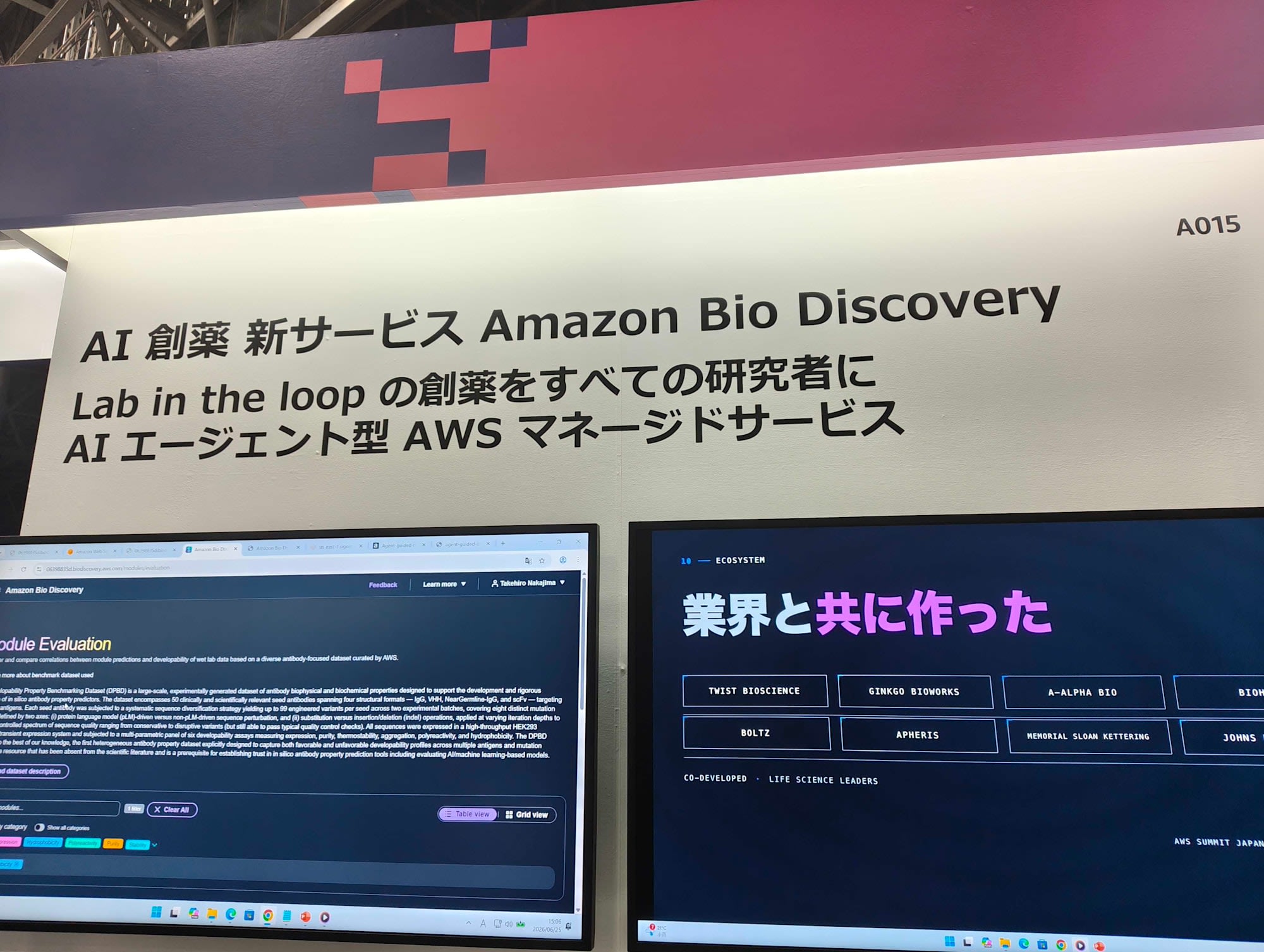
I actually studied pharmacy in college. So this service really resonated with me!
What is Amazon Bio Discovery?
First, let's read the official AWS description.
Translated from the original (English), it goes like this:
Amazon Bio Discovery is a service that gives researchers direct access to "biological AI models" trained on vast amounts of biological data. These specialized AI models generate and evaluate antibody drug candidates. But access alone isn't enough. AI agents assist with selecting the right models for your research goals, optimizing input data, and evaluating candidates, then seamlessly send them to partner labs for synthesis and testing. Test results are automatically returned to the application for analysis and model refinement. This creates a "lab-in-the-loop" experimental cycle, where organizational knowledge accumulates with each iteration.
…Right. Honestly, I think just reading that might not make much sense, so let me break down things like:
- What does it actually mean to create a drug?
- What is AI-driven drug discovery?
- How does this service change things?
- Is it actually useful?
What does it mean to create a drug (antibody drug) in the first place?
This service is designed for creating a type of drug called an "antibody." Simply put, an antibody is "a protein that latches onto the cause of a disease and fights it off." You've probably heard the term in news about COVID-19.
To turn this into a medicine, you need to repeatedly go through the cycle of "design → actually make and test it → review the results and redesign."
By the way, doing design and prediction computationally is called in silico, and testing it with actual cells or in test tubes is called in vitro. Drug discovery is a much broader process, but along the way these two approaches are used back and forth to narrow down candidates. Understanding this will help the rest of this article make more sense.
In recent years, "AI-driven drug discovery" has been advancing
Traditionally, this "design" phase involved researchers drawing on experience and knowledge to think, "if it's shaped like this, it might bind," then actually making it and testing it—over and over again. But making and testing even a single candidate takes time and money, so there are limits to how many candidates can be tried.
This is where AI came in. That said, it's not the same as so-called "generative AI" like ChatGPT or image generation—the main players here are machine learning models trained on vast amounts of biological data.
Specifically:
- AI predicts the three-dimensional shape of proteins
(The famous example is AlphaFold, which won the 2024 Nobel Prize in Chemistry!) - AI designs a large number of molecules likely to bind to a target
- Whether those candidates will "actually bind" is evaluated computationally (in silico) before they're synthesized
In other words, "design → evaluate → narrow down" is all done on a computer first, and only the most promising candidates are actually synthesized and tested. This is AI-driven drug discovery.
The "design" part of the loop has shifted significantly from human hands to AI.
Amazon Bio Discovery: Before / After
Before
Researchers had to prepare all of the following on their own:
- Computing environment … Build the infrastructure to run models and manage them with machine learning expertise
- Model selection expertise … Choose the right models from a large number of options and combine them appropriately
- A place to experiment … Actually synthesize and test the designed candidates in a real laboratory (wet lab)
As you can see, the barrier to entry was quite high.
After
Amazon Bio Discovery bundles all of these fragmented, high-barrier elements together.
Mapping them against the Before, here's how they correspond:
- Computing environment → Already provided
Infrastructure and more than 40 types of models are available from the start, with no need to build your own. - Model selection expertise → Supported by AI agents
The agent suggests which models to use, where to target binding, and makes recommendations based on industry best practices. - A place to experiment → Can be outsourced
Even without your own lab, you can place orders directly from the screen to affiliated research institutions (a CRO network). You can also check pricing and turnaround times.
As a result,
Something that previously required having your own wet lab, computing infrastructure, and specialized personnel all in place—AI-driven drug discovery—might now be accessible to much smaller teams.
That's personally the most exciting point for me.
For example, a drug discovery startup, even without massive research facilities, could join this loop and do drug discovery with just ideas and domain expertise! That's the kind of service I felt this was.
And it has actually been published as a paper
In fact, this approach has already been published as a paper.
The paper describes how nanobodies (small antibodies) designed from scratch using this workflow against a certain cancer target were confirmed to actually bind in real experiments.
In other words, it has been properly demonstrated to actually work. That was personally the point that gave me the most confidence.
And according to AWS officially, the speed of such development has increased dramatically—a process that previously could take up to a year with traditional design methods was completed in just a few weeks.
Thoughts
I never really associated AWS with anything biology-related, so I was surprised to find that such an impressive service—one that's already made it into actual papers—had been released. It would be exciting to see research accelerate even further using this.
This is something I wouldn't have known about without attending AWS Summit, so I'm glad I went.
Apparently there's a trial available now, so I'd like to take a closer look at it sometime!
Thank you so much for reading all the way to the end!