![[From IVR to AI Conversation] AWS Summit Japan 2026 Customer Support Session Cross-Cutting Report](https://images.ctfassets.net/ct0aopd36mqt/7cN8mkB4Ni5uqeEvJpsSW1/b629d0b5a4a192e6547eaa743065e1bd/aws-summit-japan2026_session.png?w=3840&fm=webp)
[From IVR to AI Conversation] AWS Summit Japan 2026 Customer Support Session Cross-Cutting Report

This page has been translated by machine translation. View original
Hello, I'm Irii from the Business Efficiency Solutions Department.
At AWS Summit Japan 2026, I attended three sessions in the customer support area.
- Contact Center Transformation at Tokyo Electric Power - AI Utilization Initiatives for CX Improvement (AIM240)
- SBI Sumishin Net Bank's Challenge: Generative AI Contact Center Transformation (AIM263)
- "How Much Can We Leave Resident Inquiries to AI?" - The Current State of Shinagawa Ward × SHIFT's Municipal Voice AI Pilot (PRT246)
The industries vary - electric power, banking, and local government - but there was a common trend across all three sessions.
That trend is the movement away from conventional button-selection IVR (Interactive Voice Response), which has reached its limits, toward a new form of IVR where AI naturally converses with customers to classify their inquiries.
This article summarizes the three cases cross-sectionally, focusing on this common trend.
Understanding the IVR Limitations Each Organization Faced
All three cases share a common point: they all felt challenges with conventional IVR.
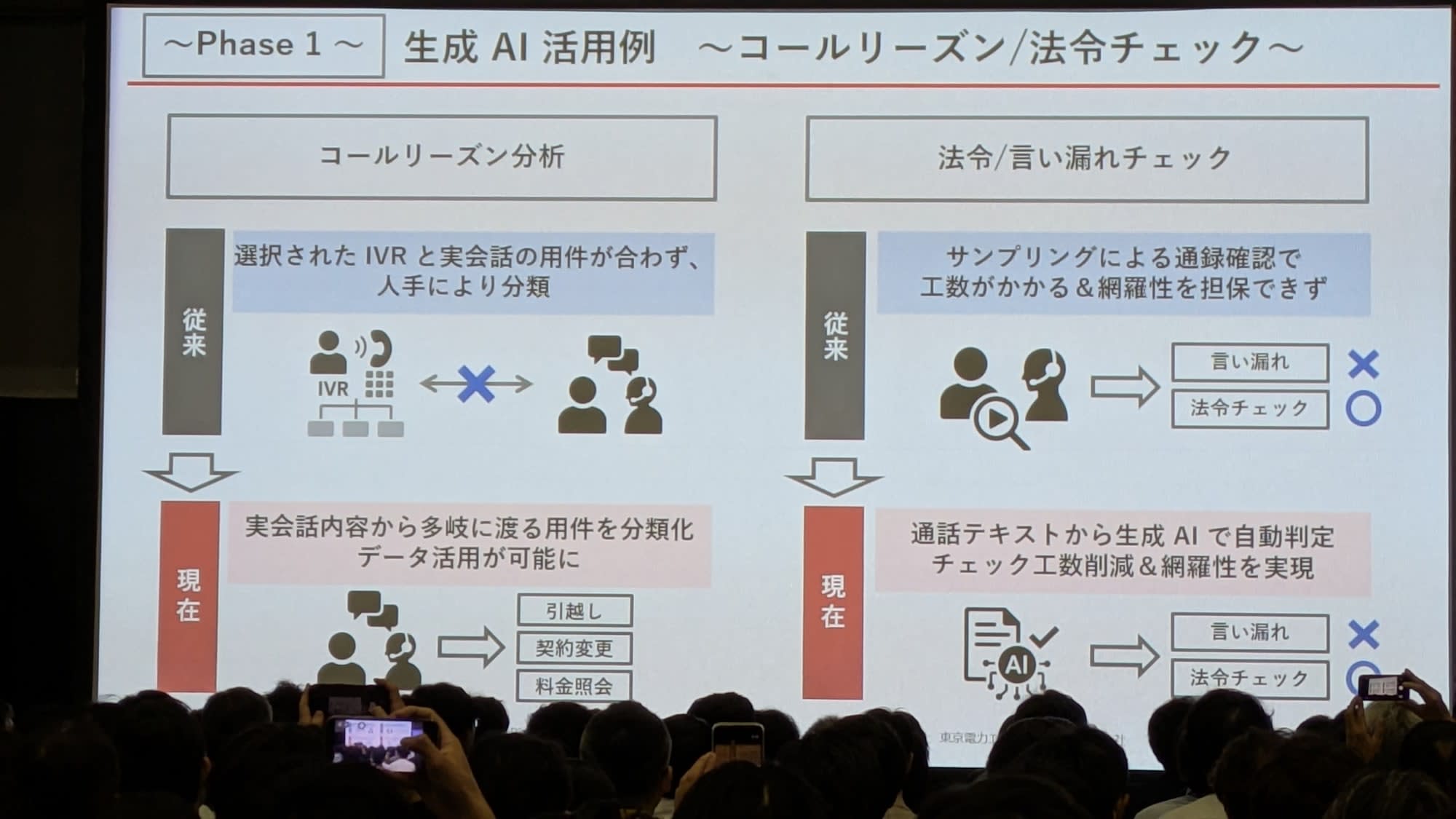
At Tokyo Electric Power Energy Partner, cases frequently occurred where the inquiry selected in the IVR did not match the actual conversation content. In the end, inquiries had to be manually reclassified, and the data was reportedly unreliable even as call reason analysis data.
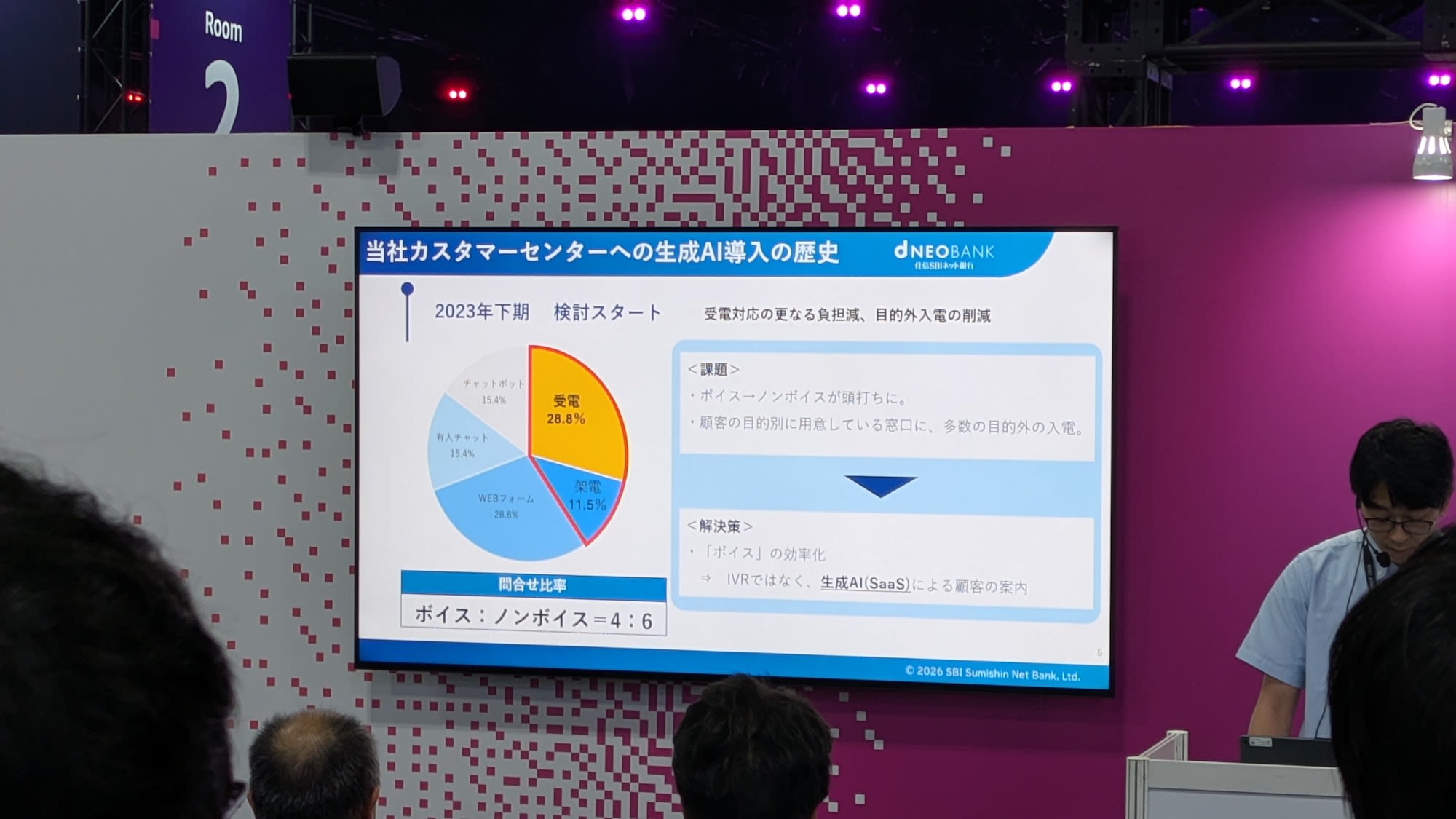
At SBI Sumishin Net Bank, despite having dedicated counters for each customer purpose, a large number of calls came in for purposes other than intended. For example, general inquiries were coming into the credit card incident reception line, revealing the limitations of IVR-based routing.
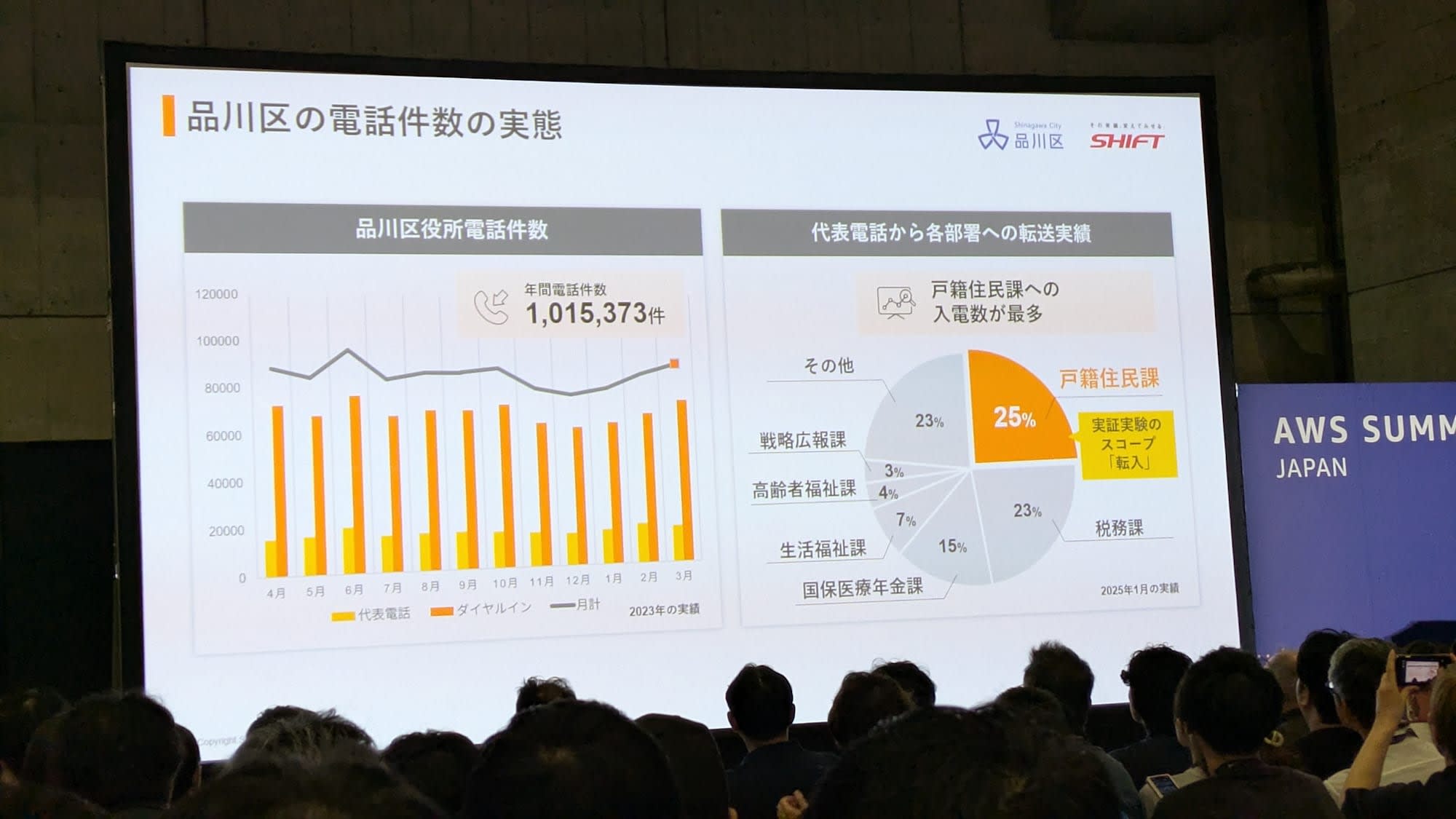
In Shinagawa Ward, of approximately one million telephone inquiries per year, transfers to the Family Registry and Residents Division accounted for the highest proportion at 25%. However, since the guidance content varies depending on the attributes of the inquirer (whether they are the person themselves or a proxy, whether calling from within or outside Japan, etc.), there was a challenge in that single-question-answer IVR could not provide correct guidance.
In other words, what the three cases had in common was the limitation of conventional button-selection IVR. Phone-based customer service will not disappear going forward, but the challenge of simple button selection being unable to capture customers' true inquiries had persisted for a long time.
Comparing How Each Organization Introduced AI Conversation
Tokyo Electric Power Energy Partner: Migrating 18 On-Premises Sites in One Year, Aiming to Eliminate IVR
Tokyo Electric Power Energy Partner's initiatives are divided into two phases.
In Phase 1 (2025), they replaced the on-premises call reception system across all 18 sites with Amazon Connect Customer. Along with this migration, they built their own business infrastructure called SEEDS (Smart Engagement and Efficient Data System). Generative AI features such as real-time transcription of conversations, AI-based conversation summarization, call reason analysis, and regulatory compliance checks were also introduced.
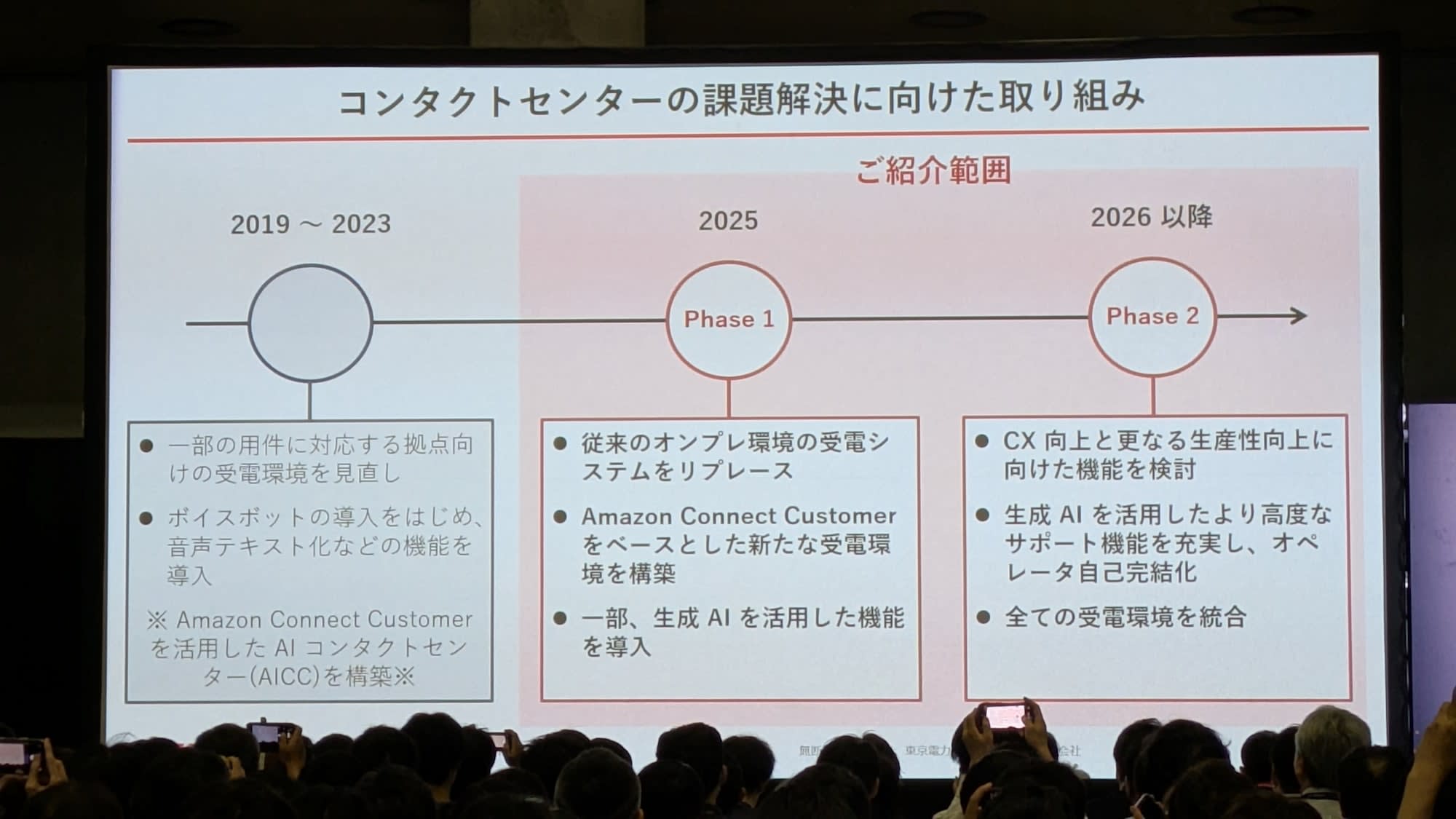
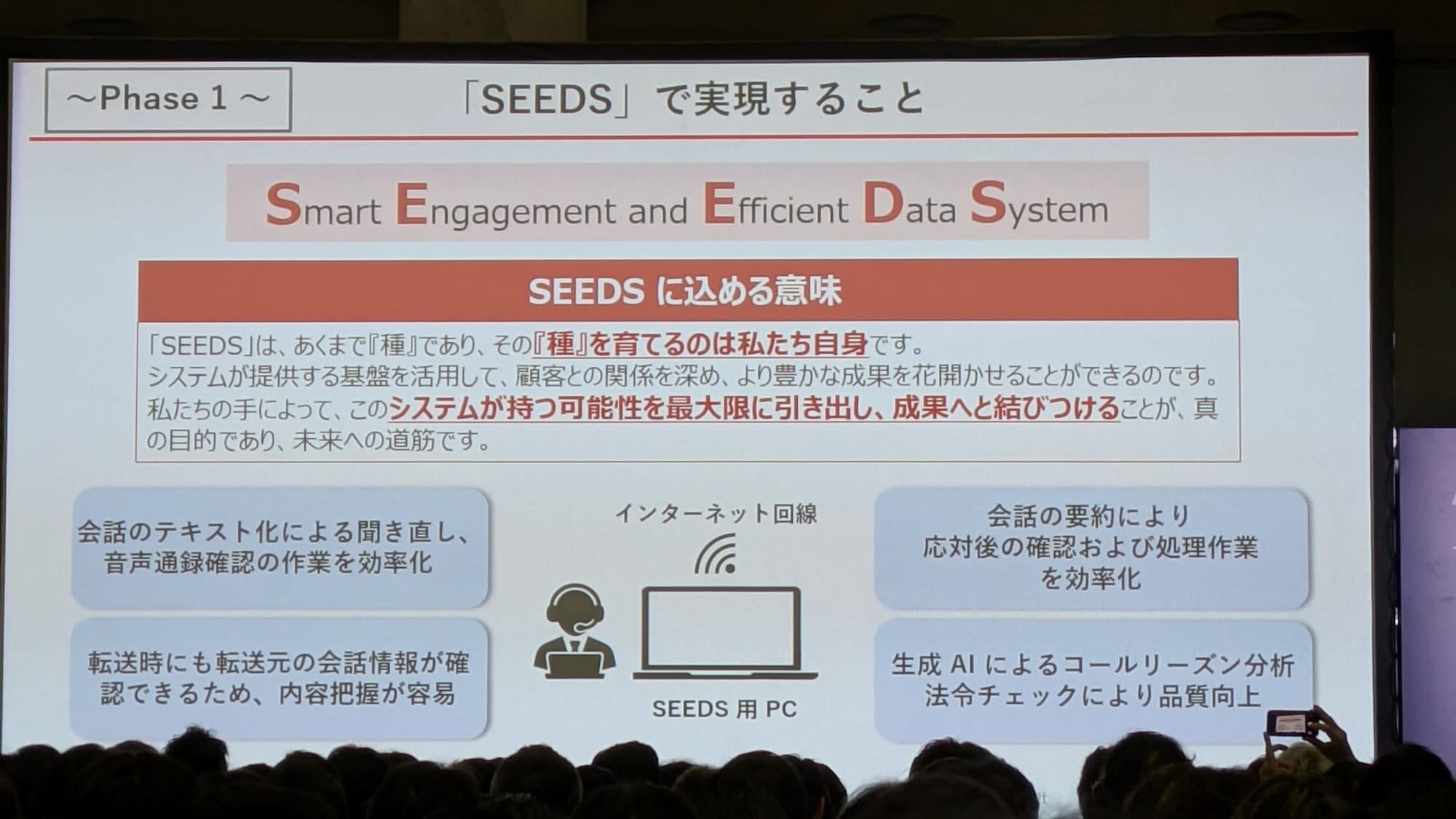
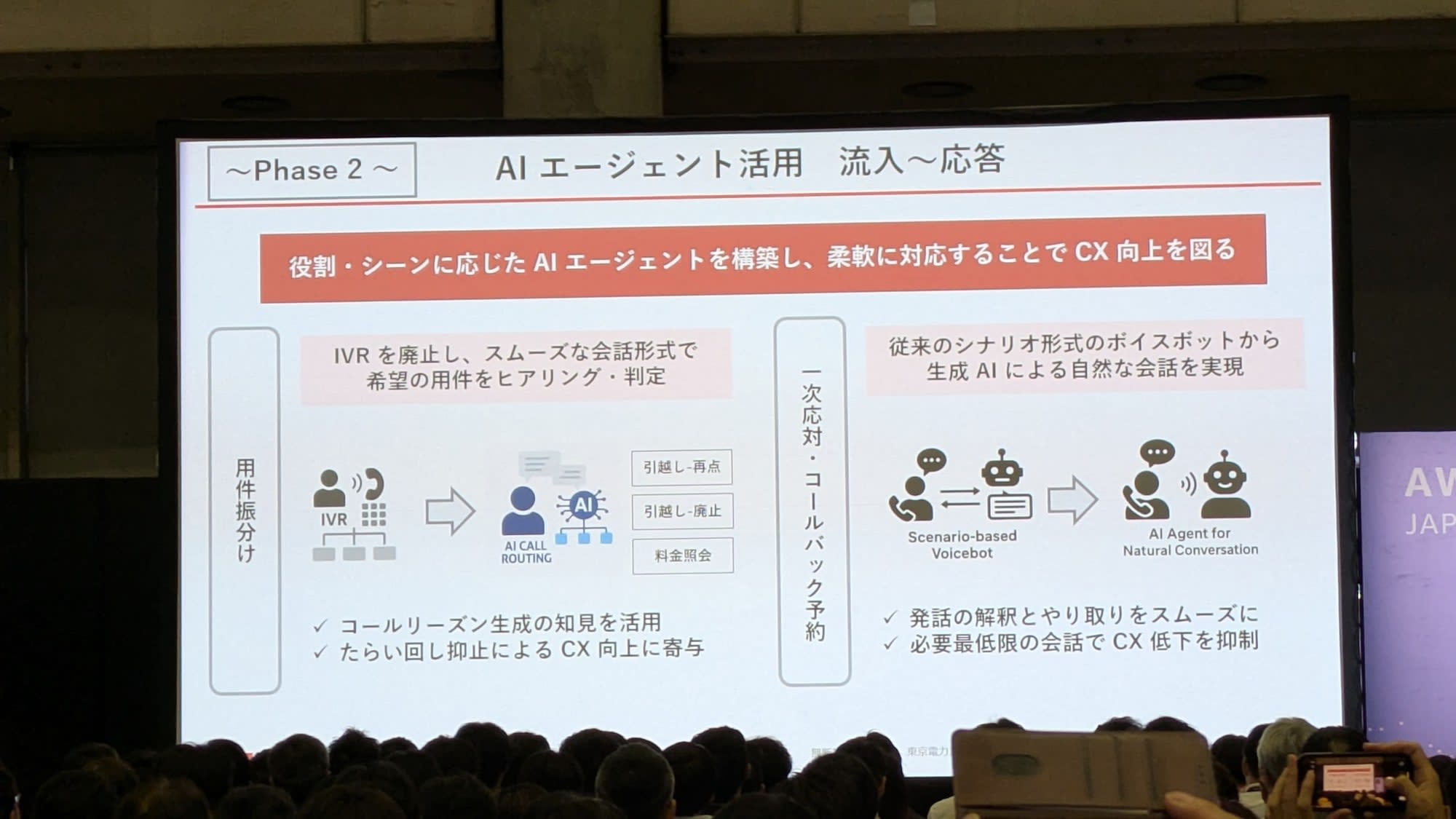
In Phase 2 (2026 and beyond), they plan to eliminate the IVR and transition to AI-based inquiry routing. The AI will listen to customers' inquiries in a conversational format and route them to the appropriate department. An evolution from conventional scenario-based voice bots to natural conversation using generative AI is also planned. On the operator support side, AI will suggest FAQs and knowledge based on real-time conversation content and also support post-call processing. This aims to enable operators to handle cases independently.
SBI Sumishin Net Bank: Reducing Staffed Responses by 57% and Further Deepening with AI Agents
SBI Sumishin Net Bank has introduced AI pre-response instead of IVR, and rather than having AI directly generate response text, they have adopted a method of determining the call reason and then presenting pre-learned FAQs.
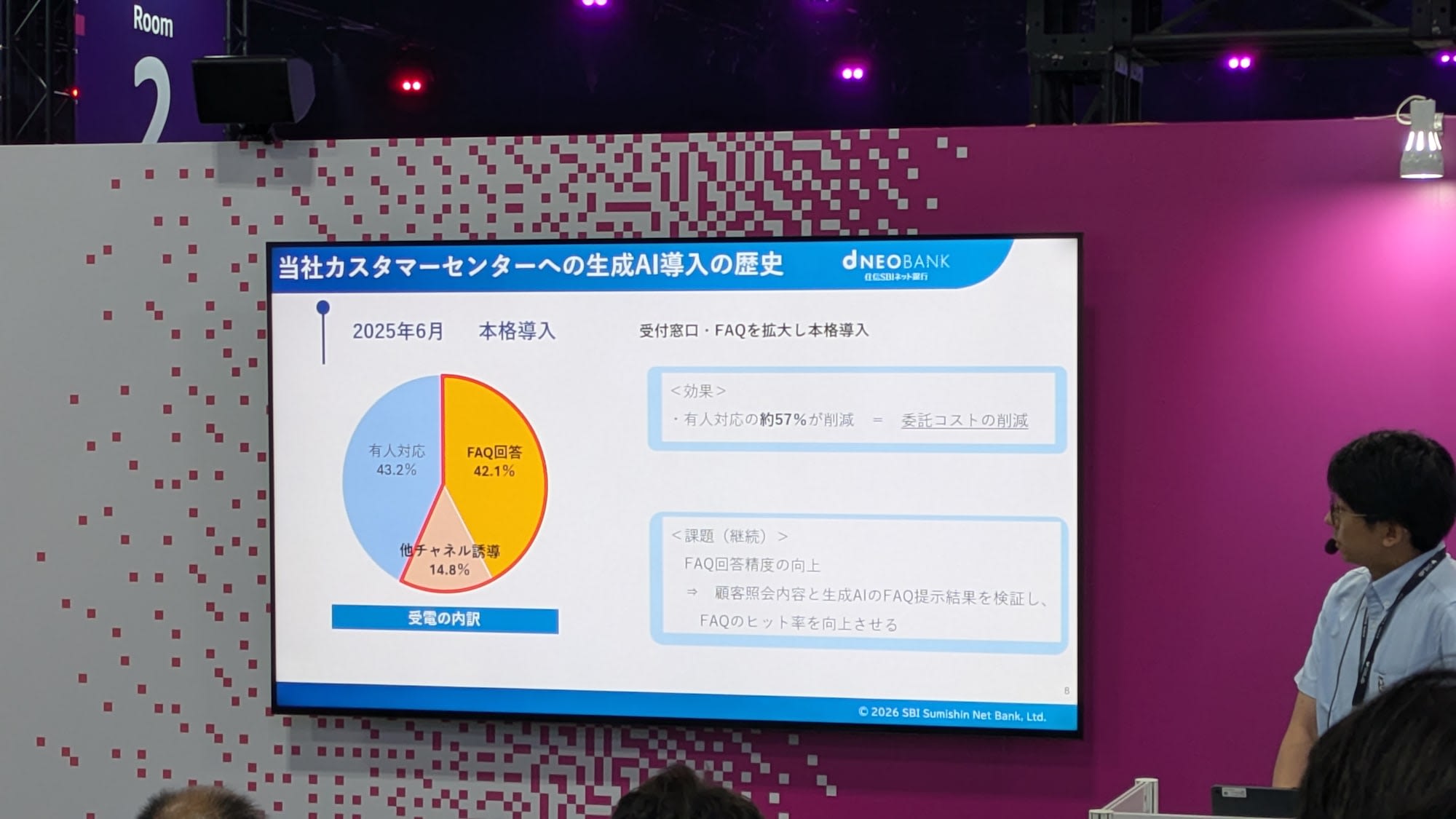
After full deployment, the call breakdown is 42.1% for FAQ responses, 14.8% for other channel guidance, and 43.2% for staffed responses. They were able to reduce staffed responses by approximately 57%, leading to cost reductions.
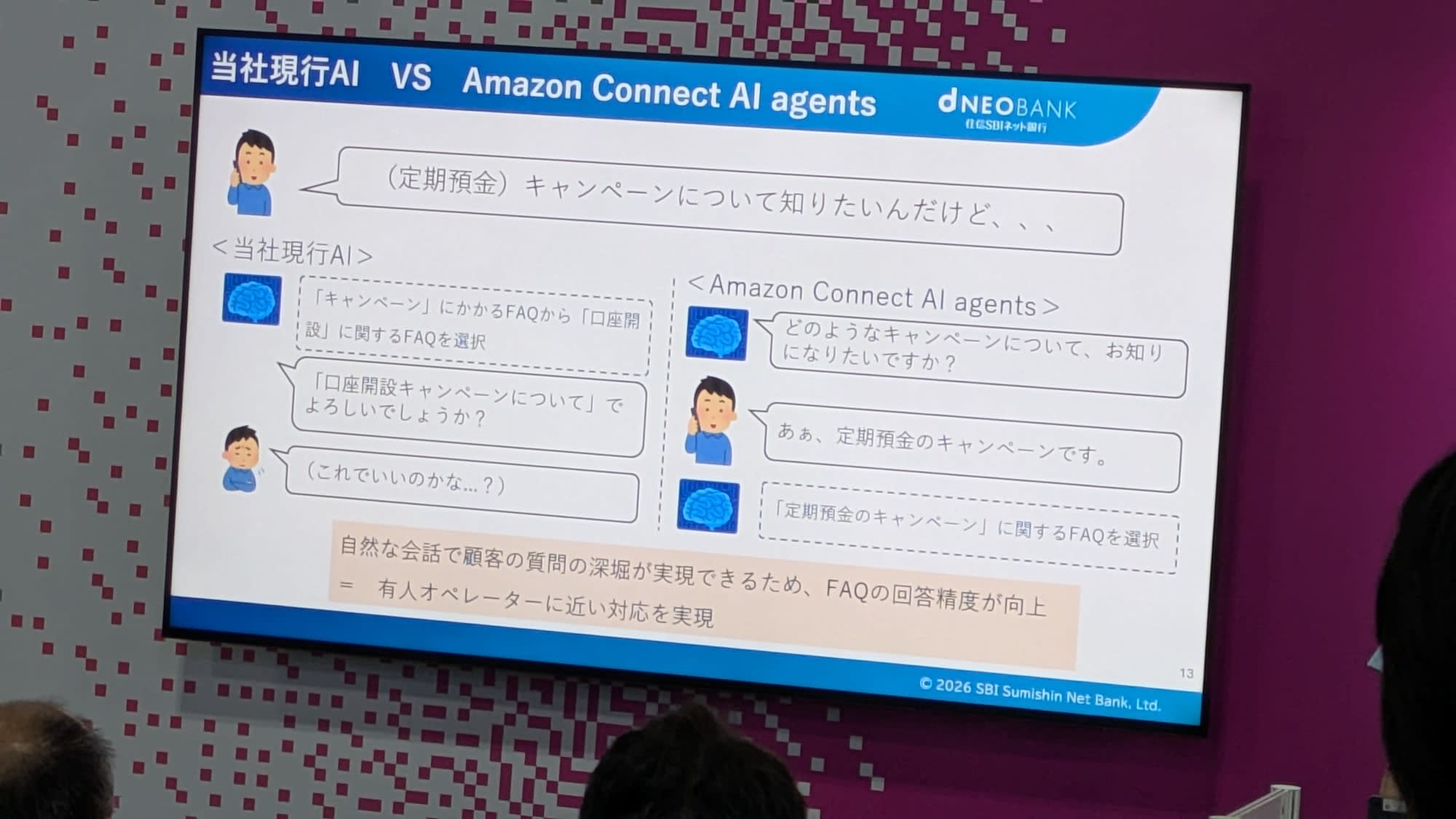
Furthermore, verification of Amazon Connect AI agents is also progressing. With conventional AI performance, there were cases where the system would latch onto just the keyword "campaign" and select a single FAQ from among multiple campaigns. In contrast, the AI agents currently being verified can ask follow-up questions to dig deeper into which campaign the customer wants to know about, which is expected to improve FAQ response accuracy.
In the PoC, response accuracy of 95% or higher was achieved for both calls and chat, and they are currently entering requirements definition for full-scale development.
Shinagawa Ward: Exploring the Boundary Between Tasks Left to AI and Tasks Handled by People
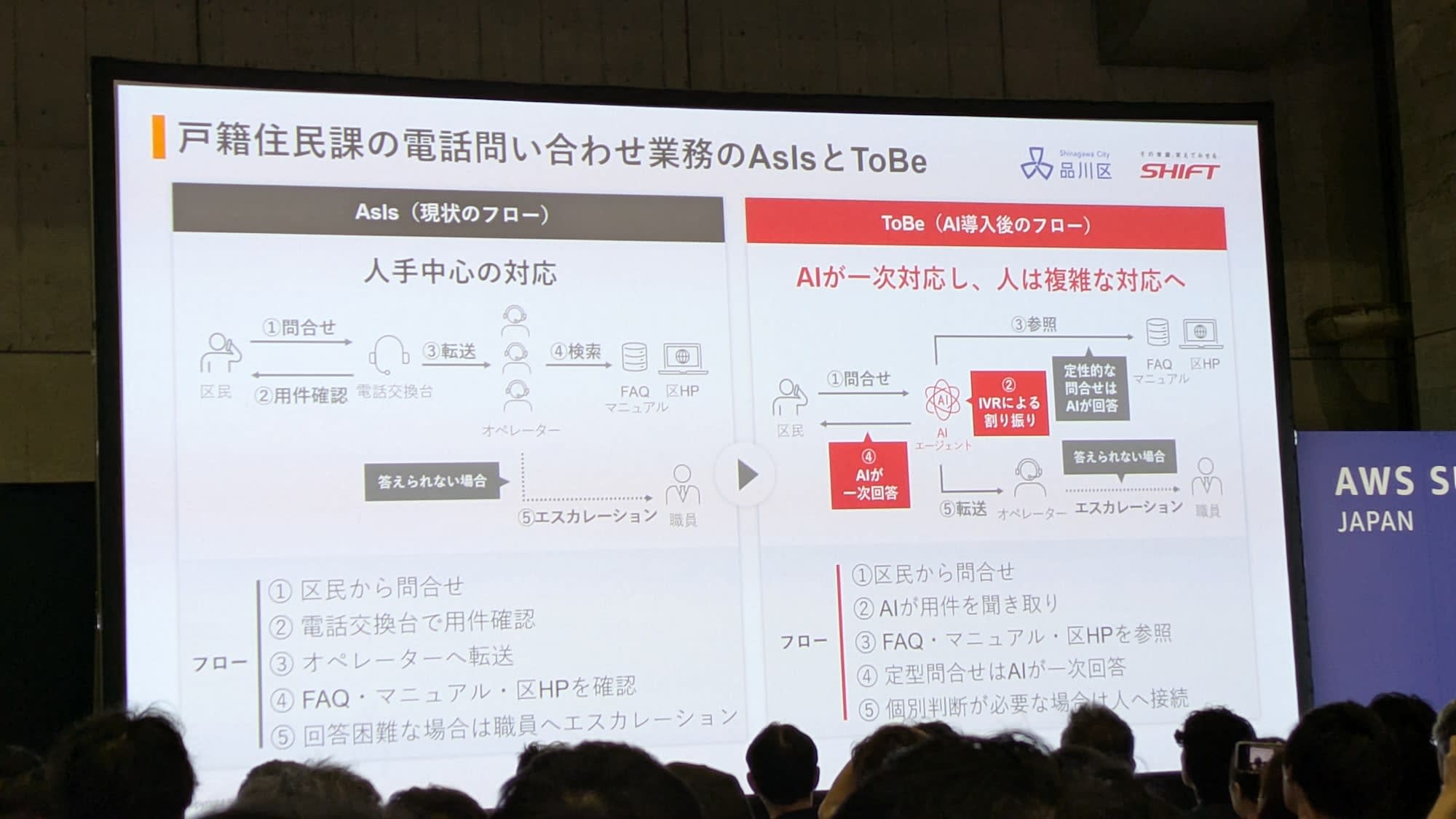
In Shinagawa Ward, AI handles first-level responses instead of IVR, with AI responding to routine inquiries and connecting to a person when individual judgment is required.
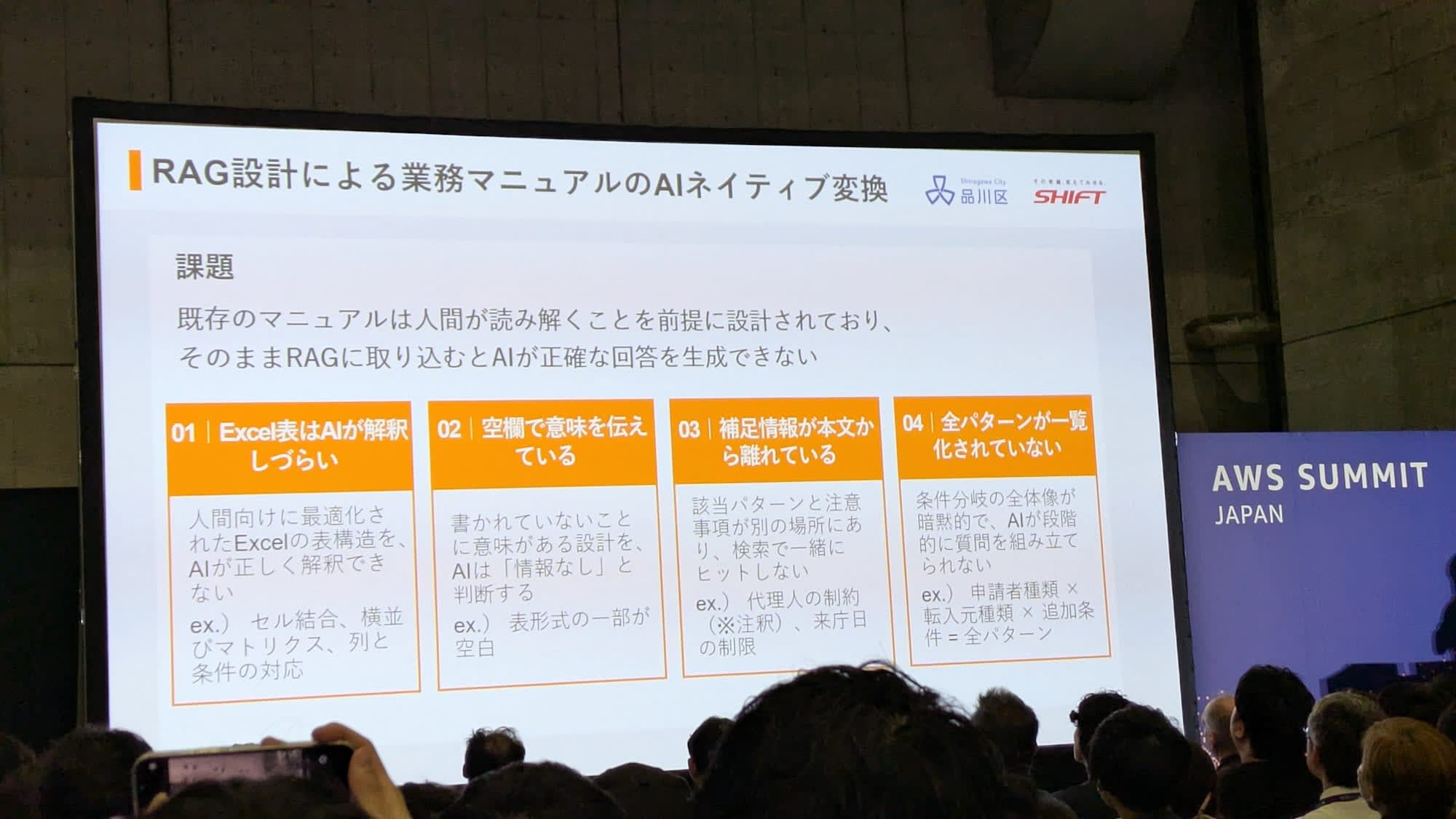
Particularly interesting was their approach to how knowledge and systems are fed to the AI. Existing operational manuals are designed with humans as the intended readers, and expressions that convey meaning through merged cells in Excel or blank cells cannot be correctly interpreted by AI. Therefore, rather than importing existing operational manuals directly into RAG, they converted them into AI-native formats using decision tree modeling, semantic chunking, guardrail implementation, and similar techniques. The conversion itself is also automated using generative AI, with the design being that humans focus on reviewing the generated text.
Common Points Visible from the Three Cases
Dividing Roles Between AI and People
With current AI capabilities, it is not possible to automatically handle all inquiries. Therefore, each organization has divided the areas where AI excels from the areas that should be handled by people.
Tokyo Electric Power Energy Partner aims to create an environment where operators can handle cases independently by having AI suggest knowledge and support post-processing. SBI Sumishin Net Bank has AI handle FAQ responses and other channel guidance, reducing staffed responses to 43.2%. Shinagawa Ward's division is that AI responds to general inquiries while people handle matters requiring interpretation of policies and individual circumstances.
In all cases, the structure is to leave routine responses and mechanical information organization to AI, while people handle new types of inquiries and cases requiring advanced judgment. Concentrating human resources on areas where human effort is truly needed can be said to be the main objective of AI utilization.
On the other hand, customer needs to have customer support handled by people still exist. However, there is also a segment that does not mind if AI handles the interaction as long as the problem is resolved. As AI utilization in call centers becomes commonplace, this sentiment may change, and it seems we will need to watch how things develop going forward.
Standardization Is Also Progressing on the Platform Side
The systems that each organization has been building individually are beginning to be provided as platform features of Amazon Connect Customer itself. At the Amazon Connect Customer session (BIZ326) at the same AWS Summit, features such as autonomous inquiry listening by AI agents, handoff to people while maintaining context, and performance evaluation of AI agents were demonstrated. The systems that each organization built through trial and error are now being provided as platform standards.
Closing
What became clear through the three sessions is a definitive trend away from conventional button-selection IVR, which has reached its limits, toward conversational inquiry classification using AI. This trend was visible beyond just the sessions I attended, and the elimination of conventional IVR and its replacement with AI conversation appears to be becoming a major current in contact centers.
Note that the mechanism for AI pre-inquiry listening introduced here can be built using the self-service feature of Amazon Q in Connect. For specific configuration procedures, please refer to our company blog article on automatically listening to inquiries before agent transfer using Amazon Q in Connect self-service, which provides detailed explanations, so please check it out if you are interested.