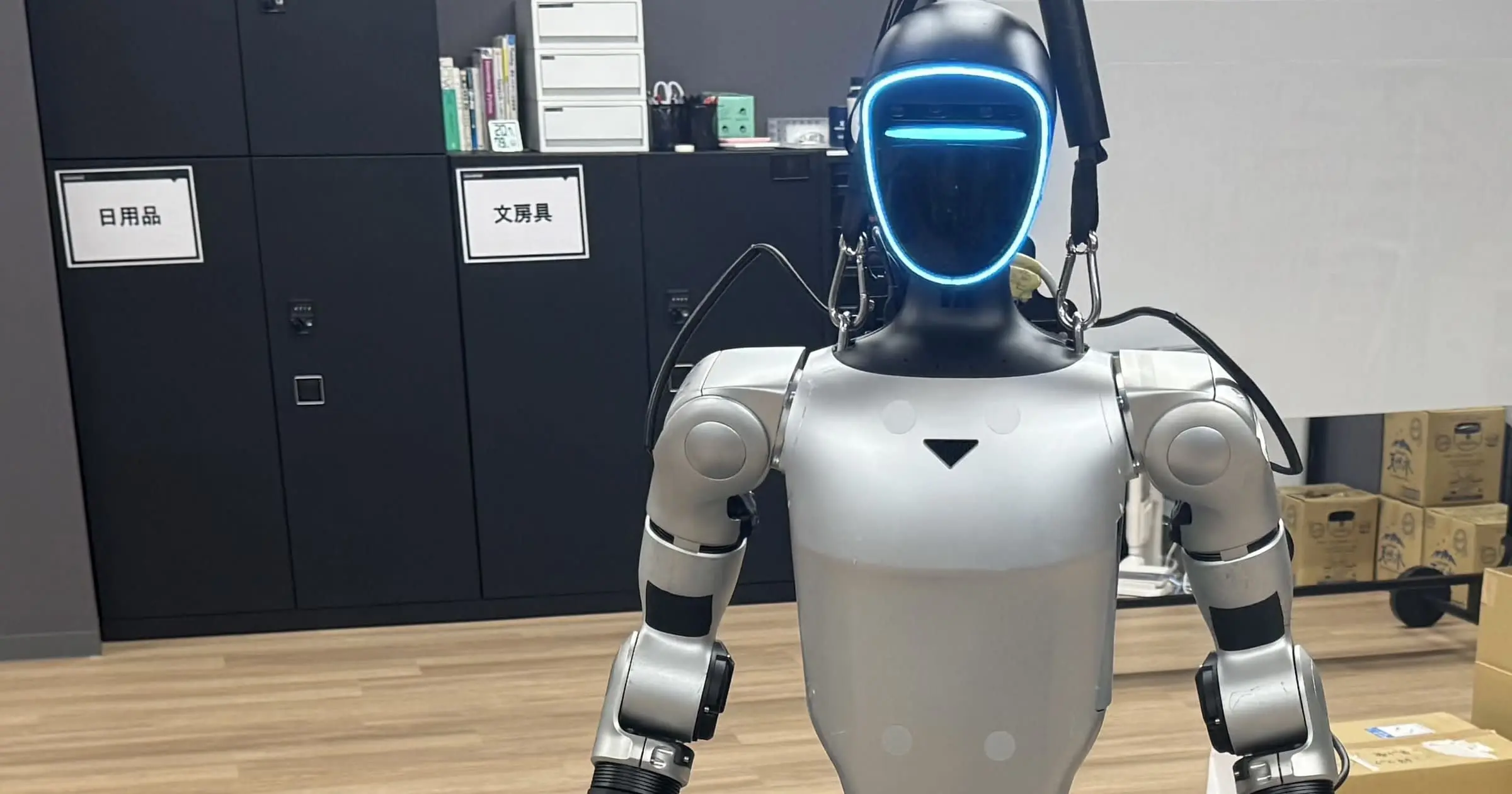
Isaac Lab and PPO-Based Reinforcement Learning Project for Bottle Grasping and Lifting with Unitree G1: Mass Curriculum up to 0.62 kg and Safe Approach Policy

This page has been translated by machine translation. View original
Introduction
In the previous article, we built a reinforcement learning environment on Isaac Lab targeting the Unitree G1 Inspire Hand, for grasping and lifting a bottle-shaped object.
The main items confirmed up to the previous article are as follows.
- RL environment using fixed-base G1 and Inspire Hand
- Scripted phase controller with separate safe / ingress / grasp / lift phases
- Slow contact / squeeze / lift trajectory
- Scripted grasp / lift baseline for lightweight bottle-like objects
- 12D hand residual PPO
- Deterministic lift / hold showcase with fixed initial state
- Safe pre-grasp policy considering self-collision
At the end of the previous article, the plan was to proceed to small bounded RandPos, varying the bottle's initial position by ±1.5 cm in the x/y direction as the next step.
However, when actually trying the RandPos task, we found problems that could not be solved simply by expanding the learning range of the hand residual.
Furthermore, success with the lightweight 0.08 kg bottle-like object used previously does not explain grasp / retention under mass conditions close to a 600 ml beverage bottle.
So this week, rather than simply continuing the originally planned RandPos training, we divided the challenges into the following two areas.
- Mass Curriculum for gradual adaptation up to the 0.62 kg condition
- Safe Approach Policy for approaching the outside of a dynamic bottle without knocking it over
Furthermore, after evaluating each policy individually, we also verified the controlled ingress connecting Stage 1 to Stage 2.
This article summarizes the following work carried out this week.
- Limitations found with hand-only RandPos
- Mass Curriculum from 0.08 kg to 0.62 kg
- Formal deterministic evaluation of the 0.62 kg grasp / lift policy
- Safe Approach Policy for dynamic RandPos
- Formal deterministic evaluation of the Stage 1 policy
- Controlled ingress connecting Stage 1 and Stage 2
- Isaac Lab decimation issue discovered during integration
- Current status and plans for next week
The results in this article are simulation results using a simplified rigid-body bottle on Isaac Lab. They do not represent actual PET bottles, the performance of a real G1, safety, or sim-to-real transfer.
Issues Carried Over from Last Time
In the previous configuration, the large arm trajectory was fixed as scripted, and PPO was responsible for the 12D residual action of the Inspire Hand.
scripted arm trajectory
  + scripted hand target
  + 12D PPO hand residual
  ↓
grasp formation
  ↓
lift
  ↓
retention
This configuration was effective as a baseline for learning contact adaptation and anti-slip correction for lightweight bottles at a fixed initial position.
On the other hand, the following two constraints remained.
1. Arm trajectory does not follow the bottle position
Even if the bottle position changes, the scripted arm trajectory moves to the same position.
Therefore, even with a positional offset of a few centimeters, there was a possibility that the hand residual alone could not compensate up to the grasp position.
2. The bottle used was lightweight
The previous bottle-like object was 0.08 kg.
This is effective as a lightweight proxy for confirming the feasibility of the contact trajectory, but it is not close to the mass conditions of a 600 ml beverage bottle.
This time, the following was assumed as a simplified full-bottle condition.
liquid:
  approximately 0.60 kg

bottle / cap:
  approximately 0.02 kg

total:
  0.62 kg
However, this is a simplified condition that only approximates the mass.
The following elements present in an actual PET bottle are not included.
- Sloshing of the liquid contents
- Changes in center of mass
- Deformation of PET material
- Changes in friction due to label and surface condition
- Flexibility of the bottle wall
- Detailed contact geometry of the cap and neck
Limitations Found with Hand-Only RandPos
First, as planned previously, we implemented a RandPos task varying the bottle's initial position by ±1.5 cm in the x/y direction.
The conditions were as follows.
bottle position:
  x/y ±0.015 m

arm:
  fixed scripted trajectory

hand:
  12D PPO residual

bottle:
  dynamic rigid body

training:
  128 parallel environments
  300 iterations
In this task, PPO corrects only the finger joints, and the arm trajectory moves to the same position regardless of the bottle's random position.
Training results
Near the end, the following values were confirmed.
| Metric | Result |
|---|---|
| Mean reward | approximately +0.91 |
| Object out of workspace | 0.1328 |
| Strict retention / lift success | 0.0000 |
Mean reward became a positive value, but strict retention / lift success was 0.
When checking the deterministic playback, the main failures were as follows.
bottle position changes
  ↓
scripted arm moves to the nominal ingress pose
  ↓
hand contacts the bottle from an incorrect position
  ↓
bottle is pushed or toppled
  ↓
finger residual cannot recover the grasp
In other words, even if the PPO reward increases, it does not necessarily mean that the behavior of grasping and lifting the bottle is working.
Why hand residual alone could not handle it
What the 12D hand residual can handle is mainly local corrections such as the following.
- Fine adjustment of finger contact
- Adjustment of thumb opposition
- Correction of grip strength
- Anti-slip correction during lift
On the other hand, what is needed when the bottle position changes is correction of the arm's overall final approach position.
finger-scale correction
≠
arm-scale positioning correction
From this result, we determined that rather than leaving RandPos adaptation to a hand-only policy, it was necessary to divide roles as follows.
Stage 1:
  arm approach according to bottle position

Stage 2:
  grasp / squeeze / lift / retention
This was the first important failure case of this week.
Hand residual policy is not a policy that corrects arm positioning errors on the scale of several centimeters.
Why We Proceeded to Mass Curriculum Before RandPos
While the limitations of hand-only RandPos became clear, there was also another important problem.
There is no guarantee that the policy trained with the previous 0.08 kg bottle maintains grasp / retention at 0.62 kg.
In fact, when we ran the 0.62 kg bottle under a scripted zero-residual condition, the close / squeeze sequence itself could be executed, but meaningful lift was not achieved.
Representative results were as follows.
| Condition | Maximum center-height increase | Strict retention |
|---|---|---|
| Hand stiffness 50 | approximately 2.9 mm | False |
| Hand stiffness 100 | approximately 2.9 mm | False |
Even when hand stiffness was increased from 50 to 100, the lift amount changed very little.
This shows that simply increasing actuator stiffness does not establish full-mass grasp.
Also, when checking the actual joint position, some of the four fingers had moved close to the target, but the thumb intermediate / distal joints were significantly constrained by contact.
In other words, the problem when the bottle mass increases is not simply insufficient target angle, but a contact-rich problem that includes the following elements.
- Thumb-to-finger opposition
- Relative position of hand and bottle
- Contact force distribution
- Object displacement during squeeze
- Slip at the start of lift
- Increase in required grip force due to bottle mass
Therefore, instead of changing from 0.08 kg to 0.62 kg all at once, we adopted a Mass Curriculum that gradually increases the mass.
Mass Curriculum from 0.08 kg to 0.62 kg
The mass stages used this time are as follows.
0.08 kg
  ↓
0.20 kg
  ↓
0.35 kg
  ↓
0.50 kg
  ↓
0.62 kg
The basic scripted trajectory and hand residual action are common across each stage.
arm:
  safe → ingress → slow lift

hand:
  side-open
  → slow contact
  → slow squeeze
  + 12D PPO residual

self-collision:
  enabled

action:
  12D hand residual
Transfer method
For each stage with changed mass, weights-only transfer was used instead of a normal resume.
transferred:
  actor weights
  critic weights

reset:
  optimizer state
  training iteration
  log directory
After changing the mass, this was treated as adaptation to a different dynamic condition rather than a simple continuation of the same task.
If the optimizer state is also carried over, the update history for the previous mass condition may not be appropriate for the new condition.
Therefore, network weights were reused as the initial policy, while the optimizer and iteration were reset.
Behaviors Confirmed at Each Mass Stage
An overview of each stage is as follows.
| Stage | Mass | Initialization | Main results |
|---|---|---|---|
| Lightweight | 0.08 kg | Scripted / PPO baseline | Fixed-state lift / hold |
| M1 | 0.20 kg | Fresh PPO | Deterministic lift confirmed |
| M2 | 0.35 kg | Weights-only transfer | Lift with tilt confirmed |
| M3 | 0.50 kg | Weights-only transfer | Meaningful lift confirmed |
| M4 | 0.62 kg | Weights-only transfer + consolidation | Formal evaluation conducted |
0.20 kg
At the 0.20 kg stage, the formal success signal was around 1–3%.
This is not a practical success rate, but deterministic playback confirmed behavior where the bottle was lifted.
In particular, behavior was observed where the thumb pulled the bottle toward the fingers.
This suggests that not only the scripted target, but the learned residual may be changing its behavior depending on the contact condition.
However, a single deterministic playback is not proof of robustness.
0.35 kg
At the 0.35 kg stage, weights-only transfer was performed from the 0.20 kg checkpoint.
Deterministic playback confirmed a lift, but the bottle was significantly tilted.
lift:
  observed

upright retention:
  not confirmed
This is not a complete success, but it was treated as a curriculum signal indicating that the learned behavior was not completely lost even when the mass was increased.
0.50 kg
The formal success rate at the 0.50 kg stage was also low.
On the other hand, meaningful lift was confirmed in selected deterministic playback.
Formal success near the end of training was approximately 1.56%, corresponding to approximately 2 out of 128 environments.
Therefore, at this stage, the evaluation was as follows.
Grasp / lift behavior remains at 0.50 kg, but cannot be said to be a practical or robust policy.
0.62 kg
As the final stage, adaptation was performed to 0.62 kg, the simplified full-bottle condition.
The initial training included a setting that started episodes from a random phase.
However, this task is a multi-phase controller as follows.
startup
  ↓
ingress
  ↓
side-open
  ↓
contact
  ↓
squeeze
  ↓
lift
  ↓
hold
Using random episode length initialization for such a task can result in training episodes starting from a state where startup or phases before contact are skipped.
Therefore, in the next consolidation run, random episode-length initialization was disabled, so that each run starts in the same phase order.
The Last Checkpoint Is Not Necessarily the Best
In the 0.62 kg consolidation, checkpoints from the early part of training showed relatively high success signals.
On the other hand, as training continued, behavior degraded in later checkpoints.
early training:
  better retention behavior

late training:
  degraded behavior
From this result, rather than simply selecting the checkpoint from the final iteration, the following were combined for selection.
- Task-specific training metric
- Deterministic playback
- Strict termination-based evaluation
- Bottle lift amount
- Object displacement
- Retention behavior
In RL, that training completed to the end and that the last checkpoint is the best are not the same thing.
This time as well, rather than the final checkpoint, we targeted a checkpoint near the relatively early peak for formal evaluation.
Formal Evaluation of the 0.62 kg Stage 2 Policy
In the previous article, deterministic playback video was used as the main showcase.
However, a single MP4 alone is not sufficient to judge the success rate of a policy.
Therefore, this time we created a formal evaluator that runs deterministic inference in multiple environments and aggregates successes from the results of the termination manager.
The evaluation conditions are as follows.
bottle:
  simplified rigid bottle

mass:
  0.62 kg

initial position:
  fixed nominal position

policy:
  deterministic inference

success:
  strict retention / lift termination

evaluation:
  multiple episodes
  multiple seeds
Evaluation results
| Seed | Success | Success rate |
|---|---|---|
| 42 | 255 / 256 | 99.6094% |
| 43 | 511 / 512 | 99.8047% |
| Combined | 766 / 768 | 99.7396% |
Also, across a total of 768 episodes, object-out-of-workspace was 0.
strict retention / lift success:
  766 / 768

object out of workspace:
  0 / 768

timeout:
  2 / 768
From these results, we confirmed that the selected Stage 2 policy has a high success rate under the fixed conditions evaluated.
These results are simulation results for a fixed initial position, fixed geometry, fixed mass, and simplified rigid bottle. They do not imply RandPos robustness or real-hardware performance.
Separating Training Rollout and Deterministic Evaluation
This time, there was a large difference between the stochastic rollout metric during training and the formal deterministic evaluation.
This was confirmed not only in Stage 2 but also in Stage 1 described later.
Policy actions during training include exploration noise.
training:
  stochastic action sampling

evaluation:
  deterministic actor output
Therefore, the success rate in training rollouts and the success rate of the deterministic policy used at deployment time may not match.
From the results this time, we reconfirmed the need to record the following separately.
- Training-time stochastic rollout
- Deterministic checkpoint playback
- Multi-episode formal deterministic evaluation
- Scripted zero-residual baseline
- Held-out randomized evaluation
The fact that mean reward increased, or that some environments succeeded during training, alone is not sufficient to determine that a deterministic policy can solve the task.
Conversely, even if the success rate in training rollouts is low, there are cases where deterministic inference using the actor mean is stable.
Separating RandPos Handling into a Safe Approach Policy
After confirming the Stage 2 full-mass fixed-condition policy, we returned to RandPos.
From the failure of hand-only RandPos, we knew that arm final approach according to bottle position was necessary.
Therefore, in the new Stage 1, rather than moving directly to the inner grasp pose, a pre-contact waypoint on the outside of the bottle was targeted.
dynamic bottle
  ↓
outer safe waypoint
  ↓
controlled ingress
  ↓
grasp-ready pose
  ↓
Stage 2
Why an outer waypoint was necessary
In the previous Stage 1 policy, we had the policy approach directly to an inner target close to the grasp.
With kinematic bottle training, the target could be reached, but when switching to a dynamic bottle, failures occurred where the bottle was contacted before closing, causing it to be pushed or toppled.
direct inner approach
  ↓
premature bottle contact
  ↓
bottle displacement / toppling
  ↓
invalid Stage 2 handover
Therefore, the objective of Stage 1 was limited to the following.
Reach the outer pre-contact pose without moving the dynamic bottle, while maintaining an open hand and safe wrist orientation.
The conditions for the new Stage 1 task are as follows.
bottle:
  dynamic 0.62 kg

bottle position:
  x/y ±0.015 m

wrist:
  yaw 0.0
  roll 0.0
  pitch 0.0

hand:
  open

self-collision:
  enabled

action:
  4D shoulder / elbow

target:
  outer pre-contact waypoint
Stage 1 does not learn finger contact.
The objective is to create an arm position that can safely connect to Stage 2.
Formal Evaluation of the Stage 1 Safe Approach Policy
In stochastic rollouts near the end of training, pregrasp success was approximately 55–63%.
stochastic training rollout:
  approximately 0.55–0.63
Looking at this value alone, Stage 1 might appear insufficient.
However, just like Stage 2, a formal deterministic multi-episode evaluator was created and formal evaluation was performed.
Evaluation conditions
bottle:
  dynamic 0.62 kg

RandPos:
  x/y ±0.015 m

wrist roll:
  0.0

hand:
  open

self-collision:
  enabled

policy:
  deterministic inference
Evaluation results
| Seed | Pregrasp success | Success rate |
|---|---|---|
| 42 | 256 / 256 | 100% |
| 43 | 512 / 512 | 100% |
| Combined | 768 / 768 | 100% |
Failure outcomes were as follows.
| Outcome | Count |
|---|---|
| Pregrasp success | 768 |
| Object out of workspace | 0 |
| Timeout | 0 |
| Other / multiple termination | 0 |
Under the bounded RandPos condition evaluated this time, the deterministic policy reached the outer pregrasp target in all episodes.
The difference from training rollouts is considered to be due to the difference between stochastic exploration and the deterministic actor mean.
In light of these results, the Stage 1 policy was treated as a frozen policy for integration without additional training.
The result of 768/768 is an empirical result under the evaluated conditions. It does not guarantee a 100% success rate for all unknown conditions.
Adding Controlled Ingress Between Stage 1 and Stage 2
After being able to evaluate Stage 1 and Stage 2 individually, a bridge connecting the two was implemented.
However, if the outer pose from Stage 1 is instantly switched to the inner grasp pose of Stage 2, there is a possibility of delivering a large impact to the dynamic bottle.
Therefore, a deterministic controlled ingress was added between Stage 1 and Stage 2.
Stage 1:
  outer safe approach
    ↓
  outer hold
    ↓
Controlled ingress:
  slow arm interpolation
  wrist roll 0.0 → -0.25
    ↓
Stage 2:
  side-open
  → contact
  → squeeze
  → lift
  → hold
In Stage 1, the wrist roll is kept at 0.0 to avoid premature contact with the bottle.
During controlled ingress, the arm position and wrist roll are simultaneously interpolated to Stage 2's grasp-ready pose.
Zeroing Stage 2 Residual in the First Bridge
If the Stage 2 learned residual is activated from the beginning, it becomes difficult to separate the cause when failures occur.
For example, it becomes hard to determine which of the following has a problem.
- Stage 1 final pose
- Outer hold
- Controlled ingress
- Wrist interpolation
- Hand pre-shape timing
- Stage 2 observation
- Learned residual
Therefore, in the first bridge diagnostic, the Stage 2 learned residual was strictly set to zero.
Stage 1:
  learned deterministic policy

controlled ingress:
  enabled

Stage 2 scripted prior:
  enabled

Stage 2 learned residual:
  exactly zero
With this configuration, we first confirmed only the handover geometry from Stage 1 to Stage 2 and the bottle stability.
Results of the Nominal Zero-Residual Bridge
Running with nominal bottle position, Stage 1 reached the outer gate, then transitioned to Stage 2 through the controlled ingress.
Representative results are as follows.
Stage 1 outer gate:
  reached

controlled ingress:
  approximately 60 environment steps

Stage 2:
  started

unsafe before Stage 2:
  false

workspace violation:
  false
The bottle state at handover was as follows.
| Metric | Value |
|---|---|
| Bottle displacement | approximately 7.1 mm |
| Bottle speed | approximately 0.089 m/s |
| Bottle tilt metric | approximately 0.0019 |
| Stage 2 residual | exactly 0 |
From this result, we confirmed that under the current nominal condition, it is possible to connect from the learned Stage 1 through the controlled ingress to Stage 2.
On the other hand, strict retention / lift success was not achieved under the zero-residual condition.
strict retention / lift:
  false

maximum center-height increase:
  approximately 4.8 mm

final center-height increase:
  approximately 0.04 mm

maximum horizontal displacement:
  approximately 43 mm
In other words, the bottle did not lift to a meaningful height and moved approximately 4.3 cm horizontally after the contact phase.
This result shows the need to evaluate the following two aspects separately.
safe Stage 1-to-Stage 2 handover:
  passed

full-mass grasp / lift without learned residual:
  failed
The fact that lift was not achieved with zero-residual does not mean that the overall bridge failed.
Rather, it confirmed that while the controlled handover itself succeeded, the Stage 2 learned residual is necessary for 0.62 kg grasp / retention.
Decimation Timing Issue Discovered During Integration
In the process of integrating Stage 1 and Stage 2, an important implementation issue related to Isaac Lab's custom ActionTerm was discovered.
The following settings are used in this environment.
physics step:
  approximately 0.0083 s

environment step:
  approximately 0.0167 s

decimation:
  2
In other words, while the policy outputs an action once, the physics simulation is updated twice.
Execution timing of custom ActionTerm
In the manager-based environment used this time, the conceptual difference is as follows.
process_actions():
  executed every environment action step

apply_actions():
  executed every physics substep
In the initial implementation, the counter for controlled ingress and Stage 2 phase was being incremented inside apply_actions().
Therefore, with decimation 2, the counter was advancing twice per environment step.
Behavior before the fix
According to the settings, the controlled ingress was 60 steps, but in practice it was ending in approximately 30 environment steps.
| Metric | Before fix |
|---|---|
| Outer gate | step 36 |
| Stage 2 start | step 65 |
| Effective ingress | approximately 29 environment steps |
| Handover speed | approximately 0.176 m/s |
| Final Stage 2 local step | 1551 |
Also, the side-open, contact, squeeze, and lift timing of Stage 2 was proceeding at approximately twice the intended speed.
Fix method
We recorded when process_actions() was called as needing an environment-step update, and changed it so that the phase counter is only advanced in the first apply_actions() call after that.
In the remaining physics substeps, the previously computed joint targets are held.
Conceptually, this is as follows.
process_actions():
  new environment action received
  update_pending = true

first apply_actions():
  update phase
  update counter
  compute new targets
  update_pending = false

remaining physics substeps:
  hold previous targets
  do not advance phase counter
Behavior after the fix
| Metric | Before fix | After fix |
|---|---|---|
| Outer gate | step 36 | step 40 |
| Stage 2 start | step 65 | step 99 |
| Ingress duration | approximately 29 steps | approximately 59 steps |
| Handover speed | 0.176 m/s | 0.089 m/s |
| Final local step | 1551 | 742 |
The controlled ingress now proceeds at a speed close to the configured approximately 60 environment steps.
The bottle speed at handover also decreased to approximately half.
This issue requires particular attention when implementing a multi-phase controller in simulation.
It is necessary to clearly distinguish whether the phase counter is advanced in units of physics substeps or environment action steps.
Simply naming a variable step makes it impossible to know which time axis that step represents.
Checkpoint Contract Issue Encountered During Policy Integration
Another important failure was manually guessing the network architecture and observation dimension of the Stage 1 checkpoint.
In the initial bridge implementation, the Stage 1 actor was assumed as follows.
assumed observation:
  21D

assumed actor:
  21 → 256 → 128 → 64 → 4
However, when checking the actual checkpoint tensor shape, the correct contract was as follows.
observation:
  24D

actor:
  24 → 128 → 64 → 4

activation:
  ELU
If the network architecture is incorrectly constructed, the checkpoint weights cannot be loaded correctly.
Also, even if the observation dimension is the same, if the meaning or order of each observation term differs, it is not compatible as a policy input.
Therefore, rather than manually reconstructing the observation in the bridge, the policy observation group used in the Stage 1 training task was reused as-is.
Stage 1 training task observation
  ↓
exact same observation config
  ↓
integrated bridge runtime observation
From this experience, we learned that checkpoint compatibility requires at least the following.
- Network layer shape
- Activation function
- Observation dimension
- Observation term order
- Observation semantics
- Observation normalization
- Action dimension
- Action scale / offset
When a policy checkpoint exists, do not guess the architecture or observation — treat the checkpoint tensor and training task config as the source of truth.
This was an important lesson when reusing policies across different tasks.
Lessons Learned from Organizing the Evaluation Script
This time, termination-based evaluators were created for both Stage 1 and Stage 2.
The official playback script is convenient for confirming deterministic behavior, but is not suited for aggregating termination outcomes across multiple episodes.
Therefore, the formal evaluator directly aggregated the following.
success termination
object-out-of-workspace
timeout
other / multiple outcome
Also, for judging execution success, not only the process exit code but also the following were checked.
- Explicit start marker
- Result marker
- Completion marker
- Presence of Python tracebacks
- JSON summary
- Total episode count
- Consistency of termination counts
In simulation scripts, even if the application starts and the exit code is 0, the actual main loop may not have been executed.
Therefore, explicitly outputting markers such as the following proved to be effective.
EVALUATION_START
EVALUATION_RESULT
EVALUATION_COMPLETION=OK
On the other hand, if requiring the marker to be output after simulation_app.close() as a mandatory condition, there may be false failures due to the shutdown process.
It was more appropriate to output the completion marker before application shutdown, and then check process status and the presence of tracebacks afterward.
Summary of Failure Cases This Week
This week, rather than simply increasing the success rate, we reviewed task design and evaluation methods through multiple failures.
Failure 1:Hand-only RandPos
fixed arm trajectory
  + randomized bottle position
  + hand residual
  ↓
incorrect contact position
  ↓
bottle push / toppling
  ↓
strict success 0
Countermeasure:
Separate RandPos compensation into Stage 1 arm policy
Failure 2:Direct application from 0.08 kg to 0.62 kg
lightweight grasp prior
  ↓
full-mass bottle
  ↓
insufficient force closure
  ↓
no meaningful lift
Countermeasure:
0.20 → 0.35 → 0.50 → 0.62 kg
mass curriculum
Failure 3:Direct inner approach
policy approaches grasp pose directly
  ↓
premature dynamic bottle contact
  ↓
bottle disturbance before close
Countermeasure:
outer safe waypoint
  + controlled ingress
Failure 4:Judgment based on training metrics alone
mean reward increases
  ↓
visual or formal success remains absent
Countermeasure:
deterministic playback
  + termination-based multi-episode evaluation
Failure 5:Guessing checkpoint contract
assumed observation / architecture
  ↓
checkpoint incompatibility
Countermeasure:
inspect model_state_dict
  + reuse exact training observation config
Failure 6:Phase timing acceleration due to decimation
phase counter updated per physics substep
  ↓
ingress / contact / lift execute approximately 2x faster
Countermeasure:
phase counter update once per environment action step
Current Pipeline
After this week's work, the pipeline has the following configuration.
dynamic 0.62 kg bottle
  ↓
bounded x/y RandPos
  ↓
Stage 1:
  4D safe outer approach policy
  open hand
  wrist roll 0.0
  self-collision enabled
  ↓
outer hold
  ↓
controlled ingress:
  approximately 60 environment steps
  wrist roll 0.0 → -0.25
  ↓
Stage 2:
  scripted side-open / contact / squeeze / lift
  + frozen 12D learned hand residual
  ↓
strict retention / lift evaluation
Currently, Stage 1 and Stage 2 have each completed formal evaluation in their respective individual tasks.
| Module | Evaluation condition | Result |
|---|---|---|
| Stage 1 Safe Approach | Dynamic 0.62 kg, x/y ±1.5 cm | 768 / 768 |
| Stage 2 Grasp / Lift | Fixed nominal 0.62 kg | 766 / 768 |
| Nominal zero-residual handover | Fixed nominal 0.62 kg | Handover passed |
| Integrated learned grasp / lift | Not yet evaluated | Pending |
What is important is that simply multiplying these success rates does not yield the integrated success rate.
The final state distribution of Stage 1 is not necessarily consistent with the training distribution of Stage 2.
Therefore, in the next phase, it is necessary to run the Stage 2 learned residual from the actual Stage 1 handover state and measure the formal success rate after integration.
What Was Accomplished This Week
The main achievements this week are as follows.
- Implementation and failure analysis of the hand-only RandPos task
- Separation of roles between arm final approach and hand residual
- Mass Curriculum from 0.08 kg to 0.62 kg
- Weights-only transfer workflow
- Fixed-condition consolidation of the 0.62 kg policy
- Formal deterministic evaluation of the 0.62 kg Stage 2 policy
- Safe Approach Policy for dynamic 0.62 kg bottle
- Stage 1 formal evaluation with x/y ±1.5 cm RandPos
- Implementation of outer safe waypoint and controlled ingress
- Verification of zero-residual nominal handover
- Correction of checkpoint architecture / observation contract
- Decimation-aware timing fix for custom ActionTerm
- Separation of training metrics, playback, and formal evaluation
In terms of numbers, the following results were confirmed.
Stage 2 fixed-condition:
  766 / 768 strict retention / lift success

Stage 1 bounded RandPos:
  768 / 768 pregrasp success

Nominal controlled ingress:
  reached Stage 2
  no pre-Stage-2 safety violation
On the other hand, the following have not yet been confirmed.
learned Stage 2 from actual integrated handover
integrated RandPos pick-and-lift success
realistic PET bottle behavior
perception-based bottle localization
real robot evaluation
sim-to-real transfer
Next Week:Toward Final Evaluation of Integrated Pick-and-Lift
Next week, we plan to proceed with the final integration of this simulation-first project.
First, we will confirm via video the zero-residual controlled ingress that was verified by metrics this week.
After that, we will enable the frozen Stage 2 learned residual under the same nominal handover conditions.
learned Stage 1
  ↓
controlled ingress
  ↓
learned Stage 2
  ↓
grasp
  ↓
lift
  ↓
retention
If strict retention / lift is achieved under nominal conditions, we will then conduct an integrated multi-episode evaluation including x/y ±1.5 cm RandPos.
In next week's evaluation, we plan to record the following separately.
- Stage 1 outer gate success
- Unsafe disturbance before Stage 2
- Controlled ingress completion
- Strict retention / lift success
- Object-out-of-workspace
- Timeout
- Bottle horizontal displacement
- Maximum lift height
- Uprightness
- Final hold duration
In the next article in this series, we plan to summarize the following.
- Nominal integrated result with learned Stage 2 connected
- Integrated RandPos multi-episode evaluation
- Failure distribution
- Final evaluation of the entire simulation-first project
- Additional verification required before proceeding to a real robot
Even if we proceed to real robot evaluation, rather than directly connecting the simulation policy to the real hardware, we will need to separately confirm the hardware configuration, joint mapping, control interface, velocity / torque limits, emergency stop, and operator supervision.
We also have no plans to perform online RL exploration on real hardware.
Summary
In the previous article, we built a scripted grasp / lift baseline and a 12D hand residual PPO for a lightweight bottle-like object of 0.08 kg.
This week, we attempted to move from there to a small bounded RandPos, but found that the hand residual alone could not compensate for arm positioning errors.
Furthermore, to extend the success with the lightweight bottle to conditions closer to a 600 ml beverage bottle, we conducted a Mass Curriculum at 0.20 kg, 0.35 kg, 0.50 kg, and 0.62 kg.
As a result, under fixed conditions at 0.62 kg, the Stage 2 policy recorded 766/768 strict retention / lift success.
For RandPos support, we redesigned Stage 1 policy to target a safe waypoint outside the dynamic bottle, rather than approaching the grasp pose directly.
The Stage 1 policy recorded 768/768 pregrasp success under bounded RandPos of x/y ±1.5 cm.
In addition, we added approximately 60 environment steps of controlled ingress between Stage 1 and Stage 2, and confirmed that the Stage 2 handover can be reached safely under nominal conditions.
Through the integration process, we also learned that checkpoint architecture and observation semantics must not be assumed, and that the phase timing of custom ActionTerm must be distinguished between physics substeps and environment steps.
The current point of progress is as follows.
We individually built and evaluated Stage 1 Safe Approach and Stage 2 Grasp / Lift for a 0.62 kg bottle, and confirmed that the two can be connected via controlled ingress under nominal conditions.
On the other hand, the integrated grasp / lift running the learned Stage 2 from the actual handover state, and the end-to-end evaluation including RandPos, have not yet been completed.
Next week, we plan to conduct a nominal integrated evaluation with the learned Stage 2 connected, as well as a bounded RandPos multi-episode evaluation, and summarize the final results of this simulation-first bottle pick-and-lift project.
We will continue verification in a way that does not overestimate simulation results, recording not only successful behaviors but also failures such as hand-only RandPos, full-mass scripted grasp, direct inner approach, checkpoint contract, and decimation timing.